 SUNSET:

 0
0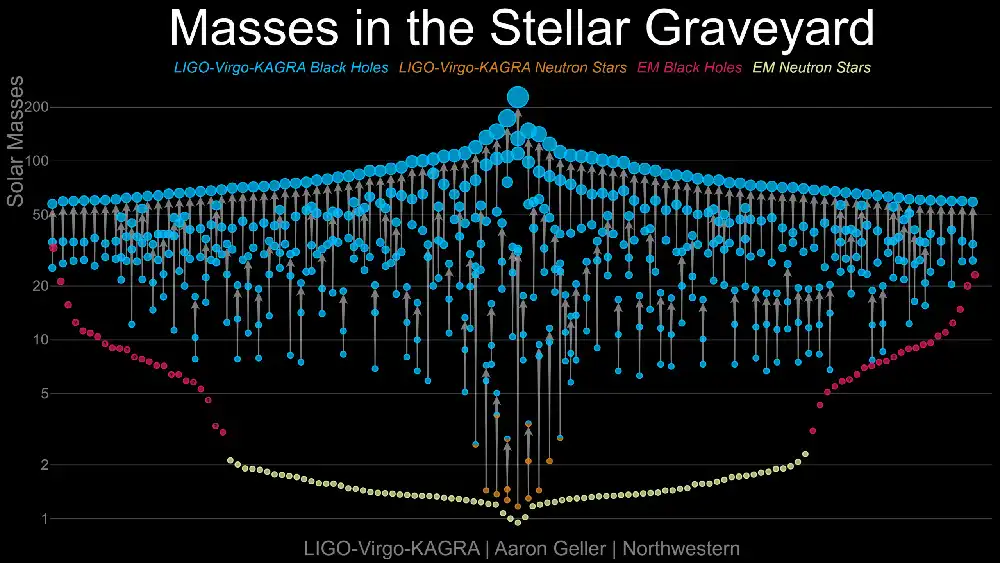
LVK / A. Geller / Northwestern
The number of gravitational-wave signals, ripples in spacetime that sweep past Earth, has just doubled.
On August 25th, scientists with the worldwide LIGO-Virgo-KAGRA Collaboration released results from the first part of their fourth observing run, as well as an updated catalog of all gravitational-wave events identified by the collaboration thus far.
The new results roundup includes 128 confidently detected mergers, all but two of which were smashups of binary black holes. These bring the total tally of events over all observing runs so far to 218, more than doubling the previous count. (These numbers do not include events discovered by independent teams in the data, which are publicly available — since the analysis methods are different, LVK scientists prefer to exclude independent results.) The mergers have implications across a range of topics, from cosmology to gravity itself, discussed in a slew of companion papers. The researchers are in the process of submitting these to the Astrophysical Journal Letters for an upcoming special issue.
The new release covers observations by the Laser Interferometer Gravitational-Wave Observatory (LIGO) from May 24, 2023, to January 16, 2024, as well as a short engineering run before that. LIGO’s Japanese counterpart, KAGRA, joined for the first few months, but its data are not sensitive enough to include in the analysis. Virgo did not join this round of observations.
During the observing run, the collaboration released detections as near-real-time public alerts to the astronomical community, to enable speedy follow-up. Only a fraction of these detections proved likely to be true astrophysical events, however. The results released now are the scientists’ slower, more rigorous analysis, which identified eight additional reliable events. All 128 new events listed have at least a 50% chance of being real, astrophysical events
Two of the 128 mergers appear to have involved a black hole and a neutron star, based on the objects’ masses. Astronomers are intrigued by such mergers because, in the right circumstances, the black hole will shred the neutron star before swallowing it, revealing details about the neutron star’s interior. But researchers detected no sign of shredding for these two mergers, either as light signals or as imprints in the gravitational-wave data.
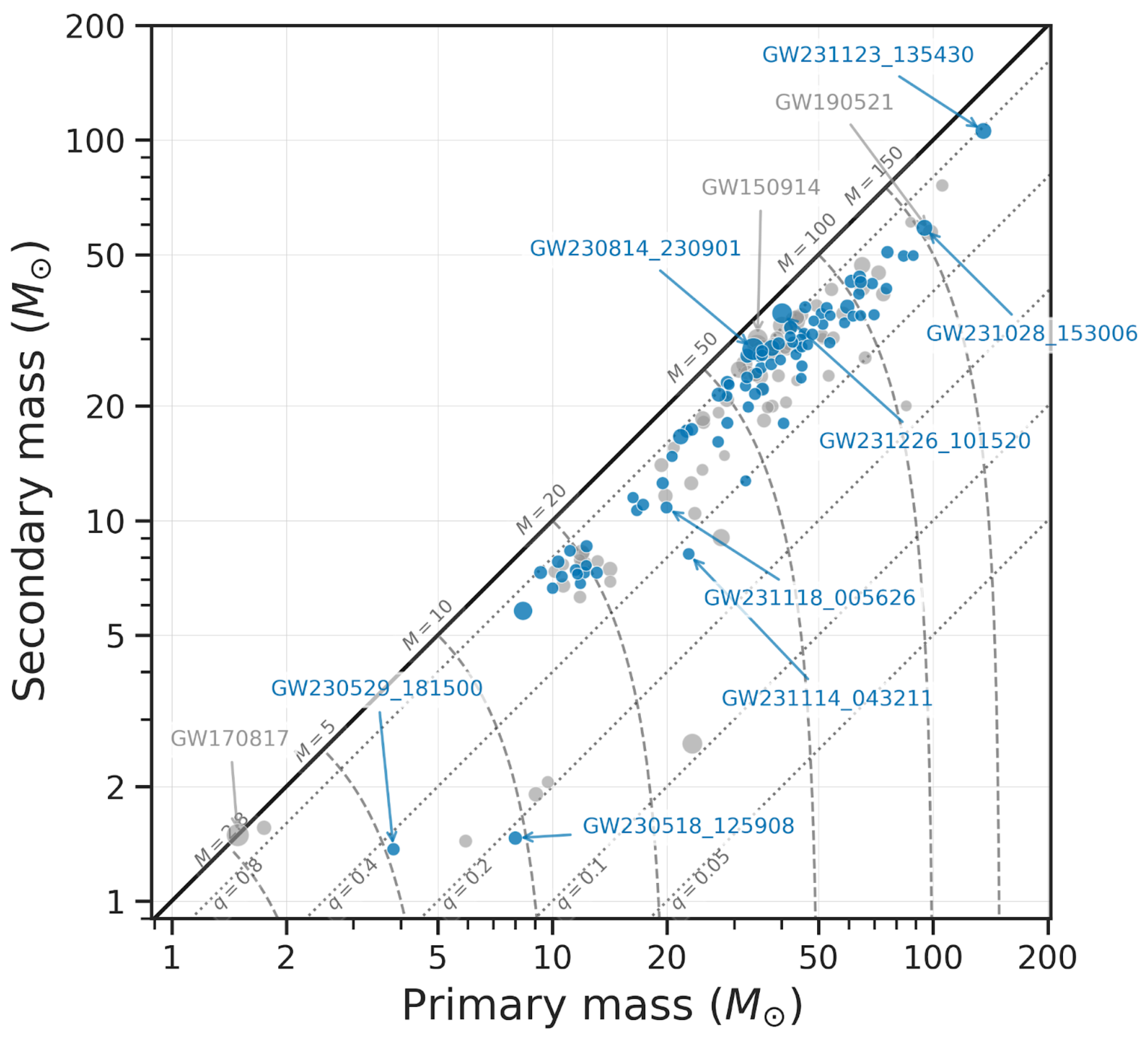
The other 126 events were mergers of two black holes. The black holes span a wide range of masses, from about 5 solar masses to more than 100. These include the recently announced GW231123, which is likely the most massive black hole binary merger discovered to date. (The “likely” is because there’s significant wiggle room in the catalog’s mass estimates, and another binary might take the prize in real life.)
G. Ashton (Royal Holloway University of London)
The larger binary members, called primaries, tend to have masses that cluster between 30 to 70 Suns, but that’s due to LIGO’s sensitivity sweet spot; it doesn’t mean most black holes have those masses. Several objects have masses that fall in the putative no man’s lands — where no objects should exist — at the upper and lower ends of black holes’ mass range.
One of the many companion papers combines the 85 most reliable mergers from this catalog with 76 from a previous catalog and looks at what these detections tell us about the population of merging compact objects as a whole. That study concludes that, in keeping with the previous catalog analysis, black holes tend to have a mass of around 10 Suns. There’s a second, smaller bump around 35 Suns. Astronomers think that black hole pairs that have been together since they were stars are likely to have masses around 10 Suns, but that statement comes with caveats.
The LVK data also reveal that the heftier group of black holes tends to pair with companions of similar masses. Those of around 10 Suns, conversely, often have partners notably less massive than they are. Since most theories for how black hole binaries form favor equal-mass systems, it’s unclear what this bifurcation might tell us about the binaries’ origins.
The black holes’ spins also follow previous trends, with roughly one-third of the merging objects spinning backwards compared to their mutual orbit. That misalignment suggests these binaries paired up later in life, perhaps in the dense hearts of star clusters.
This latest round of detections now reaches out to when the universe was half its age (at a redshift of 1, or about 8 billion years ago). The rate of mergers increases as we look back in time, consistent with the rise in star formation, which peaked across the cosmos around 10 billion years ago (at a redshift of about 2).
Explore the gravitational-wave signals discovered so far in LIGO's neat infographic!
About Camille M. Carlisle
Science Editor Camille M. Carlisle handles science features for Sky & Telescope. She specializes in black holes, Mars, and whatever she happens to be writing about at the time. Frolic with her through the delights of black holes in her blog, The Black Hole Files.




Comments
You must be logged in to post a comment.