 SUNSET:

 9
9New adaptive optics technology has resulted in the sharpest views yet of the solar corona.
Schmidt et al. / NJIT / NSO / AURA / NSF
Astronomers learned how to overcome the blurring effects of Earth's unruly atmosphere decades ago. Adaptive optics correct for that effect in images of everything from stars and nebulae to the Sun's visible surface. Now, a new system has brought the power of adaptive optics to images of the Sun's atmosphere, the solar corona. The technology has the potential to explain a persistent and vexing question: Why can the corona be heated to millions of degrees while underlying regions closer to the Sun are up to 1,000 times cooler?
Temperature changes and motions in the air cells above Earth's surface slightly distort light as it passes through. An adaptive optics system changes the shape of the telescope's mirror to correct for those distortions, but that requires knowing what the distortions are. Nighttime imaging uses bright nearby stars for reference, or even artificial stars created by sodium lasers if no reference stars are near enough. Adaptive-optic images of the solar disk are corrected using the omnipresent granulation, or cells of boiling plasma on the Sun's visible surface.
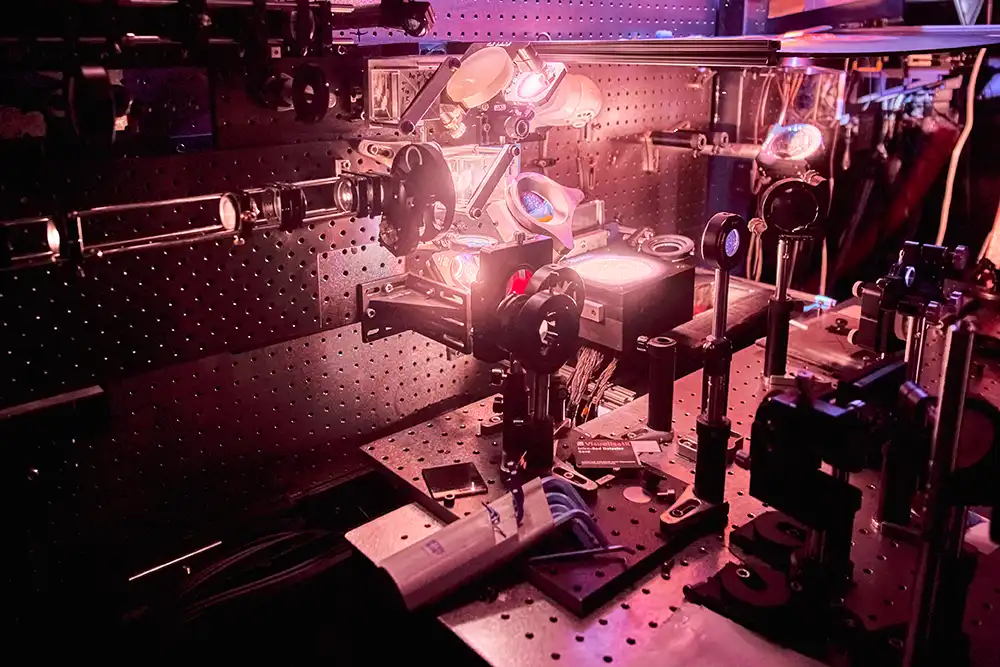
But structures in the corona were too faint and transient to use as references until the development of the Cona system. The team designed and tested Cona on the Goode Solar Telescope at Big Bear Solar Observatory near Los Angeles, California.
Dirk Schmidt
Dirk Schmidt (National Solar Observatory) and colleagues present the Cona system on May 27th in Nature Astronomy. Cona reshapes the telescope's mirror 2,200 times per second. On the Goode Solar Telescope, Cona results in hydrogen-alpha images that resolve structures just 63 kilometers (39 miles) across — more than 10 times sharper than previously possible. The images capture fine details in the hot plasma of the solar corona, where the high temperature splits neutral atoms into their constituent charged particles, which speed along magnetic field lines like beads on a string.
The roiling magnetic field shapes coronal plasma into features such as loops and arcs over the visible surface, called prominences (scroll down to watch two videos). The pull of gravity may also trap plasma, creating narrow threads of coronal rain that fall back onto the Sun (first video, above). Sprouting like grass from all over the surface are spicules, narrow jets of plasma traveling as fast as 100 kilometers per second (more than 200,000 mph). Spicules climb as high as 10,000 kilometers from the visible surface.
Schmidt et al. / NJIT / NSO / AURA / NSF
Schmidt et al. / NJIT / NSO / AURA / NSF
The researchers also spotted a fast-evolving feature they'd never seen before. "Hoping to capture tiny structures that demonstrate the performance of the adaptive optics, we became astounded witnesses of the strange, fine-structured, and fast-evolving plasma feature," Schmidt and colleagues write.
Schmidt et al. / NJIT / NSO / AURA / NSF
The images are sharp enough to resolve twists in the short-lived phenomenon, which indicates its origin in the sudden snap and realignment of field lines known as magnetic reconnection. More work is needed to see how this feature, and the underlying physics it represents, can explain why the corona is so hot compared to regions closer to the Sun.
This new adaptive optics technology stands to be implemented at solar telescopes worldwide, with the team already at work building a similar system for the Daniel K. Inouye Telescope in Hawai'i.
About Monica Young
Monica Young, a professional astronomer by training, is News Editor of Sky & Telescope.



Comments
Michael Molitor
May 31, 2025 at 12:52 pm
It would be useful to know the actual duration for each time-lapse video.
You must be logged in to post a comment.
Greg-Taylor
June 4, 2025 at 6:26 pm
Minutes to maybe an hour at the most, based upon prior experience. Even the coarser details that I saw, when I did my work, still changed within minutes. The last video is surely only tens of minutes long, at the most.
You must be logged in to post a comment.
Greg-Taylor
June 4, 2025 at 6:27 pm
I just noticed a clock in the lower right-hand of the frame. That is going to be in Universal Time.
You must be logged in to post a comment.
Greg-Taylor
June 4, 2025 at 6:19 pm
Way to go, Dirk Schmidt! I worked with him in the early days of this project, but it has sure come a long way since then.
You must be logged in to post a comment.
Greg-Taylor
June 4, 2025 at 6:42 pm
For the Curious: https://ui.adsabs.harvard.edu/abs/2015SoPh..290.1871T/abstract
You must be logged in to post a comment.
Greg-Taylor
June 4, 2025 at 6:44 pm
Broken Link! Just copy and paste the whole thing into your browser.
You must be logged in to post a comment.
Greg-Taylor
June 4, 2025 at 6:45 pm
Try the preprint.
https://arxiv.org/abs/1508.01826
You must be logged in to post a comment.
AB
June 14, 2025 at 12:47 am
Awww, Mr. Sun is fluffy!
...srsly, those videos are the coolest thing I've seen in quite some time. Stuff like this is why I subscribe 🙂
You must be logged in to post a comment.
[email protected]
October 22, 2025 at 3:05 pm
Makes you want to hug it.
You must be logged in to post a comment.
You must be logged in to post a comment.