 SUNSET:

 0
0The summertime Milky Way ascends in the east on May nights. Find a dark sky and let it take you away!

Bob King
Spring brings new growth, milder temperatures, and gobs of intergalactic space. The band of the Milky Way lays low at the eastern and western horizons, allowing us unfettered access to deep space with little interference from cosmic dust. Tracking dirt in from the outdoors is one of main contributors of dust in our homes. The Milky Way, our home galaxy, soils interstellar space in more dramatic ways through supernova explosions and star mergers. Less violently, stars like the Sun release self-forged elements into space when they cast off their outer envelopes in old age.
Gregory M. Green, Stanford / KIPAC
All of it adds to the volume of cosmic dust, estimated to make up 1% of the galaxy's mass. The debris is tiny — smaller than sand grains — and made of silicates, metals and carbon-rich "star soot" mantled in water and other ices. The density of dust in the interstellar medium is incredibly low, but stacked up over light-years in thickness, it effectively blocks the light from external galaxies. To observe them we must literally look in the other direction, away from the Milky Way band.
Like many of you, I've been out galaxy-hopping this season. While I enjoy piloting my telescope to the fringes of the universe, the sight of the Milky Way climbing the eastern sky in May always makes me smile with anticipation. Not only for the arrival of summer, but also for the cosmic goodies that await — star clusters of every stripe, bright and dark nebulae, and endless thickets of stars.
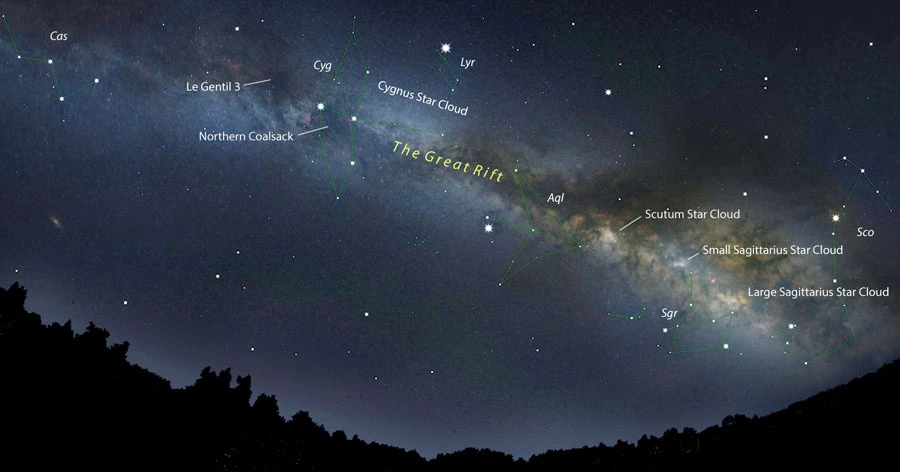
Stellarium with annotations by Bob King
Seeing the Milky Way again also makes me nostalgic. When I was a kid living in the light-polluted Chicago area, I'd get up in the wee hours in late spring when the galactic band stood highest against the darkest possible sky at the time. It was my first taste of immensity — I'd never seen anything that big before. While the sight looked anemic compared to its appearance from the countryside, the thrill of that first acquaintance reverberates to this day. At the Milky Way's return each spring, the rising tide of starlight reawakens those first inklings of cosmic grandeur.
Home sweet home
Our solar system resides within the Milky Way's flat disk, about halfway between the center and edge. When we gaze through its disk and spiral arms, where most of the stars are concentrated, they stack up along our line of sight (across thousands of light-years) to create a relatively narrow, diffuse band of starlight. The galaxy's sash-like appearance demonstrates just how thin its disk is.
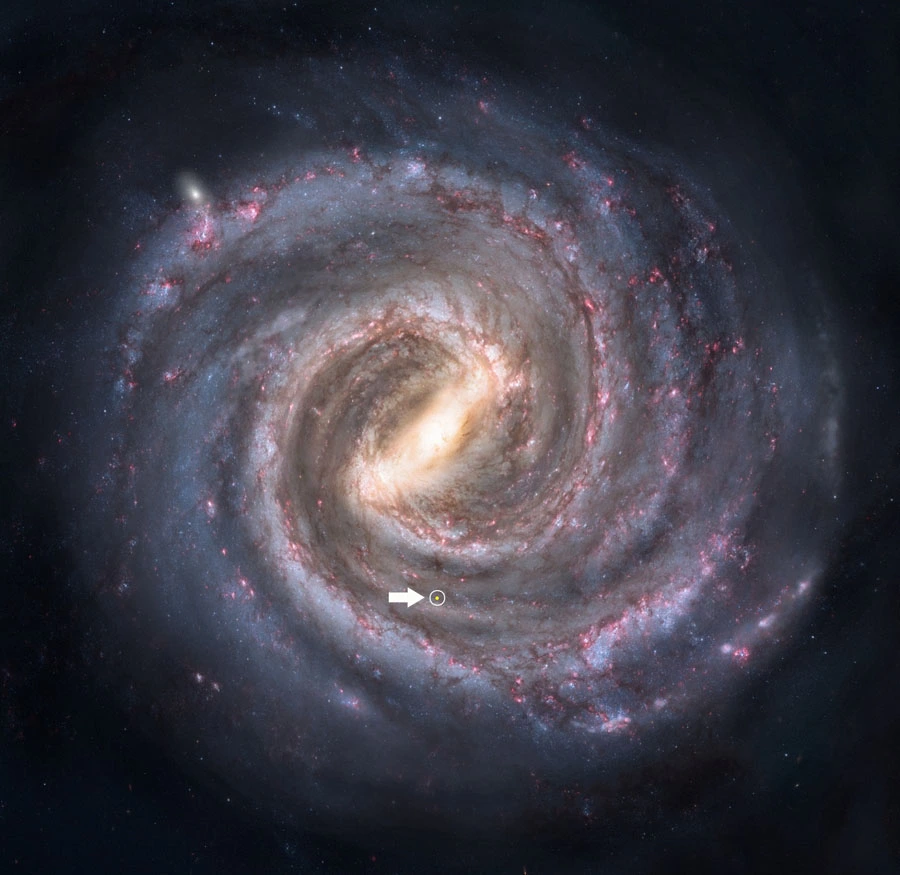
Model by Jean Beaufort (public domain)
If you direct your gaze just a little above or below the disk (Milky Way band), the number of stars rapidly diminishes because your line of sight soon takes you outside the galaxy, into nearly empty intergalactic space. This lack of stars helps to define the borders of the Milky Way band.
There are some 9,100 naked-eye-visible stars in the galaxy, of which about 90% lie within 1,000 light-years from us. When you think of how big the Milky Way is, and how little of it we experience without optical aid, it boggles the mind.
Sweep the night away!
Bob King
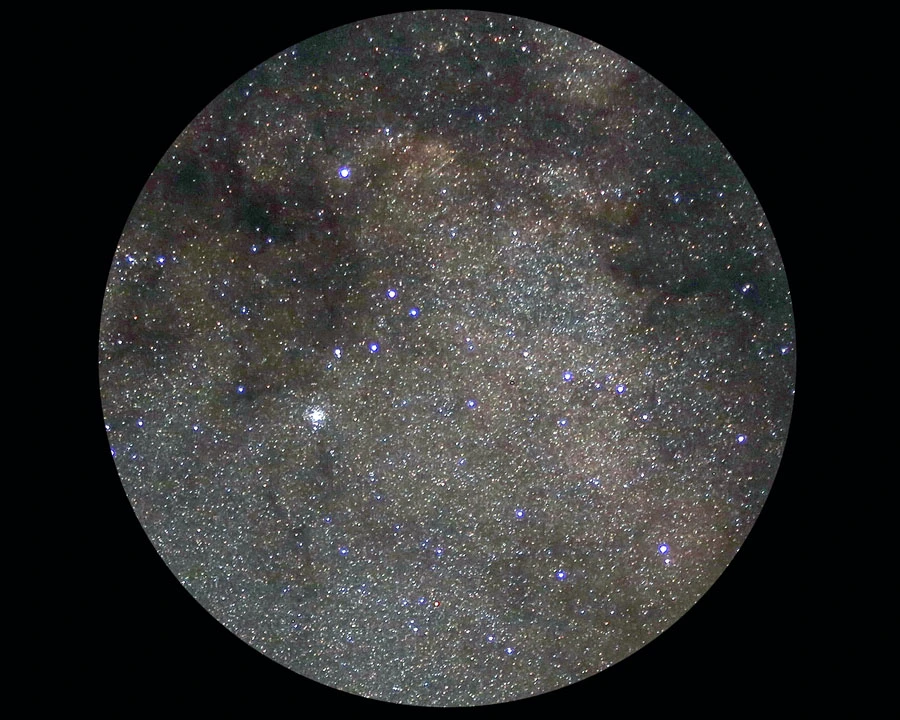
Altogether, the Milky Way is a rich tapestry of individual entities bound together by gravity into a ginormous, spinning cinnamon roll of cosmic goodness. Many of us spend a lifetime exploring its myriad deep-sky objects in great detail to better understand and appreciate our cosmic neighborhood. There are also other ways to experience our galaxy. One of my favorites is sweeping.
My first sweeps were with a 6-inch telescope. I'd drop in a low-power eyepiece, point the scope somewhere within the Milky Way band, and slowly plow through forests of stars, random clusters, occasional colorful suns, and "voids" of interstellar dust. My favorite was Cygnus because its high placement in the sky meant it was least affected by city lights.
Watching countless stars enter and exit the field of view with the push of a finger feels like space travel. It's also a fun way to get lost again in the sky. We amateurs often carefully plan our observing sessions, so it's liberating to toss out self-imposed procedures and just go for a Sunday drive. Whatever you want to do, the Milky Way is waiting for you the next clear night.
About Bob King
I love the sky (day and night) and have been a skywatcher and amateur astronomer since childhood. I'm also a long-time member of the American Association of Variable Star Observers (AAVSO) and Astronomical League. I pen the Astro Bob blog and have written four books: Night Sky with the Naked Eye (2016); Wonders of the Night Sky You Must See Before You Die (2018) and Urban Legends from Space (2019) and Magnificent Aurora, published in 2024. The universe invites us on an adventure every single night. To accept the invitation, we only need look up.




Comments
You must be logged in to post a comment.