 SUNSET:

 3
3New observations reveal a strange structure in the iconic nebula that has evaded astronomers for centuries.
University College London / CC BY 4.0
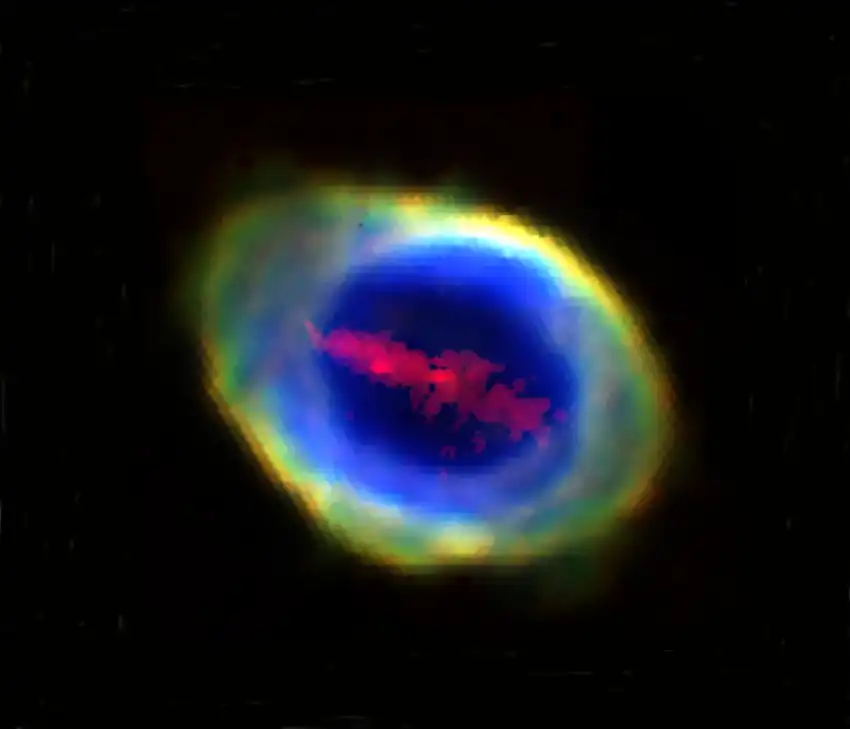
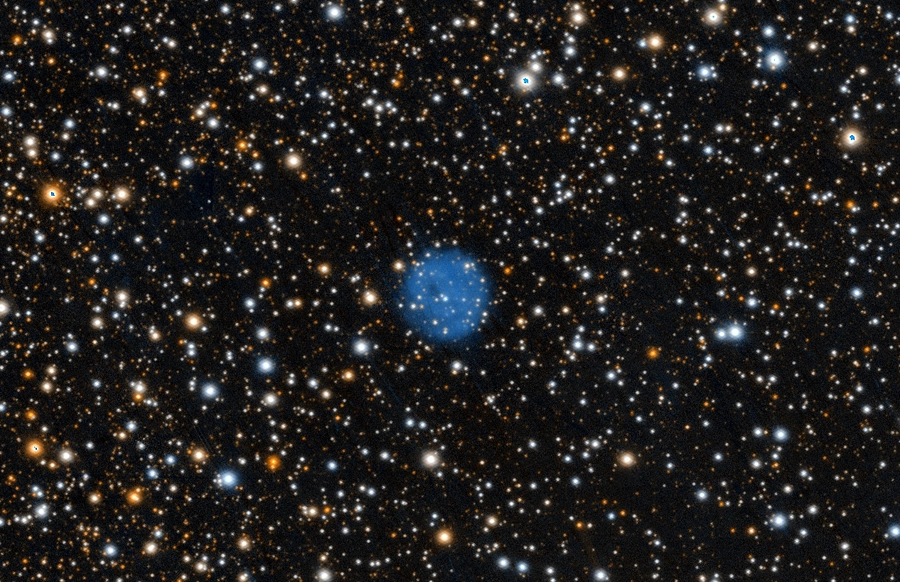
The Ring Nebula in Lyra, also known as Messier 57, is the most famous planetary nebula in the sky. It’s also one of the most imaged and studied objects of its class. But when Roger Wesson (Cardiff University, UK) and his colleagues analyzed a series of spectra taken between May and June 2023, they found something completely new: An oddly shaped “bar” of ionized iron gas that crosses the nebula roughly from west to east along the elliptical ring’s major axis.
The bar is 500 times wider than Pluto’s orbit around the Sun, and it contains enough iron to form a planet the size of Mars. Why has it been overlooked for so long? And where did it come from?
Enter WEAVE
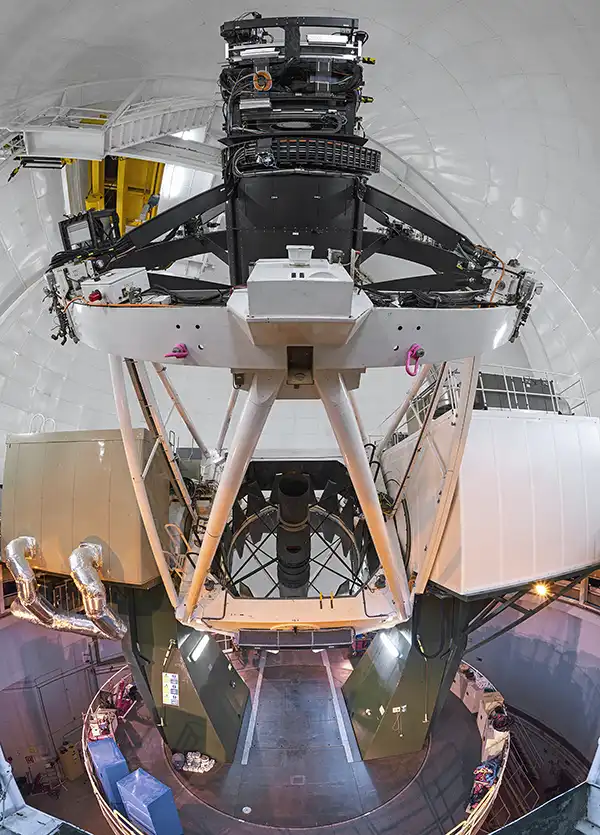
Key to their discovery, Wesson explains, was the newly installed WHT Enhanced Area Radial Velocity Explorer (WEAVE) at the 4.2-meter William Herschel Telescope on La Palma, Spain. WEAVE is a fiber-fed multi-object spectrograph, which means it can obtain hundreds of spectra all at the same time. In its Large Integral-Field Unit (LIFU) mode, this means that in just one observing session, 547 fibers record spectra of 2.6 arcsecond-wide “pixels” across a hexagonal field that measures 90 by 78 arcseconds. To cover Messier 57, the researchers combined three such fields.
After two nights of taking data, they analyzed these spectra to identify different chemical elements such as hydrogen, oxygen, carbon, neon, and iron.
Javier Mendez
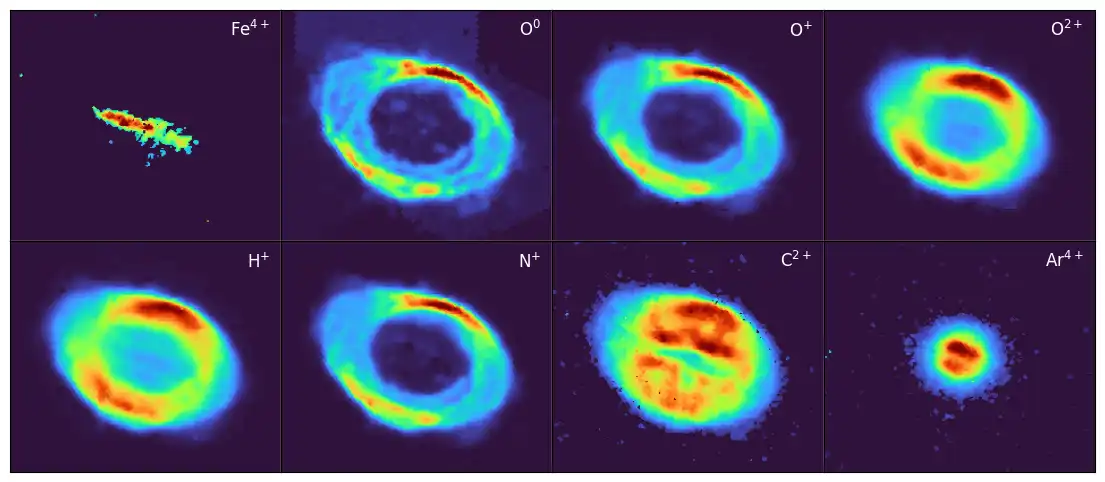
“When we processed the data and scrolled through the images, one thing popped out as clear as anything – this previously unknown ‘bar’ of ionized iron atoms, in the middle of the familiar and iconic ring,” Wesson recalls. Curiously, only iron seems to follow a bar structure. When the emission from other atoms are isolated, their images look like the ring as we know it.
“The Ring Nebula has not really been studied with integral field unit spectrographs before,” Wesson explains. “With images alone, it would be very hard to detect the bar.” The ionized iron atoms — that is, atoms with their outermost electrons stripped off — glow at 422.7 and 567.8 nanometers, but the Ring’s emission at those wavelengths is faint. “You would need a dedicated narrow-band filter to isolate it,” he adds. “It is not a commonly observed emission line, so I doubt any such filter exists at any observatory.” Spectrum taken in the more typical way might have detected the iron emission, but would have provided no way of knowing it comes in a bar shape.
University College London; CC BY 4.0
A Destroyed Planet?
The origin of the iron bar is still unknown. Iron forms in the cores of massive stars, and in order to release it back to the galaxy, these stars must explode as supernovae — but this clearly didn’t happen in Messier 57. A supernova would have left behind a gas cloud that’s expanding much faster than the Ring is.
Instead, the Ring Nebula is a planetary nebula, formed when a Sun-like star evolved, expanding and ejecting its outermost gaseous layers some 10,000 years ago. That star, now a white dwarf, can be glimpsed in larger optics as a 15.8-magnitude dot of light near the Ring’s center. Its blisteringly hot surface emits ultraviolet radiation that makes the nebula shine. Even in its best days, the star was much too light to ever have produced iron.
The material of the bar, Wesson and his collaborators suggest, might instead have come from a planet that once orbited the star but was destroyed during the nebula’s formation. “We’d expect it to be vaporized,” Wesson says. “The outer layers of the star would have had temperatures above the boiling point of iron.” However, this scenario is only speculation at this stage. Even if a vaporized planet left the iron, there are no good ideas yet for why it should have taken the shape of a bar.
Sun Kwok (The University of Hong Kong) helped develop our understanding of planetary nebulae in the late 1970s (though he wasn’t involved in this study), but he’s baffled by the bar’s presence, too. “[This] is an interesting result,” he says. “Although the Ring Nebula is a well-observed object, there are still many aspects of its structure that are continuously being discovered.” Kwok suggests that integral field imaging spectroscopy offers “great potential” in the future study of planetary nebulae.
That’s why Wesson and his team want to repeat their observations, looking for other chemical elements that coexist with the iron bar. They also want to use WEAVE to scan more planetary nebulae for similar hidden structures.
Interestingly, another group has recently found a similar iron bar in NGC 6818, a bright planetary nebula in Sagittarius. Their analysis is currently in preparation, so it’s likely we’ll be hearing more news about planetary nebulae soon!



Comments
relh
January 30, 2026 at 7:02 pm
Could the bar be a strung out ring of iron following the orbit of the proposed former planet? Or would there be sufficient iron to show up as observed?
You must be logged in to post a comment.
Steven-Rudnick
January 31, 2026 at 3:05 pm
Fe4+ is typically short lived. Are ther no negative ions in the vicinity?
You must be logged in to post a comment.
[email protected]
February 22, 2026 at 7:50 pm
Perhaps the bar is similar to a comet's tail that has spread out as it orbits a much gravitationally weaker residual white dwarf. The diameter and shape (eccentricity) of the original planet's orbit would have increased as the original star's lost mass moved outside the planet's orbit.
You must be logged in to post a comment.
You must be logged in to post a comment.