 SUNSET:

 0
0A new analysis of the Solar Orbiter’s unique views of the Sun’s poles shows how a “conveyor belt” moves within our nearest star.
Last spring, the European Space Agency’s Solar Orbiter obtained its first glimpse of the Sun’s poles. Now, a new analysis of those data shows that the hot gases there move in a way that scientists hadn’t anticipated. The finding has potential implications for the 11-year solar cycle that drives sunspots, solar flares, and other activity.
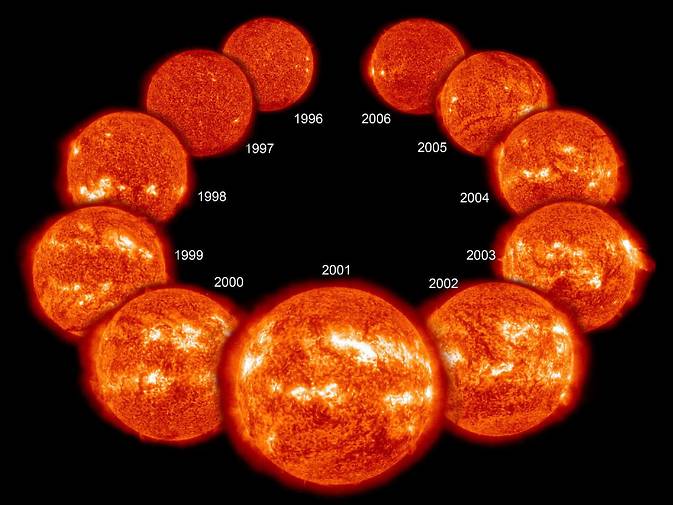
The Sun’s gases are so hot that they split into charged particles, known collectively as plasma. The particles’ boiling motions generate a magnetic field that starts out relatively sedate, akin to that of a bar magnet. Gradually, the faster-rotating equator twists up the field until it starts popping out of the surface in active regions, visible as sunspots. Flares and eruptions are visible from Earth, producing magnificent auroral displays if we’re lucky. Then the poles swap and the activity settles down before the whole cycle begins again.
NASA
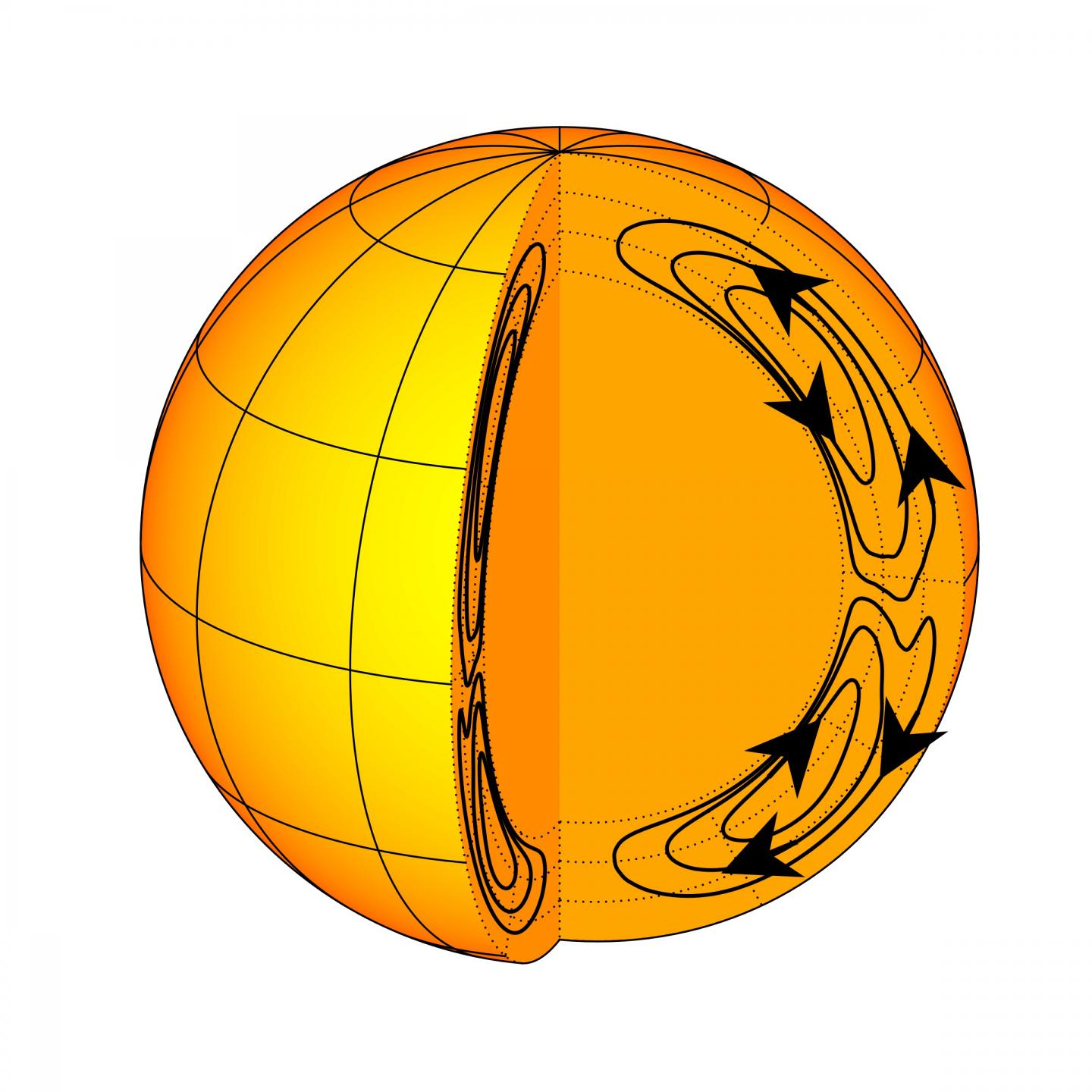
The reset button for that 11-year cycle depends in large part on a sort of conveyor belt in the solar interior, called the meridional flow. That flow carries magnetized plasma along the surface toward the poles, where the belt sinks. The plasma then travels deep within in the Sun back toward the equator. The speed and strength of the magnetic field that’s brought to the poles determines when the poles flip their polarity (from north to south and vice versa), beginning the cycle anew. The meridional flow also appears to regulate the strength of the next solar cycle.
MPS (Z.-C. Liang)
In previous studies that tracked the motion of magnetic features on the Sun’s visible surface, scientists found that the meridional flow is stronger near the equator, slowing as it approaches the poles. But those studies could only see the poles at a glancing angle.
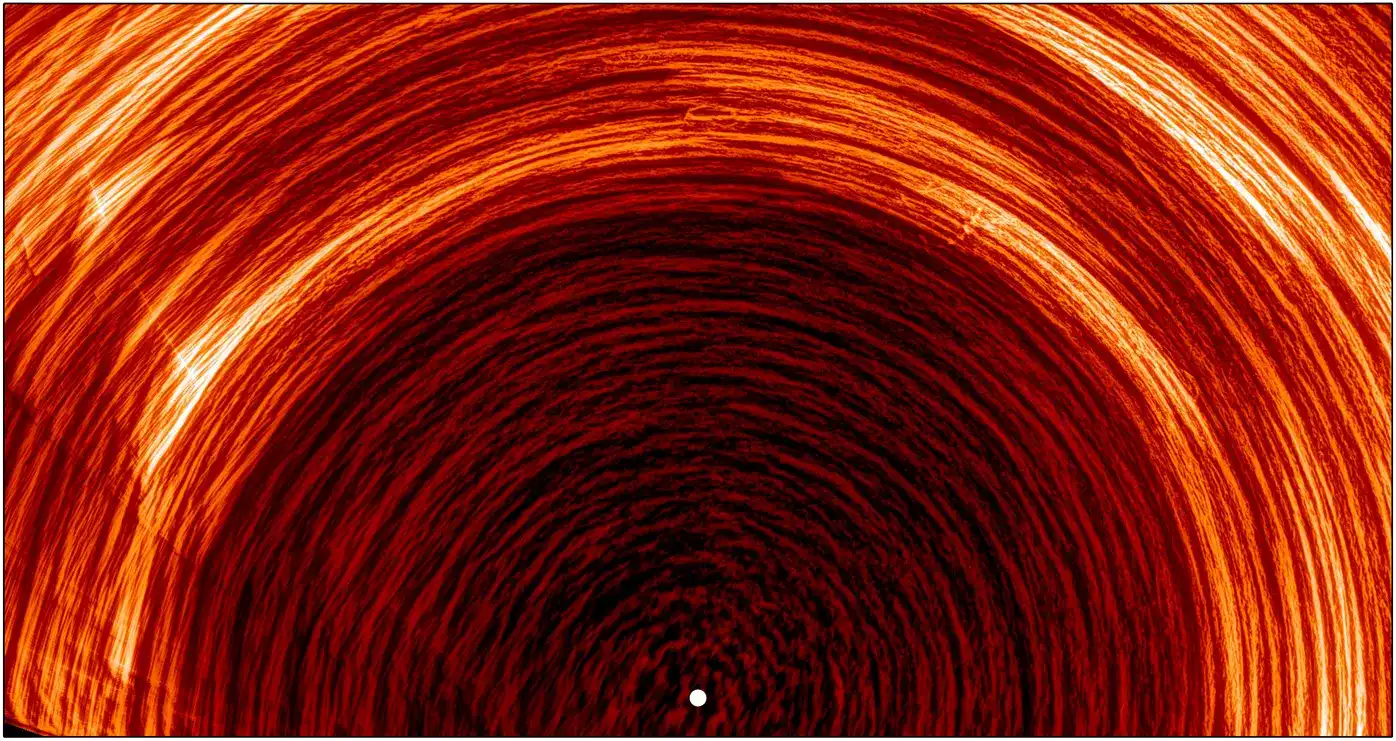
The Solar Orbiter, on the other hand, has already risen out of the ecliptic plane that Earth and the other planets orbit in. Each swing around the Sun slants its orbit further; currently, its view is tilted by 17 degrees to the ecliptic. The unique angle tells a different story.
ESA & NASA / Solar Orbiter / EUI-Team
Lakshmi Pradeep Chitta (Max Planck Institute for Solar System Research, Germany) and colleagues started out by identifying gigantic plasma bubbles. In the huge pot of boiling plasma that is the Sun, these supergranules are the largest bubbles to rise to the surface, each one spanning two or three Earths laid side by side. Plasma rises toward the surface at the center of each bubble and speeds toward the edges, where it sinks again. The supergranules expand and disappear over the course of hours, in the process driving the flow of magnetized plasma. (Smaller-scale granules appear on much shorter timescales of several minutes, and probably represent the splintered tops of supergranules.)
Based on those first measurements taken last March, Chitta’s team were able to measure the motions of supergranules and the plasma within them, finding that the magnetized plasma is moving poleward just as fast when it’s near the poles as near the equator — about 10 to 20 meters per second (22 to 45 mph). That’s twice as fast as previous studies have found.
However, it’s worth noting that the spacecraft tracks features at extreme ultraviolet wavelengths, which tend to be a bit farther up in the solar atmosphere (in the chromosphere) rather than near the visible surface. It could be that the magnetic field travels faster when it’s higher up in the solar atmosphere, Chitta and colleagues write.
The study, published in the Astrophysical Journal Letters, is a first look at Solar Orbiter data. There’s much more to come as Solar Orbiter continues to rise out of the ecliptic plane with ever-improving views of the Sun’s unexplored territory. Meanwhile, the mission continues to offer mesmerizing imagery of our nearest star:
Solar Orbiter captured a dark prominence sticking out from the side of the Sun on March 17th. The dark material is dense plasma trapped in the Sun's complex magnetic field.About Monica Young
Monica Young, a professional astronomer by training, is News Editor of Sky & Telescope.



Comments
You must be logged in to post a comment.