 SUNSET:

 1
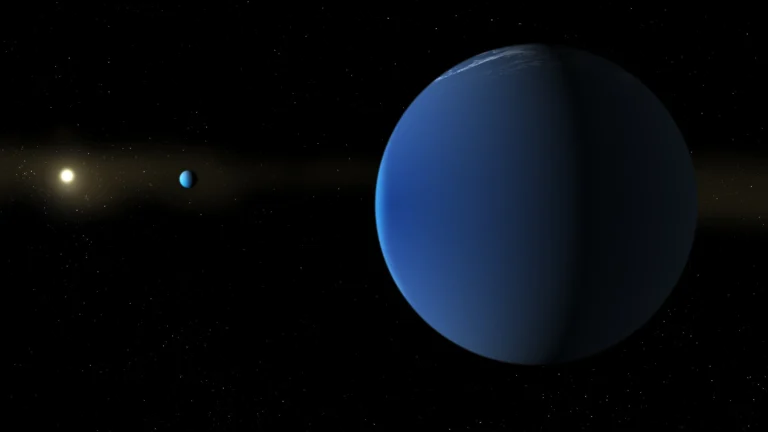
1When JWST looked at what was supposed to be a hot Jupiter, it found something else instead: a fluffy, shrinking planet that’s more like Neptune.

NASA / ESA / CSA / Dani Player (STScI)
Nearly three decades since the first exoplanet discovery, astronomers have only become certain of their own uncertainty regarding these diverse worlds’ formation. Every new young transiting planet is a valuable target for their developing models — which is why the James Webb Space Telescope (JWST) turned its prized attention to a baby world named HIP 67522b for a few hours back in 2023.
Aside from its remarkably young age at just 17 million years, HIP 67522b had appeared to be a typical close-in, Jupiter-size planet. However, JWST’s new observations unveiled a surprise: HIP 67522b looks nothing like Jupiter. Instead, as detailed in a recent study, it has a puffy, extended atmosphere full of water vapor and carbon dioxide and is likely a different type of planet altogether.
The atmosphere’s composition isn’t unprecedented, but it was the puffiness that came as a surprise to the team, led by Pa Chia Thao (University of North Carolina at Chapel Hill). If the planet had a mass similar to Jupiter’s, its gravity would have hugged the surrounding gases close in. Since the JWST observations indicated the atmosphere extends much farther out than expected, the planet must have a much smaller mass than they anticipated and be unable to squeeze all the surrounding gas downwards with its resulting weak gravitational pull
Via further analysis of the atmosphere’s thickness, the astronomers suggest that HIP 67522b weighs in at about 14 times Earth’s mass despite its Jupiter-like size. That makes it one of the lightest giants ever discovered — and more similar to sub-Neptunes than Jupiters.
Sub-Neptunes are a strange type of world larger than Earth but smaller than the ice giants. Though we don’t have such a planet in our own solar system, astronomers have confirmed that they’re one of the most common types of planets elsewhere in the galaxy. Astronomers sub-Neptunes might form with much larger atmospheres but then lose these initial envelopes through a complicated combination of processes that include star-induced boil-off.
Unfortunately for HIP 67522b, its low mass likely dooms it to this harsh fate. Although today we see it as a giant, inflated planet, its proximity to its star and inability to maintain a tight hold on its gases means it will probably lose much of the gases we currently see surrounding it. Its atmosphere is probably already boiling off, and it will probably lose most of it in the next billion years. All that will be left is the shrunken core.
For scientists, catching this evaporation process in action could help explain how some sub-Neptunes arrived at their final sizes. “Measuring the atmospheric properties of young planets provides a unique opportunity to understand the formation and evolutionary histories of these planets,” says Munazza Alam (Space Telescope Science Institute), who was not involved in the study. “Placing constraints on atmospheric escape early on in a planet’s lifetime can help us better understand the processes at play that sculpt their atmospheres.”
This unexpected discovery not only sheds light on sub-Neptune formation, it also marks the first time astronomers have measured the mass of a planet using the spectrum of starlight passing through its atmosphere. The team could thus circumvent the challenges of observing young, active stars and use the atmosphere’s puffiness as a probe instead.
Some astronomers are hopeful that this trick can be repeated: “It’s notoriously challenging to weigh young exoplanets,” says Shreyas Vissapragada (Carnegie Observatories), who also was not involved in this recent research. “This comprehensive study demonstrates (among many other things) just how powerful JWST can be for measuring the masses of young exoplanets.”



Comments
accurateye
December 13, 2024 at 11:16 am
This might also be a common evolutionary stage for what eventually become Earth-like (or Venus-like) planets; heavier molecules will be among the last to be lost. Much likely depends on core rotation and development of a protective magnetic field, which also begs the importance of the Earth-Theia collision.
You must be logged in to post a comment.
You must be logged in to post a comment.