 SUNSET:

 0
0The constellation of the Peacock is home to some splendid stellar and deep sky sights.
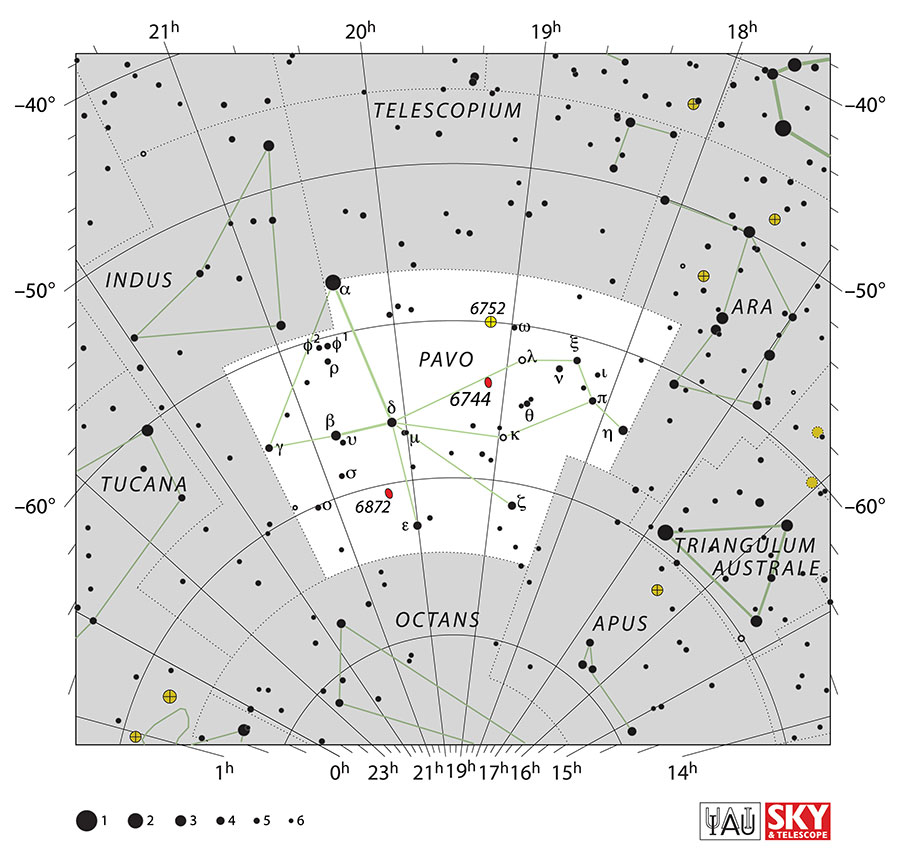
IAU / Sky & Telescope (Roger Sinnott & Rick Fienberg)
Pavo, the Peacock, is one of four constellations known collectively as the Southern Birds, the others being Grus (the Crane), Phoenix (the Phoenix), and Tucana (the Toucan). Like many constellations, Pavo goes a long way back, to 1598 in fact, when it was included on a celestial globe produced by Dutch-Flemish cartographers Petrus Plancius and Jodocus Hondius.
To construct this (and some other) constellations, Plancius and Hondius used observations of the Southern Hemisphere sky made by Pieter Dirkszoon Keyser and Frederick de Houtman during their voyage to the Dutch East Indies in the mid-1590s. Indeed, the Peacock is likely not the one most of us would picture — the blue-feathered Indian peafowl — but rather the larger green peafowl found in Southeast Asia, including Java (then in the Dutch East Indies, now part of Indonesia).
Pavo contains a respectable number of naked-eye stars — 16 that are brighter than magnitude 5. Its most brilliant beacon, Alpha (α) Pavonis, is a tight binary system with a combined magnitude of 1.9. It’s made up of the bright, bluish-colored primary and a dim companion too faint to see.
On the face of it, magnitude-3.6 Delta (δ) Pavonis seems somewhat ordinary, but it has some interesting qualities. For a start, it’s a solo star, whereas many of the others we see in the night sky are members of multiple-star systems. It’s also Sun-like in many respects, being of a similar spectral class, only 5% more massive and 20% larger than our own star. And at a distance of 20 light-years, it’s also the closest Sun-like singleton outside our solar system.
Nearby Gamma (γ) Pavonis, magnitude 4.2, is only 15% larger and 20% more massive than the Sun, but it’s lacking the heavier elements that the Sun has.

Fernando Menezes / S&T Online Photo Gallery
Pavo is home to the sky’s fourth-brightest globular star cluster, NGC 6752, described by Sky & Telescope Contributing Editor Steve Gottlieb as the favourite of all the objects he viewed during an observing trip to Australia. At magnitude 5.4 it’s visible to the naked eye as a tiny light, although you’ll need dark skies and good, dark-adapted eyes to spot it. Through a telescope, it’s quite magnificent. Finding it is easy; simply start at Lambda (λ) Pav and, with a low-power eyepiece, sweep a bit more than 3° to the northeast until you come to it.
A 3-inch aperture will show NGC 6752 as a small smattering of stars against a hazy background, while a 4-inch reveals why some people call this cluster “the Starfish,” with multiple curved strings of stars becoming readily apparent. And on the cluster’s southern edge, you won’t be able to miss a pretty, bright-blue, magnitude-7.4 foreground double star system, SAO 254482.

Team Chameleon (Franz Hofmann and Wolfgang Paech) / S&T Online Photo Gallery
Pavo is also home to one of the most magnificent spiral galaxies, NGC 6744. Like the globular, the galaxy was discovered by Scottish astronomer James Dunlop while observing from Parramatta (now a suburb of Sydney) in 1826. A member of the Virgo Supercluster, NGC 6744 is about 30 million light-years away and often compared to the Milky Way in terms of its appearance, with majestic spiral arms and a stretched core region. But it’s much bigger — with a width of around 175,000 light-years, it’s about twice the diameter of our galaxy.
To find NGC 6744, head 2½° due south from NGC 6752. Some sources list its magnitude as around 8, while others say about 9.2; I lean toward the fainter estimate. A 3-inch refractor just barely reveals it as an unresolved blob, while 4-inches begin to resolve the oval-shape glow of its central region. An aperture of 8 to 10 inches reveals hints of its spiral structure under excellent viewing conditions.

Digitized Sky Survey
A tougher target is the barred spiral galaxy NGC 6872. With an apparent size of 6.0′ × 1.7′ and magnitude of 11.6, it’s quite small and dim; you’ll need 8 inches of aperture just to make it out as a small smudge of light. But I often find when observing that it’s not an object’s visible appearance that makes an impression; rather, it’s the knowledge of what I’m seeing. And that’s definitely the case with NGC 6872, because when you gaze at it, you’re seeing the largest spiral galaxy discovered anywhere in the universe so far. It spans an amazing 522,000 light-years from tip to tip. Our Milky Way by comparison, no slouch itself in the size stakes, is thought to be only some 100,000 light-years across.
To find NGC 6872, picture a straight line between Eta (η) Pav and β Pav. From η, sweep northeast along the line for 2½°; once you reach that point, you should spot the galaxy a smidgeon to the northwest. Even if it might not look too impressive through the eyepiece, it’s definitely worth seeking out this mightiest of the spirals, just to say you’ve seen it.
That’s it for this tour of Pavo, but, as I always say, while you’re in the vicinity, make sure to sweep your eyes, binoculars, or telescope around the constellation to see what else you can find. There’s plenty more to see.




Comments
You must be logged in to post a comment.