 SUNSET:

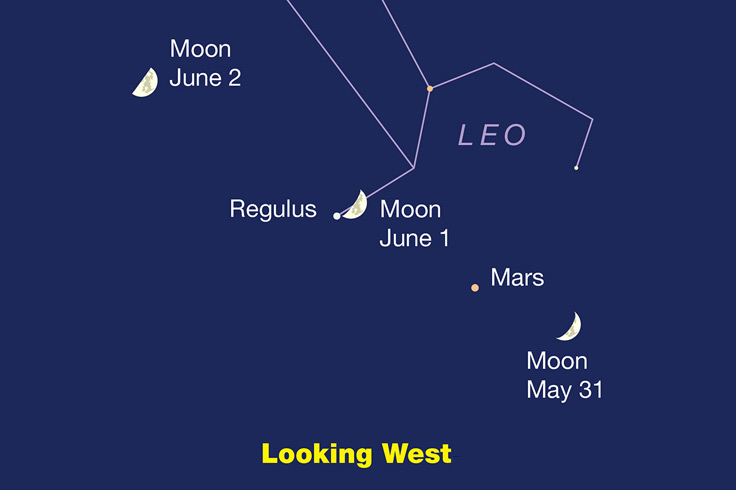
This Week's Sky at a Glance, May 30 – June 8
The waxing Moon poses with Mars, then Regulus, in the west. Double stars await near Vega, while another double star far across the sky points the way.

This Week's Sky at a Glance, May 23 – June 1
Have you ever found a hairline crescent Moon as young as 24 hours from new? You get a chance Tuesday after sunset. Mars fades, Jupiter says goodbye, and a globular cluster waits for you in the Keystone.

This Week's Sky at a Glance, May 16 – 25
Jupiter waves goodbye for the season. Mars forsakes Pollux and Castor and heads for Regulus. Saturn and Venus each pair up with the waning crescent Moon at dawn.

This Week's Sky at a Glance, May 9 – 18
Every month, the Moon takes four days to cross the sky from Spica to Antares. This week it goes unusually close to each of them.

This Week's Sky at a Glance, May 2 – 11
In the evening sky, the Moon meets Mars meeting the Beehive. Low the dawn, Venus and Saturn contrast enormously in a telescope.

This Week's Sky at a Glance, April 25 – May 4
The Moon passes Mars when Mars passes the Beehive. Sirius, the Winter Star, sinks away in the southwest. Arcturus, the Spring Star, shines high toward the southeast. Vega, the Summer Star, is already nosing up in the northeast. All at once.

This Week's Sky at a Glance, April 18 – 27
Bright Jupiter is getting lower in the west week by week and is nearly at its farthest from Earth. But it's still the brightest point in the evening sky, qualifying as the "Little Evening Star" in the absence of Venus.

This Week's Sky at a Glance, April 11 – 20
The bright Moon pairs with Spica on Saturday the 12th. Three nights later, the waning Moon in the small hours occults one of the head stars of Scorpius.

This Week's Sky at a Glance, April 4 – 12
The first-quarter Moon joins the Mars-Pollux-Castor trio, which are on their way to lining up straight. When the Moon turns full, it will meet Spica.

This Week's Sky at a Glance, March 28 – April 6
While waiting for sunrise on eclipse morning, can you catch Venus rising as a tiny, thin crescent? Go out earlier while the sky is still dark, and you get a preview of July evenings with Scorpius on the meridian.

This Week's Sky at a Glance, March 21 – 30
If you're in the US northeast or eastern Canada, start planning for the sunrise partial eclipse on March 29th! In the night sky the stern of the ship Argo is at its highest, abutting the stern of Canis Major.

This Week's Sky at a Glance, March 14 – 23
High overhead after dark, how accurately can you judge a celestial right angle? Watch the changing Castor-Pollux-Mars group to find out. Meanwhile the waning gibbous Moon will rise later and later, opening up dark-sky observing in the evening.

This Week's Sky at a Glance, March 7–16
A late-night total eclipse of the Moon highlights the coming week, and never mind that this is a minimoon. Sirius holds the meridian at nightfall, just as the Winter Triangle tips to balance on its brightest point.

This Week's Sky at a Glance, February 28 – March 9
The Moon passes four bright planets this week, starting as a thin crescent below Mercury on February 28th, passing by Venus this weekend, and visiting Jupiter and Mars later in the week.

This Week's Sky at a Glance, February 21 – March 2
Venus, after standing alone, is joined by the crescent Moon and low little Mercury in twilight late this week. Higher in the night, Jupiter and Mars continue in their distinctive triangles.

This Week's Sky at a Glance, February 14 – 23
Jupiter makes a triangle with Aldebaran and the Pleiades. Mars makes a nicer triangle with Pollux and Castor. The pre-dawn Moon hangs with Spica, then Antares.

This Week's Sky at a Glance, February 7 – 16
Watch the bright Moon step past Mars, Castor, and Pollux. They bunch up on Sunday evening the 9th. Then on Tuesday and Wednesday, "full moon" spans two evenings.

This Week's Sky at a Glance, January 31 – February 9
The waxing crescent Moon pairs up with Saturn, then Venus. On the night of the 5th the Moon occults some of the Pleiades. Looking wider, the Winter Hexagon fills much of the February sky.

This Week's Sky at a Glance, January 24 – February 2
Mars pulls away from Pollux this week. The winter Milky Way crosses the zenith. Lepus, the Hare under Orion's feet, offers a famous nearby double star and a rare winter globular cluster.

This Week's Sky at a Glance, January 17 – 26
Brilliant Mars, just past opposition, outshines its neighbors Pollux and Castor in the east. Venus and Saturn pull apart in the southwest. Orion dominates the high southeast after dinnertime, with searing white Sirius sparkling below it.
