 SUNSET:

 3
3FRIDAY, JANUARY 24
■ The Gemini twins lie on their sides these January evenings, left of Orion. Farthest from Orion are their head stars, Castor and Pollux. But Mars is now passing them and far outshines them! As shown below. Tonight, Mars is still just 2.5° from Pollux.
Lower right of them shines Procyon, the Little Dog Star. Farther lower right of Procyon, watch Sirius come up as nightfall deepens.

Compare their colors with your naked eyes, then when they're brighter in binoculars, and then when much brighter in a medium or large telescope. Color is tricky. Our perception/experience of it is a different kind of thing than the physical reality of it (such as a spectroscope might reveal). As is true for everything else outside of us, i.e. in the physical world.
Mars is slowly retrograding westward against the background stars: toward upper right as seen during evening. After tonight the gap between Mars and Pollux will widen. Keep watch. Mars will reach its western stationary point on February 24th, when will appear just about equidistant (7.2°) from both Pollux and Castor: near the "E" in "GEMINI" above. After that Mars will resume its usual eastward (prograde) motion, to pass Pollux again on March 30th.
SATURDAY, JANUARY 25
■ Orion is now high in the southeast right after dark. He stands highest and upright due south around 9 p.m. Orion is the brightest of the 88 constellations, but his main pattern is surprisingly small compared to some of his dimmer neighbors. The biggest of these is Eridanus the River to his west (right), enormous but hard to trace. Dimmer Fornax the Furnace, to Eridanus's lower right, is almost as big as Orion! But its brightest star, Alpha Fornacis, is only magnitude 3.9.
Even the main pattern of Lepus, the Hare cowering under the Hunter's feet, isn't much smaller than he is. That's some big bunny.
■ Do you know the constellation down below Lepus? It's a tough one: Columba the Dove, faint, sprawly, and to my eye not a bit dove-like. See the constellation chart in the center of the February Sky & Telescope.
Its brightest star, Alpha Columbae or Phact, is a decent magnitude 2.6. To find it, draw a line from Rigel through Beta Leporis (the front of the bunny's neck) and extend it an equal distance onward.
SUNDAY, JANUARY 26
■ In early evening, the equilateral Winter Triangle shines in the southeast. Sirius is its brightest and lowest star. Betelgeuse stands above Sirius by about two fists at arm's length. Left of their midpoint shines Procyon.
Can you discern their colors? Sirius (spectral type A0) is cold white, Betelgeuse (M2) is yellow-orange, and Procyon (F5) is a pale, very slightly yellowish white.
And, standing 4° above Procyon is 3rd-magnitude Gomeisa, Beta Canis Minoris, the only other easy naked-eye star of Canis Minor.
MONDAY, JANUARY 27
■ While the evenings are still dark and moonless, use big binoculars or a telescope to hunt down the 8th-magnitude globular cluster M79 in Lepus below the feet of Orion. Summer is the season for most globular clusters, but here we have a rare winter one. It's below the two brightest stars of Lepus, Alpha and Beta Leporis: the back and front of the Hare's neck. Continue the line that they make downward by that same distance and you're just about there. Use the chart with Matt Wedel's Binocular Highlight column "Down the Rabbit Hole" in the February Sky & Telescope, page 43.
Also check out the binocular double star Gamma Leporis nearby on the chart. It's a yellow-white F6 dwarf a little larger, hotter, and brighter than the Sun, with a dimmer orange K2 dwarf travelling through space with it about 96 arcseconds to its north-northwest (directly above it in the evening). They're magnitudes 3.6 and 6.3. It helps a lot to brace your binoculars firmly against something to eliminate the jiggles.
The orange dwarf is very slightly variable due to large starspots on its surface; the star rotates with a 21-day period, so the spots come and go. The pair is just 29 light-years away.
■ Algol high overhead should be in mid-eclipse, magnitude 3.4 instead of its usual 2.1, for about two hours centered on 10:17 p.m. EST; 7:17 p.m. PST. Algol takes several additional hours to fade and to rebrighten. Estimate its magnitude with this comparison-star chart, which has north up. Celestial north is always the direction in the sky toward Polaris. Outside at night, turn the chart around to match.
TUESDAY, JANUARY 28
■ After dark now the Great Square of Pegasus sinks low in the west, tipped onto one corner. Meanwhile the Big Dipper is creeping up in the north-northeast, tipped up on its handle.
WEDNESDAY, JANUARY 29
■ The Pleiades and Hyades are the most famous star clusters in Taurus, which is now high overhead and hosting Jupiter. But awaiting your telescope in Taurus on these moonless evenings are also big, scattered NGC 1746 and NGC 1647, and the smaller, sparse cluster pair NGC 1807 and NGC 1817, which look almost like two little parallel lines. Ken Hewitt-White calls these two the "ugly duckling" clusters in his Suburban Stargazer column in the January Sky & Telescope, page 55. Included there are photos and a big chart, with a half dozen notable double stars for telescopes scattered along the way.
■ New Moon (exact at 7:36 a.m. EST).
THURSDAY, JANUARY 30
■ Is your sky dark enough for you to trace the winter Milky Way? After dinnertime now, it runs vertically from Canis Major low in the southeast, up between Orion and Gemini, through Auriga and Perseus almost straight overhead, and down through Cassiopeia, Cepheus, and Cygnus to the northwest horizon.
■ Algol should be in mid-eclipse for about two hours centered on 7:06 p.m. EST.
FRIDAY, JANUARY 31
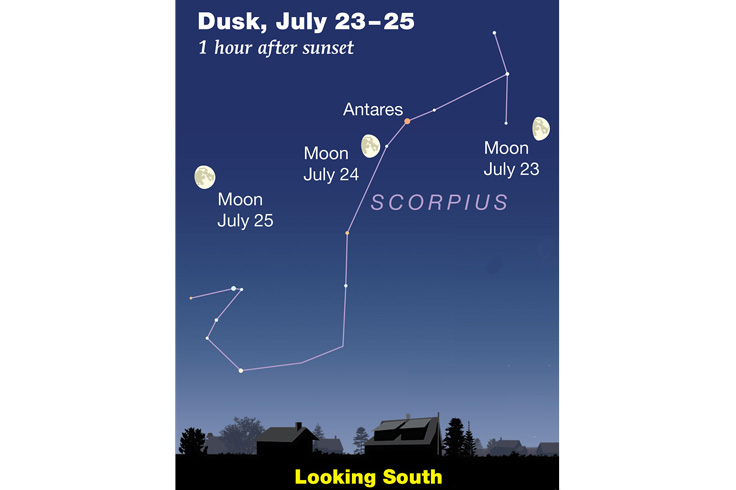
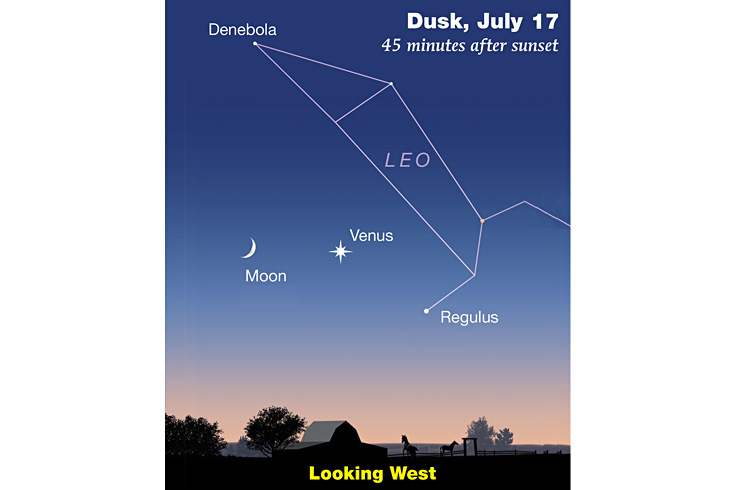
■ The waxing crescent Moon shines under 1.1-magnitude Saturn this evening, as shown below. Venus, more than 200 times brighter than Saturn at magnitude –4.8, looks on expectantly from above.

SATURDAY, FEBRUARY 1
■ Now it's Venus's turn to host the lunar guest, as shown above. They are not as paired as they look. Venus, currently 4 light-minutes away, is about 200 times farther from us than the Moon's current distance of 1.2 light-seconds.
■ Jupiter's moon Io enters onto Jupiter's face at 6:41 p.m. EST coming from the east, then it exits from Jupiter's western limb at 8:53 p.m. EST. Following behind Io across the planet's face, from 7:50 to 10:02 p.m. EST, will be Io's tiny black dot of a shadow.
SUNDAY, FEBRUARY 2
■ The biggest well-known asterism (informal star pattern) is the Winter Hexagon. It fills the sky toward the east and south these evenings.
Start with brilliant Sirius at its bottom. Going clockwise from there, march up through Procyon, Pollux and Castor, Menkalinan and Capella on high, down to Aldebaran, then to Rigel in Orion's foot, and back to Sirius. Betelgeuse shines inside the Hexagon, way off center.
The Hexagon is somewhat distended. But if you draw a line through its middle from Capella down to Sirius, the "Hexagon" is fairly symmetric with respect to that long axis.
Take the line from Aldebaran to Capella, turn it to go from Aldebaran to Betelgeuse instead, and the Winter Hexagon becomes the Heavenly G.
This Week's Planet Roundup
Mercury is out of sight, hiding in superior conjunction with the Sun.
Venus (magnitude –4.8, near the dim Circlet of Pisces) shines high and bright as the "Evening Star" in the southwest during twilight, then lower in the west-southwest as evening grows late. It sets almost due west nearly 2½ hours after dark.
In a telescope this week Venus appears about 40% sunlit: a thick crescent. Venus is enlarging week by week as it swings toward us — it's now 30 arcseconds from pole to pole — while waning in phase as it draws closer to our line of sight to the Sun. It'll be about 55 arcseconds in diameter when it becomes a thin crescent and plunges down into the sunset near winter's end.
Increasingly far below Venus is fainter Saturn.
Mars was at opposition on January 15th. It's now shrinking and fading a bit, to about 14.0 arcseconds in diameter and magnitude –1.1. Mars comes into view in twilight as a steady orange spark low in the east-northeast. As darkness deepens, watch for Pollux and Castor emerge into view upper left of it.
Mars climbs high into good telescopic viewing earlier now. It's best examined from mid-evening through midnight, when it's high in the southeast to south. A map of the major Martian surface features is in the January Sky & Telescope, page 48, in Bob King's article "Mars is in Fine Form." See also Bob's Mars Extravaganza online, which includes a surface-feature map. To find which side of Mars (i.e. which part of the map) will be facing you at the date and time you'll observe, use our Mars Profiler tool.

Jupiter, nearly two months past opposition, shines at a bright magnitude –2.5 in Taurus. It dominates the high south in early evening, near Aldebaran and the Pleiades. Jupiter is still 44 arcseconds wide.

On this side of Jupiter at least, the tan North Equatorial Belt is distinctly more prominent than its south equivalent.
Saturn, magnitude +1.1 in Aquarius, is a little spark below brilliant Venus during and after dark. The gap between them is widening. Saturn is 6° below Venus on Friday the 24th and 11° below it by the 31st.
Uranus, magnitude 5.7 at the Taurus-Aries border, is very high toward the south during evening, 18° west of Jupiter along the ecliptic. You'll need a good finder chart to tell it from the similar-looking surrounding stars. See last November's Sky & Telescope, page 49.
Neptune, tougher at magnitude 7.9, is passing a few degrees from Venus this week far in the background. Again you'll need a sufficient finder chart.
All descriptions that relate to your horizon — including the words up, down, right, and left — are written for the world's mid-northern latitudes. Descriptions and graphics that also depend on longitude (mainly Moon positions) are for North America.
Eastern Standard Time (EST) is Universal Time minus 5 hours. UT is also known as UTC, GMT, or Z time.
Want to become a better astronomer? Learn your way around the constellations. They're the key to locating everything fainter and deeper to hunt with binoculars or a telescope.
This is an outdoor nature hobby. For a more detailed constellation guide covering the whole evening sky, use the big monthly map in the center of each issue of Sky & Telescope, the essential magazine of astronomy.
Once you get a telescope, to put it to good use you'll need a much more detailed, large-scale sky atlas (set of charts). The basic standard is the Pocket Sky Atlas, in either the original or Jumbo Edition. Both show all 30,000 stars to magnitude 7.6, and 1,500 deep-sky targets — star clusters, nebulae, and galaxies — to search out among them.
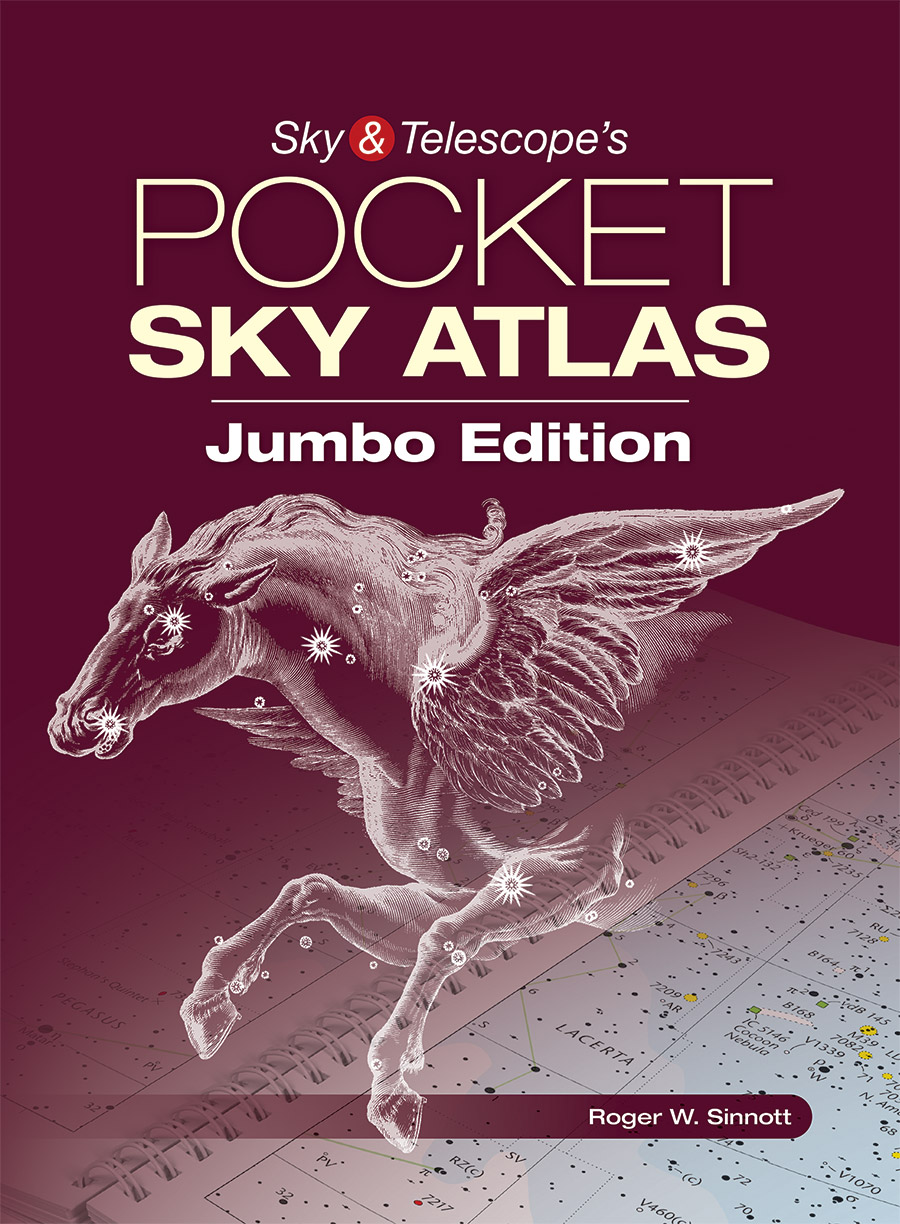
Next up is the larger and deeper Sky Atlas 2000.0, plotting stars to magnitude 8.5; nearly three times as many, as well as many more deep-sky objects. It's currently out of print, but maybe you can find one used.
The next up, once you know your way around well, are the even larger Interstellarum atlas (201,000+ stars to magnitude 9.5, and 14,000 deep-sky objects selected to be detectable by eye in large amateur telescopes), andUranometria 2000.0 (332,000 stars to mag 9.75, and 10,300 deep-sky objects). And read How to Use a Star Chart with a Telescope. It applies just as much to charts on your phone or tablet as to charts on paper.
You'll also want a good deep-sky guidebook. A beloved old classic is the three-volume Burnham's Celestial Handbook. An impressive more modern one is the big Night Sky Observer's Guide set (2+ volumes) by Kepple and Sanner. The pinnacle for total astro-geeks is the new Annals of the Deep Sky series, currently at 11 volumes as it works its way forward through the constellations alphabetically. So far it's up to H.
Can computerized telescopes replace charts? Not for beginners I don't think, and not for scopes on mounts and tripods that are less than top-quality mechanically. Unless, that is, you prefer spending your time getting finicky technology to work rather than learning how to explore the sky. As Terence Dickinson and Alan Dyer say in their Backyard Astronomer's Guide, "A full appreciation of the universe cannot come without developing the skills to find things in the sky and understanding how the sky works. This knowledge comes only by spending time under the stars with star maps in hand and a curious mind." Without these, "the sky never becomes a friendly place."
If you do get a computerized scope, make sure that its drives can be disengaged so you can swing it around and point it readily by hand when you want to, rather than only slowly by the electric motors (which eat batteries).
However, finding faint telescopic objects the old-fashioned way with charts isn't simple either. Do learn the essential tricks at How to Use a Star Chart with a Telescope.
 Audio sky tour. Out under the evening sky with your
earbuds in place, listen to Kelly Beatty's monthly
podcast tour of the naked-eye heavens above. It's free.
"The dangers of not thinking clearly are much greater now than ever before. It's not that there's something new in our way of thinking, it's that credulous and confused thinking can be much more lethal in ways it was never before."
— Carl Sagan, 1996
"Facts are stubborn things."
John Adams, 1770
About Alan MacRobert
Alan M. MacRobert became an avid Sky & Telescope subscriber in 1966 at age 14, joined the editorial staff in 1982, and is now a senior contributing editor, semi-retired. He played a role in practically every part of the magazine and the company's other products for more than a generation, both on the amateur-observing side and the science-reporting side. In 1994 a book collection of his observing how-tos and telescopic sky tours was published as Star Hopping for Backyard Astronomers. He has produced This Week's Sky at a Glance online every week since 1989.





Comments
misha17
January 25, 2025 at 12:54 am
FRIDAY, JANUARY 24 -
During the late afternoon and early evening hours in North America, it was the pre-dawn hours over the Indian Ocean, where the Moon occulted Antares over a path running from off the Eastern coast of Africa, then passing well South of Sri Lanka and Indonesia, then passing across southwestern and southeastern Australia. Antares is still close to the Sun in the sky, just two months since conjunction, so only the western one-fourth of the path lay in the night-time part of the Earth.
You must be logged in to post a comment.
misha17
January 25, 2025 at 1:06 am
Re:"FRIDAY, JANUARY 31
■ The waxing crescent Moon shines under 1.1-magnitude Saturn this evening, as shown below. Venus, more than 200 times brighter than Saturn at magnitude –4.8, looks on expectantly from above" - after moonset in North America, the Moon will occult Saturn. The path covers most of central and eastern Asia as far south as Vietnam and northern Thailand as well as all of mainland China and Russian Siberia.
With the Moon just says past New, most of the occultation occurs in the daytime sky; it is a night-time/early-evening event only along the extreme northeastern end of the path over the Bering Sea.
You must be logged in to post a comment.
misha17
January 25, 2025 at 1:11 am
Because of timezones and the location of International Date Line, the event will occur during the day and early evening of February 1st along the places that I mentioned.
You must be logged in to post a comment.
You must be logged in to post a comment.