 SUNSET:

 5
5The Moon passes four bright planets this week, starting as a thin crescent below Mercury on February 28th, passing by Venus this weekend, and visiting Jupiter and Mars later in the week.
FRIDAY, FEBRUARY 28
■ While twilight is fading 20 or 30 minutes after sunset this evening, look 16° below Venus (about a fist and a half at arm's length) for Mercury and, even lower, a very thin crescent Moon as shown below.
Saturn is so dim and low that it's probably out of reach even with binoculars.

SATURDAY, MARCH 1
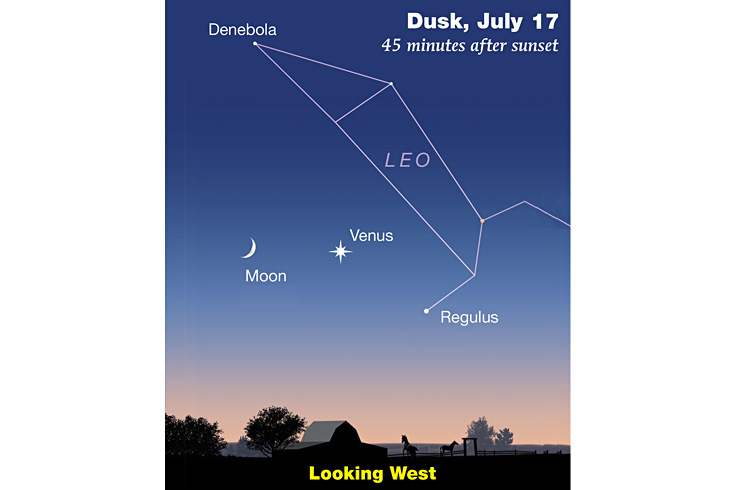
■ Now the crescent Moon, thicker and higher, hangs lower left of Venus as shown above (for North America). They're 6° or 7° apart.
■ Look east after dark this week for the constellation Leo climbing nicely up in the almost-spring sky. Its brightest star is Regulus. The Sickle of Leo, about a fist and a half long, extends upper left from there. It's shaped like a backward question mark.
A fist or so to the Sickle's lower left, Leo's rear quarters and tail form a long triangle.
SUNDAY, MARCH 2
■ February was Orion's month to stand at his highest in the south in early evening. Now March pushes him westward and spotlights his dog, Canis Major with Sirius on his chest, standing center stage on the meridian.
Sirius is not only the brightest star in our sky after the Sun, at a distance of 8.6 light-years it's also the closest naked-eye star after the Sun for those of us living at mid-northern latitudes.
Alpha Centauri is the actual closest star at 4.3 light-years, but you have to be farther south to see it. And in the northern sky three dim red-dwarf stars are closer to us than Sirius, but these require binoculars or a telescope.
MONDAY, MARCH 3
A Naked-Eye Venus Challenge this Week! Some people can resolve the crescent of Venus with their unaided eyes when it's as large and thin as it is now. Mere 20/20 vision probably isn't good enough; success may require 20/15, 20/12, 0r (very rare) 20/10 vision. Try early in twilight before the sky becomes too dark and Venus too glary. Look long and carefully and please report your results to Sky & Telescope's Bob King, [email protected].
You may improve your chances by sighting through a clean, round hole in a thick piece of paper about 1 mm, 2mm, or 3mm in diameter held right next to your eye (try them all). It will mask out optical aberrations that are common away from the center of your eye's cornea and lens. Try each eye.
One person who apparently succeeded was Edgar Allan Poe. An amateur astronomer since boyhood, he used a naked-eye sighting of Venus's crescent as the central event in his poem "Ulalume" (1847) near the end of his life. Before dawn, a bereaved lover roams a misty October woodland accompanied by "Psyche, my soul." Ahead of them low in the east, where the constellation Leo ascends before dawn in mid-autumn, they witness the new-risen Venus, star of romantic love in Roman mythology, coming "up through the lair of the Lion." Poe refers to the planet as Astarte — the wilder, more wanton Greek version of the Romans' Venus goddess:
And now, as the night was senescent,
And star-dials pointed to morn —
As the star-dials hinted of morn —
At the end of our path a liquescent
And nebulous lustre was born,
Out of which a miraculous crescent
Arose with a duplicate horn—
Astarte's bediamonded crescent
Distinct with its duplicate horn.
Poe contrasts its passionate brilliance to cooler, more composed Dian, the horned crescent Moon, and urges Psyche forward:
Let us on by this tremulous light!
Let us bathe in this crystalline light!
But Psyche, who knows better, is terrified, and this being Poe, it doesn't end well.
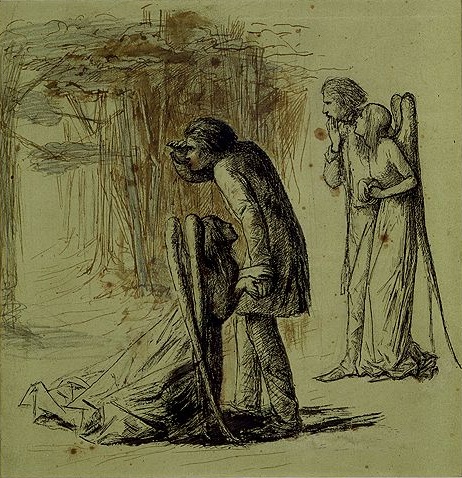
Poe wrote "Ulalume" in the fall of 1847. Before dawn on November 4, 1847, a crescent Venus and crescent Moon ("Dian") indeed hung near each other low in the east below Leo — in Poe's "lair of the Lion," the sky area from which the Leo figure stalks upward.
Astarte's bediamonded crescent was there a couple weeks earlier as well, during the mid- and late "lonesome October" of Poe's most immemorial year (his wife had died). Venus was then a larger, thinner, more easily resolvable crescent, though Dian at that time was away.
TUESDAY, MARCH 4
■ The thick crescent Moon shines lower right of the Pleiades, Jupiter, and Aldebaran this evening, as shown below.

WEDNESDAY, MARCH 5
■ Catch the almost-first-quarter Moon about 7° from Jupiter this evening, as shown in late twilight above.
THURSDAY, MARCH 6
■ First-quarter Moon (exactly so at 11:32 a.m. EST). That 2nd-magnitude star near the Moon this evening is Beta Tauri.
FRIDAY, MARCH 7
■ The Moon, just past first quarter, shines upper right of the Mars-Castor-Pollux triangle as the stars come out, as shown below. As evening progresses, the whole arrangement quickly rotates clockwise as it moves westward across the sky if you turn to keep facing it directly. Such rapid rotation always happens for patterns passing near the zenith. By as early as 8 p.m. the Moon will be directly right of Mars when you stand facing them.

SATURDAY, MARCH 8
■ The Moon horns in on the Mars-Castor-Pollux triangle this evening, as indicated above. Watch the Moon also change its separation with respect to background objects as the hours pass. The Moon travels eastward along its orbit by almost one Moon diameter per hour.
■ Daylight-saving time, observed in most of North America, begins at 2:00 a.m. Sunday morning. Clocks "spring ahead" an hour. Daylight time for North America runs from the second Sunday in March to the first Sunday in November. Daylight time is not used in Hawaii, Saskatchewan, Puerto Rico, or in most of Arizona.
SUNDAY, MARCH 9
■ It's not spring for a couple more weeks, but the Spring Star Arcturus seems eager to get rolling. It now rises above the east-northeast horizon around 9 p.m. daylight-saving time, depending on your location.
To see where to watch for Arcturus-rise, find the Big Dipper as soon as the stars come out; it's high in the northeast. Follow the curve of the Dipper's handle down and around to the lower right by a little more than a Dipper-length. That's the spot on the horizon to watch.
By 11 p.m. Arcturus quite dominates the eastern sky.
This Week's Planet Roundup
Mercury is having a fine apparition in the evening twilight all week! About 40 minutes after sunset, look for it low in the west down below bright Venus. They're closing fast. Mercury is 16° under Venus on February 28th, but only 7° to Venus's lower left by March 7th.
During that time Mercury loses half its brightness, fading from magnitude –1.0 to –0.3.
Venus (magnitude –4.7, in Pisces) is the bright "Evening Star" in the west during and after twilight. But it's getting lower day by day, and at an increasing pace. It sets about an hour after dark on February 28th and only a half hour after dark a week later.
In a telescope or good binoculars Venus displays a strikingly thin crescent — narrowing from 15% sunlit on February 28th to 8% by March 7th. And if you have unusually sharp or well-corrected vision, can you detect the crescent of Venus naked eye? See March 3rd above.
Venus is on its way to passing a wide 8.4° north of the Sun at inferior conjunction on March 22nd.
Mars (about magnitude –0.2, in central Gemini) comes into view in twilight as a steady orange spark very high toward the southeast. It continues to fade week by week as it shrinks into the distance. As darkness deepens, watch for fainter Pollux and Castor (magnitudes 1.1 and 1.6) to emerge left of it. The triangle the three make is gradually changing shape; its two long sides are no longer quite equal. Later in the evening the triangle turns around to become an upright V less high in the west.
For telescope users, Mars has shrunk to 11 or 10 arcseconds in diameter and is plainly a bit gibbous (93% sunlit). A map of Mars's major surface features is in the January Sky & Telescope, page 48, and in Bob King's Mars Extravaganza online. To find which side of Mars (i.e. which part of the map) will be facing you at the date and time you'll observe, use our Mars Profiler tool.
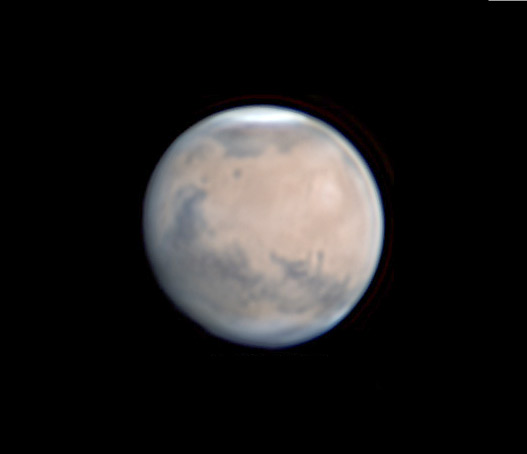
The brightness and contrast are adjusted here to mimic Mars's visual appearance in a very large telescope at very high power in perfect seeing. For a more realistic impression of Mars visually, step back several feet and squint a bit.
Jupiter shines bright white (magnitude –2.3) in Taurus, 35° west along the ecliptic from Mars. Jupiter dominates the high southwest after dusk near Aldebaran and the Pleiades. It still makes a nearly right triangle with them.
Later in the evening they move lower toward the west. Jupiter sets in the west-northwest around 1 a.m.
In a telescope Jupiter is about 39 arcseconds wide, noticeably smaller than at the beginning of the year. For timetables of the doings of its Galilean moons and the meridian transits of its Great Red Spot, see the March Sky & Telescope, page 50.

Saturn is lost in the sunset.
Uranus, magnitude 5.8 at the Taurus-Aries border, is still high toward the southwest right after dark, about 20° west of Jupiter along the ecliptic. You'll need a good finder chart to tell it from the similar-looking surrounding stars; see last November's Sky & Telescope, page 49.
Neptune is lost in the sunset.
All descriptions that relate to your horizon — including the words up, down, right, and left — are written for the world's mid-northern latitudes. Descriptions and graphics that also depend on longitude (mainly Moon positions) are for North America.
Eastern Standard Time (EST) is Universal Time minus 5 hours. Eastern Daylight Time (EDT) is UT minus 4 hours. UT is also known as UTC, GMT, or Z time.
Want to become a better astronomer? Learn your way around the constellations. They're the key to locating everything fainter and deeper to hunt with binoculars or a telescope.
This is an outdoor nature hobby. For a more detailed constellation guide covering the whole evening sky, use the big monthly map in the center of each issue of Sky & Telescope, the essential magazine of astronomy.
For the attitude every new amateur astronomer needs, read Jennifer Willis's Modest Expectations Give Rise to Delight.
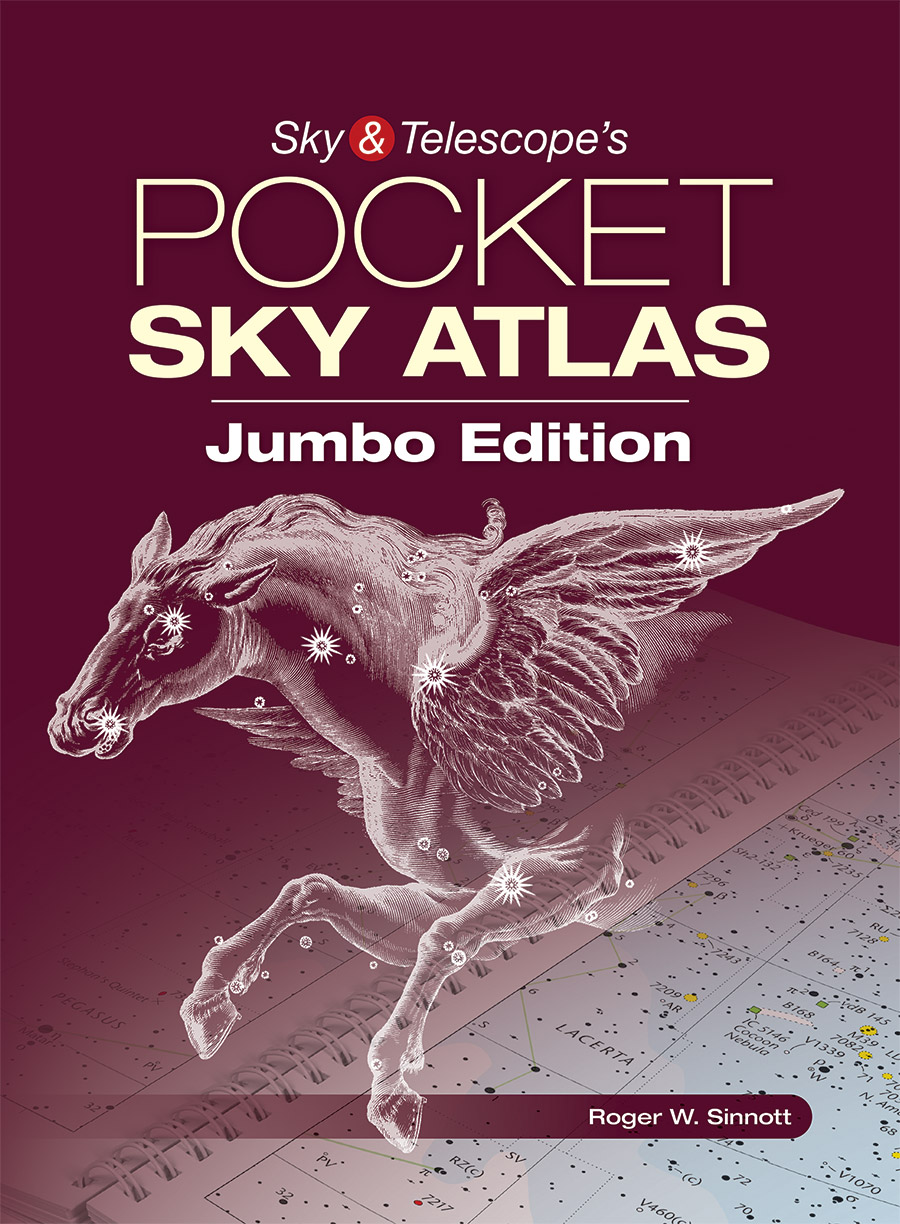
Once you get a telescope, to put it to good use you'll need a much more detailed, large-scale sky atlas (set of charts). The basic standard is the Pocket Sky Atlas, in either the original or Jumbo Edition. Both show all 30,000 stars to magnitude 7.6, and 1,500 deep-sky targets — star clusters, nebulae, and galaxies — to search out among them.
Next up is the larger and deeper Sky Atlas 2000.0, plotting stars to magnitude 8.5; nearly three times as many, as well as many more deep-sky objects. It's currently out of print, but maybe you can find one used.
The next up, once you know your way around well, are the even larger Interstellarum atlas (with 201,000+ stars to magnitude 9.5, and 14,000 deep-sky objects selected to be detectable by eye in large amateur telescopes), and Uranometria 2000.0 (332,000 stars to mag 9.75, and 10,300 deep-sky objects). And read How to Use a Star Chart with a Telescope. It applies just as much to charts on your phone or tablet as to charts on paper.
You'll also want a good deep-sky guidebook. A beloved old classic is the three-volume Burnham's Celestial Handbook. An impressive more modern one is the big Night Sky Observer's Guide set (2+ volumes) by Kepple and Sanner. The pinnacle for total astro-geeks is the new Annals of the Deep Sky series, currently at 11 volumes as it works its way forward through the constellations alphabetically. So far it's up to H.
Can computerized telescopes replace charts? Not for beginners I don't think, and not for scopes on mounts and tripods that are less than top-quality mechanically. Unless, that is, you prefer spending your time getting finicky technology to work rather than learning how to explore the sky. As Terence Dickinson and Alan Dyer say in their Backyard Astronomer's Guide, "A full appreciation of the universe cannot come without developing the skills to find things in the sky and understanding how the sky works. This knowledge comes only by spending time under the stars with star maps in hand and a curious mind." Without these, "the sky never becomes a friendly place."
If you do get a computerized scope, make sure that its drives can be disengaged so you can swing it around and point it readily by hand when you want to, rather than only slowly by the electric motors (which eat batteries).
However, finding faint telescopic objects the old-fashioned way with charts isn't simple either. Do learn the essential tricks at How to Use a Star Chart with a Telescope.
 Audio sky tour. Out under the evening sky with your
earbuds in place, listen to Kelly Beatty's monthly
podcast tour of the naked-eye heavens above. It's free.
"The dangers of not thinking clearly are much greater now than ever before. It's not that there's something new in our way of thinking, it's that credulous and confused thinking can be much more lethal in ways it was never before."
— Carl Sagan, 1996
"Facts are stubborn things; and whatever may be our wishes, our inclinations, or the dictates of our passion, they cannot alter the state of facts and evidence."
— John Adams, 1770
About Alan MacRobert
Alan M. MacRobert became an avid Sky & Telescope subscriber in 1966 at age 14, joined the editorial staff in 1982, and is now a senior contributing editor, semi-retired. He played a role in practically every part of the magazine and the company's other products for more than a generation, both on the amateur-observing side and the science-reporting side. In 1994 a book collection of his observing how-tos and telescopic sky tours was published as Star Hopping for Backyard Astronomers. He has produced This Week's Sky at a Glance online every week since 1989.




Comments
Rod
March 3, 2025 at 7:28 pm
I did get out and enjoy some time under the heavens this evening. 1745-1900 EST. Sunset tonight near 1802 EST. First Quarter Moon 06-March-2025 1632 UT. Lovely sky tonight with temp 1C. I viewed the waxing crescent Moon and thin crescent Venus this evening. 90-mm refractor telescope with 14-mm TeleVue Delos eyepiece. 71x views tonight. Much earthshine visible on the Moon, excellent crater relief along the terminator line and Mare Crisium, a variety of smaller craters visible inside. Venus very close to 51 arcsecond angular size tonight according to Stellarium 24.4. Easy to see thin crescent Venus, brilliant in the field of view at 71x. I did more log splitting earlier this morning and tonight, some telescope time outdoors. Wood burning stove is running 🙂
You must be logged in to post a comment.
Martian-Bachelor
March 4, 2025 at 4:56 pm
Of the 5 or 6 times I've seen Mercury this had to be the easiest, Friday evening, thanks to the crescent moon right below. And I didn't even have a particularly good horizon.
You must be logged in to post a comment.
Rod
March 4, 2025 at 11:38 pm
Very good Martian-Bachelor on seeing Mercury. When I was viewing Venus with my telescope on 03-March near 1830 EST, Mercury was about 10 degrees above the W horizon but not visible where I was standing. A line of trees blocked the view but the waxing crescent Moon and thin crescent Venus were lovely to see.
You must be logged in to post a comment.
misha17
March 5, 2025 at 11:39 pm
Re: "THURSDAY, MARCH 6
■ First-quarter Moon (exactly so at 11:32 a.m. EST). That 2nd-magnitude star near the Moon this evening is Beta Tauri." -
The Moon will occult Beta Tauri, aka "El Nath", under night time skies along a path from Southern California (as far north as Lompoc), Mexico, Central America, ending at moonset in northwestern Colombia.
(The path includes the Hawaiian Islands, but it is a daytime event there, occurring in the late afternoon).
Path and timings for selected cities:
http://www.lunar-occultations.com/iota/bstar/0307zc810.htm
For viewers in Los Angeles, the star disappears along the top of the dark limb at 8:40pm local time
(just after the instance of First Quarter phase),
and reappears along the top of the bright limb 17 minutes later.
You must be logged in to post a comment.
misha17
March 6, 2025 at 1:56 am
El Nath is so far above the Ecliptic that occultations are not visible at latitudes above about 50 degrees North.
The high point of the Moon's orbit will pass by the star's Celestial Longitude later this year; after that, occultation paths will move further south each month until the series ends with an occultation visible west of Australia in March 2027.
There will be one more occultation in the series visible from the U.S. later this year on the morning of September. 14th.
It will be visible from San Diego CA, southern AZ, southern NM, and southern TX (in pre-dawn twilight).
Map and timings:
http://www.lunar-occultations.com/iota/bstar/0914zc810.htm
The path continues across the southern U.S., but it occurs there in the morning skies after sunrise.
You must be logged in to post a comment.
You must be logged in to post a comment.