 SUNSET:

 2
2
FRIDAY, MARCH 28
■ If you're in the northeastern US or eastern Canada, find those old eclipse glasses, and/or mount a safe solar filter on the front of your scope, and set an alarm for tomorrow morning's sunrise partial solar eclipse! You'll need to have scouted out an observing site with a view down to the east horizon. Europe and northwest Africa have it easier, with the partially eclipsed Sun high in the sky during the day. See the next entry.

NASA/Aubrey Gemignani
SATURDAY, MARCH 29
■ A partial eclipse of the Sun happens for northeastern North America, Greenland, Iceland, and most of Europe. For most the northeastern US and the Canadian Maritimes, the eclipse will already be under way at sunrise. Use Xavier Jubier's interactive map to find your own exact times, the maximum obscuration and magnitude of the eclipse at your location, the Sun's altitude, and other circumstances. Times are given in Universal Time (which is four hours ahead of Eastern Daylight Time).
For instance: At New York City the eclipse is already diminishing when the Sun rises at 6:44 a.m. EDT, with 27% of its surface being obscured at that time. The last trace of the eclipse ends 21 minutes later when the Sun is still a mere 3° above the east horizon. So be on a high rooftop or a shoreline with a flat eastern view.
Boston has it better. The Sun is 57% obscured when it rises at 6:32 a.m. EDT, and it attains 6° altitude by the time the last of the partial eclipse slips away at 7:08 a.m.
At Halifax, maximum eclipse comes 16 minutes after sunrise, with the Moon then covering 85% of the Sun's surface and the Sun just 2° up.
Also see Bob King's article Sunrise Solar Eclipse on March 29th for Eastern North America, with timetable.

The green lines show when maximum eclipse will occur, if this happens with the Sun above the horizon. Times are in UTC, Coordinated Universal Time (a.k.a. UT). Eastern Daylight Time (EDT) is 4 hours behind UTC, so 10:30 UTC is 6:30 a.m. EDT.
The brown loops are sunrise and sunset lines. The western half of the loop crossing North America shows where the partial eclipse ends at sunrise; none of the eclipse can be seen there and farther west. The eastern half of the loop is where the eclipse begins at sunrise.
The blue line down the center of the brown loop is where maximum eclipse occurs at sunrise.
NASA Scientific Visualization Studio
SUNDAY, MARCH 30
■ Mars is passing 4° south of Pollux. This evening Mars is also passing just ½° south of Kappa Geminorum, magnitude 3.6, one of the outstretched hands of the Pollux stick figure. Kappa Gem is a delicate telescopic double star, with a much fainter companion, magnitude 8.2, glimmering 7 arcseconds to the celestial west-southwest. Kappa A is an orange giant, and Kappa B is a rather Sunlike main-sequence star of spectral type G4. Use high power for it: the same eyepiece you just used for Mars.
■ Another telescopic project is right nearby: Just 3½° southeast of Kappa Gem is the famous repeating nova U Geminorum. See Bob King's article and charts at T CrB Not the Only Star Ready to Blow; Meet U Gem.
MONDAY, MARCH 31
■ The two biggest open clusters in the starry sky are the Hyades behind Aldebaran, now descending in the west, and the Coma Berenices Star Cluster, wheeling up the spring sky in the east. The Coma Star Cluster appears about the size of a ping-pong ball held at arm's length. But it's very sparse and dim.
Do you know where to find it? Here's the trick: Look 40% of the way from Denebola, the tail star of Leo, to Alkaid, the end of the Big Dipper's handle and the tail of Ursa Major. Tail of the Lion to tail of the Bear.
In a really dark sky the Coma Star Cluster is a definite dim glow, with its brightest specks (5th and 6th magnitude) forming an upside-down Y. Through poorer skies, it just about fills a binocular's view with somewhat more stars than usual. The swarm is 280 light-years away, about twice as far as the Hyades.
■ Speaking of Leo, have you checked out the telescopic Leo Triplet? Three spiral galaxies, magnitudes 9 to 10, fit into a 1° eyepiece view in the hind leg of Leo. Two are Messier objects to add to your life list. See Ken Hewett-White's Suburban Stargazer article, finder chart, and pix in the March Sky & Telescope, page 55.
TUESDAY, APRIL 1
■ Every springtime we get lovely pairings of the Pleiades and the crescent Moon in the west in late twilight. This month's happens tonight. For North Americans the Pleiades will be just 2° or 3° under the Moon. That's a finger-width or two at arm's length. Think photo opportunity.
WEDNESDAY, APRIL 2
■ Now the evening Moon pairs with Jupiter. They're about 5° apart for North America. Aldebaran, the Hyades, and the Pleiades shine below them.
THURSDAY, APRIL 3
■ Tonight the Moon forms a roughly equilateral triangle with Beta and Zeta Tauri below it: the horn tips of Taurus.
FRIDAY, APRIL 4
■ The first-quarter Moon this evening shines under Castor, Pollux, and Mars. The view below is for late twilight as the stars come out (for North America). As the night progresses and the sky turns westward, the arrangement will rotate clockwise as you turn to keep facing it — quickly at first, then more slowly. (Extra credit: Why? Answer is in footnote 1 at the bottom of this page.)

SATURDAY, APRIL 5
■ Now it's the turn of Mars to pair with the Moon, as shown above. They're 3° or 4° apart for the Americas.
SUNDAY, APRIL 6
■ The Big Dipper is high in the northeast these evenings, tipping over to the left dumping its water. Its handle and the two stars of its bowl closest to the handle form a broad, rough arc. To the right of it, somewhat near the focus of that arc, shines a lone 3rd-magnitude star. That's Cor Caroli, the brightest star of Canes Venatici. It's beautiful telescopic double, magnitudes 2.9 and 5.6, separation 19 arcseconds. They're spectral types A0 and F2, respectively.
Also in CVn is one of the brightest deep-red carbon stars in the sky. Y Canum Venaticorum, also known as La Superba, varies between magnitudes 4.6 and 5.9. Currently it's visual mag 5.3. Matt Wedel calls it "arguably the finest carbon star for binocular users" in his Binocular Highlight column in the April Sky & Telescope, page 43. Carbon stars like this are so red because we see them through a red filter: an atmosphere rich in diatomic carbon molecules, C2.
This Week's Planet Roundup
Mercury is out of sight in the glare of the Sun.
Venus, having passed its March 22nd inferior conjunction, is now emerging into dawn view. Look for it very low due east starting about 30 minutes before sunrise. It's a bright magnitude –4.3 or so, but binoculars will help. Look for it if you get to your eastern-view site early on eclipse morning!

Venus gets higher, brighter, and easier every day. It's again in its dramatic thin-crescent phase in a telescope or steadily braced binoculars. Post-conjunction, the bulge of the crescent now faces lower left toward the Sun. This may look odd if you've gotten used to Venus's opposite look when it was an evening crescent after sunset.
Mars (about magnitude +0.4, near the heads of Gemini) comes into view evening twilight as a steady yellow-orange spark very high toward the south, almost overhead. It continues to fade as it shrinks into the distance, looking ever more like its neighbors Pollux and Castor (magnitudes 1.1 and 1.6, respectively.) The three dots form an arc that gradually straightens out day by day. They'll form a straight line on April 10th.
For telescope users, Mars has shrunk to 8 arcseconds in diameter. It's plainly gibbous, 90% sunlit.

Jupiter shines bright white (magnitude –2.1) high in the west these evenings, in Taurus 38° lower right of Mars along the ecliptic. This week Jupiter shines midway between Aldebaran below it and Beta Tauri (El Nath) above it. This line of three turns straight on April 1st and 2nd.
Farther to Jupiter's lower right you'll find the Pleiades.
Jupiter sinks as evening grows late. It sets in the west-northwest around midnight or 1 a.m. daylight-saving time.
In a telescope Jupiter has shrunk to 36 arcseconds wide, small for Jupiter, as Earth pulls far ahead of it in our faster orbit around the Sun. For the daily doings of its Galilean moons see the March Sky & Telescope, page 51.

Saturn and Neptune are hidden behind the glare of the Sun.
Uranus, magnitude 5.8 on the Taurus-Aries border, is getting low in the west right after dark, 7° below the Pleiades. You'll need a good finder chart to tell it from its similar-looking surrounding stars; see last November's Sky & Telescope, page 49.
All descriptions that relate to your horizon — including the words up, down, right, and left — are written for the world's mid-northern latitudes. Descriptions and graphics that also depend on longitude (mainly Moon positions) are for North America.
Eastern Daylight Time (EDT) is Universal Time minus 4 hours. UT is also known as UTC, GMT, or Z time.
Want to become a better astronomer? Learn your way around the constellations. They're the key to locating everything fainter and deeper to hunt with binoculars or a telescope.
This is an outdoor nature hobby. For a more detailed constellation guide covering the whole evening sky, use the big monthly map in the center of each issue of Sky & Telescope, the essential magazine of astronomy.
For the attitude every new amateur astronomer needs, read Jennifer Willis's Modest Expectations Give Rise to Delight.
Once you get a telescope, to put it to good use you'll need a much more detailed, large-scale sky atlas (set of charts). The basic standard is the Pocket Sky Atlas, in either the original or Jumbo Edition. Both show all 30,000 stars to magnitude 7.6, and 1,500 deep-sky targets — star clusters, nebulae, and galaxies — to search out among them.
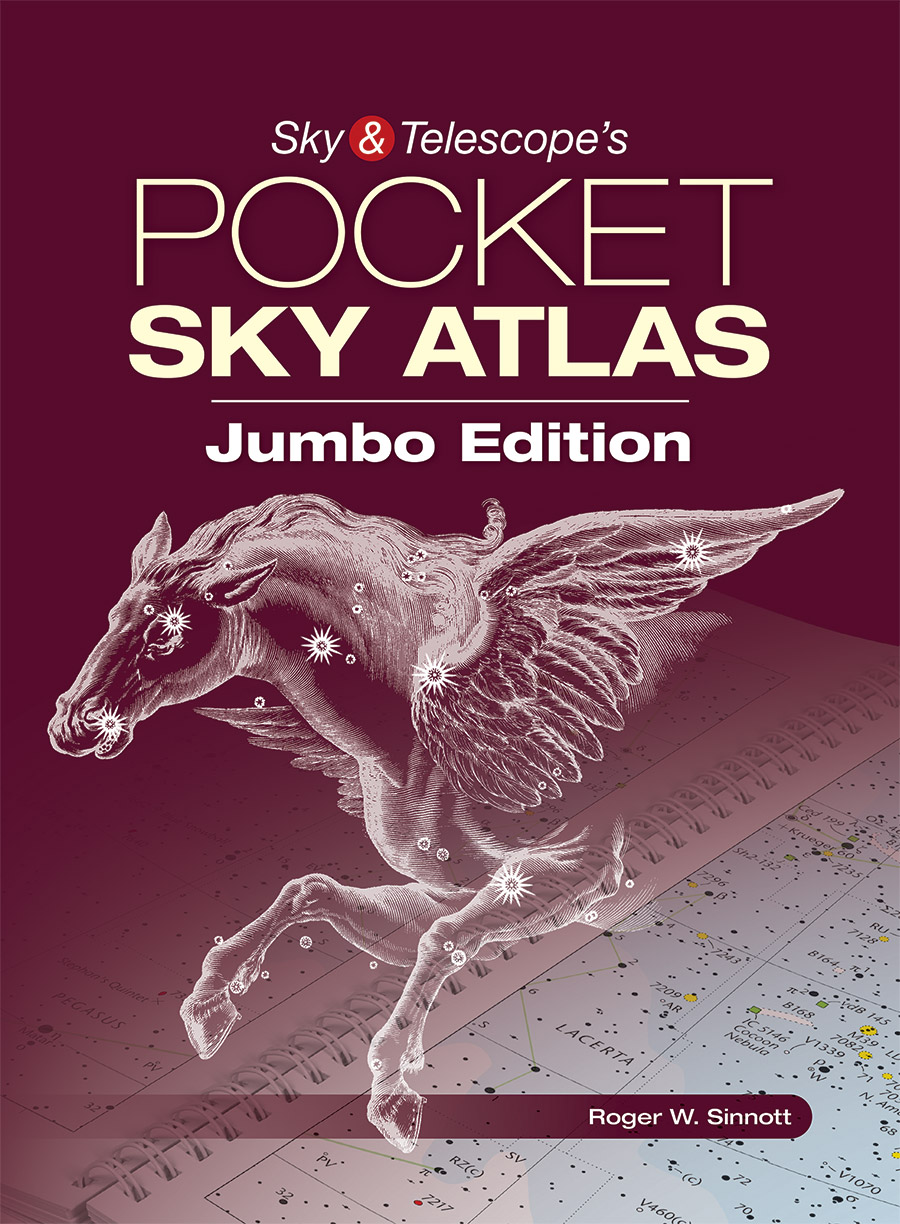
Next up is the larger and deeper Sky Atlas 2000.0, plotting stars to magnitude 8.5; nearly three times as many, as well as many more deep-sky objects. It's currently out of print, but maybe you can find one used.
The next up, once you know your way around well, are the even larger Interstellarum atlas (with 201,000+ stars to magnitude 9.5, and 14,000 deep-sky objects selected to be detectable by eye in large amateur telescopes), and Uranometria 2000.0 (332,000 stars to mag 9.75, and 10,300 deep-sky objects). And read How to Use a Star Chart with a Telescope. It applies just as much to charts on your phone or tablet as to charts on paper.
You'll also want a good deep-sky guidebook. A beloved old classic is the three-volume Burnham's Celestial Handbook. An impressive more modern one is the big Night Sky Observer's Guide set (2+ volumes) by Kepple and Sanner. The pinnacle for total astro-geeks is the new Annals of the Deep Sky series, currently at 11 volumes as it works its way forward through the constellations alphabetically. So far it's up to H.
Can computerized telescopes replace charts? Not for beginners I don't think, and not for scopes on mounts and tripods that are less than top-quality mechanically. Unless, that is, you prefer spending your time getting finicky technology to work rather than learning how to explore the sky. As Terence Dickinson and Alan Dyer say in their Backyard Astronomer's Guide, "A full appreciation of the universe cannot come without developing the skills to find things in the sky and understanding how the sky works. This knowledge comes only by spending time under the stars with star maps in hand and a curious mind." Without these, "the sky never becomes a friendly place."
If you do get a computerized scope, make sure that its drives can be disengaged so you can swing it around and point it readily by hand when you want to, rather than only slowly by the electric motors (which eat batteries).
However, finding faint telescopic objects the old-fashioned way with charts isn't simple either. Do learn the essential tricks at How to Use a Star Chart with a Telescope.
 Audio sky tour. Out under the evening sky with your
earbuds in place, listen to Kelly Beatty's monthly
podcast tour of the naked-eye heavens above. It's free.
"The dangers of not thinking clearly are much greater now than ever before. It's not that there's something new in our way of thinking, it's that credulous and confused thinking can be much more lethal in ways it was never before."
— Carl Sagan, 1996
"Facts are stubborn things; and whatever may be our wishes, our inclinations, or the dictates of our passion, they cannot alter the state of facts and evidence."
— John Adams, 1770
1. Why do constellations appear to twist fast near the zenith and slower when they're lower? Because when a celestial object passes near the zenith, you have to turn faster to keep facing it.
Or to put it another way, the direction down from a sky object (that is, the direction away from the zenith point) changes a lot when the object moves sideways even a little near the zenith.
There are subtleties here. In ordinary life we think of sky objects in alt-azimuth coordinates: up-down and side-to-side. These are set by our up-down gravity and our side-to-side horizon.
The sky, however, rotates according to the celestial coordinate system, which is tilted with respect to our alt-azimuth worldview. This means that if a celestial object passes near the zenith — the pole of the alt-azimuth system — it changes azimuth (compass direction) quickly. So you have to turn yourself faster to keep facing it.
This would not happen if you turned yourself from celestial east to west instead, as you would if you lashed yourself lengthwise to a diagonal rotating stake aimed at the north celestial pole like the polar axis of an equatorial mount. If you did that and watched a constellation move for hours, slowly turning the stake to keep the constellation in front of you, it would not appear to rotate with respect to your head-to-foot axis at all.2
P.S. That zenith-twist effect is stronger the closer you live to Earth's equator. At the equator itself, a constellation that crosses the zenith rises straight up due east, goes straight down due west, and flips 180° when it crosses the zenith and you turn around 180°.
Seen from Earth's poles, the constellations just circle around you without changing altitude at all.
2. I once met someone who actually did something like that and took it to an extreme. Years ago an affable local man came to the Sky & Telescope office in Cambridge, Mass., looking for some obscure information. He visited several times and wouldn't take a hint that we were busy. It turned out he believed that he had found evidence in his religion's holy book of how he could unwind all the tangled messes of this world and set everything right. In his apartment he had built a rotating chair centered on a tilted axis aimed at the north celestial pole. He had pictures. He would sit strapped in the chair as it spun opposite the rotation of the Earth. He believed that if just one person did this and unwound all of Earth's daily rotation back to the date of Creation, the world would reset itself as good as new. He posted stickers for his website on utility poles.
About Alan MacRobert
Alan M. MacRobert became an avid Sky & Telescope subscriber in 1966 at age 14, joined the editorial staff in 1982, and is now a senior contributing editor, semi-retired. He played a role in practically every part of the magazine and the company's other products for more than a generation, both on the amateur-observing side and the science-reporting side. In 1994 a book collection of his observing how-tos and telescopic sky tours was published as Star Hopping for Backyard Astronomers. He has produced This Week's Sky at a Glance online every week since 1989.



Comments
misha17
March 28, 2025 at 9:57 pm
Re: March 29th:
"Venus, having passed its March 22nd inferior conjunction, is now emerging into dawn view. Look for it very low due east starting about 30 minutes before sunrise. It's a bright magnitude –4.3 or so, but binoculars will help. Look for it if you get to your eastern-view site early on eclipse morning!"
Eclipse viewers in Maine and the Canadian Maritimes, where more than 80% of the Sun will be obscured, might be able to track Venus from the pre-dawn skies, through the darker-than-usual skies just before sunrise (where the Sun is already deeply eclipsed but has not risen above the horizon yet), into the post-dawn sky, where the eclipsed Sun and the thicker layers of atmosphere near the horizon will continue to keep the sky around the Sun darker than usual.
Venus will be about a fist width (held at arms length) to the left of the Sun. Additionally, you can use landmarks along the horizon near Venus to help locate planet after sunrise.
For viewers farther South, how long could you track Venus, and how deep was the eclipse in your viewing area?
You must be logged in to post a comment.
Rod
April 1, 2025 at 9:25 pm
Tonight was some sky to view! I observed 1900-2045 EDT. Sunset 1930-1931 EDT, First Quarter Moon 05-April-2025 0215 UT. Clear skies with 10C temperature. Excellent views of the waxing crescent Moon with M45 in Taurus, Jupiter in Taurus. At Jupiter, Europa and Ganymede about 6 arcsecond angular separation (according to Stellarium 25.1), distinct separation at 71x. Cloud bands on Jupiter visible and M42 splendid view in Orion as I say goodbye to star clusters of winter. I used TeleVue 40-mm for 25x and about 1.8-degree true FOV for the Moon and M45 together. At Jupiter and M42 in Orion, I used TeleVue 14-mm Delos for 71x views, about 1-degree true FOV. Near 1937 EDT, some brighter stars of M45 became visible along with the waxing crescent Moon in the field of view at 25x. Later after 2000 EDT, the view was beautiful, a great photo opportunity. Using my 10x50 binoculars I could see M45 and the Moon together, much earthshine visible on the Moon. Mare Crisium along with many smaller craters along the terminator line visible. Mare Crisium is featured in my total lunar eclipse notes of 14-March, Blue Ghost lander there taking pictures of Earth causing a total solar eclipse as seen from the Moon. Using my 90-mm refractor telescope at 25x, more detail on the Moon along the terminator line visible but the 10x50 binocular view was great too. It was a very lovely time outdoors this evening as sunset approached and the evening progressed. Stunning sky tonight. Waxing crescent Moon and M45 about 1.5 degrees or so apart in W sky.
You must be logged in to post a comment.
You must be logged in to post a comment.