 SUNSET:

 2
2
FRIDAY, MAY 9
■ Three zero-magnitude stars shine after dark in May: Arcturus high in the southeast, Vega much lower in the northeast, and Capella low in the northwest. They look so bright because each is at least 60 times as luminous as the Sun and because they're all relatively nearby: 37, 25, and 42 light-years from us, respectively.
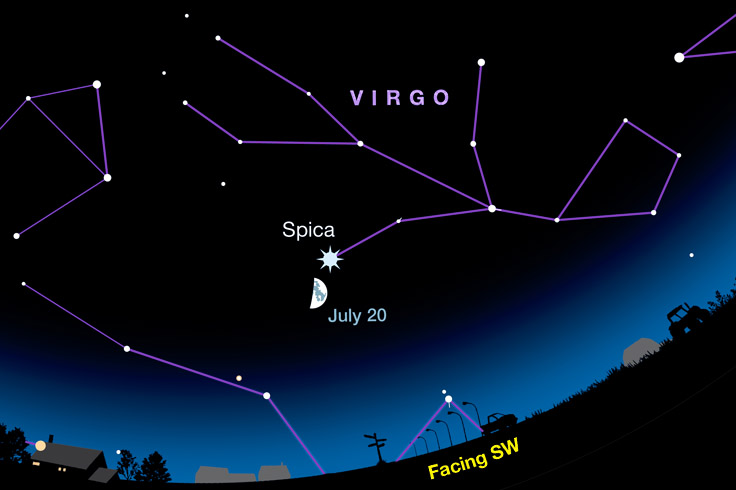
■ Spica, one magnitude fainter than Arcturus, shines a couple degrees lower left of the Moon this evening as shown below. But the moonlight in the sky, and the Moon's glare in your own eyes, will make Spica look fainter than that!

SATURDAY, MAY 10
■ Now Spica shines about 10° upper right of the bright evening Moon, as shown above.
SUNDAY, MAY 11
■ What is the oldest thing you have ever seen? For everyone in the world it's at least the Sun and other objects of the solar system, age 4.6 billion years. (Virtually everything on or a little way under Earth's surface is much younger.)
Next is Arcturus, which most people have surely seen whether they know it or not, since it's one of the brightest stars in the sky. It's a Population II orange giant, age about 7 billion years, just passing through our region of the Milky Way.
Amateur astronomers have globular clusters. Most are older still, at least in part. White dwarfs in familiar M4 in Scorpius have dated it (or at least some population of it) at 12.7 ±0.7 billion years old.
But individual stars that you can observe nearby? For that you want Bob King's article In Search of Ancient Suns with its finder charts. Assigning dates to individual stars from the first eras after the Big Bang is still iffy; astronomers have to work from the near-absence of heavy elements in their spectra. But a 6th-magnitude star in Boötes and a 7th-magnitude star in Libra, both in binocular range, await you these May and June nights. They probably date from about 12½ billion and at least 13 billion years ago, respectively. These will probably be the oldest things you have ever seen or ever will. The Big Bang itself is well dated at 13.8 billion years.
One could pick nits. Pick a proton, any proton right in front of you. That assemblage of three quarks has very likely remained intact since the Big Bang's first millionth of a second. And what a history it has had since then!
MONDAY, MAY 12
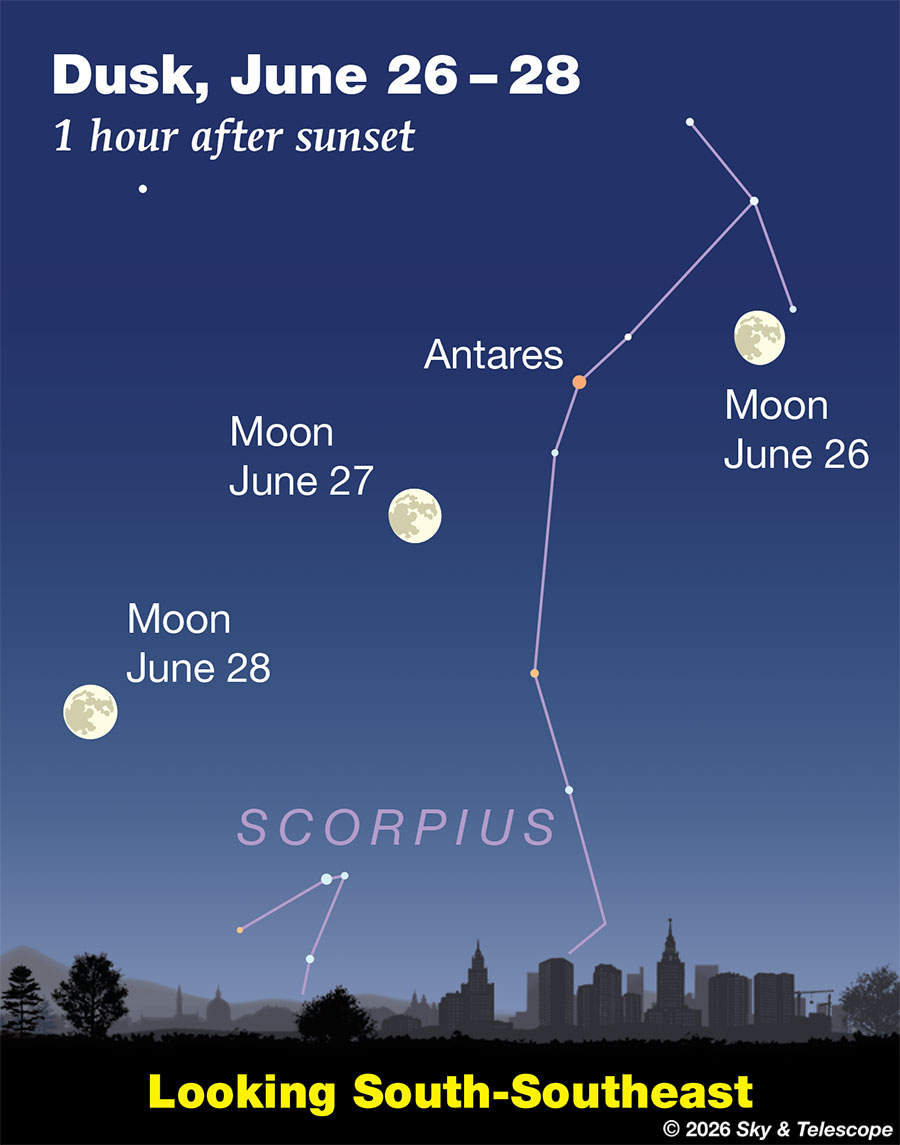
■ Full Moon this evening (it's exactly full at 12:56 p.m. EDT today). The Moon rises in the southeast about a half hour after sunset. Once it's well up and the night is dark, spot orange Antares and the other, whiter stars of upper Scorpius to the Moon's lower left.
TUESDAY, MAY 13
■ The Moon, nearly a day past full, rises around the end of nightfall closely accompanied now by Antares. As they climb higher and cross the sky through the night, watch them draw farther apart as the Moon moves eastward along its orbit.
The other stars of upper Scorpius also lie in the Moon's background. Cover the glary Moon with your fingertip to help see them.
WEDNESDAY, MAY 14
■ A gigantic asterism you may not know about is the Great Diamond, some 50° tall and extending over five constellations. It now stands upright in the southeast to south after dusk.
Start with Spica, its bottom. Upper left from Spica is bright Arcturus. Almost as far upper right from Arcturus is fainter Cor Caroli, 3rd magnitude. The same distance lower right from there is Denebola, the 2nd-magnitude tailtip of Leo. And then back to Spica.
The bottom three of these stars, the brightest, form a nearly perfect equilateral triangle. This has been called the Spring Triangle to parallel to those of summer and winter.
THURSDAY, MAY 15
■ Jupiter's 2024-25 apparition is finally drawing toward its close. Jupiter is the "False Evening Star" shining at a bright magnitude –2.0 low in the west-northwest during and after dusk.
But this evening Jupiter performs a noteworthy naked-eye act on its way out. It forms an exact straight line with Taurus's two horntip stars: Beta Tauri to its upper right and fainter Zeta Tauri closer to its lower left (magnitudes 1.6 and 3.o).
FRIDAY, MAY 16
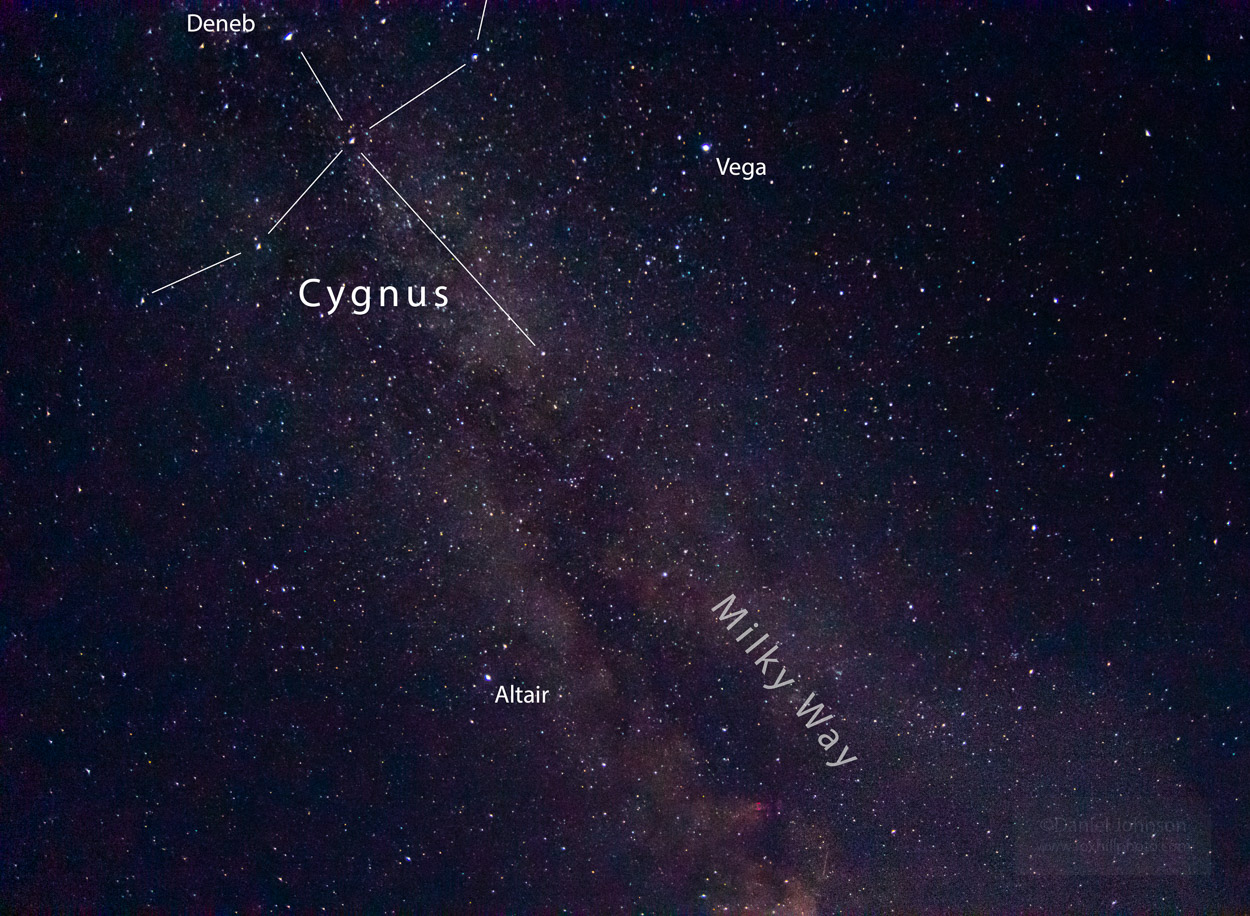
■ Vega is the brightest star in the east-northeast after dark. Look 15° (about a fist and a half at arm's length) upper left of Vega for Eltanin, the 2nd-magnitude nose of Draco the Dragon. Closer above and upper left of Eltanin are the three fainter stars that form the rest of Draco's stick-figure head, also called the Lozenge. Draco always points his nose to Vega, no matter how he's oriented. Dragons do have a thing for jewels.
The faintest star of Draco's head, opposite Eltanin, is Nu Draconis. It's a fine, equal-brightness double star for binoculars (separation 61 arcseconds, both magnitude 4.9). The pair is 99 light-years away. Both are hot, chemically peculiar type-Am stars somewhat larger, hotter, and more massive than the Sun.
■ The brightest asteroid, 4 Vesta, is nicely placed now in a moonless dark sky in late evening. It's two weeks past opposition and still magnitude 5.9. It's some 24° below Arcturus, near the Virgo-Libra border about 9° and 10° above Beta and Alpha Librae, respectively. You'll need the finder chart with Bob King's article Asteroid Vesta Now an Easy Catch in Binoculars.
If you have a really dark sky, can you detect Vesta now with the unaided eye? It's pretty much the only naked-eye dwarf planet, and only near its opposition.
SATURDAY, MAY 17
■ And as Vega climbs higher in the evening, its little constellation Lyra, the Lyre, becomes easier to recognize. Lyra's main pattern hangs down from Vega with its bottom canted to the right. Look for a little equilateral triangle with Vega as its top corner, and a longer parallelogram attached to the triangle's bottom corner.
SUNDAY, MAY 18
■ This is the time of year when Leo the Lion starts walking downward toward the west, on his way to departing into the sunset in early summer. Right after dark, spot the brightest star fairly high in the west-southwest. That's Regulus, his forefoot.
Regulus is also the bottom of the Sickle of Leo: a backward question mark about a fist and a half tall that outlines the lion's forefoot, chest, and mane.
This Week's Planet Roundup
Mercury is lost in the glow of sunrise.
Venus and Saturn inhabit the eastern dawn. They both rise around the very first glimmer of morning twilight, nearly two hours before sunrise. But Venus, magnitude –4.7, shines 230 times brighter than Saturn! Which is a weak magnitude +1.2.
Binoculars will help locate Saturn 8° to the right or upper right of Venus on the morning of May 10th, widening to 12° upper right of Saturn by the 17th.
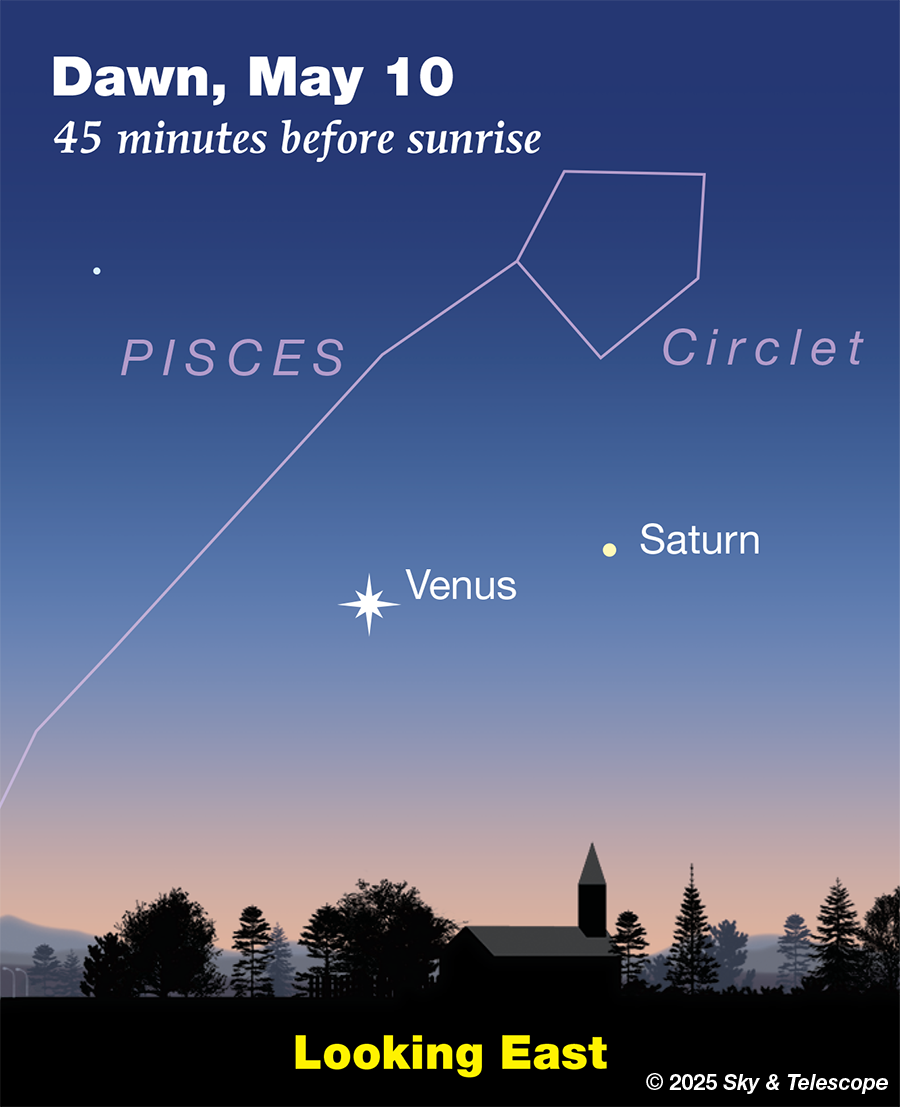
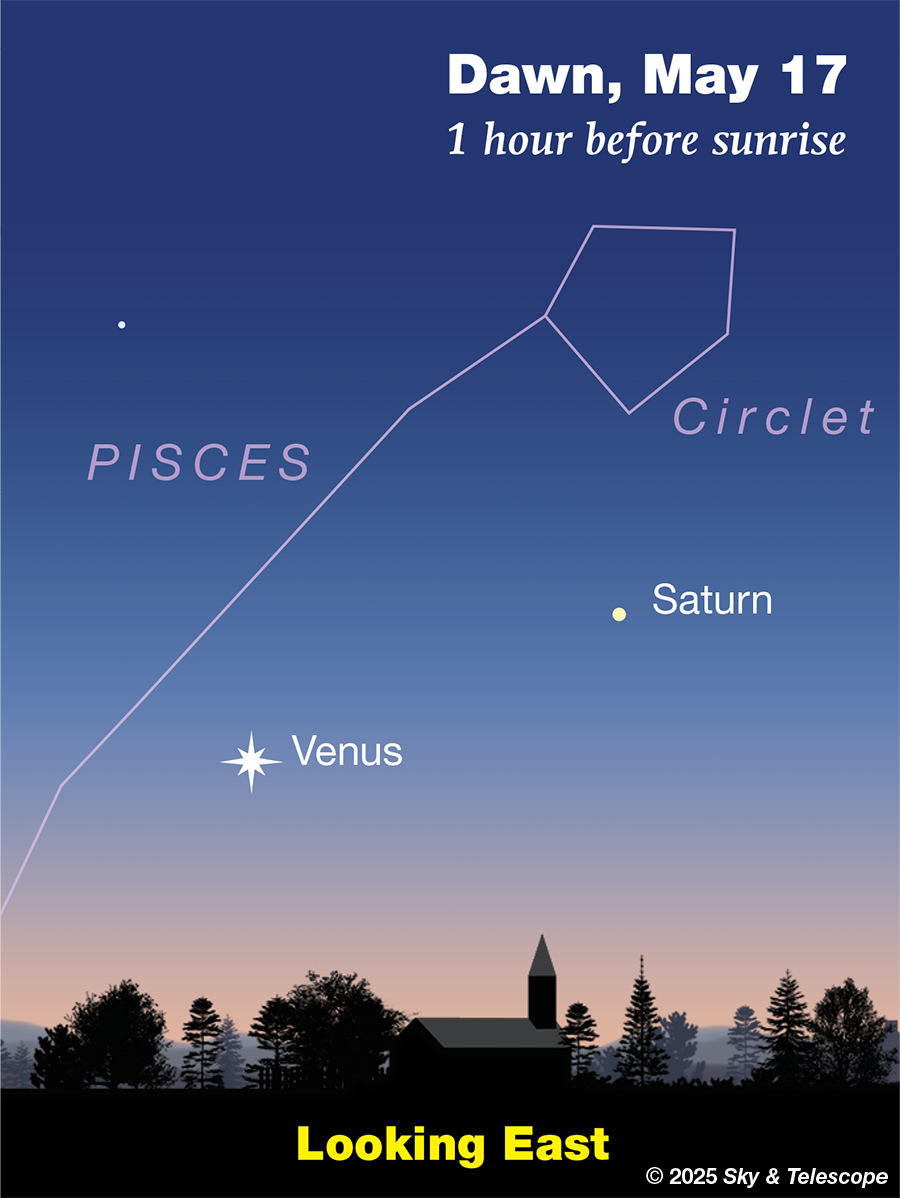
How different they look in a telescope! Venus is a dazzling thick crescent about 37% sunlit. Saturn is a vastly dimmer little ball with only 1/250 of Venus's surface brightness. That's mostly because Saturn is 13 times farther from the illuminating Sun than Venus is, and partly because Venus has an albedo of 65% compared to Saturn's 47%. (Albedo is how much of the incoming light an object reflects.)
Both will be blurred and shimmery in a telescope in the low-altitude seeing. So you may see nothing of Saturn's rings, which are turned nearly edge-on to us this year. Look for traces of a hairline needle stuck diagonally (celestial east-west) through Saturn's globe. That's them.
Mars (magnitude +1.1, in Cancer) glows high in the southwest in the evening. It's the orange dot about 1½ or 2 fist-widths upper left of Pollux and Castor, which are similar to it at magnitudes +1.1 and +1.6, respectively.
Now that Mars and Pollux are the same brightness, it's an ideal time to compare their colors. Mars is more strongly tinted than pale yellow-orange Pollux, a type G8 giant star. Farther below Mars shines Procyon, magnitude +0.4.
Mars continues to recede into the distance as Earth pulls ahead of it in our faster orbit around the Sun. In a telescope Mars is now only 6 arcseconds in diameter, a fuzzy blob. Maybe you can detect that it's slightly gibbous, 90% sunlit.
Jupiter (magnitude –2.0, in Taurus) shines low in the west during and shortly after dusk, setting less than an hour after the end of twilight. It's between Taurus's two horntip stars, Beta Tauri to its upper right and fainter Zeta Tauri closer to its lower left (magnitudes 1.6 and 3.o). The three become a perfect straight line on May 15th.
Don't expect a decent telescopic view. Jupiter has shrunk to only 33 arcseconds wide, as small as it gets, and it will be badly blurred by the low-altitude seeing.
Uranus is hidden in conjunction with the Sun.
Neptune, a mere 8th magnitude, lurks hidden in the dawn in the background of Saturn.
All descriptions that relate to your horizon — including the words up, down, right, and left — are written for the world's mid-northern latitudes. Descriptions and graphics that also depend on longitude (mainly Moon positions) are for North America.
Eastern Daylight Time (EDT) is Universal Time minus 4 hours. UT is also known as UTC, GMT, or Z time.
Want to become a better astronomer? Learn your way around the constellations. They're the key to locating everything fainter and deeper to hunt with binoculars or a telescope.
This is an outdoor nature hobby. For a more detailed constellation guide covering the whole evening sky, use the big monthly map in the center of each issue of Sky & Telescope, the essential magazine of astronomy.
For the attitude every amateur astronomer needs, read Jennifer Willis's Modest Expectations Give Rise to Delight.
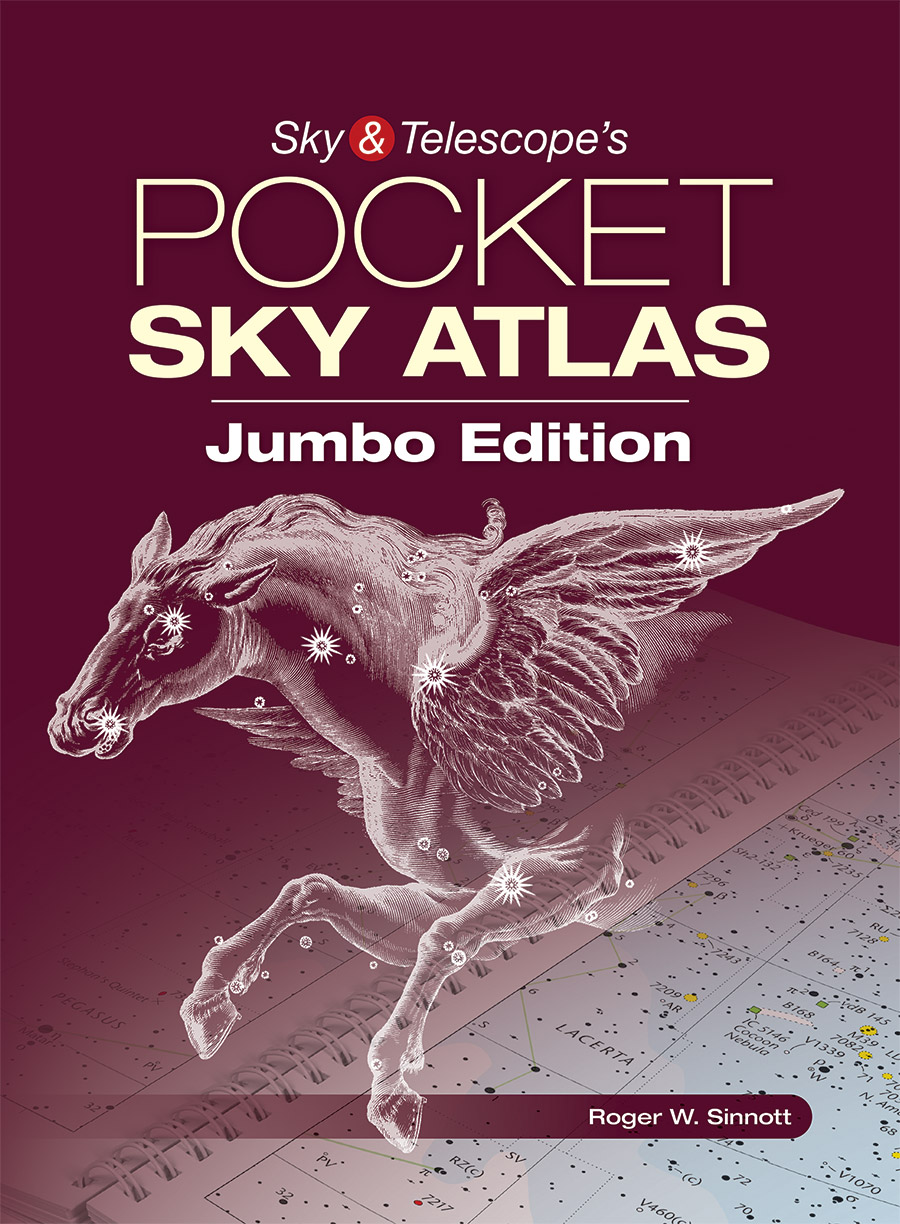
Once you get a telescope, to put it to good use you'll need a much more detailed, large-scale sky atlas (set of charts). The basic standard is the Pocket Sky Atlas, in either the original or Jumbo Edition. Both show all 30,000 stars to magnitude 7.6, and 1,500 deep-sky targets — star clusters, nebulae, and galaxies — to search out among them.
Next up is the larger and deeper Sky Atlas 2000.0, plotting stars to magnitude 8.5; nearly three times as many, as well as many more deep-sky objects. It's currently out of print, but maybe you can find one used.
The next up, once you know your way around well, are the even larger Interstellarum atlas (with 201,000+ stars to magnitude 9.5 and 14,000 deep-sky objects selected to be detectable by eye in large amateur telescopes), and Uranometria 2000.0 (332,000 stars to mag 9.75, and 10,300 deep-sky objects). And read How to Use a Star Chart with a Telescope. It applies just as much to charts on your phone or tablet as to charts on paper.
You'll also want a good deep-sky guidebook. A beloved old classic is the three-volume Burnham's Celestial Handbook. An impressive more modern one is the big Night Sky Observer's Guide set (2+ volumes) by Kepple and Sanner. The pinnacle for total astro-geeks is the new Annals of the Deep Sky series, currently at 11 volumes as it works its way forward through the constellations alphabetically. So far it's up to H.
Can computerized telescopes replace charts? Not for beginners I don't think, and not for scopes on mounts and tripods that are less than top-quality mechanically. Unless, that is, you prefer spending your time getting finicky technology to work rather than learning how to explore the sky. As Terence Dickinson and Alan Dyer say in their Backyard Astronomer's Guide, "A full appreciation of the universe cannot come without developing the skills to find things in the sky and understanding how the sky works. This knowledge comes only by spending time under the stars with star maps in hand and a curious mind." Without these, "the sky never becomes a friendly place."
If you do get a computerized scope, make sure that its drives can be disengaged so you can swing it around and point it readily by hand when you want to, rather than only slowly by the electric motors (which eat batteries).
However, finding faint telescopic objects the old-fashioned way with charts isn't simple either. Do learn the essential tricks at How to Use a Star Chart with a Telescope.
 Audio sky tour. Out under the evening sky with your
earbuds in place, listen to Kelly Beatty's monthly
podcast tour of the naked-eye heavens above. It's free.
"The dangers of not thinking clearly are much greater now than ever before. It's not that there's something new in our way of thinking, it's that credulous and confused thinking can be much more lethal in ways it was never before."
— Carl Sagan, 1996
"Facts are stubborn things; and whatever may be our wishes, our inclinations, or the dictates of our passion, they cannot alter the state of facts and evidence."
— John Adams, 1770
About Alan MacRobert
Alan M. MacRobert became an avid Sky & Telescope subscriber in 1966 at age 14, joined the editorial staff in 1982, and is now a senior contributing editor, semi-retired. He played a role in practically every part of the magazine and the company's other products for more than a generation, both on the amateur-observing side and the science-reporting side. In 1994 a book collection of his observing how-tos and telescopic sky tours was published as Star Hopping for Backyard Astronomers. He has produced This Week's Sky at a Glance online every week since 1989.


Comments
Tom Hoffelder
May 12, 2025 at 10:34 am
I always open This Weeks Sky every Friday because it is always the perfect level of things to check in the night sky. I'm easily confused by many things, including time, but it seems to me that if the Moon is full on the 12th at 12:56 PM, when it rises on the 13th it would be a little more than a day past full, not nearly a day past full.
You must be logged in to post a comment.
mary beth
May 12, 2025 at 11:05 am
Hello Tom, I was thinking that exact thing last night so I got out my app called Sun Surveyor, which is a minute by minute tracking of the sun and moon and Milky Way. The moon commenced to be full at exactly 8:10pm Sunday the 11 and apparently stays full until 2:42 am on the 13! I feel like that is an exceptionally long length of time. I would if someone could explain to us the variations in the length of time the moon is considered full. On the app it is declared FULL at 99.5% but sometimes a minute or two on either side of 99.5% will say waxing or waning, so I’m not sure the exact scientific definition. Maybe somewhere I saw it has to be 99.49 before they will consider it full and maybe at 99.48 it becomes gibbous?? I’m going to do a search on that and see if I can get us any answers. In the meantime I guess we could just enjoy an almost 3 day full moon!! It was cloudy last night, I did not get to see it, but it should be beautiful tonight. I believe Antares is riding along with the moon. I hope you have clear skies to see it too! Update tomorrow if you see it!
You must be logged in to post a comment.
You must be logged in to post a comment.