 SUNSET:


Ancient Galaxies Seen Dying Inside-Out
Astronomers have found massive galaxies 3 billion years after the Big Bang that are dying from the inside out.

Dawn Maps Ceres in False Color
Thanks to NASA’s Dawn spacecraft, we’re finally seeing more of the asteroid Ceres than a fuzzy ball.

Dragons and Venus Arise to Fool
On April 1st astronomers and other important folk got serious about science jokes in an annual tradition of scientific tomfoolery.

MAVEN Spots Dust Cloud, Aurora on Mars
NASA’s MAVEN spacecraft has detected dust high in Mars’s atmosphere and auroras across the planet’s northern hemisphere.

Ripples in the Milky Way
Astronomers have detected what look like four undulations in the Milky Way Galaxy’s disk. If the structures are all part of the disk, our galaxy is more than half again as large as we thought it was.

Dusty Galaxy in the Early Universe
A small galaxy 700 million years after the universe’s birth has a dust reservoir that makes it look like a much older galaxy.
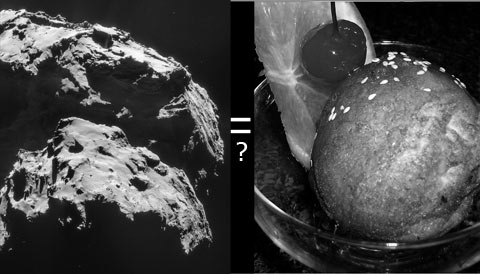
Deep Fried Comet Ice
Scientists studying ice here on Earth think they’ve confirmed why comets have hard crusts covered in hydrocarbon gunk.

Pluto and Charon’s Gravitational Dance
This image series, taken by NASA’s New Horizons spacecraft in late January 2015, reveals the dwarf planet Pluto and its largest moon, Charon, orbiting their common center of mass.

Ancient Five-Planet System Found
Astronomers have potentially confirmed a five-planet exoplanet system around an 11-billion-year-old star in our galaxy.

Black Hole Binary En Route to Merger?
Astronomers poring through two decades of archival and survey observations have discovered what looks like a pair of supermassive black holes closing in for a merger.

Curiosity Studies Mars Dry-out
Samples taken from two drill holes on Mars support the idea that Mars lost a whole lot of water fairly early in its history.

Curiosity Finds Methane, Other Organics
NASA’s Curiosity rover has detected both methane in Mars’s atmosphere and carbon-bearing organic compounds in its rocks. But it’s unclear where these molecules come from — or whether there’s any biological connection.

MAVEN Finds New Particles, Ion Plume
NASA’s MAVEN mission has discovered a new population of particles in Mars’s upper atmosphere. It’s also found a plume of particles escaping from the planet’s poles, confirming atmospheric loss is happening today.

Test Flight Success for Orion Spacecraft
On December 5th, NASA successfully launched the first test flight of its Orion capsule. Scheduled to carry astronauts beyond low-Earth orbit in the 2020s, the spacecraft is NASA’s first deep-space people transporter since the Apollo days.

Bright Spot in Uranus’s Atmosphere
Amateur astronomers have confirmed the presence of a large, bright storm cloud on the ice giant Uranus.

Two Exocomet Populations Around Beta Pictoris
The comets in the infant planetary system around the star Beta Pictoris fall into two distinct families, with one reminiscent of the solar system’s Kreutz sungrazers.

G2 Object Survives Black Hole Pass in Milky Way Center
The gaseous object G2 has survived its swing around the Milky Way’s central supermassive black hole, but the questions of what it is and where it comes from remain unanswered.

Gamma-ray Novae Explained?
Astronomers might have an explanation for why some classical novae erupt in gamma rays.

Mergers Create Disk Galaxies
Observations from several radio telescopes reveal that, when two galaxies merge, their progeny often have gaseous disks—a hypothesis that before now didn’t have solid observational evidence.

The Quasar Main Sequence
A new diagram might link the diverse visible-light characteristics of quasars to two physical properties — essentially, their accretion rate and orientation. If the analysis holds up, it could point the way toward a long-sought unification.
