 SUNSET:


Hot Jupiters: Cloudy or Clear?
New analysis of Kepler observations shows that hot Jupiters' temperatures might predict their weather report.

Spotting Andromeda Galaxy’s Giant Halo
Astronomers have detected a massive yet elusive nimbus of hot gas surrounding Andromeda Galaxy.

Mysterious X-rays Spotted in Galactic Center
NASA’s NuSTAR mission has detected an unexpected haze of high-energy X-rays in our galaxy’s center, perhaps the signal of a mass stellar graveyard.

Do Explosive Bursts Heat the Sun’s Corona?
New evidence suggests that nanoflares, small but potent bursts of energy, might heat the Sun’s atmosphere. But not everybody’s convinced.

Hubble Investigates Ghosts of Quasars Past
A galaxy-size blob of gas discovered eight years ago by a Dutch schoolteacher has galvanized the study of the spectral remains of once-bright quasars.
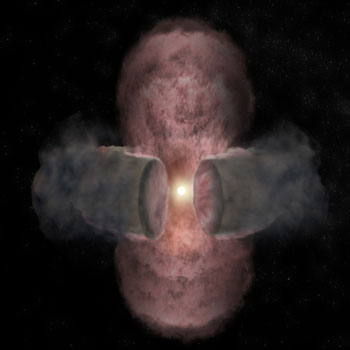
Watching Starbirth in Real Time
A team of astronomers compared two images taken 18 years apart to catch the dramatic evolution of a forming star and its surroundings.

NASA Selects Asteroid Mission Concept
NASA has selected the design for its Asteroid Redirect Mission, opting to retrieve a boulder from a larger asteroid.

New Stars On Strange Orbits in Milky Way
Astronomers have found two just-born star clusters an incredible 16,000 light-years above the plane of the Milky Way galaxy.

Cepheids Map Milky Way - and Beyond
Cepheid variable stars are helping astronomers see what our galaxy looks like from within.

Tempest in the Teacup Galaxy
New observations of the Teacup Galaxy show that even black holes with wimpy radio jets can quench a galaxy's star formation.

Before They Were (Binary) Stars
Astronomers have taken a behind-the-scenes look at a set of dense gas clumps, catching a quadruple star system in the fleeting act of formation.

Citizen Science: Projects & Collaboration
Yellowballs: A New View of Star Formation
Thanks to the help of the general public, astronomers have discovered a new signature marking a hidden phase of star formation.

Citizen Science: Projects & Collaboration
Exploring Exoplanet Origin Stories
Citizen scientists are exploring exoplanets’ birthplaces, classifying more than 1 million infrared sources and finding 37 disk candidates (so far) for follow-up study.

The Future of Exoplanet Hunts
As the Kepler mission shifts into its new mode of operations, multiple new searches for exoplanets are in the works.

Charting the Andromeda Galaxy
The Hubble Space Telescope has turned its ultraviolet, visible-light, and near-infrared eyes to the queen of galaxies, M31, capturing the biggest and sharpest image yet of our neighbor.
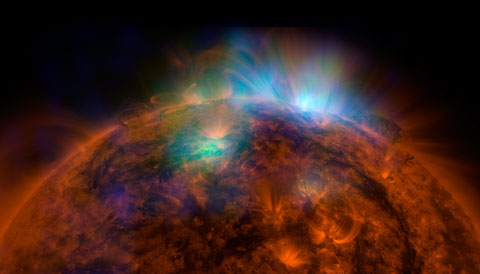
Seeing the Sun with X-ray Vision
NASA’s NuSTAR mission recently returned a striking image that shows the Sun’s active regions crackling with X-rays.

App-Powered Astronomy
In our March 2015 issue, we ask noted amateur and professional astronomers to highlight the astronomy apps they use most. These are apps that every astronomer should have in their back pocket, ranging from practical planetarium and weather apps, such as Scope Nights and Sky Safari 4, to science guides,…

Help Name Mercury's Craters
The International Astronomical Union is hosting a public contest to name five of Mercury's craters, with a deadline of January 15.

Flying Through Cosmic Voids
In the February 2015 issue of Sky & Telescope, author Marcus Woo walks readers through the science of cosmic voids. Here, videos demonstrate a sense of cosmic perspective, taking the reader on flights through the universe both theoretical and observed.

Ghostly Light From Dead Galaxies
Astronomers are peering into a galaxy cluster’s past, using Hubble’s Frontier Fields to measure the light from ghost stars cast adrift in galaxy collisions.
