 SUNSET:


How to Never Miss an Aurora
Learn exactly how and when to expect the next display of the northern lights with a few easy-to-use online tools.
This Week's Sky at a Glance, September 19–27
Arcturus is the bright star fairly high due west at nightfall. It's an orange giant 37 light-years away. Off to its right in the northwest is the Big Dipper, most of whose stars are about 80 light-years away.
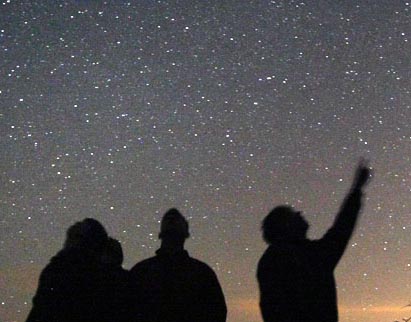
9,096 Stars in the Sky—Is That All?
Ten thousand stars bedazzle the eye on a dark night. Wait, how many?
This Week's Sky at a Glance, September 12–20
Follow the lineup of Saturn, Mars, and Antares as it changes day by day.

Meet My Variable Friend SS Cygni
Get acquainted with SS Cygni, the sky's brightest cataclysmic variable star. It's guaranteed to keep you on your toes.
This Week's Sky at a Glance, September 5 – 13
Friday, September 5 Saturn, Mars, Delta (δ) Scorpii, and Antares form an equally-spaced ragged line in the southwest at dusk, as shown at right. Delta Scorpii used to be a bit dimmer than Beta above it. Then in July 2000 it doubled in brightness. It has remained bright, with slow…

A Worldwide Night of Moonwatching
International Observe the Moon Night is an event that encourages people to "look up" and enjoy our nearest neighbor. This year's InOMN is Saturday, September 6th. Here's a quiz: What astronomical object looks amazing no matter what the magnification, never looks exactly the same no matter how often you view…
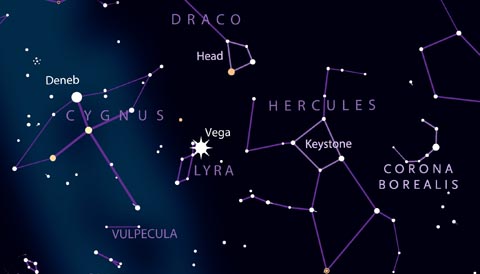
Tour September's Sky: Farewell to Saturn
The astronomical calendar says autumn arrives on September 22nd. It's a season of transition, with plenty of celestial comings and goings in the evening sky. September’s equinox takes place on the 22nd at 10:29 p.m. Eastern Daylight Time. At that moment the Sun shines directly overhead as seen from the…
This Week's Sky at a Glance, August 29 – September 6
The Moon is coming back into the evening sky. Look for the waxing crescent low in the west-southwest in twilight, as shown at lower right. Can you make out Spica twinkling beneath it?

Earthshine, the Moon's Darker Side
Explore the Moon's dark side with the aid of earthshine.
This Week's Sky at a Glance, August 22 – 30
Friday, August 22 Altair is the brightest star shining halfway up the southeastern sky after nightfall. Look to its left, by a little more than a fist at arm's length, for the dim but distinctive constellation Delphinus, the Dolphin. He's leaping leftward, just below the Milky Way. In Saturday's dawn,…
This Week's Sky at a Glance, August 15 – 23
Jupiter and Venus join together in the dawn sky, while Vega bejewels the zenith and the Milky Way's center reaches its highest in the south.

Close Venus-Jupiter Conjunction on August 18th
Here's your invitation to view a spectacular close conjunction of the sky's two brightest planets, Venus and Jupiter, before dawn on Monday morning.
This Week's Sky at a Glance, August 8 – 16;
Friday, August 8 Already you may see an occasional Perseid meteor if you keep an eye on the night sky. The shower's peak night is predicted for next Tuesday (August 12–13), but moonlight will compromise the view all week. Look northeast as the stars come out for W-shaped Cassiopeia. It's…

How to See Cygnus's Other Veil Nebula
You'll be entering uncharted territory when you seek out this little known 'Shadow of the Veil' in Cygnus this summer.
This Week's Sky at a Glance, August 1 – 9
Friday, August 1 At dusk this evening, the Moon forms the lower-right end of a very long, curving line of celestial objects. Counting to the Moon's upper left, these are Spica, Mars, and Saturn, as shown here. Today is Lammas Day or Lughnasadh, one of the four traditional "cross-quarter" days…

Tour August's Sky: Sagittarius and Scorpius
Late summer offers the Teapot of Sagittarius and the nearby arc of the Scorpion's Tail in the evening, the Perseid meteor shower, and a spectacular pairing of Venus and Jupiter before dawn.

Earth's Shadow Creeps Up on Us Every Night
The next time you're out watching a sunset, turn around and relish the mighty shadow of Earth looming just behind your back.
This Week's Sky at a Glance, July 25 – August 2
Friday, July 25 Mars and Spica shine in the southwest at nightfall. Mars keeps pulling farther away from Spica; they're now 6° apart. Saturn glows pale yellow to their upper left. Arcturus sparkles high to their upper right. Saturday, July 26 New Moon (exact at 6:42 p.m. EDT). Summer is…

Blank Sun? Faculae to the Rescue!
Fascinating faculae provide a way for anyone with a small telescope to track the ups and downs of the solar cycle — even when there are no sunspots.
