 SUNSET:

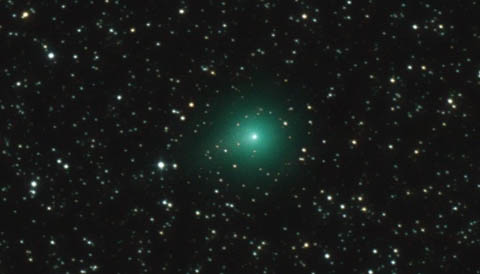
See Comet Jacques Before Dawn
It's not a showstopper, but right now Comet Jacques (C/2014 E2) is poised for telescopic viewing in the hours before dawn.
This Week's Sky at a Glance, July 18 - 26
Mars at dusk is still slightly less than 3° (two finger widths at arm's length) from Spica in the southwestern sky at the beginning of the week. But they're widening and sinking lower day by day.

Predictive Prowess: See an Iridium Flare
Channel your inner superpower by looking up at the night sky precisely when a dazzling blaze of light is beamed to Earth from outer space.
This Week's Sky at a Glance, July 11 – 19
Friday, July 11 Mars and Spica form a striking pair in the southwestern sky at dusk! They're now just under 2° apart. On Sunday evening they'll be at their minimum separation, 1.3°. Watch them change day by day. Full Moon tonight and Saturday night (exactly full at 7:25 a.m. Saturday…

Astronomy and Stargazing Projects
See Summer's Best Naked-Eye Double Stars
Not every set of closely paired stars requires binoculars or a telescope to "split". Here's a guide to summertime doubles you can tackle with your eyes alone.
This Week's Sky at a Glance, July 4-12
Friday, July 4 Out to watch fireworks? As you're waiting for twilight to end, spot the Moon in the west-southwest with Mars and Spica off to its left, as shown for July 4 here. High above them all shines brighter Arcturus. Saturn is farther left (off the left edge of…

Super-close Pairing of Ceres and Vesta
Two bright asteroids now appear extremely close to one another in the evening sky. Here's how to spot them in binoculars or a small telescope.
This Week's Sky at a Glance, June 27 - July 5
Friday, June 27 This is the time of year when, at the end of dusk, the dim Little Dipper floats straight upward from Polaris (the end of its handle) — like a helium balloon on a string, escaped from some summer evening party. Look due north. (Through light pollution, all…

Iapetus Comes Over to the Bright Side
Astronomers now know the secret of this moon's strange two-faced appearance, but it's still remarkable to watch the "now you see it, now you don't" performance as it moves around Saturn.
This Week's Sky at a Glance, June 20 - 28
A calendar of daily sky sights, from Sky & Telescope magazine.

Summer Quest for Noctilucent Clouds
Noctilucent clouds form at the boundary between Earth and space. Their electric blue billows incite the imagination and inspire us to keep watch at dusk for their arrival.
This Week's Sky at a Glance, June 13 - 21
Friday, June 13 Vega is the brightest star shining in the east after dusk. It's currently the top star of the big Summer Triangle. The brightest star to Vega's lower left is Deneb. Look farther to Vega's lower right for Altair. The Summer Triangle will climb higher in early evening…
Sky at a Glance, June 6 - 14
Friday, June 6 Look left of the Moon this evening for Mars, then Spica, as shown at right. With June under way, the Big Dipper is swinging around after dark to hang down by its handle high in the northwest. The middle star of its handle is Mizar, with tiny…
New E-Book: Summer Deep-Sky Observing
Look a little deeper into the summer sky with our new e-book, Summer Deep-Sky Observing. We'll have you happily busy at your telescope all season long!
Sky at a Glance, May 30 - June 7
The crescent Moon passes Mercury and Jupiter as it waxes across the sky this week.

Tour July's Sky: Moon Hugs Mars & Saturn
Sky & Telescope's audio sky tour makes it easy to discover the night sky. During July, the Moon makes very close brushes with Mars and Saturn.

Tour June's Sky: Three Planets in View
For anyone north of the equator, days are longest and nights shortest during June. But you can still get an eyeful of celestial sights, starting with a parade of Jupiter, Mars, and Saturn in the evening sky.
Sky at a Glance, May 23 - 31
Friday, May 23 Meteor Update Saturday morning: Well that was a dud! Meteor watchers all over North America who went out in the early morning hours for the new predicted Camelopardalid shower saw few if any. People indeed reported observing a handful of meteors from the new radiant, but just…
Sky at a Glance, May 16 - 24
Friday, May 16 Look for Mercury as twilight darkens. It's low in the west-northwest, far to the lower right of Jupiter and lower left of Capella. Mercury is having its highest showing of 2014 (for skywatchers at mid-northern latitudes). Saturday, May 17 Arcturus shines high in the southeast these nights.…
Sky at a Glance, May 9 - 17
Friday, May 9 The waxing gibbous Moon in the evening sky forms a curving line with Mars to its left, and Spica to the lower left of Mars. Saturday, May 10 Bright Mars shines left of the Moon. Although they look rather close together, Mars is 260 times farther away…
