 SUNSET:


Sky at a Glance | February 14th, 2014
Jupiter shines high in evening, Mars and Saturn follow up late, and Venus blazes at its brightest as the Morning Star at dawn.

How to See Jupiter: Big, Bright, and Beautiful
Jupiter, the King of Planets, is a captivating sight no matter how you look at it.
Ceres and Vesta in 2014
The two brightest asteroids are very close to each other in the sky in 2014, fitting in a single field of view through binoculars and some telescopes.
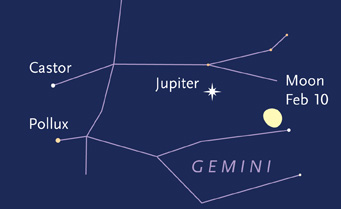
Tour February's Sky! | February 1st, 2014
Jupiter is well up in the east as darkness falls, surrounded by a cohort of bright winter stars and constellations.

S&T's Audio Sky Tour for February 2014
Jupiter is well up in the east as darkness falls, surrounded by a cohort of bright winter stars and constellations.
Sky at a Glance | January 31st, 2014
The waxing crescent Moon passes Mercury low in evening twilight, and Jupiter blazes high through much of the night.
Sky at a Glance | January 24th, 2014
Mercury after sunset, and Venus before sunrise, have both climbed up into excellent view. After nightfall, Jupiter continues to dominate the moonless evening sky.
Sky at a Glance | January 17th, 2014
The waning Moon is rising later each night, opening an evening window of darkness for observing winter's deep-sky wonders. Then, turn your scope to dazzling Jupiter climbing high.
Sky at a Glance | January 10th, 2014
Jupiter is still about at its closest and largest of the year, rising high earlier in the night. The Moon waxes to full, so with a telescope this is a good time to specialize in a bright thing like Jupiter.
Sky at a Glance | January 3rd, 2014
This is Jupiter's week to shine — it's at opposition! Also lighting the evening sky is the Moon, waxing past first quarter on Tuesday the 7th.

Meteor Showers in 2014
Sky & Telescope predicts that 2014's best meteor shower won't be one of the traditional displays. Instead, on May 24th the predawn skies over North America might come alive with a robust display of "shooting stars" shed by Comet 209P/LINEAR.
Eclipses in 2014
This year features three celestial cover-ups that favor North Americans: total lunar eclipses on April 15th and October 8th, and a partial solar eclipse on October 23rd.
Tour January's Sky! | December 27th, 2013
Start the new year right with a little evening stargazing! Venus is dropping from sight low in the west just as Jupiter and mighty Orion are ascending in the east.
Sky at a Glance | December 27th, 2013
As the solstice passes, the Great Square turns on end and a Christmas-ornament star emerges through bare trees.

New Telescope? Learn How to Use a Telescope and See Amazing Sights
Thousands of telescopes are given and received as gifts during the holidays. But once you've assembled your new treasure, then what? The editors of Sky & Telescope show you where to look first.
Sky at a Glance | December 20th, 2013
As the solstice passes, the Great Square turns on end and a Christmas-ornament star emerges through bare trees.
Sky at a Glance | December 13th, 2013
The days grow their shortest, the Geminid meteors shower, and the Moon passes through. . . Orion?!
Sky at a Glance | December 6th, 2013
The Sun sets its earliest of the year, Moon waxes through first quarter, and Jupiter passes the waist star of the Pollux stick figure.
S&T's Audio Sky Tour for January 2014
Start the new year right with a little evening stargazing! Venus is dropping from sight low in the west just as Jupiter and mighty Orion are ascending in the east.
Tour December's Sky! | December 1st, 2013
December's crystal-clear skies offer Venus low in the west after sunset, a “tower of brilliance” (including Jupiter) rising in the east, and the prospect of a nice showing by Comet ISON in the predawn sky early in the month.
