 SUNSET:


Tour April's Sky! | March 26th, 2010
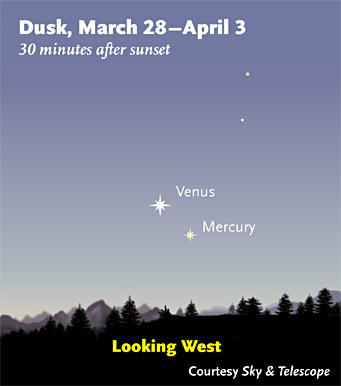
If you've always wanted to spot Mercury, here's your chance. Find out where and when to look for the fleet-footed planet using this month's audio sky tour. Host: S&T's Kelly Beatty. (6.5MB MP3 download: running time: 6m 52s)
Sky at a Glance | March 26th, 2010
Venus and Mercury begin their lovely early-spring pairing low in the western sunset.
The Top 12 Naked-Eye Variable Stars
Lurking in the seemingly changeless constellations are a few inconstant stars that pulse and eclipse. Here are a dozen variables that are easy to observe.

Sky at a Glance | March 19th, 2010
The Moon pairs with the Pleiades and then runs under the arc of Castor, Pollux, and Mars this week. Saturn comes to opposition. And as spring begins, Sirius leaves the meridian behind.
Sky at a Glance | March 12th, 2010
The thin Moon passes Venus low in the west in bright twilight this week. And Mars remains shining near Castor and Pollux high overhead after dark.
Sky at a Glance | March 5th, 2010
This week Mars is as near as it will get to Castor and Pollux, high in the east after dark. Narrow-ringed Saturn rises soon after dark.
Zodiacal Light in the Evening
The zodiacal light is on its best display in the Northern Hemisphere on moonless evenings from February through April.
Sky at a Glance | February 26th, 2010
Mars is fading and shrinking, but on the other hand it's now very high early in the evening. And narrow-ringed Saturn rises soon after dark.
S&T's Audio Sky Tour for February 2010
Say "goodbye" to Jupiter and "hello" to Mars, as the midwinter evening skies come alive with activity. Learn to identify what stargazers call the Winter Hexagon, and much more. Host: S&T's Kelly Beatty. (3.9MB MP3 download: running time: 4m 8s)
S&T's Audio Sky Tour for March 2010
What a difference a month makes! The lengthening days, together with a switch to daylight time, mean that the evening constellations are changing rapidly. Host: S&T's Kelly Beatty. (6.5MB MP3 download: running time: 6m 52s)
Tour March's Sky! | February 25th, 2010
What a difference a month makes! The lengthening days, together with a switch to daylight time, mean that the evening constellations are changing rapidly. So use this easy-to-follow audio tour to figure out what's what. Host: S&T's Kelly Beatty. (6.5MB MP3 download: running time: 6m 52s)
Sky at a Glance | February 19th, 2010
Mars is high in the evening sky below Pollux and Castor. It's starting to fade and shrink a bit, but it's in best view for your scope earlier in the evening now.
Sky at a Glance | February 12th, 2010
Mars is high in the evening sky, still bright but starting to fade and shrink. Asteroid 4 Vesta is brightest and closest to Earth this week. And Venus and Jupiter have a challenging conjunction just above the west-southwest horizon after sunset.
Sky at a Glance | February 5th, 2010
Mars, just past opposition and still blazing brightly, rises higher in the east each evening. And Saturn is now up in the east by about 10 p.m.
Tour February's Sky! | January 30th, 2010
Say "goodbye" to Jupiter and "hello" to Mars, as the midwinter evening skies come alive with activity. Learn to identify what stargazers call the Winter Hexagon, and much more. Host: S&T's Kelly Beatty. (3.9MB MP3 download: running time: 4m 8s)
Sky at a Glance | January 29th, 2010
Fiery Mars, at opposition, shines as brightly as icy Sirius. Catch Jupiter departing low in twilight. And Saturn is now up in the east by 10 or 11 p.m.

Occultation Web Resources
Occultations of stars and planets by the Moon and asteroids are exciting to watch, and amateur occultation timings can have real scientific value. But first you need to know what occultations will be happening in your area.
Sky at a Glance | January 22nd, 2010
This week Mars comes to opposition and passes closest to Earth, shining its brightest in the evening sky. Meanwhile, Jupiter slinks offstage low in the southwest.
Sky at a Glance | January 14th, 2010
Jupiter remains an eye-catcher as twilight fades, but it sinks low and sets early in the evening. Meanwhile Mars climbs high in the eastern sky during evening, shining nearly its brightest of the year.
Sky at a Glance | January 8th, 2010
Jupiter sinks lower at dusk, Mars rises earlier and earlier, Mercury begins to emerge in the dawn, and the Rabbit's Ruby reaches its maximum brightness.
