 SUNSET:

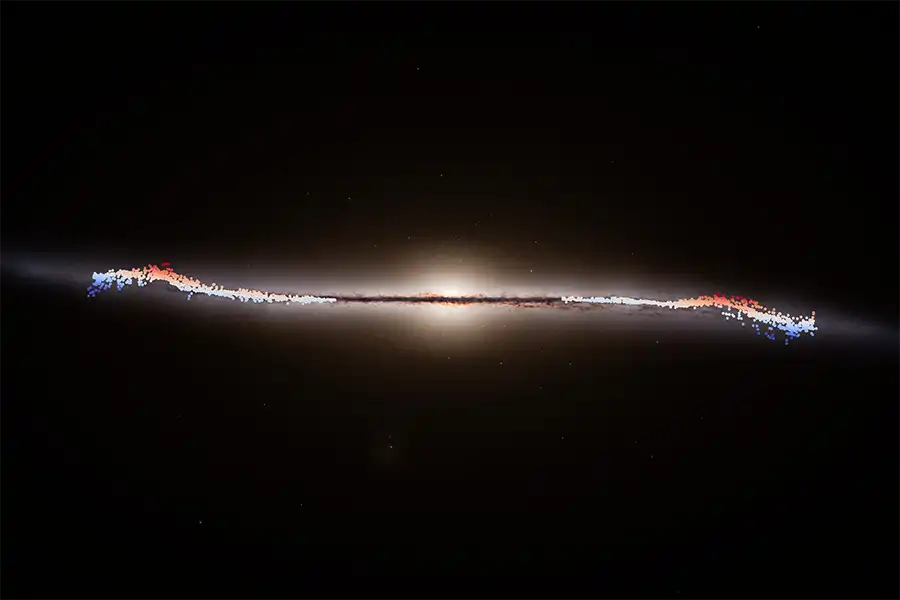
A “Great Wave” Is Crashing through the Milky Way
Precise measurements of stars’ motions show that a wave is propagating outward from our galaxy’s center — perhaps from a long-ago collision with another galaxy.

Galaxy-mapping Gaia Satellite Ends Science Operations
After more than a decade in space, the European Gaia spacecraft will end its observations this week. Astronomers are still busy preparing final data blasts.

Did the Milky Way Form Faster Than We Thought?
New research suggests that our galaxy’s first stars might have come together within a billion years after the Big Bang.

Astronomers Find 21 “Dark” Neutron Stars Orbiting Sun-like Stars
New analysis has revealed 21 Sun-like stars in mutual orbit around dark objects of neutron star–like masses — rare systems that have escaped destruction by supernova.

Star-Mapping Mission Gaia Impacted by Micrometeoroid, Solar Storm
Having survived two recent threats — high-velocity space dust and enhanced solar activity — Gaia is now returning better data than ever.
The Gaia Revolution: New Data and Strange Stars
Astronomers will use the newest data release from the Gaia mission to explore stellar tsunamis, Milky Way history, and more.

Gaia Makes Most Accurate 3D Map of the Milky Way Yet
Astronomers have released a new, extremely detailed three-dimensional census of our Milky Way galaxy.

Baby Stars Found in Ancient Part of Our Galaxy
Ground- and space-based observations have revealed a group of stars at the head of the giant stream of gas burrowing its way through the Milky Way.

Our Quiet Galaxy Used to Burst with Stars
New research shows that our quiet, middle-aged galaxy used to be quite the firecracker — a couple billion years ago it was exploding with new stars.
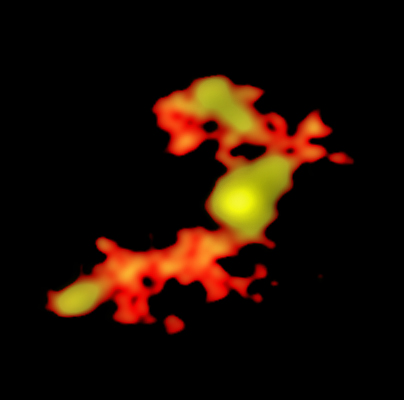
60-Second Astro News: A Carnivorous Quasar and a Galaxy Ghost
In astronomy news this week: The most luminous quasar known in the cosmos is devouring three galaxy companions, while a newly discovered ghostly satellite of the Milky Way hints at hordes more just waiting to be found.

Evidence Mounts for a Magellanic Collision
Astronomers have suspected for some time that the Large and Small Magellanic Clouds collided in the recent past. The Gaia space telescope provides striking new evidence for a head-on collision.

Ancient Merger Wreckage in the Milky Way
Mounting evidence indicates that our galaxy smashed up another smaller galaxy roughly 10 billion years ago.

Some Stars Around Galaxy May Be From Elsewhere
Data from the Gaia satellite reveal 20 new high-speed stars, 13 of which appear to have originated outside of the Milky Way.

Mind the Gap: Gaia Mission Reveals the Insides of Stars
Astronomers have discovered a hiccup in stellar luminosities that may point to a new understanding of stellar structure.
