 SUNSET:

 0
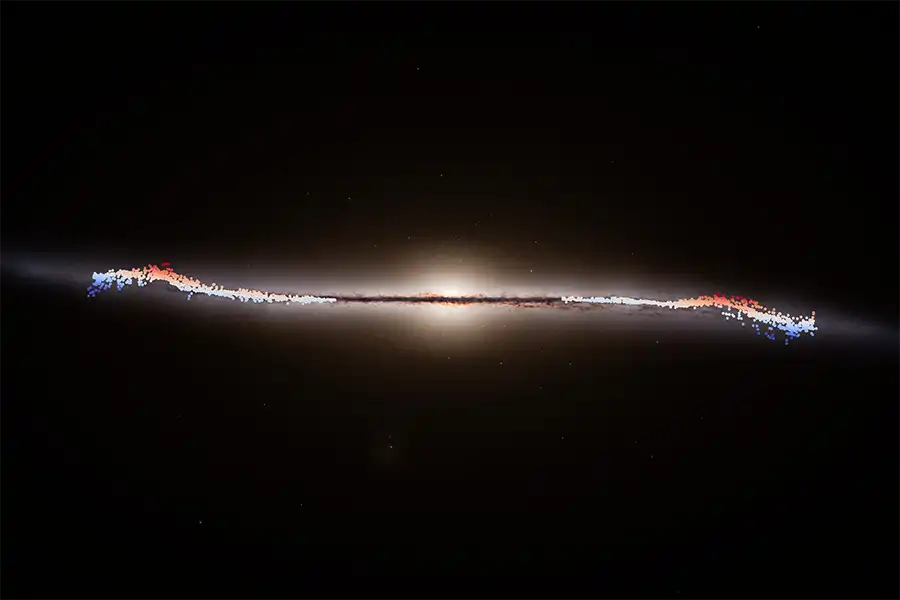
0Precise measurements of stars’ motions show that a wave is propagating outward from our galaxy’s center — perhaps from a long-ago collision with another galaxy.
ESA / Gaia / DPAC / S. Payne-Wardenaar / E. Poggio et al (2025)
The stars in our skies appear motionless. And yet they move, just on timescales and across spaces beyond human intuition. Taken together, their movements can hint at secrets in our galaxy’s past.
Eloisa Poggio (Astrophysical Observatory of Torino, Italy) and colleagues dug into that history using the ultra-precise measurements from the European Space Agency’s Gaia mission, reporting results in Astronomy & Astrophysics. The Gaia mission has mapped more than 1 billion Milky Way stars, but Poggio’s team traced our galaxy’s shape using 20,000 massive young stars. Their positions and velocities have revealed what the researchers call a “Great Wave” that’s rippling through our galaxy’s outskirts.
Its origin, though, remains an open question.
All in Motion
The Milky Way is never still. Its stars are in constant motion as they revolve around the galactic center. In the 1950s, astronomers learned that the disk in which the stars revolve is itself warped like a misshapen sunhat. As a result, stars also have some vertical motion that takes them above and below the plane of the galaxy. And that’s not all: More recent studies have hinted that there’s more action in the galaxy’s outskirts than can be explained by a spinning and warped disk of stars.
ESA / Gaia / DPAC / S. Payne-Wardenaar / E. Poggio et al (2025)
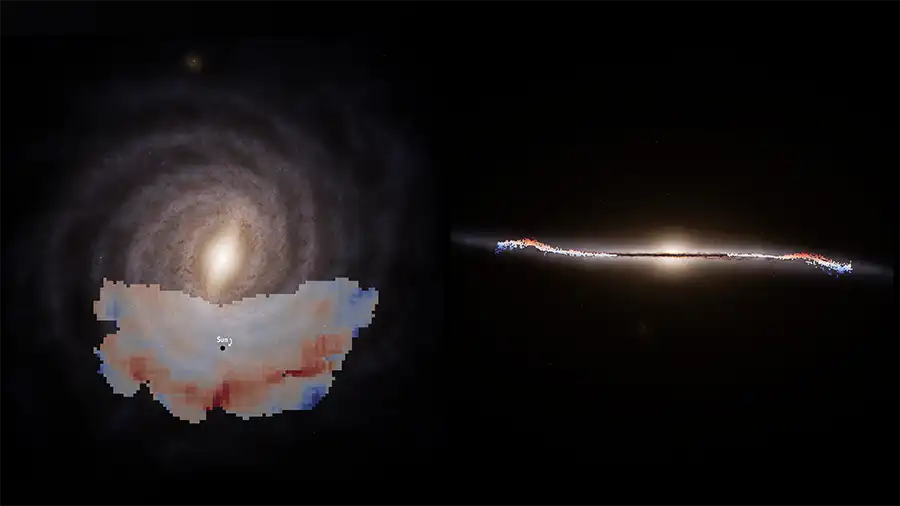
Poggio and colleagues map stellar movements using a set of 17,000 young giant stars and 3,400 rarer stars known as Cepheid variables. Both types of stars sit squarely in our galaxy’s spiral arms, having only recently been born out of the gas that clumps there. The abundant young giants are more typically found closer to the galactic center, though, while the brighter Cepheids can be seen all the way out to the edges of the spiral arms.
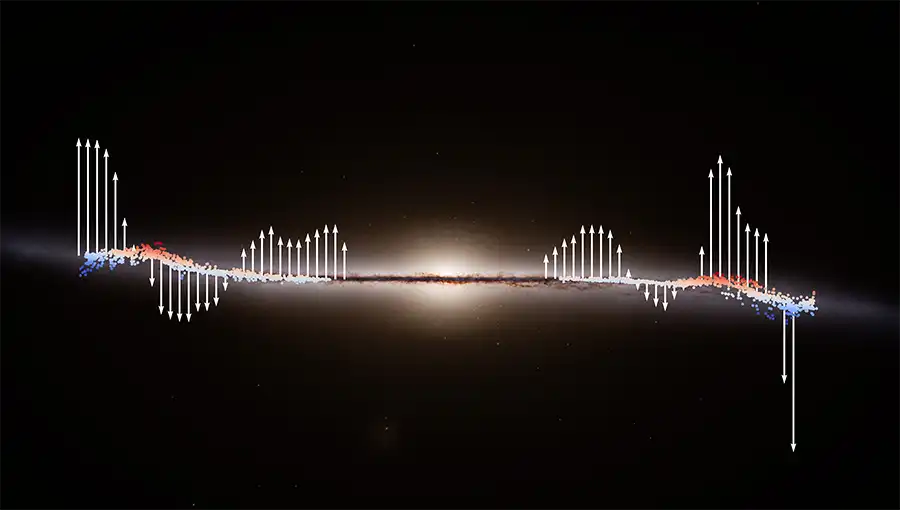
Together, the giants and the Cepheids chart a consistent story: On the Milky Way’s outer edge — that is, between 30,000 and 45,000 light-years from the galactic center, well past the Sun’s galactic orbit — a wave is churning through the young stars. The wave makes itself known by the stars’ vertical motions, which go beyond what would be expected from a simple warped disk.
Previous studies have found similar ripples in the outer galaxy, but this is the first time they’ve been defined in such detail. Gaia data have the advantage because they include not just the positions of stars but also their velocities through space.
“The intriguing part is not only the visual appearance of the wave structure in 3D space, but also its wave-like behavior when we analyze the motions of the stars within it,” Poggio says. Not only are the stars offset from where we expect them to be, but their motions toward and away from the galactic center seem to be coupled to their vertical motions above and below the galactic plane. Ocean waves churn water in a similar way.
ESA / Gaia / DPAC / S. Payne-Wardenaar / E. Poggio et al (2025)
Intriguingly, stars in the recently discovered Radcliffe Wave, a sinuous structure much closer to the Sun, exhibit similar wave-like motions. But Poggio’s team notes that it’s unclear whether the Great Wave in the outskirts is an extension of the Radcliffe Wave.
Pebble in the Pond
The ripples on our galaxy’s outer edge are reminiscent of the ripples that expand around a pebble thrown in a pond. Other signs also point to a singular event in our galaxy’s past. A previous study of Gaia data showed that the Milky Way’s disk wobbles, like a spinning top that has gone slightly off-balance. The finding suggested that something — perhaps a dwarf galaxy — whacked our galaxy several hundred million years ago.
The Sagittarius Dwarf, a smaller galaxy that’s being torn apart in the Milky Way’s strong gravitational field, initially seemed to fit the bill. But attempts to mimic a past collision in computer simulations didn’t reproduce the observed stellar orbits.
Another team, led by Sukanya Chakrabarti (University of Alabama in Huntsville), has hinted at a different dwarf-galaxy culprit, known as Antlia 2. It could have swept by the Milky Way’s outer disk to set off the ripples. “I am excited to see this paper and the overall similarity between our work many years ago,” says Chakrabarti, who wasn’t involved with this work.
Poggio’s team doesn’t land on any one explanation. Future work, both with upcoming Gaia releases and other data sets as well as with improved computer simulations of galaxy formation and evolution will provide the tools astronomers need to dig up the secrets in our galaxy’s past.
About Monica Young
Monica Young, a professional astronomer by training, is News Editor of Sky & Telescope.



Comments
You must be logged in to post a comment.