 SUNSET:

 2
2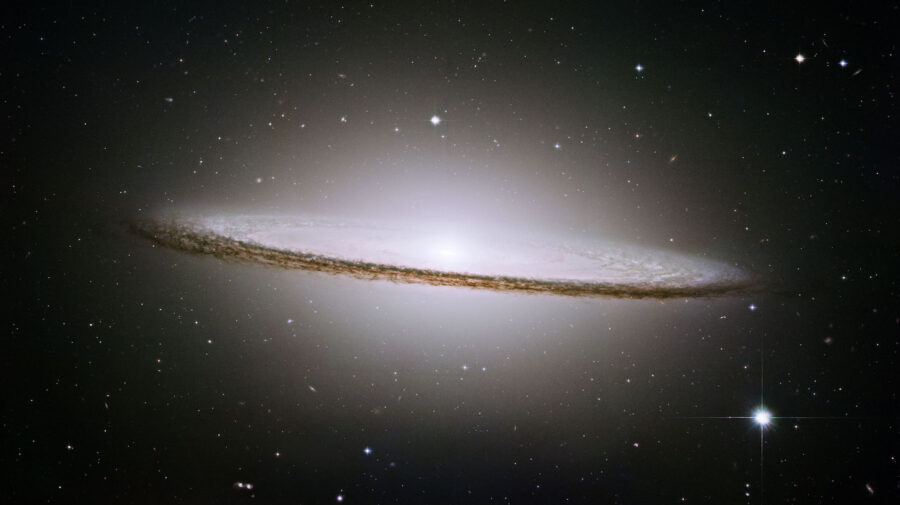
ESA / C. Carreau
Previously, I explored astronomy-adjacent activities for nights — and weeks — when the skies are socked in. One option is to tune into an online telescope or another amateur astronomer’s live feed as they image the heavens. But a one-on-one connection to a friend or relative under clearer skies represents such vicarious astronomy at its best.
For me, this means FaceTime calls with my dad.
Last fall, I gave my father my Dwarf II smart telescope for his 80th birthday. I didn’t realize how perfect the little scope would be for him, that our shared interest would act as a bridge to bring us closer — and that there would be the added bonus of observation by proxy.
It’s late afternoon for me in Portland, Oregon, but Dad is setting up under darkening skies in Richmond, Virginia. Our system is only slightly clunky: From my desk, I call in to Dad’s phone, which is pointed at his iPad controlling the Dwarf II. We’re getting better at making sure the screens line up, so I can intelligently answer questions and help troubleshoot if the display looks weird or if the telescope glitches.
When skies are good in Richmond, we hunt for nebulae, clusters, and galaxies with his smart telescope. We commiserate about his neighbor’s crepe myrtle and elm trees that block views to the east and strategize about how to avoid the overhead phone and power lines that obscure celestial sights and hamper basic focusing.
Dad swears he can’t operate the telescope without me, but he now runs through the Dwarf II’s functions by rote, no longer needing the cheat sheet we developed together. His confidence is growing. Thanks to his Sky & Telescope subscription, he’s learning about deep-sky objects and observation targets, then feigns indignation when I’m not up to speed. He called in excitement about Euclid’s Einstein ring, and he is keen on Webb’s Wreath. I’ve had to do a surreptitious internet search to keep up with the conversation. (And as soon as he reads this, he’ll text me to say that he feigns nothing.)
He still relies on me to choose targets — a great way for me to enjoy the cosmos from frequently overcast Portland. Big hits so far have been the Orion Nebula (M42), the Pinwheel Galaxy (M101), and the M3 globular cluster. Because we’re doing shorter astrophotography runs — 15-second exposures in stacks of 40, instead of hundreds of frames — we cover each deep-sky object in a matter of minutes.
While we’re waiting for the image to build, we talk about Alex Filippenko’s astronomy course that Dad’s watching on DVD. He asks if our target is inside or outside the Milky Way Galaxy, and how far away it is. He often poses specific questions I can’t begin to answer — like how far an astronaut wearing a special spacesuit could travel into a black hole before being terminally spaghettified (I’m guessing not far), or the specifics of how the Dwarf II optics work. He’s an avid reader, and we have mini–book club discussions while the telescope rotates to find its next target. Most recently, I sent him Emily Levesque’s The Last Stargazers; not only did he devour the book in mere days, but his first comment was, “I hadn’t realized how difficult it was for women in professional astronomy. That was really eye-opening.”
The telescope finishes its run on the Sombrero Galaxy (M104), and Dad pauses to admire the image before moving on. The edge-on galaxy is tiny but bright on the screen, suspended against a striking star field. “See what you did?!” I exclaim, but he refuses to take credit for the effort.
We cover about a half-dozen targets over FaceTime and finish before full night in Richmond, thanks to the lengthening days. By then, I’m ready for dinner and Dad is ready for bed, his phone battery running low. We say goodnight and wish each other clear skies again soon.
We don’t (yet) have any in-person stargazing planned, but we muse about “someday” trips to dark-sky sites and aurora borealis tours. When we’re both beleaguered by bad weather, we complain about clouds and play with planispheres. One such evening, I gave an impromptu tutorial on the Stellarium app (which he calls “Solarium”), and we explored constellations from other cultures.
With summer stargazing ahead, we have lots of nebulae on the agenda, including the Trifid Nebula (M20), Eagle Nebula (M16), Ring Nebula (M57), the Veil (Caldwell 33/34), and the elusive Rho Ophiuchi (IC 4604) — though that one might be beyond his telescope’s capabilities under Bortle 9 skies. For clusters, M13 in Hercules obviously makes the list, along with the Wild Duck Cluster (M11), the Coathanger (Collinder 399), and M19 in Ophiuchus. I hope we can peek at the M24 star cloud, and we’ll hunt for Webb’s Wreath once it’s clear of the crepe myrtle.
And maybe T Coronae Borealis will finally go nova — perhaps around Father’s Day? Even though we’re thousands of miles apart, we can enjoy the sight together.



Comments
AB
June 15, 2025 at 12:31 am
What a lovely way to make memories! Having a hobby that you both share and enjoy together is a great gift.
You must be logged in to post a comment.
Jen Willis
June 16, 2025 at 5:23 pm
Thanks, AB!
You must be logged in to post a comment.
You must be logged in to post a comment.