 SUNSET:

 3
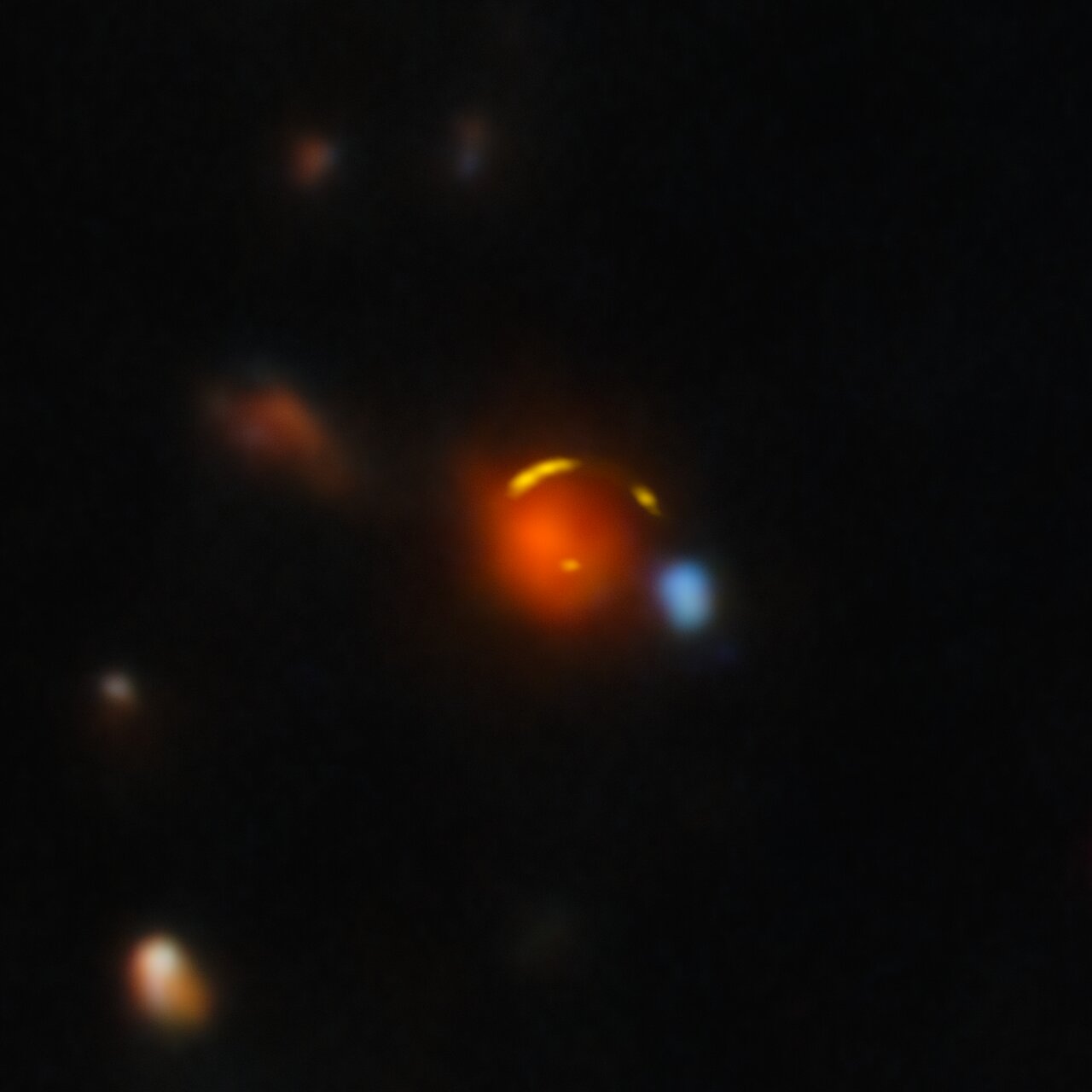
3Dozens on amateur astronomers helped measure the minuscule difference in Didymos’s trajectory around the Sun, after NASA’s DART mission impacted its moon.
ASI / NASA
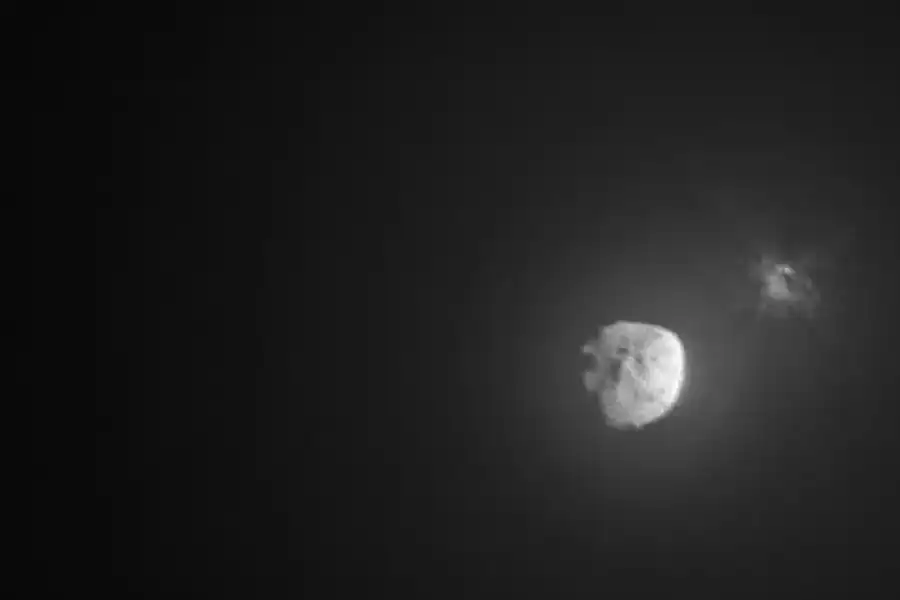
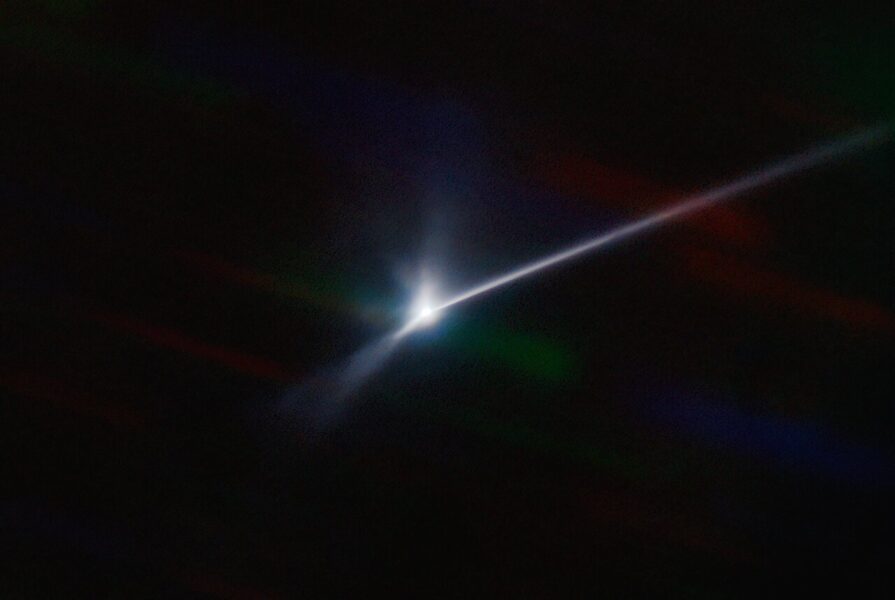
When NASA’s Double Asteroid Redirection Test (DART) slammed into Dimorphos, a tiny moonlet orbiting the asteroid Didymos, it not only changed the shape and trajectory of the moonlet itself, but also the orbit of its larger companion 65803 Didymos. Professional and amateur astronomers worked together to measure the minute but distinct effect the 2022 impact had on the larger asteroid as it orbits the Sun.
Gauging that displacement was the equivalent of distinguishing the width of a human hair 10 miles (16 km) away, says study co-lead Steven Chesley (JPL).
The center of gravity of the Didymos-Dimorphos system changed its speed by only 11.7 microns per second. “In human terms, that’s about 4 centimeters per hour,” Chesley explains to Sky & Telescope. The asteroid’s own orbital motion was about 34 kilometers per second, he adds. “We were able to detect the change of about one part in 3 billion in the orbital velocity around the Sun.”
Chesley helped lead the team whose analysis of the asteroid’s deflection was published March 6th in Science Advances. The remarkably precise determination was made possible by measuring when the asteroid occulted (or covered up) background stars. These occultations are like mini-eclipses, in which the tiny asteroid, unseen, passes in front of a star, causing it to briefly blink out as seen from particular locations on Earth. The ESA’s Gaia catalog precisely calibrates that star’s location in space, which enables the team to convert the measurements into the asteroid’s exact location.
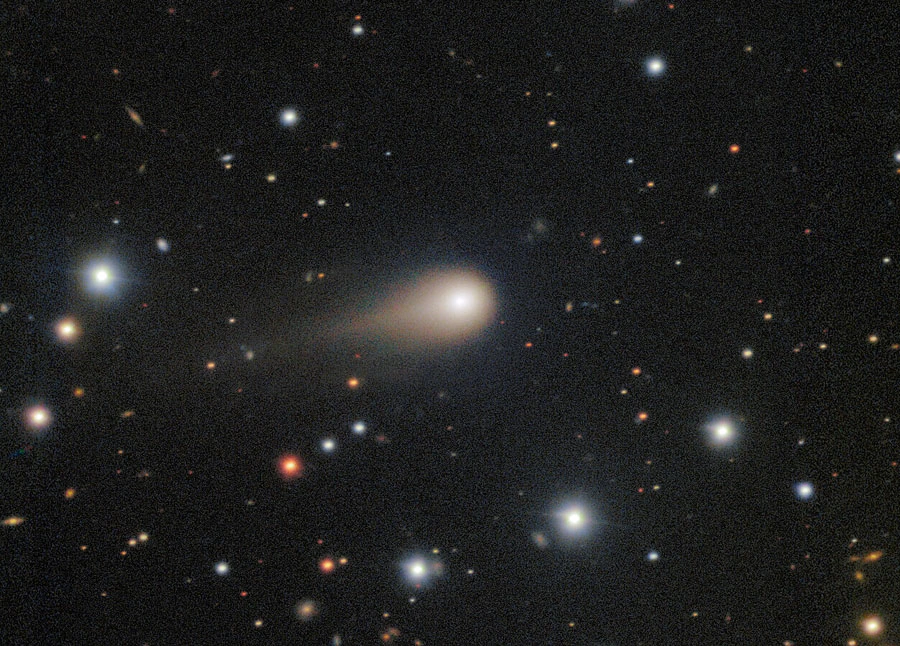
CTIO / NOIRLab / SOAR / NSF / AURA / T. Kareta (Lowell Observatory), M. Knight (US Naval Academy); Image processing: T.A. Rector (University of Alaska Anchorage / NSF’s NOIRLab), M. Zamani & D. de Martin (NSF’s NOIRLab)
Doing so requires dedicated and sometimes quite extreme efforts on the part of highly experienced amateur astronomers scattered across the globe. Chesley, along with Rahil Makadia (University of Illinois Urbana-Champaign) and others, calculated the times and places of predicted occultations across the globe. Amateurs then rushed to take up the challenge, taking video recordings through their telescopes to catch the precise moment that the star blinked out.
In one case, Chesley says, amateur astronomer John Broughton drove for two days across the Australian Outback to arrive at a predicted location. He set up his three telescopes and video cameras, captured the event — and then drove two days back to download the data and submit his observations to the team.
Others, sometimes in teams of a half-dozen or more, made observations from Japan, Europe, and southwestern U.S.
One amateur observer even managed to catch an occultation not by larger Didymos but by tiny Dimorphos, which is only about 150 meters across, after pulling his car off to the side of a California highway to set up his equipment. “That was the smallest occultation object or target that had ever been captured,” Chesley says.
Altogether, he says, “maybe the coolest part of this whole investigation is the incredible, dedicated efforts of some very dedicated folks.” While he says they often call themselves amateurs, he adds, “These folks are very technically savvy about the hardware that they’re using.”
Makadia, who led the paper describing these findings, worked on this project for his doctorate, which he earned in December. He tells Sky & Telescope that he and his team got busy right after DART’s impact. “We started looking into what kinds of measurements and how many measurements we would need in order to detect any heliocentric changes,” he added. Those predictions motivated amateurs to make observations between May 2024 and March 2025.
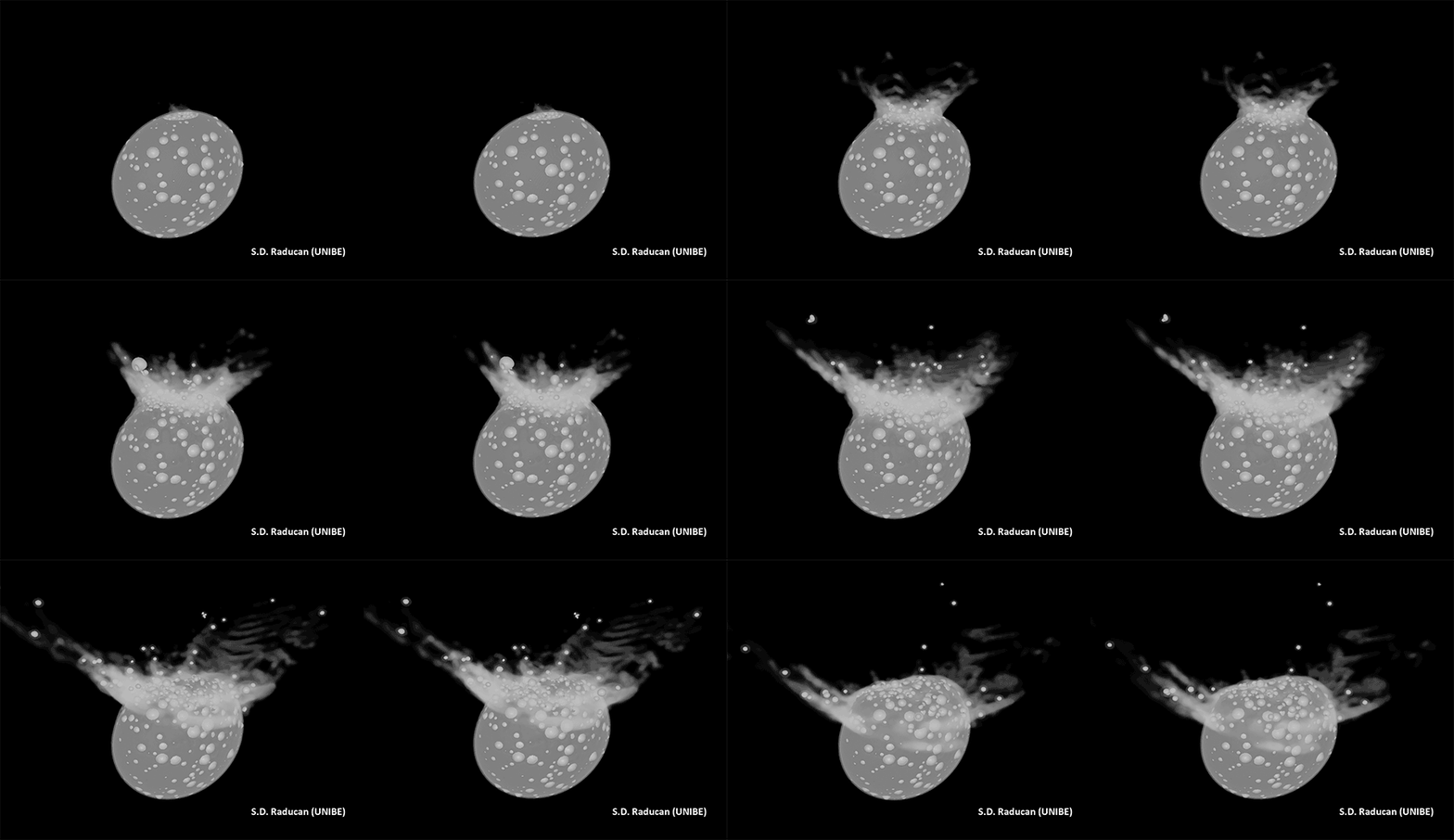
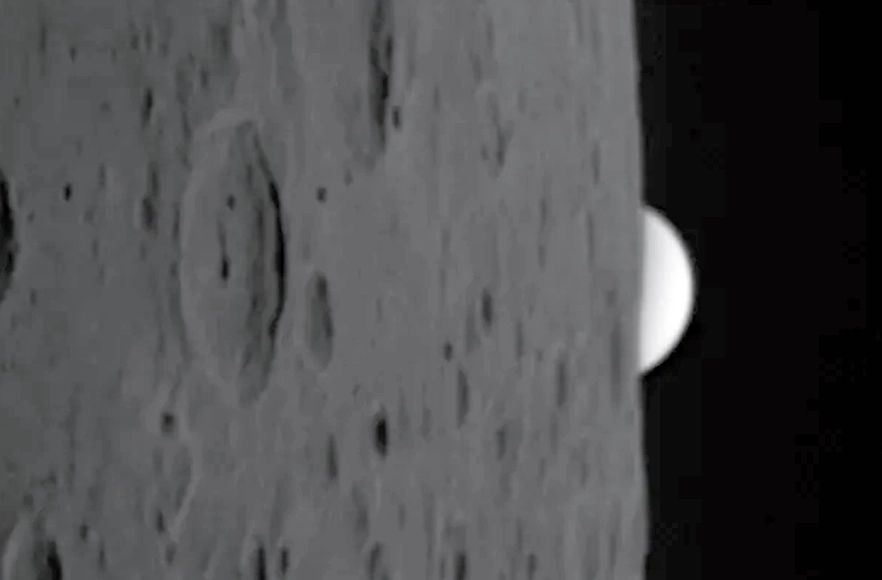
The fact that an asteroid’s path was altered just by impacting its satellite suggests that such hits could one day deflect an asteroid heading toward Earth. “The secondary asteroid, because it is the secondary, sits further outside the sphere of influence, the gravity well of the system,” Makadia explains. “So it’s easier for us to hit the secondary, and to get material to escape the system when it starts from the secondary.”
That ejection of debris creates a rocket-like push on the asteroid, which, in the case of the DART impact, doubled the momentum imparted.
S.D. Raducan
Even doubled, the change in momentum to the asteroid system was minuscule. But such changes matter, says Richard Binzel (MIT), who developed the Torino scale to describe the risks of near-Earth impacts. “The laws of physics say that a tiny bug splatting on the windshield slows you down, even if it seems imperceptible,” he says.
“Even a minuscule change slowing an asteroid’s orbit can add up to a great effect if implemented many years or decades ahead of time,” he adds. “The slowdown can be just enough for the asteroid to be late for its date with Earth.”



Comments
StanR
March 14, 2026 at 4:26 am
I think 34 kilometers per hour is the wrong number for the asteroid's orbital motion. Most of us drive faster than that.
You must be logged in to post a comment.
Frank Reed
March 17, 2026 at 10:38 am
Yes. It should have been 34 km/sec. And if you check the comparison, "one part in three billion" makes sense only if the speed change was "4cm/hour" and the initial speed was 34 km/sec (not per hour). It's easy to trip over these mixed units. 🙂
Point of the article in physics terms and its implications for future asteroid deflections: Conservation of momentum is true. This confirms centuries of science, and it is not really "news", but it's nice to see that funding can confirm fundamentally obvious science.
Second point of the article: amateur astronomy (at least the high-end variety) still has a role to play! And that's probably more important.
You must be logged in to post a comment.
Monica Young
March 17, 2026 at 1:00 pm
Dear StanR, Thank you for noting the typo, I've fixed it in the piece.
You must be logged in to post a comment.
You must be logged in to post a comment.