 SUNSET:

 0
0New observations reveal that permanently shadowed regions at the lunar poles might contain less water ice than astronauts were hoping for.
NASA / KARI / ASU
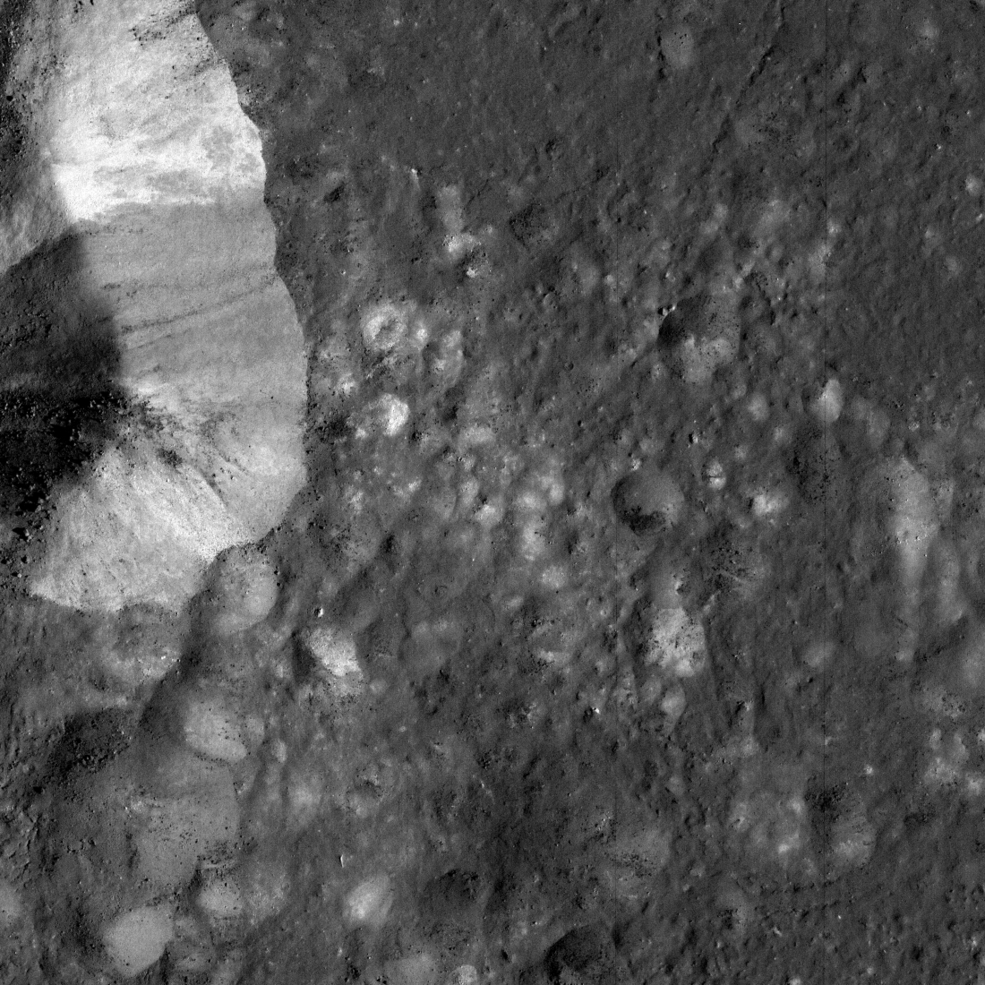
Scientists have long looked for such ice deposits hidden on permanently shadowed craters and other depressions at the Moon’s poles. These topographic lows never receive direct sunlight and remain extremely cold, potentially trapping water molecules. Numerous spacecraft have peered into these holes searching for ancient ice with mixed results.
Now, a new set of observations lowers the threshold for how much water the lunar poles might hold. Using NASA’s ShadowCam, a camera flying on the Korea Pathfinder Lunar Orbiter (KPLO), researchers peered into these dark areas but found no evidence of widespread ice deposits on the surface. Instead, they concluded that at most, 20% to 30% of the surface regolith is water (by weight).
ShadowCam, which has been orbiting the Moon on KPLO since December 2022, is extremely sensitive. It makes use of the faint reflection of sunlight off of Earth, or earthshine, as well as light scattered by nearby terrain — the only illumination that reaches permanently shadowed areas. “That’s super weak,” says Shuai Li (University of Hawai'i at Manoa), lead author of a study in Science Advances. “Compared with atmospheric scattering [on Earth], that’s nothing.”
Researchers used a pair of tricks to gauge how much water ice is mixed in with the regolith. The first is by measuring reflectance, or how much light bounces back. Water ice is notoriously bright, reflecting most of the visible light that hits it. In general, in the inner solar system “ice is bright, and rocks are dark,” Li explains. But in this case, the team did not find ice deposits rich enough to be singled out from other relatively bright features, such as boulders or crater ejecta.
The second involves scattering. Lunar soil and rocks reflect light back toward the source, but water ice acts more like a mirror — it reflects light forward. “Fortunately, during the extended mission, we are allowed to tilt the [spacecraft] a little bit,” Li explains. This allowed the researchers to capture images of the same areas from different angles, letting them determine if ice was present based on how the terrain redirected the light.
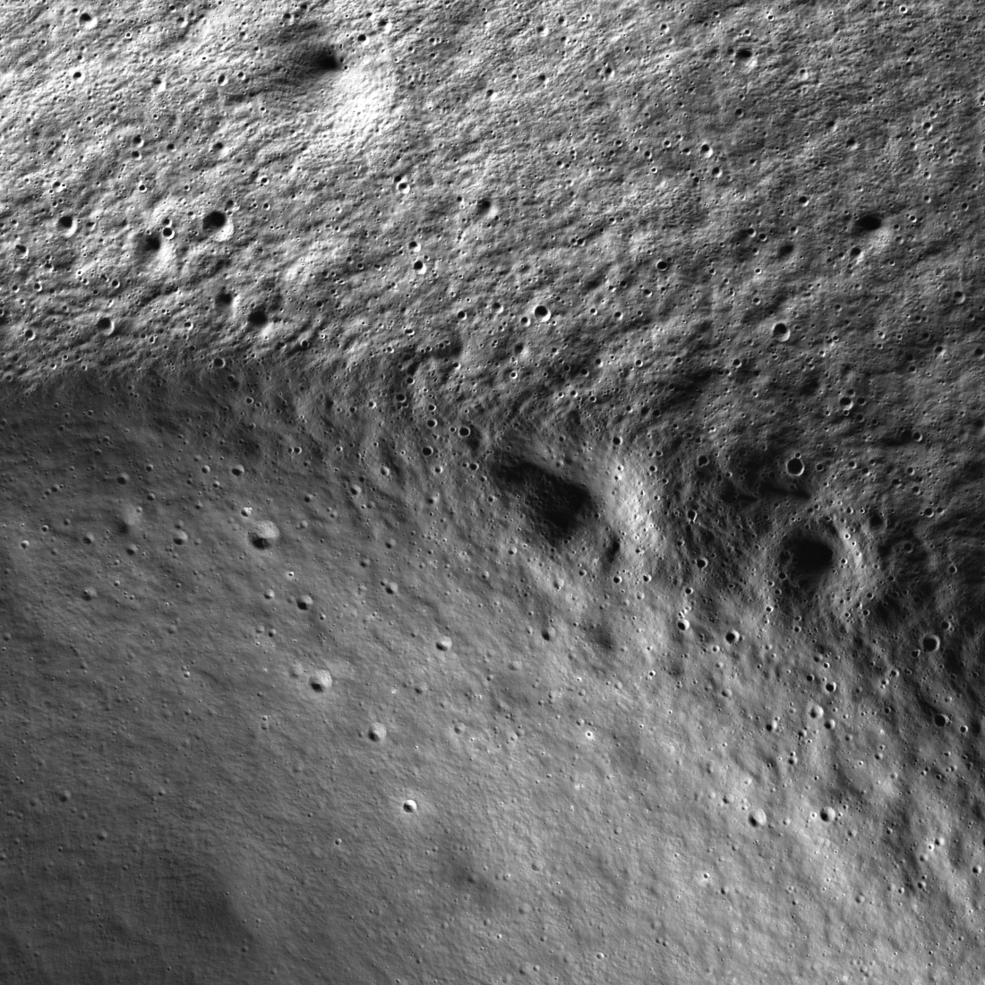
Using this method, Li and his colleagues found several locations reflecting more light than dry regolith would. These are mostly associated with freshly exposed material at relatively young features, such as meteorite impacts. This suggests that the amount of ice water below the surface could be higher than in the top layer. “That’s the highlight of the work,” Li says.
NASA / KARI / ASU
Based on the observations, the researchers set an upper limit to how much surface water the Moon’s poles could hold. Because they understand the camera’s properties so well, they are confident that all of the permanently shadowed regions must contain less than 20% of water ice by weight; Li says most areas contain only a few percent. They also think that this percentage is likely higher at the Moon’s north pole than in the south, having detected a systematically higher albedo in the northern regions.
The finding doesn’t quite match the researchers’ expectations. “We expected to see more,” Li says. Scientists are confident that Mercury has meters of thick ice deposits on its permanently shadowed regions, and they expect the same water-delivery mechanisms on both bodies, including volcanism, asteroid impacts, and the implantation of water molecules by the solar wind. Yet, unlike Mercury, the Moon lacks large ice deposits. It’s hard to explain the difference, Li says.
“I think the paper highlights just how difficult it is to make conclusive observations from orbit,” says Simeon Barber (Open University, UK), who wasn’t involved with the new study. He argues that measurements from the Moon itself are needed to provide some ground truth that could help calibrate orbital observations. “What’s really nice about ShadowCam is that you get a wide range of sites imaged in great detail,” he says. “It’s a really sensitive instrument optimized for looking in in low-light areas, but I think it’s missing that real, true calibration that a lander or a rover mission would give.”
As it stands, the finding is bad news for future human lunar exploration plans. Lots of hope has been put on the possibility of mining this water from the Moon’s poles, both for drinking and for fuel production. But with such low levels, it’s unclear if those plans would be viable.
For his part, Barber thinks the “gold rush” to mine the Moon’s water ice is premature. “We’re getting a little bit ahead of ourselves,” he says. “We genuinely don't know what the concentration of ice is, and that makes a big difference to how accessible and how valuable it is.”
There are a few missions already in the works that will try and settle the question of lunar water ice. Barber is involved in developing a miniature chemical laboratory for PROSPECT, an experiment that will drill beneath the surface at the Moon’s south polar region. The lab will look for water ice in extracted samples. PROSPECT will hitch a ride to the Moon on the Intuitive Machines’ Nova C lunar lander. NASA might also deploy its VIPER rover to the lunar south pole in the coming years.
“What I’m hoping we can do with these landed measurements is to get the detail in a few places,” Barber says. This information can then serve as a calibration point to interpret the data from instruments like ShadowCam. “I think that would be a massive step forward.”
About Javier Barbuzano
Javier Barbuzano is a bilingual Spanish-English science writer and communicator. He graduated from Boston University with a master’s degree in Science Journalism. He writes about many topics, but astronomy and technology are his favorites.



Comments
You must be logged in to post a comment.