 SUNSET:

 7
7Treat yourself to a comet bright enough to see plainly even in moonlight. Tsuchinshan-ATLAS beckons at dusk!

Bob King
Rising from the solar fire, Comet Tsuchinshan-ATLAS (C/2023 A3) triumphantly returned at dusk on October 11th after intense anticipation by amateur astronomers and the public alike. That evening, I drove 15 miles north of home and methodically swept the sky to the right of Venus with binoculars. Exactly 40 minutes after sunset I stopped — there it was! The comet exhibited a tiny, bright coma and a ghostly tail that showed up best in short time exposures with a telephoto lens. Despite excellent sky conditions I saw nothing with the unaided eye.

Chris Cook
But just one night later, the comet's altitude had risen sufficiently that many observers had no problem seeing it without optical aid. Through binoculars the tail grew to 7°. Both single and stacked images revealed rays within the tail and the first signs of the antitail below the comet's head. Already the antitail has narrowed dramatically (as of October 14th) and should continue to mimic a laser beam on Tuesday night, October 15th, as Earth crosses through C/2023 A3's orbital plane.

ESA / NASA / SOHO
Even before C/2023 A3 slipped back into the evening sky we watched its progress across the LASCO C3 coronagraph on the orbiting Solar and Heliospheric Observatory (SOHO). The comet's head arrived first, followed by a bright and brilliant dust tail set aglow by forward-scattered sunlight. The combination dust-and-anti-tail extends for at least 50°!

Bob King
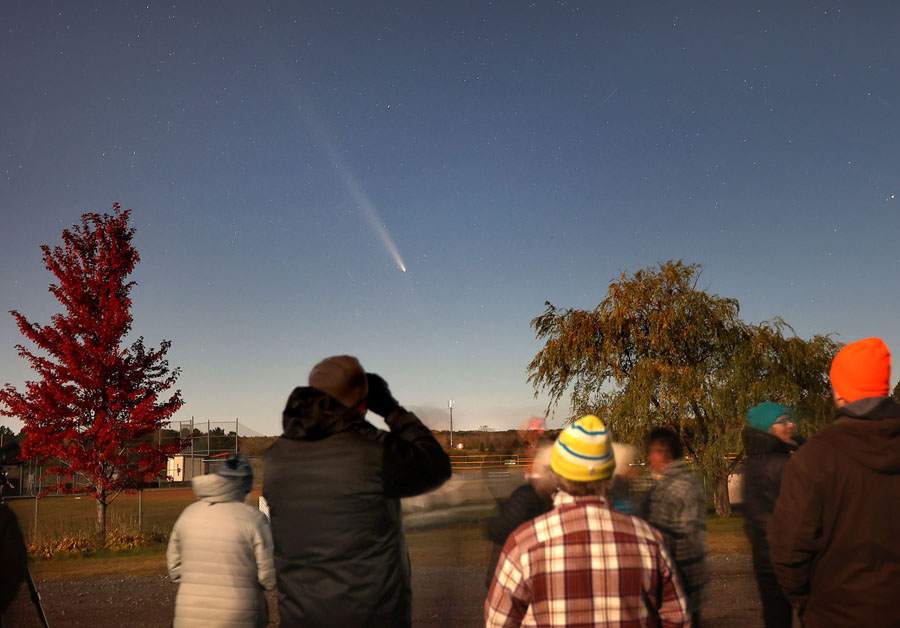
Altitude makes a big difference in being able to trace the full breadth of a comet's tail(s), and we'll have that in spades in the next few weeks as this feathery gem climbs the southwestern sky rung by rung, gaining about ~3° elevation per night. On October 11th when I first spotted the comet at dusk, I needed binoculars to identify it. Two nights later, after it had climbed an additional 7°, not only was the head visible but 5° of tail, too. On October 14th it was a feather of light in the west with a 10° tail visible even in bright moonlight.

Stellarium with additions by Bob King
Parting is such sweet sorrow
The comet is currently visible in the western sky about 2½ fists to the upper right of Venus and dimly visible with the naked eye and binoculars as soon as 45 minutes after local sunset. You'll see it best between 1 and 2 hours after sunset as the sky gets darker. Use this sunrise-sunset calculator to determine when the Sun sets at your location.
C/2023 A3 will slowly fade as it departs Earth's vicinity, traveling faster than 195,000 kilometers per hour on October 15th. Moonlight has been and will continue to be an issue until about October 20th when we'll see the comet again in a dark sky with the Moon three days past full. On that date it should glow at 3rd magnitude, sport both ion and dust tails, and make a splendid naked-eye sight from the countryside. Although it will have dimmed to 6th magnitude by Halloween, rural observers might still glimpse it. The rest of us should easily spot it in binoculars.

Dan Bartlett
This snowball from the cold version of hell will be with us for some time. Even as its brightness takes a slow tumble, the comet will keep a light on for ardent observers, glowing at around magnitude 10.5 in Aquila at year's end. We'll see it fade, shrink, and lose its tail as it returns to deep space. Although C/2023 A3's orbital parameters are still in flux, it will likely not return for millions of years.

Sky & Telescope graphics
Having watched Comet Tsuchinshan-ATLAS evolve from a 13th-magnitude fuzzball last winter into the bright and elegant object that now adorns the evening sky fills me with gratitude. Most comets don't become easy naked-eye objects, making this a precious opportunity for amateurs to witness the myriad facets of a comet's "life" cycle.

Toni Scarmato
Enjoy these additional images. You'll find many more in the Comet Watch and ICQ Comet Observations Facebook groups.

Da Ko
Bob King

Scotty Bishop

Bob King


Eliot Herman
About Bob King
I love the sky (day and night) and have been a skywatcher and amateur astronomer since childhood. I'm also a long-time member of the American Association of Variable Star Observers (AAVSO) and Astronomical League. I pen the Astro Bob blog and have written four books: Night Sky with the Naked Eye (2016); Wonders of the Night Sky You Must See Before You Die (2018) and Urban Legends from Space (2019) and Magnificent Aurora, published in 2024. The universe invites us on an adventure every single night. To accept the invitation, we only need look up.



Comments
bob kelly
October 16, 2024 at 1:26 pm
Where's the most solid information about where this comet came from, when it started heading to the inner solar system, and where is it going? I keep hearing '80,000 year' period, and 'fell in from the Oort Cloud' and 'may be ejected from the solar system'. What's the story with the most data backing it up?
You must be logged in to post a comment.
Karl
October 16, 2024 at 4:00 pm
It sounds like you've got the full story. The future orbit cannot be accurately predicted while the comet is active.
A tiny perturbation near perihelion has a huge effect at aphelion and the comet is emitting unpredictable jets. Gravitational effects of planets are sensitive to slight changes so those can't be precisely predicted yet either.
It was in approximately an 80,000-year orbit while inbound. But the difference between that and escape velocity is very small. So whether the comet will still be bound to the solar system after it quiets down is unknown.
You must be logged in to post a comment.
Bob KingPost Author
October 16, 2024 at 4:21 pm
Hi Bob,
This comet's orbit has been revised (happens often with comets) due to perturbations from the planets. Although it definitely originated in the Oort Cloud, the 80,000-year orbital period is not longer accurate. Instead it appears, for the moment at least, that there's a possibility it may exit the solar system. This according to an update from NASA.
You must be logged in to post a comment.
bob kelly
October 18, 2024 at 8:27 am
Thank you for that update. That's what I've been trying to tell people, but the 80,000 year meme has stuck.
Last night, (17th) those two little stars to the left of the comet were very helpful in finding our fading friend.
People we met were so excited to get their very own photo of the comet on their phone!
It's still great on Carol's iPhone 14 pro.
You must be logged in to post a comment.
Sandeep Joshi
October 17, 2024 at 5:54 am
Wow! Very beautiful pictures!!! And of course, the write up..!
I haven't been lucky enough yet here in Pune, India to catch a glimpse of this beauty in the evening skies. For the past 5-6 days the clouds have played spoilsport here, though I have been checking out daily, just in case they decide otherwise! Not yet.. But I am delighted looking at these wonderful pictures here though I am missing the live show! Hoping to get favorable weather soon...
Just wanted to know - what have been the visual magnitudes for this comet for the past days that it has been visible in the evening? Has it kept up with the expectations? So I know what to expect when I get a chance...
You must be logged in to post a comment.
Bob KingPost Author
October 17, 2024 at 1:09 pm
Hi Sandeep,
I hope it clears soon for you. It's been close to expectations although it's fading now — as expected. At the moment it's about magnitude 3, which makes it appear faint in bright moonlight. About the anti-tail. Although the prediction of its appearance was spot-on, it was fainter than I had imagined, in part due to moonlight. I saw part of it in binoculars but the camera really brought it out well. It was still visible last night, October 16th in an image I made with my Seestar. The tail shows beautifully still even with a smart phone. I think once the moon is out of the picture views will improve again, at least for a time.
You must be logged in to post a comment.
Sandeep Joshi
October 18, 2024 at 3:47 am
Thanks, Bob!
I was actually expecting it to be around magnitude 1-2; especially when the peak magnitude mentioned was about -6.9 or similar (probably in one of your earlier articles) when it was close to the Sun in daytime sky. In this article it's mentioned that on 20th it will be around magnitude 3. If it's already at that magnitude then it would be dimmer by 20th! But maybe without the moonlight then it will be easier to see.
Bt the way, I was able to get some clear skies yesterday, or atleast so I thought. I could see Venus but there were bright clouds (probably powered by moonshine) everywhere else. But Venus gave me some hope and I tried scanning the region with my binoculars for about 30-35 minutes. But no luck! Probably it was either hazy or plain cloudy even there! I will keep trying everyday though..
You must be logged in to post a comment.
You must be logged in to post a comment.