 SUNSET:

 7
7FRIDAY, DECEMBER 13
■ The Moon, a day from full, shines above Jupiter and Aldebaran at nightfall and lower left of the Pleiades, as shown below. Cover the glary Moon with your finger to help bring out the faint Pleiades stars.
As the evening grows late, this whole arrangement climbs higher and rotates clockwise. By about 11 p.m. the Pleiades will be directly right of the Moon, and Jupiter and Aldebaran will both be lower left of it.

■ Saturn's two largest moons, Titan and Rhea, will form a telescopic "double star" 7 arcseconds apart as they pass each other this evening. Their minimum separation will come around 5:59 p.m. EST, just after dark for eastern North America. Rhea will be south of brighter Titan. Watch them pulling apart for the rest of the evening, or already pulling apart at nightfall if you're observing from a location farther west.
Titan and Rhea are magnitudes 8.5 and 10.0, respectively. Pick them up about one ring-length to Saturn's celestial west, then switch to high power.
SATURDAY, DECEMBER 14
■ The full Moon shines all night. It's exactly full at 4:o2 a.m. Sunday morning EST. So the Moon this evening is just a few hours before its opposition. And Jupiter is just a week past its opposition. So it's no surprise that they shine close together in the sky: opposite the Sun.
■ The Moon forms a line with Jupiter and Aldebaran to its right, as shown above. For most of the night in most places, the line will gently curve. But the Moon will make an exact straight line with Jupiter and Aldebaran in late evening for most of eastern and central North America, and earlier in the evening for most of western North America.
■ By midnight the Moon will be very high, not far from the zenith. The full Moon of the Christmas season rides higher across the sky at midnight than at any other time of year, thus "giving lustre of midday to objects below."
Why? December is the month of the solstice, when the Sun is farthest south in the sky. So, this is when the full Moon (opposite the Sun) is farthest north. As it makes its way across the night sky, the December full Moon acts as a pale, cold imitation of the hot June Sun crossing the daytime sky half a year ago.
■ The Geminid meteor shower, often the richest of the year, should be at its peak late tonight. But the full moonlight will hide many of its meteors, leaving only the brightest ones to shine through. In the evening the meteors will be fewer still, but those that do appear will be long, graceful Earth-grazers skimming far across the top of the atmosphere.
The best direction to watch? Wherever your sky is darkest and the Moon can be kept out of your eyes.
So don't write this shower off. See Bob King's Don't Let the Bright Moon Ruin Your Geminids.
SUNDAY, DECEMBER 15
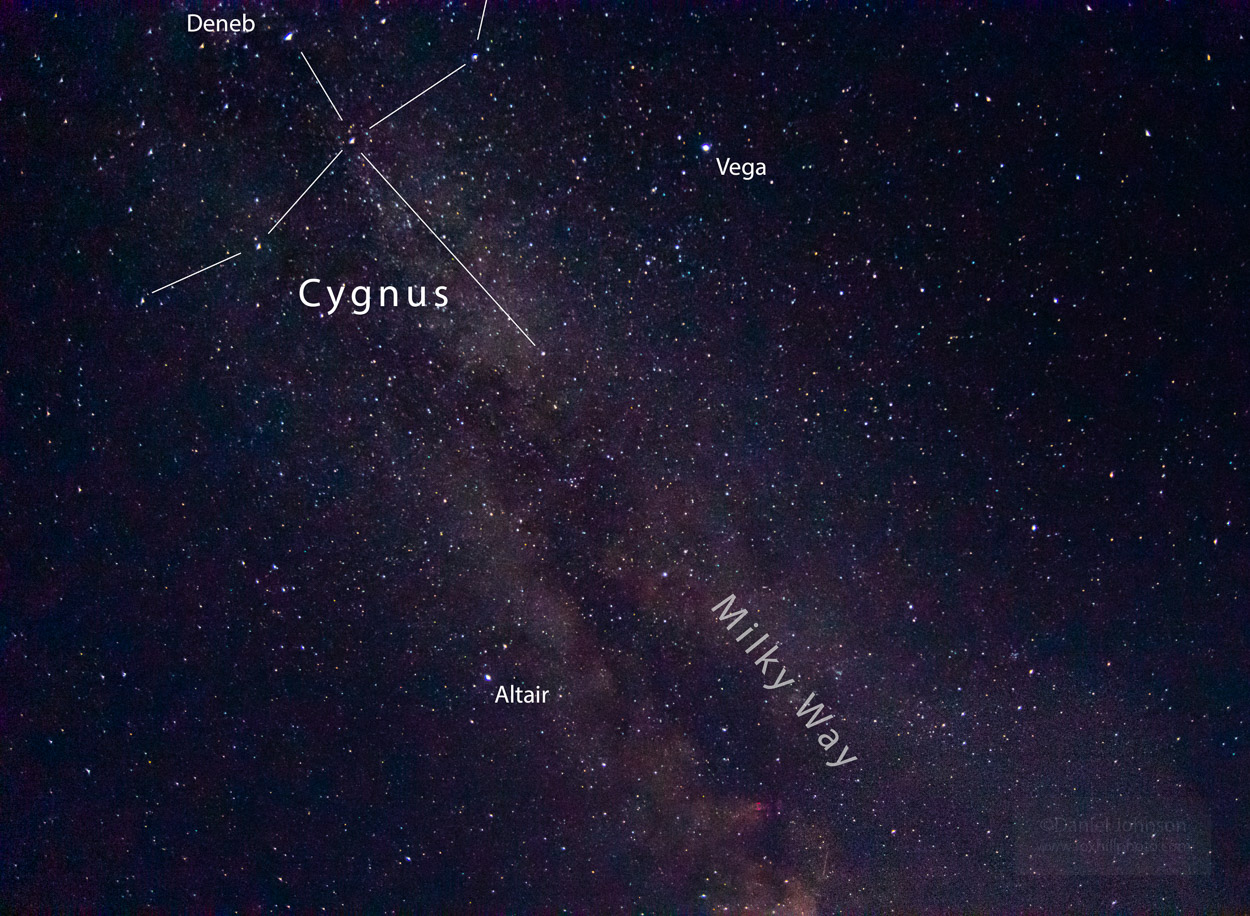
■ The Summer Triangle is finally sinking low in the west, and Altair is the first of its stars to go (for mid-northern skywatchers).
Start by spotting bright Vega, magnitude zero, the brightest star in the northwest right after dark. The brightest one above Vega is Deneb. The Triangle's third star, Altair, is farther to Vega's left or lower left. How late into the night, and into the advancing season, can you keep Altair in view?
■ Algol overhead should be at its minimum brightness for about two hours centered on 9:58 p.m. EST. Comparison-star chart, with north up. (Celestial north is always the direction in the sky toward Polaris from wherever you are looking. Outside at night, turn the chart around to match.)
MONDAY, DECEMBER 16
■ The Moon, now waning gibbous, rises around the end of twilight and is reasonably high by an hour later. It forms a triangle with Pollux and Castor about 5° to its right. Watch the triangle change shape through the night as the Moon moves eastward along its orbit.
TUESDAY, DECEMBER 17
■ Late this evening, the bright white waning Moon shines in the east just above fire-colored Mars. They rise about an hour after dark and are nicely up an hour later. These are currently the closest major objects in the solar system, 1.3 light-seconds and 5.9 light-minutes from your eyes.
■ Jupiter's inner moon Io starts crossing Jupiter's face at 7:05 p.m. EST, followed by its tiny black shadow (much more visible) 15 minutes later. They enter from Jupiter's celestial-east side. They depart from Jupiter's other side at 9:16 and 9:33 p.m. EST, respectively. Io is Jupiter's fastest-moving major satellite.
Meanwhile, Jupiter's (no longer so) Great Red Spot should cross Jupiter's central meridian around 7:21 p.m. EST.
WEDNESDAY, DECEMBER 18
■ Have you ever watched a Sirius-rise? Find an open view right down to the east-southeast horizon, and watch for Sirius to come up about two fists at arm's length below Orion's vertical Belt. Sirius rises around 8 p.m. now, depending on your location.
About 15 minutes before Sirius-rise, a lesser star comes up barely to the right of where Sirius will appear. This is Beta Canis Majoris or Mirzam. Its name means “the Announcer,” and what Mirzam announces is Sirius. You’re not likely to mistake them; the second-magnitude Announcer is only a twentieth as bright as the King of Stars soon to make its grand entry.
When a star is very low it tends to twinkle slowly, and often in vivid colors. Sirius is bright enough to show these effects well, especially in binoculars.
THURSDAY, DECEMBER 19
■ Now the late-night waning Moon pairs up with Regulus. Look east after about 10 p.m.
■ Last year, this year, and next, we see the orbital plane of Jupiter's moons tilted a bit to our line of sight. So from our viewpoint, the moons can deviate from their usual nearly straight line east and west of the planet.
For instance, tonight around midnight EST, when Jupiter is high for all of North America, Ganymede, Callisto, and Europa form a surprising isoceles triangle east of the planet, while Io looks on from Jupiter's western side as shown below.
For four other odd configurations this winter, see Joe Rao's More Unusual Jovian Satellite Lineups.

FRIDAY, DECEMBER 20
■ Sirius and Procyon in the balance. Sirius, the Dog Star, sparkles low in the east-southeast after dinnertime. Procyon, the Little Dog Star, shines to its left in the east about two fist-widths at arm's length from Sirius.
But directly left? That depends. If you live around latitude 30° (Tijuana, Austin, New Orleans, Jacksonville), the two canine stars will be at the same height above your horizon soon after they rise. If you're north of that latitude, Procyon will be higher. If you're south of there, Sirius will be the higher one. Your eastern horizon tilts differently with respect to the stars depending on your latitude.

■ You are remembered, Carl Sagan (November 9, 1934 – December 20, 1996).
SATURDAY, DECEMBER 21
■ This is the shortest day of the year in the Northern Hemisphere; the longest day in the Southern Hemisphere. The solstice occurs at 4:20 a.m. EST, when the Sun reaches its farthest southern declination and begins its six-month return northward. At sunrise I will be with a crowd of fellow oddballs from church singing up the Sun by a lakeside, just so it doesn't forget to begin its return. You can thank us for the coming spring and summer. Works every year.
SUNDAY, DECEMBER 22
■ How well do you really know the Orion's Belt region in binoculars? Can you piece out Orion's S, which begins and ends with the belt's two westernmost stars?
The Belt marks the rough center portion of the Orion OB1 Association, called OB1b. Are you aware of Orion OB1a and OB1c on either side of it? Binoculars are all you need, along with Matt Wedel's Binocular Highlight column and map in the January Sky & Telescope, page 43.
■ Last-quarter Moon (exact at 5:18 p.m. EST). The Moon rises around midnight, under the hind feet of Leo.
This Week's Planet Roundup
Mercury is emerging to become an easy sight in early dawn. About 40 minutes before sunrise, look for it low in the east-southeast. It brightens this week from a paltry magnitude +0.7 on Saturday morning December 14th to a showier –0.2 by the 21st.
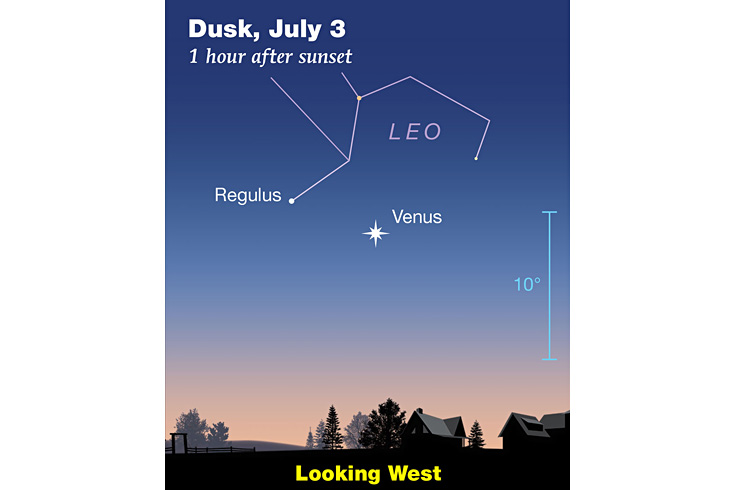
Venus (magnitude –4.3) shines high in the southwest in evening twilight, crossing central Capricornus. It's now high enough to remain up for two hours after dark before setting. In a telescope Venus is slightly gibbous (about 61% sunlit) and 19 or 20 arcseconds from pole to pole.
Mars (about magnitude –0.9, in Cancer) rises in the east-northeast by about 8 p.m. It's just past its pre-opposition stationary point, so it still forms the right angle of a right triangle with Castor and Pollux above it and Procyon to its right. Mars remains 50° east along the ecliptic from brighter Jupiter.
Once Mars is well up this week, use binoculars to find M44, the Beehive star cluster, 2° or 3° below it.
Mars shows best in a telescope when very high toward the southeast or south by midnight. It has enlarged to 12 arcseconds in apparent diameter, on its way to a relatively distant (aphelic) opposition on January 15th. It will be closest to Earth three days before that, with an apparent diameter of 14.6 arcseconds.
Jupiter, two weeks past its opposition, shines at a bright magnitude –2.8 in Taurus. Spot it climbing in the east-northeast as twilight fades. As dusk deepens, watch for Aldebaran and slightly fainter El Nath (Beta Tauri) to come into view to its right and left.
Jupiter is at its telescopic best when very high toward the southeast or south by 9 or 10 p.m. It's still 48 arcseconds wide.
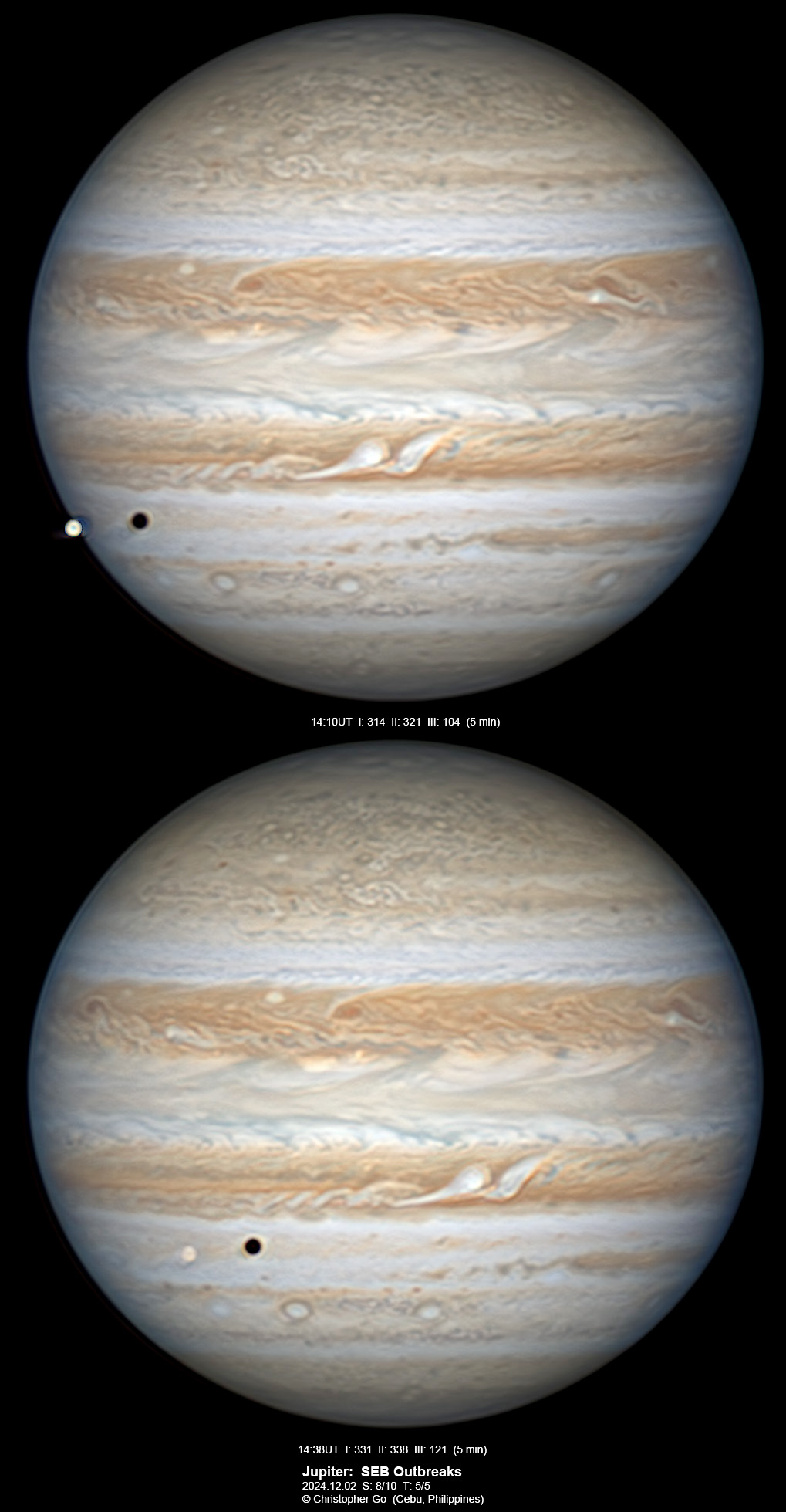
North here is up. Go writes, "The [big white] outbreak on the SEB [South Equatorial Belt] looks incredible! There are TWO outbreaks now! There is even a [small white] outbreak on the NEB" [look right]. White outbreaks on Jupiter and Saturn are thermal upwellings of white clouds. Think of thunderheads on Earth, but much, much larger.
Saturn, magnitude +1.0 in Aquarius, glows high in the south-southwest after dark. Don't confuse it with Fomalhaut twinkling two fists below it. Saturn is now about 33° east of Venus along the ecliptic. Watch them close in on each other toward their conjunction on January 18th, when they'll pass each other by 2.2°.

Uranus (magnitude 5.6, at the Taurus-Aries border) is high in the southeast during evening, about 7° from the Pleiades. You'll need a good finder chart to tell it from its similar-looking surrounding stars; see the November Sky & Telescope, page 49.
Neptune (tougher at magnitude 7.9, under the Circlet of Pisces) is high in the south after dark, 14° east of Saturn. Again you'll need a sufficient finder chart.
All descriptions that relate to your horizon — including the words up, down, right, and left — are written for the world's mid-northern latitudes. Descriptions and graphics that also depend on longitude (mainly Moon positions) are for North America.
Eastern Standard Time (EST) is Universal Time minus 5 hours. UT is also known as UTC, GMT, or Z time.
Want to become a better astronomer? Learn your way around the constellations. They're the key to locating everything fainter and deeper to hunt with binoculars or a telescope.
This is an outdoor nature hobby. For a more detailed constellation guide covering the whole evening sky, use the big monthly map in the center of each issue of Sky & Telescope, the essential magazine of astronomy.
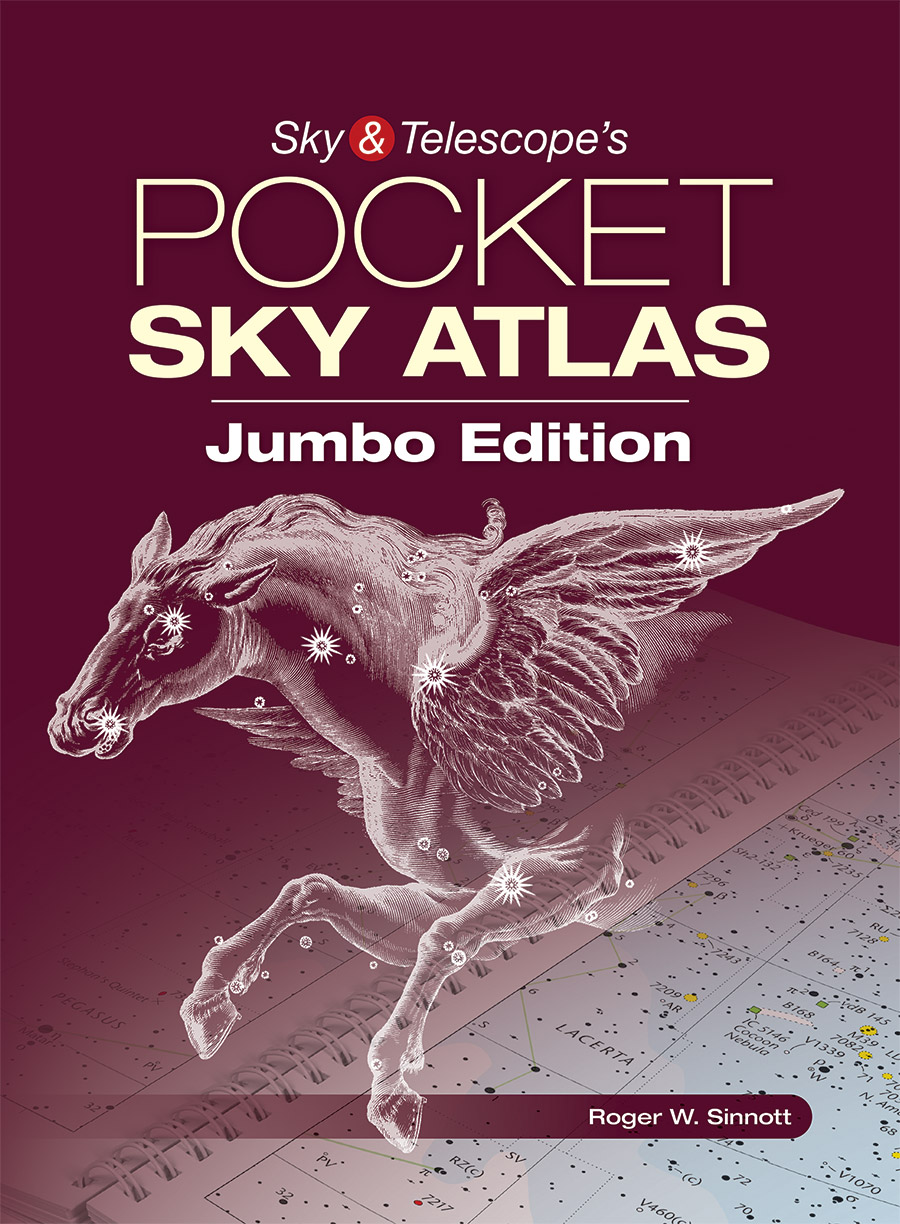
Once you get a telescope, to put it to good use you'll need a much more detailed, large-scale sky atlas (set of charts). The basic standard is the Pocket Sky Atlas, in either the original or Jumbo Edition. Both show all 30,000 stars to magnitude 7.6, and 1,500 deep-sky targets — star clusters, nebulae, and galaxies — to search out among them.
Next up is the larger and deeper Sky Atlas 2000.0, plotting stars to magnitude 8.5; nearly three times as many, as well as many more deep-sky objects. It's currently out of print, but maybe you can find one used.
The next up, once you know your way around well, are the even larger Interstellarum atlas (201,000+ stars to magnitude 9.5, and 14,000 deep-sky objects selected to be detectable by eye in large amateur telescopes), andUranometria 2000.0 (332,000 stars to mag 9.75, and 10,300 deep-sky objects). And read How to Use a Star Chart with a Telescope. It applies just as much to charts on your phone or tablet as to charts on paper.
You'll also want a good deep-sky guidebook. A beloved old classic is the three-volume Burnham's Celestial Handbook. An impressive more modern one is the big Night Sky Observer's Guide set (2+ volumes) by Kepple and Sanner. The pinnacle for total astro-geeks is the new Annals of the Deep Sky series, currently at 11 volumes as it works its way forward through the constellations alphabetically. So far it's up to H.
Can computerized telescopes replace charts? Not for beginners I don't think, and not for scopes on mounts and tripods that are less than top-quality mechanically. Unless, that is, you prefer spending your time getting finicky technology to work rather than learning how to explore the sky. As Terence Dickinson and Alan Dyer say in their Backyard Astronomer's Guide, "A full appreciation of the universe cannot come without developing the skills to find things in the sky and understanding how the sky works. This knowledge comes only by spending time under the stars with star maps in hand and a curious mind." Without these, "the sky never becomes a friendly place."
If you do get a computerized scope, make sure that its drives can be disengaged so you can swing it around and point it readily by hand when you want to, rather than only slowly by the electric motors (which eat batteries).
However, finding faint telescopic objects the old-fashioned way with charts isn't simple either. Do learn the essential tricks at How to Use a Star Chart with a Telescope.
 Audio sky tour. Out under the evening sky with your
earbuds in place, listen to Kelly Beatty's monthly
podcast tour of the naked-eye heavens above. It's free.
"The dangers of not thinking clearly are much greater now than ever before. It's not that there's something new in our way of thinking, it's that credulous and confused thinking can be much more lethal in ways it was never before."
— Carl Sagan, 1996
"Facts are stubborn things."
— John Adams, 1770
About Alan MacRobert
Alan M. MacRobert became an avid Sky & Telescope subscriber in 1966 at age 14, joined the editorial staff in 1982, and is now a senior contributing editor, semi-retired. He played a role in practically every part of the magazine and the company's other products for more than a generation, both on the amateur-observing side and the science-reporting side. In 1994 a book collection of his observing how-tos and telescopic sky tours was published as Star Hopping for Backyard Astronomers. He has produced This Week's Sky at a Glance online every week since 1989.




Comments
misha17
December 15, 2024 at 2:21 am
Re: "SATURDAY, DECEMBER 14
■ The full Moon shines all night. It's exactly full at 4:02 a.m. Sunday morning EST. ...
■ By midnight the Moon will be very high, not far from the zenith. ... Why? December is the month of the solstice, when the Sun is farthest south in the sky. So, this is when the full Moon (opposite the Sun) is farthest north."
The Moon's orbit is tilted 5 degrees from the Ecliptic, which is why we don't get eclipses at every New Moon and Full Moon. Right now, the high point of the orbit lies a few degrees East of the June Solstice point, and is is retrograding westwards towards the Solstice point. As result, the December Full Moon will be 28 degrees above the Celestial Equator (the Sun in June is "only" 23 degrees above the C.E.), and in southern Florida and southern Texas the Moon will pass ~north~ of overhead when it crosses the meridian (at "lunar noon").
Adding to the brightness, the Moon just finished a series of "Super Moons" when the Full Moon occurred a day or so away from perigee. Thr December Full Moon won't be as close as those Super Moons, but it is still closer than average, so it will be a little brighter and larger than usual.
For reference, Jupiter lies about 1 degree South of where the June SolsticeSun will be, while Aldebaran is about as far south of the Solstice point as the Moon gets as its orbital tilt completes 18-year journey around the Ecliptic. The Moon occulted the star 9 years ago, and will do again in another 9 years.
You must be logged in to post a comment.
misha17
December 15, 2024 at 2:30 am
Of course, for viewers in the Southern Hemisphere, their Summer Solstice is only a week away, so the December Full Moon lies low in the sky where their Winter Sun appears. The tilt in the Moon's orbital inclination puts this Full Moon even further south; it lies 5 degrees lower in the sky than their Winter Sun.
You must be logged in to post a comment.
mary beth
December 16, 2024 at 11:42 am
All good information, thank you. I’ve been curious about the moon’s distance from the ecliptic. Thank you for the references with Jupiter and Aldebaran.
You must be logged in to post a comment.
misha17
December 19, 2024 at 8:05 pm
Your welcome. I've posted a few times recently that the star El Nath lies at the high point of the Moon's inclination. Right now Jupiter lies about midway between Aldebaran and El Nath, so if you start a line at Aldebaran, pass it through Jupiter, and continue it about the same distance above Jupiter, you will reach El Nath, and get a good idea of the span of the Moon's orbital inclination above and below the Ecliptic.
You must be logged in to post a comment.
mary beth
December 19, 2024 at 11:47 pm
Oh good! I’m familiar with Elnath, no problem seeing it (usually notice it most in late Spring when in the west)
Marry Christmas to you and yours!
You must be logged in to post a comment.
AB
December 15, 2024 at 4:24 pm
"Singing up the sun" sounds like a fun thing to do. I wish I knew such cool people. You should post a little video 🙂
You must be logged in to post a comment.
Alan MacRobertPost Author
December 17, 2024 at 7:05 pm
Thanks AB!
> I wish I knew such cool people.
Try checking out your local Unitarian-Universalist church. Ours is probably no cooler/weirder than average.
🙂
--Alan MacRobert
You must be logged in to post a comment.
You must be logged in to post a comment.