 SUNSET:

 0
0FRIDAY, DECEMBER 26
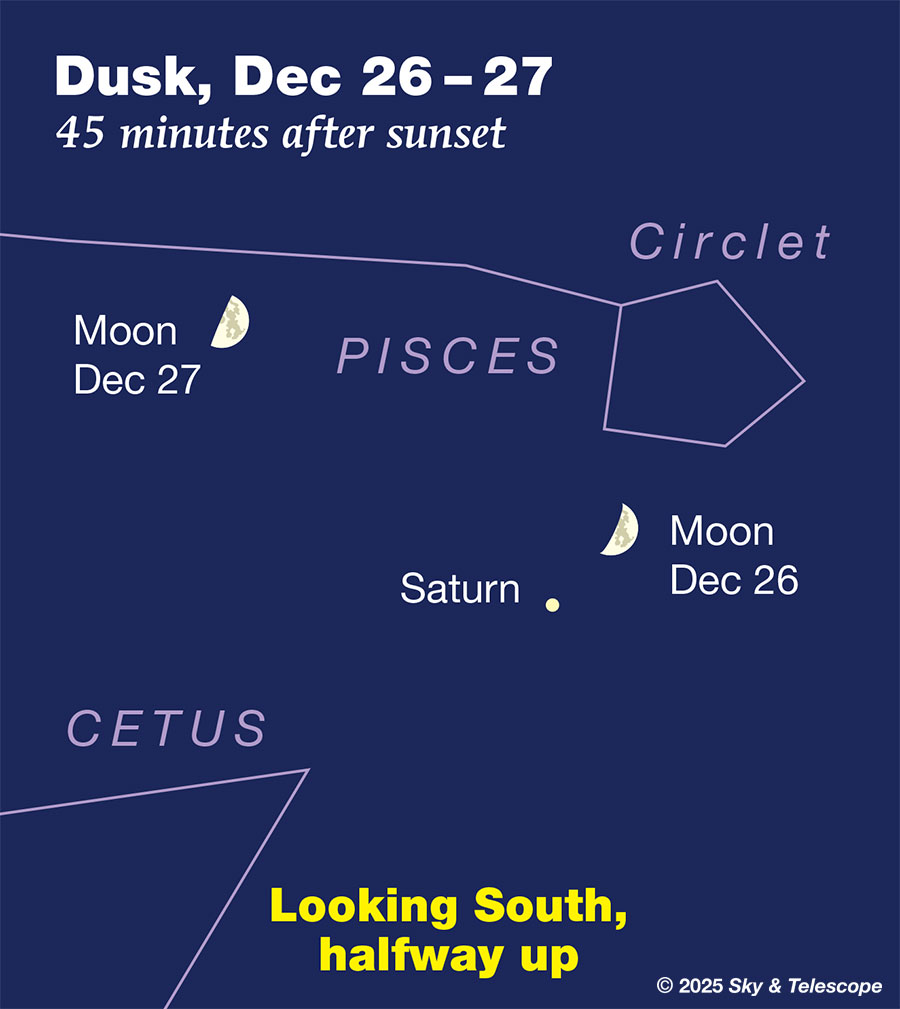
■ This evening the Moon has its monthly conjunction with Saturn, but an unusually close one. They're only 3° apart for evening viewers in the Americas, as shown below.
SATURDAY, DECEMBER 27
■ First-quarter Moon (exactly so at 2:10 p.m. EST). At dusk the Moon shines one fist or a little more to the upper left of Saturn, as shown above. Spot Fomalhaut nearly three fists below Saturn; they're almost exactly equal in brightness.
By 8 p.m. the Moon hangs straight above Saturn, now lower in the southwest, and Fomalhaut is nearly setting.
■ This is the time of year when Orion strides well up in the east-southeast after dinnertime, although his three-star Belt is still nearly vertical. The Belt points up toward Aldebaran (more or less) and, even higher, the Pleiades. In the other direction, it points down to where bright Sirius will rise around 7 or 8 p.m., twinkling furiously.
SUNDAY, DECEMBER 28
■ The waxing Moon, a day past first quarter, offers a dramatic panorama to telescope users. In the Moon's north the sunrise terminator crosses the middle of big, round Mare Imbrium (the "Sea of Rains"), which is ringed by mountains and sports flat-floored Plato just off its northern rim.
Just south of Imbrium's mountain-edge, the terminator starkly dramatizes Copernicus. Near the Moon's south limb, the terminator has unveiled bigger Clavius with its unique curving chain of four internal craters.
MONDAY, DECEMBER 29
■ The Moon has waxed quite visibly since yesterday. Now a telescope shows almost all of Mare Imbrium sunlit, with Copernicus out in the clear. The terminator crosses big, semicircular Sinus Iridum ("Bay of Rainbows") on Imbrium's northern edge.
■ When you're done with the Moon give your eye a couple minutes for some of the brightness to wear off if necessary, then look three finger-widths above the Moon for the two brightest stars of Aries: Alpha Arietis on the left and Beta on the right. They're magnitudes 2.0 and 2.6, respectively. Now find fainter Gamma, hardly a finger-width lower right of Beta. It's magnitude 3.9.
Gamma Arietis is a fine telescopic double star. Both of its components are magnitude 4.6 and white. They're lined up almost precisely north-south, 7.4 arcseconds apart.
The pair is 165 light years away, and each star is 42 times as luminous as the Sun. They're at least 370 a.u. apart, which is at least 12 times Neptune's distance from the Sun. So each of them could have a planetary system undisturbed by the other. But they are very young: only about 34 million years old.
TUESDAY, DECEMBER 30
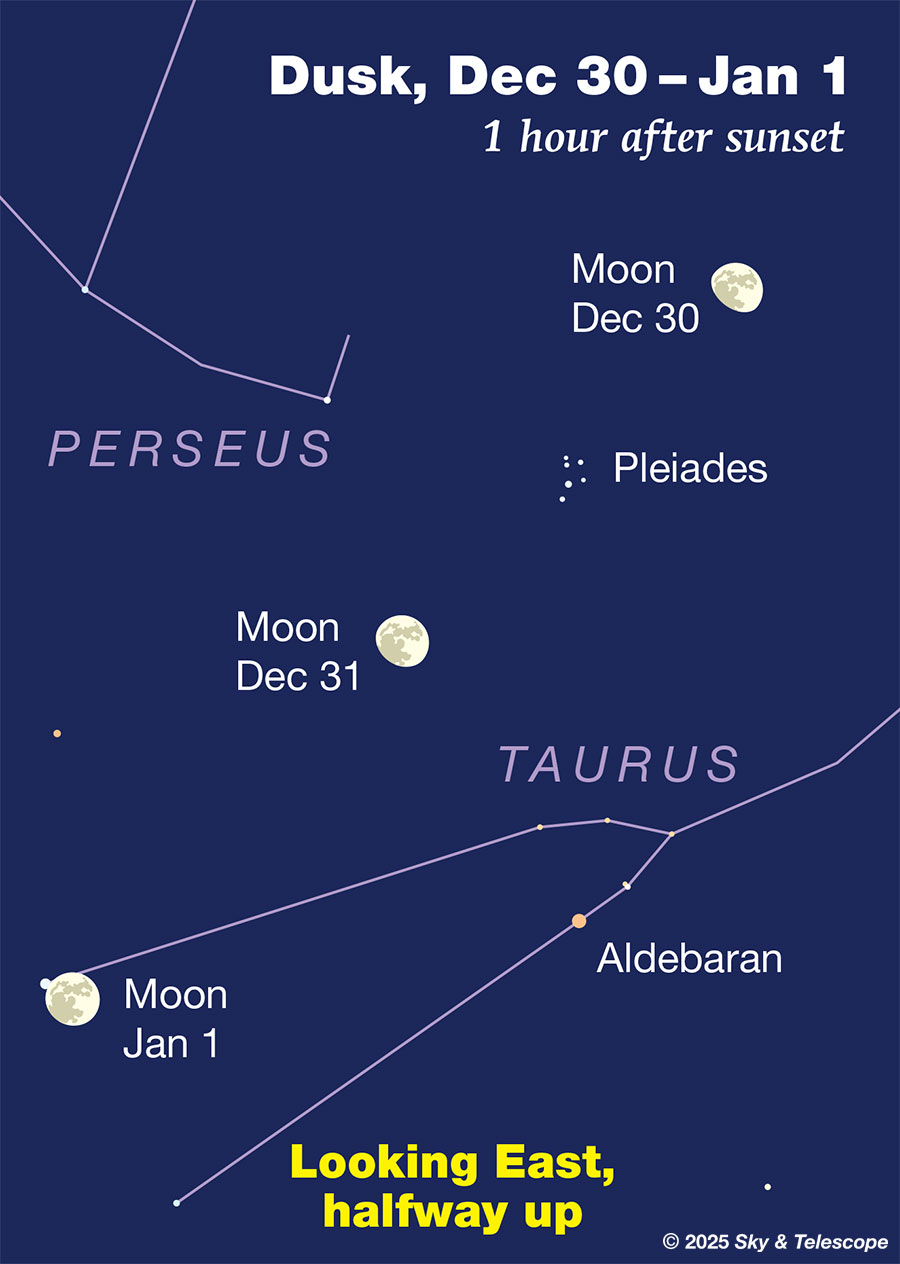
■ Look lower left of the Moon for the Pleiades, as shown below. Cover the Moon, brightening daily, with your hand to help reveal the delicate stars. The six brightest are 3rd to 5th magnitude.
WEDNESDAY, DECEMBER 31
■ After the noisy celebrating at the turn of midnight tonight, step outside into the silent, moonlit night. Shining far to the left of the Moon will be Jupiter, second only to the Moon in brightness. Below Jupiter is Procyon, and below Procyon with a jog to the right is brighter Sirius. It's almost due south (depending on your location east-west in your time zone).
Sirius is the bottom star of the equilateral Winter Triangle. The others are Betelgeuse to Sirius's upper right in Orion's shoulder, and Procyon the same distance to Sirius's upper left. The Triangle now stands upright, just about in balance as the old year tips into the new.
THURSDAY, JANUARY 1
■ During the hour after full night arrives, face north-northwest and spot Cassiopeia very high. Cas is usually called a wide letter W, but now it's upside down: a wide M. If you have a dark, clear sky and give your eyes time to adapt to the dark, you can see that the narrow winter Milky Way runs right through it.
Look again five hours later, around 1 a.m., and Cas will be standing on end lower in the northwest. At that point it's a tossup which letter to call it.
FRIDAY, JANUARY 2
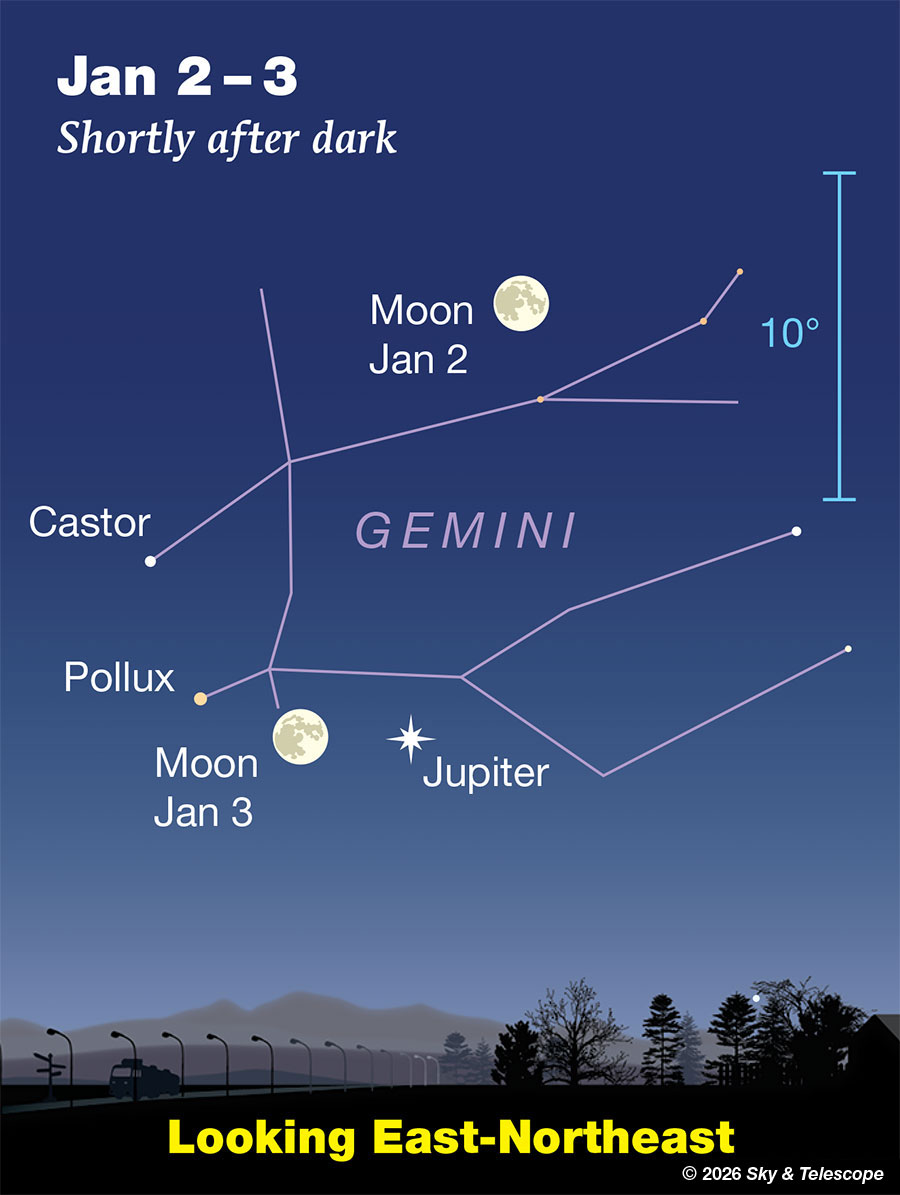
■ Full Moon (exactly full at 5:03 a.m. Saturday morning EST). It's above Jupiter, Castor, and Pollux this evening as shown below.
■ Jupiter's Great Red Spot should cross Jupiter's central meridian (the line down its middle from pole to pole) around 8:39 p.m. EST. The spot is closer to Jupiter's central meridian than to the limb for 50 minutes before and after its transit times.
SATURDAY, JANUARY 3
■ This evening the Moon is nearly as full as it was yesterday evening (for the Americas). Tonight it shines right in the midst of Jupiter, Pollux, and Castor, as shown above.
■ The annual Quadrantid meteor shower be at its peak, but the light of the full Moon will flood the sky all night. Moreover, the shower's predicted peak (relatively brief from about 18:00 to 24:00 UT January 3rd) is almost exactly a half day out of sync with the best meteor-watching hours for North America. A poor year for the Quads.
■ Earth passes through perihelion, its closest to the Sun for the year. But we're only 3% closer to the Sun now than we are at aphelion in July.
SUNDAY, JANUARY 4
■ In the cold of early January, the bowl of the Little Dipper hangs straight down from Polaris around 8 or 9 p.m. — as if (per Leslie Peltier) from a nail on the cold north wall of the sky.
The brightest star of the Little Dipper's dim bowl is Kochab, at the bowl's lip. It's the equal of Polaris. Kochab passes precisely below Polaris around 8 p.m. now, depending on how far east or west you live in your time zone.
■ Jupiter's Great Red Spot should cross the Jupiter's central meridian around 10:16 p.m. EST (7:16 p.m. PST).
This Week's Planet Roundup
Mercury sinks down out of sight in the glow of sunrise this week.
Venus and Mars are completely out of sight behind the glare of the Sun.
Jupiter (magnitude –2.6, in eastern Gemini), is nearing its January 10th opposition. It rises in the east-northeast in twilight. It dominates the eastern sky as the evening proceeds, then the high southeast. Castor and Pollux shine nearby. Jupiter is highest and telescopically sharpest in the south by midnight. It's a big 47 arcseconds wide (big for a planet, that is).
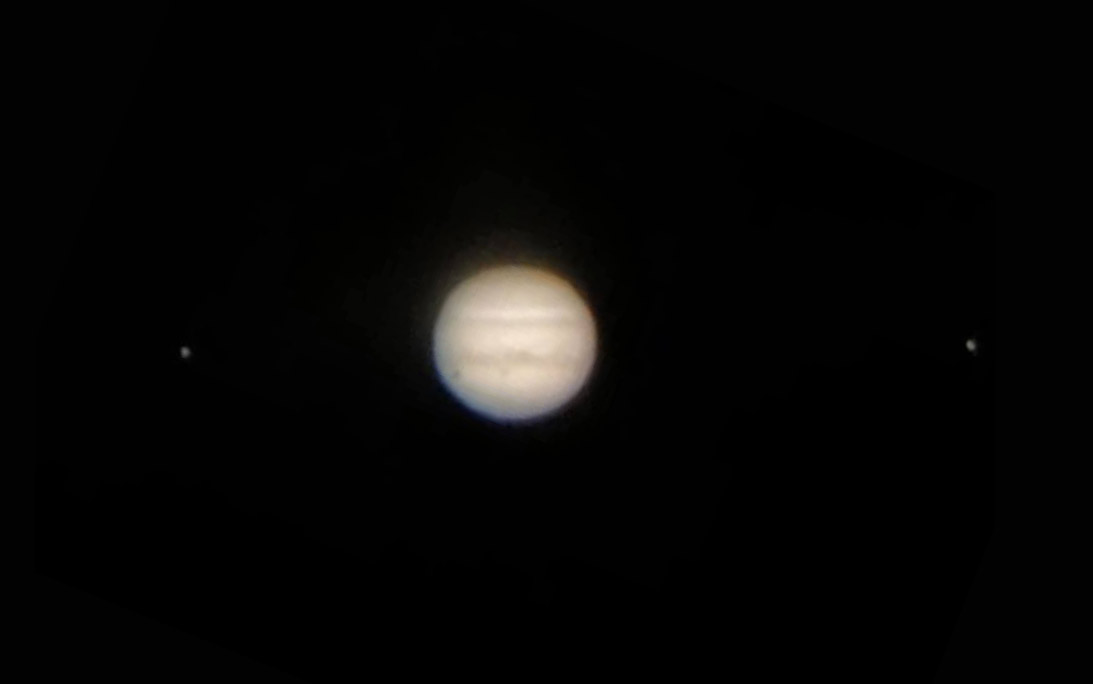
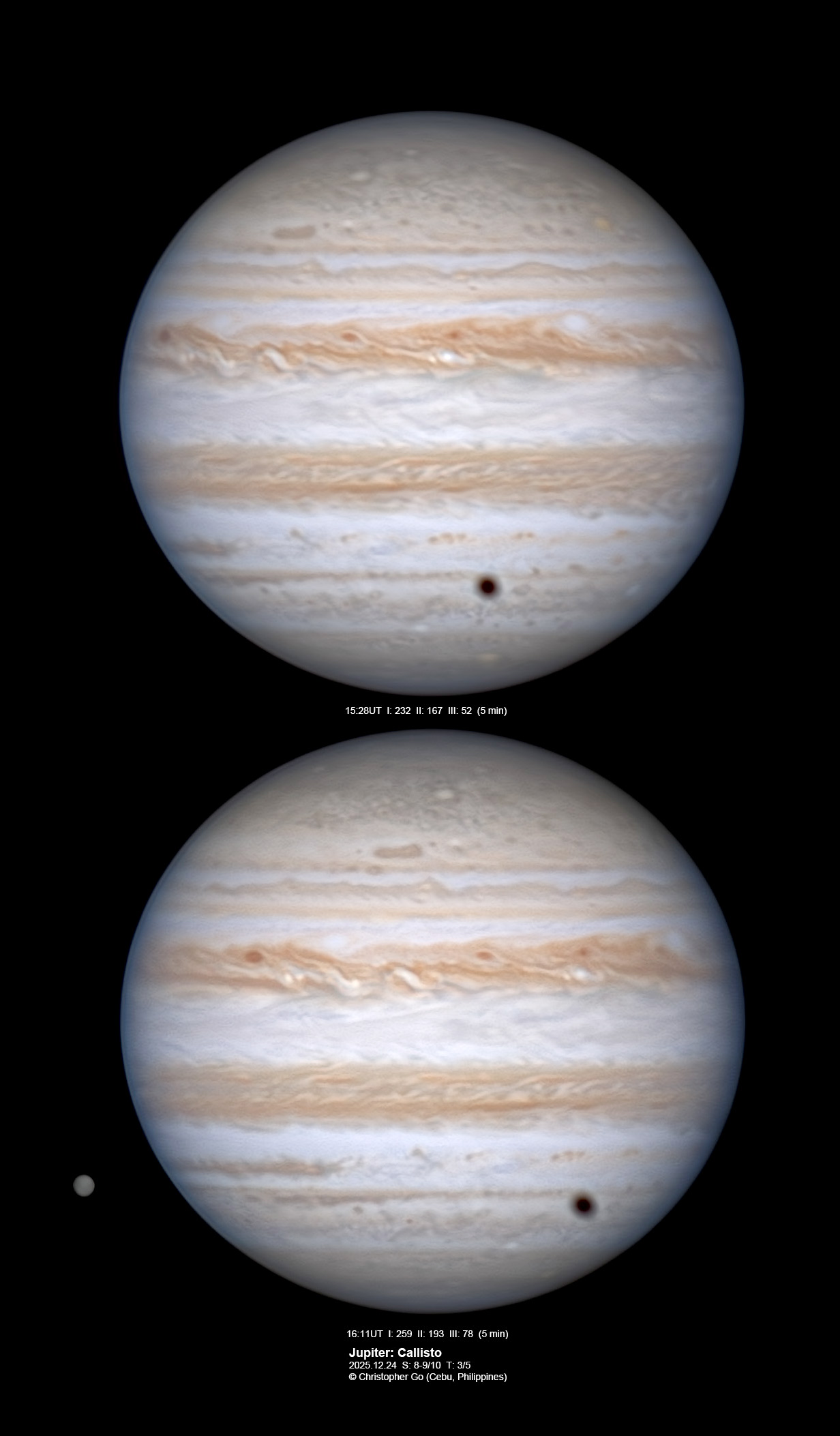
Go writes, "It is interesting to see that Callisto's shadow has a penumbra!" That's caused by Callisto being quite a bit farther from Jupiter than the other three Galilean satellites.
Saturn (magnitude +1.1, at the Aquarius-Pisces border) is the brightest dot high in the south-southwest at nightfall, lower left of the Great Square of Pegasus. It gets lower in the southwest through the evening and sets around 11 p.m.
Below Saturn, by almost three fists at arm's length, you'll find Fomalhaut, similar to Saturn in brightness. The two of them form a big isosceles triangle (two equal sides) with Beta Ceti, less bright, about half as far to Saturn's lower left.
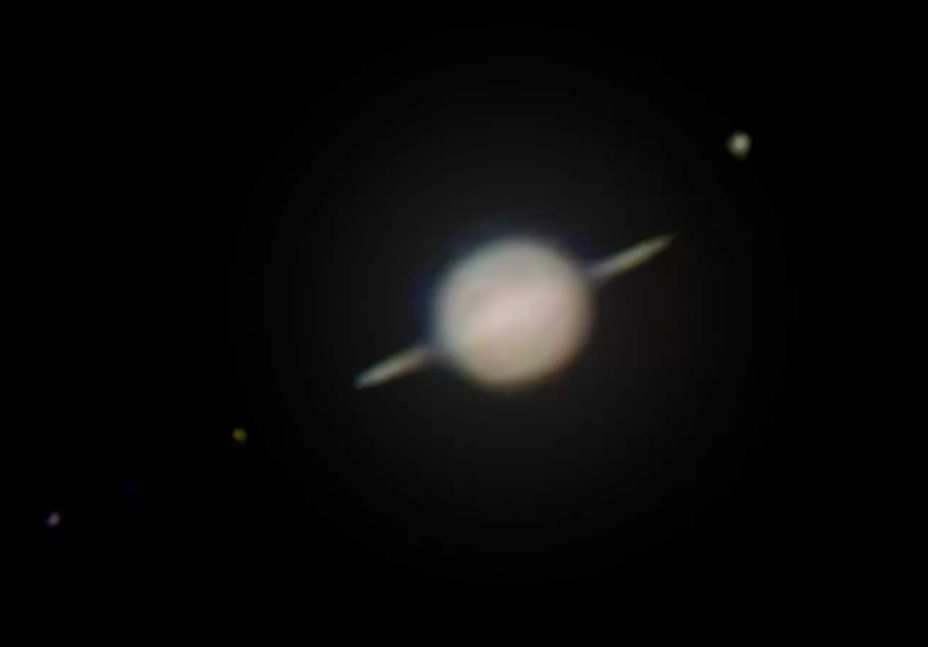
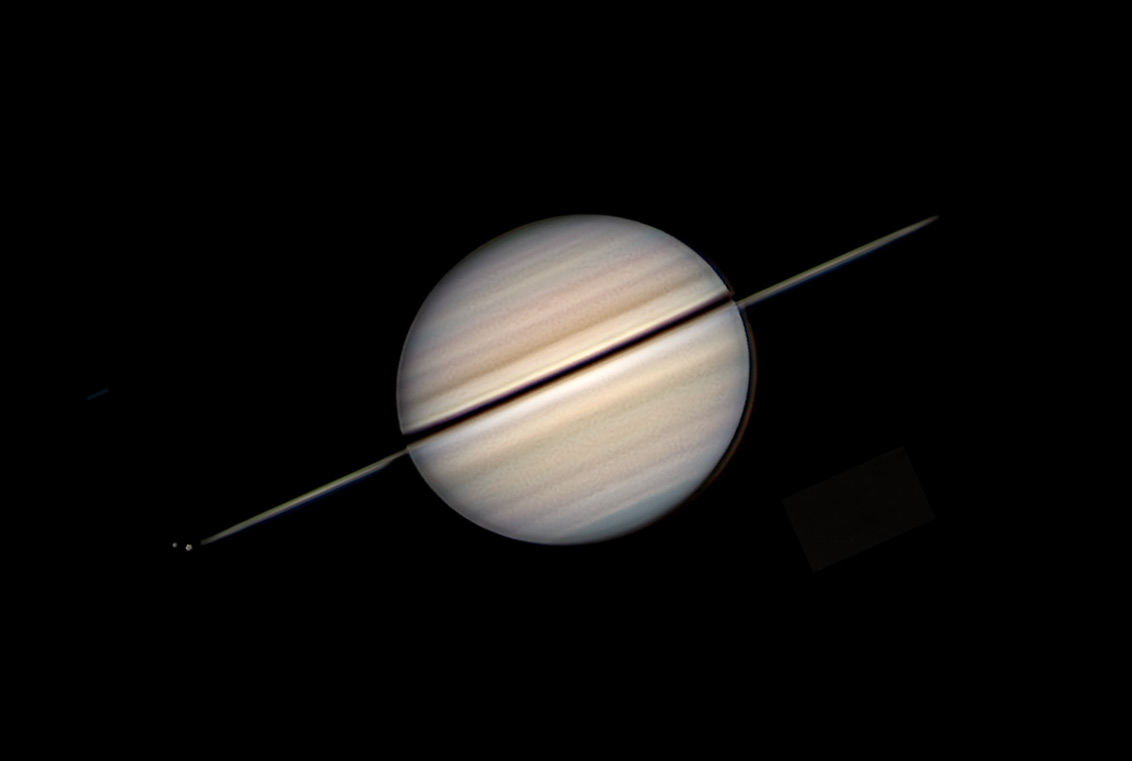
In a telescope Saturn's rings remain close to edge on; they're tilted 1° to our line of sight. For more goings-on at Saturn, see Bob King's See Saturn's Rings at Their Thinnest. He suggests using the rings' near-absence to try to add inner Mimas to your log of Saturnian moons. Or at least Enceladus, which I repeatedly glimpsed in a 6-inch reflector during a previous thin-rings season. King includes a timetable of Mimas's greatest elongations that happen when Saturn is high in the dark for North America. As for Enceladus's greatest elongations, you can find them by playing with Sky & Telescope's interactive Saturn's Moons calculator. Run the hours and minutes forward and backward to see when Enceladus ("E") is farthest out at a time when Saturn will be high in darkness for you.
Uranus (magnitude 5.6, in Taurus 5° south of the Pleiades) waits high in the southeast these evenings. At high power in a telescope it's a tiny but definitely non-stellar dot, 3.8 arcseconds wide. You'll need a detailed finder chart to identify it among similar-looking faint stars, such as the one in the November Sky & Telescope, page 49.
Neptune is a telescopic "star" of magnitude 7.8, a dim speck just 2.3 arcseconds wide 4° northeast of show-stealing Saturn. For Neptune you'll need an even more detailed finder chart.
All descriptions that relate to your horizon — including the words up, down, right, and left — are written for the world's mid-northern latitudes. Descriptions and graphics that also depend on longitude (mainly Moon positions) are for North America. Eastern Standard Time (EST) is Universal Time minus 5 hours. UT is also known as UTC, GMT, or Z time.
Want to become a better astronomer? Learn your way around the constellations. They're the key to locating everything fainter and deeper to hunt with binoculars or a telescope.
This is an outdoor nature hobby. For a more detailed constellation guide covering the whole evening sky, use the big monthly map in the center of each issue of Sky & Telescope, the essential magazine of astronomy.
For the attitude every amateur astronomer needs, read Jennifer Willis's Modest Expectations Give Rise to Delight.
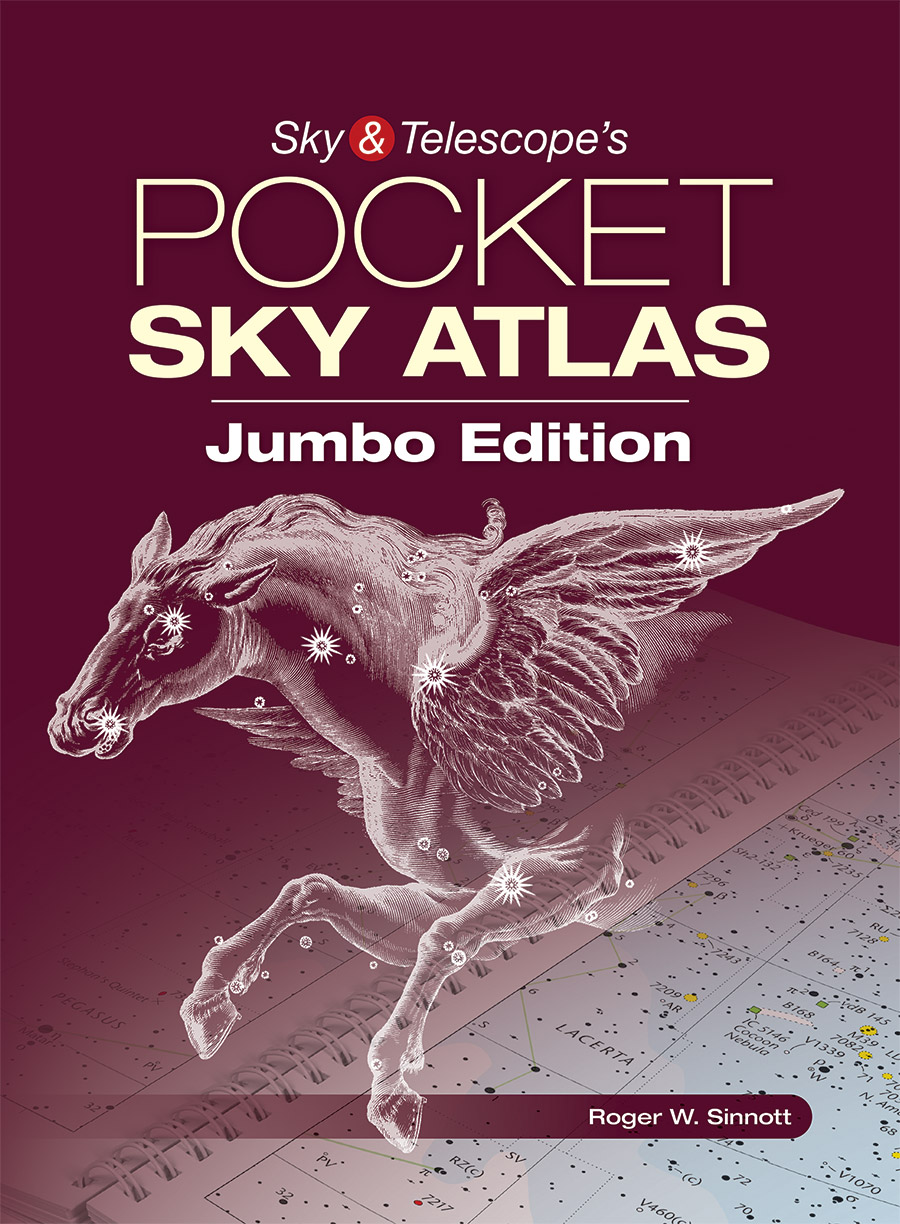
Once you get a telescope, to put it to good use you'll want a much more detailed, large-scale sky atlas (set of charts). The basic standard is the Pocket Sky Atlas, in either the original or Jumbo Edition. Both show all 30,000 stars to magnitude 7.6, and 1,500 deep-sky targets — star clusters, nebulae, and galaxies — to search out among them.
Next up is the larger and deeper Sky Atlas 2000.0, plotting stars to magnitude 8.5; nearly three times as many, as well as many more deep-sky objects. It's currently out of print, but maybe you can find one used.
The next up, once you know your way around well, are the even larger Interstellarum Deep-Sky Atlas (with 201,000+ stars to magnitude 9.5 and 14,000 deep-sky objects selected to be detectable by eye in very large amateur telescopes), and Uranometria 2000.0 (332,000 stars to mag 9.75, and 10,300 deep-sky objects).
And read How to Use a Star Chart with a Telescope. It applies just as much to electronic charts on your phone or tablet, which many observers find handier and more versatile, if perhaps less carefully designed, than charts on paper.
You'll also want a good deep-sky guidebook. A beloved old classic is the three-volume Burnham's Celestial Handbook. It was my bedside reading for years. An impressive more modern one is the big Night Sky Observer's Guide set (2+ volumes) by Kepple and Sanner. The pinnacle for total astro-geeks is the new Annals of the Deep Sky series, currently at 11 volumes as it works its way forward through the constellations alphabetically. So far it's up to H.
Can computerized telescopes replace charts? Well, I used to say this:
"Not for beginners, I don't think, unless you prefer spending your time getting finicky technology to work rather than learning how to explore through the sky yourself. As Terence Dickinson and Alan Dyer say in their Backyard Astronomer's Guide, 'A full appreciation of the universe cannot come without developing the skills to find things in the sky and understanding how the sky works. This knowledge comes only by spending time under the stars with star maps in hand and a curious mind.' Without these, 'the sky never becomes a friendly place.' "
Well, things change. The technology has continued to improve and become more user-friendly — particularly with software that can now, amazingly, recognize any telescopic star field to determine exactly where the telescope is pointed — finally bypassing all imperfections in the mount, tripod, gears, bearings and other mechanics, or in the user's skill in setting up.
The latest revolution is the rise of small, imaging-only "smartscopes." These take advantage of not only today's pointing technology, but also the vastly better capabilities of imaging chips and processing compared to the human retina and visual cortex. The most sophisticated image stacking and processing can also come built in. The result is capable deep-sky imaging from shockingly small, low-priced units. The image may be viewable on your phone or computer as it builds up in real time. Small smartscopes can enable direct contributions to citizen-science projects.
These are changing the hobby at the entry level. For more on this revolution see Richard Wright's "The Rise of the Smart Telescopes" in the November 2025 Sky & Telescope. And read the magazine's review of this especially tiny one.
If you get a larger, more conventional computerized scope that allows direct visual use, make sure that its drives can be disengaged so you can swing it around and point it readily by hand when you want to, rather than only slowly by the electric motors (which eat batteries).
 Audio sky tour. Out under the evening sky with your
earbuds in place, listen to Kelly Beatty's monthly
podcast tour of the naked-eye heavens above. It's free.
"The dangers of not thinking clearly are much greater now than ever before. It's not that there's something new in our way of thinking, it's that credulous and confused thinking can be much more lethal in ways it was never before."
— Carl Sagan, 1996
"Facts are stubborn things; and whatever may be our wishes, our inclinations, or the dictates of our passion, they cannot alter the state of facts and evidence."
— John Adams, 1770
About Alan MacRobert
Alan M. MacRobert became an avid Sky & Telescope subscriber in 1966 at age 14, joined the editorial staff in 1982, and is now a senior contributing editor, semi-retired. He played a role in practically every part of the magazine and the company's other products for more than a generation, both on the amateur-observing side and the science-reporting side. In 1994 a book collection of his observing how-tos and telescopic sky tours was published as Star Hopping for Backyard Astronomers. He has produced This Week's Sky at a Glance online every week since 1989.



Comments
You must be logged in to post a comment.