 SUNSET:

 0
0FRIDAY, JULY 11
■ One hour after sunset as twilight fades and the stars are coming out, you'll find the two brightest stars of summer, Vega and Arcturus, equally near the zenith: Vega toward the east, Arcturus toward the southwest (depending on your location). Hail jocund July.
■ In early dawn Saturday the 12th, Venus practically sits on Epsilon Tauri in the Hyades, one end of the V of Taurus's face. Aldebaran is the other end: Taurus's other eye. Epsilon is only magnitude 3.5; Venus is currently mag. –4.1, a thousand times brighter! That's quite an eye that's opening.
And can you pick out little Epsilon hiding about 0.3° under Venus? Binoculars help.
Venus drifts off that eye position in just a day or two. Catch it while you can.
And can you catch Jupiter emerging far to Venus's lower left? It becomes easier every day. Below is the scene on Saturday morning the 12th.

SATURDAY, JULY 12
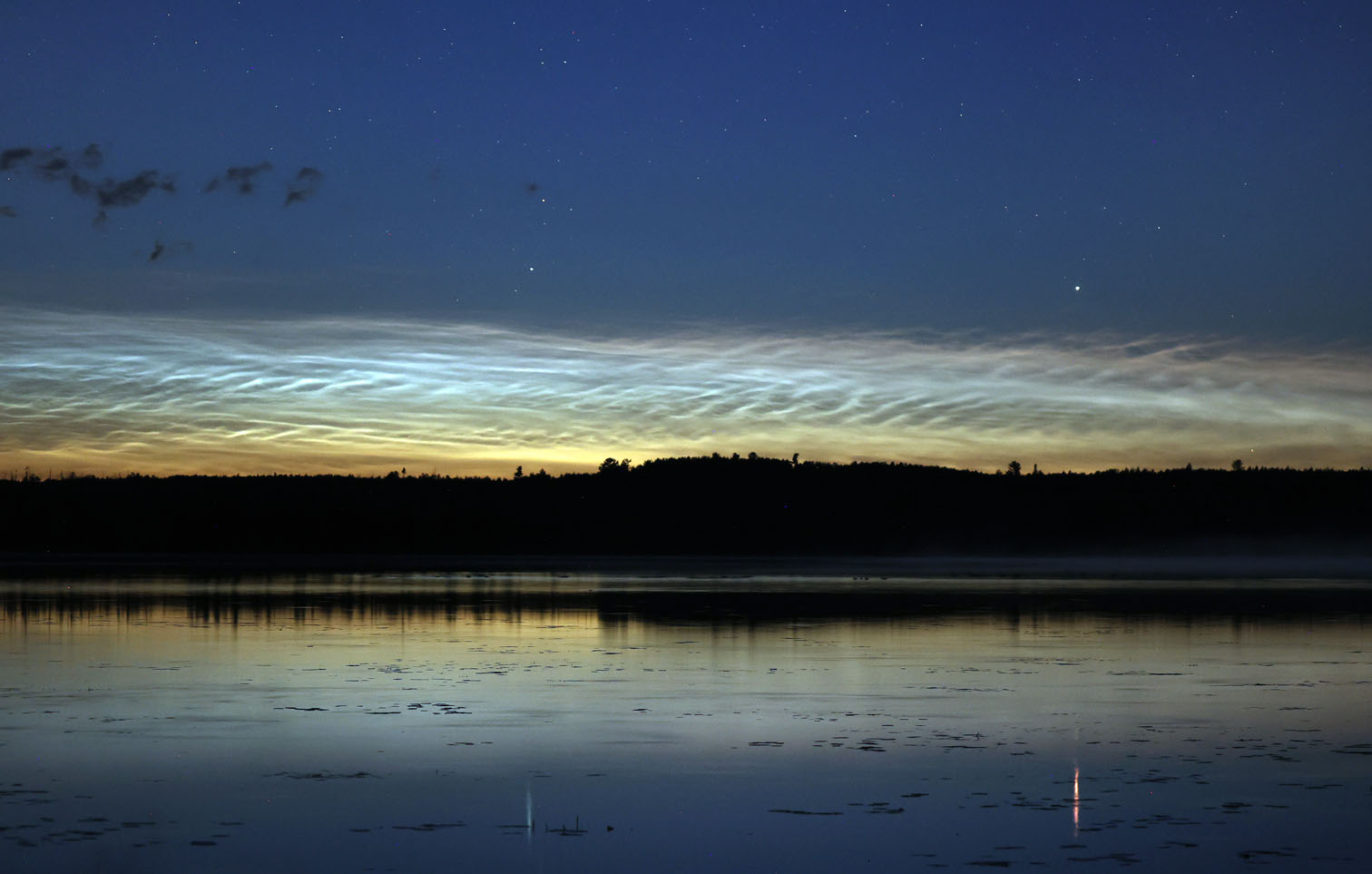
■ Look low in the northwest or north at the end of these long summer twilights. Would you recognize noctilucent clouds if you saw them? They look strangely iridescent blue or silver, often with fine-scale ripples.
These are the most astronomical of all cloud types, what with their extreme altitude and, sometimes, their formation on particles of meteoric dust. They used to be rare, but they've become more common in recent years as Earth's atmosphere changes. See Bob King's Nights of Noctilucent Clouds.
■ Vega is the brightest star high in the east these evenings. Three fists lower right of it is Altair, the second-brightest star on the eastern side of the sky.
Above Altair by a finger-width at arm's length is little orange Tarazed (Gamma Aquilae), Altair's eternal sidekick. It's a modest magnitude 2.7 compared to Altair's showy 0.7. But looks are deceiving, nowhere more so than in astronomy. Altair looks so bright because it's one of our near neighbors, just 17 light-years away. Tarazed is an orange giant star about 380 light-years farther in the background — and it's 170 times more luminous than Altair!
■ Visualize Vega and Altair along with Deneb, less bright and about two fists lower left of Vega, and you've got the Summer Triangle.
SUNDAY JULY 13
■ Scorpius is sometimes called "the Orion of Summer" for its brightness, its 1st-magnitude red supergiant star, and its many blue-white giants. But Scorpius passes a lot lower across the southern sky than Orion does. So for those of us at mid-northern latitudes it has only one really good evening month: July.
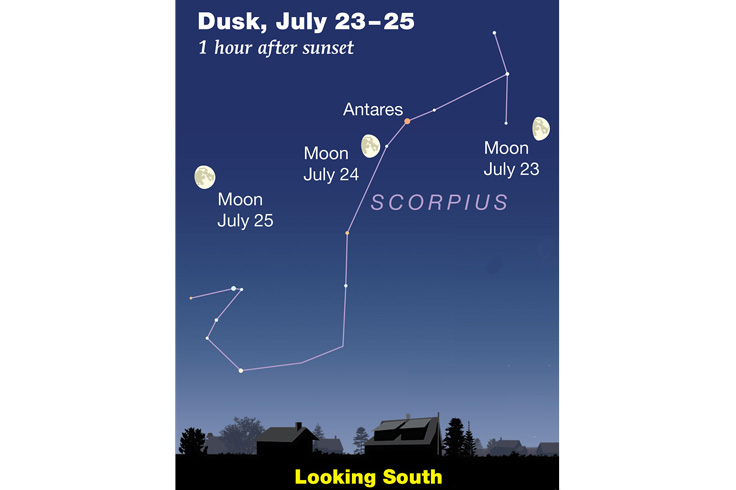
The rich area around the tail of Scorpius is now at its highest in the south right after night is fully dark, as shown below. Find it lower right of the Teapot's spout by a fist at arm's length or less. Or about a fist and a half lower left of Antares. How high or low this whole scene will appear depends on how far north or south you live: the farther south, the higher.

Spot the two stars especially close together in the tail. These are Shaula and Lesath, Lambda and Upsilon Scorpii, also known as the Cat's Eyes. They're unequal and canted at an angle; the cat has a bleary eye and is tilting his head to our right. They're magnitudes 1.6 and 2.6. Both are blue-white supergiants, 700 and 500 light years away, respectively. The fainter one, Lesath, is the nearer one.
Between the Cat's Eyes and the Teapot's spout are the open star clusters M7 and especially M6: showy speckle-splashes in binoculars. M7 is the bigger and brighter one. M6 is more subdued.
Also: A line through the Cat's Eyes points west (right) by nearly a fist toward Mu Scorpii, a much tighter pair known as the Little Cat's Eyes. They're oriented almost exactly the same way as Lambda and Upsilon but they're only 0.1° apart, so they appear as a single dot on the chart above; bring binoculars. They too are not a true binary. They're 800 and 500 light-years away, and again the fainter one is nearer.
MONDAY, JULY 14
■ Fourth star of the Summer Triangle. The next-brightest star near the Summer Triangle, if you'd like to turn it into a quadrilateral, is Rasalhague (Alpha Ophiuchi), the head of Ophiuchus. Look high toward the southeast soon after dark. You'll find Rasalhague about equally far to the upper right of Altair and lower right of Vega. Altair is currently the Summer Triangle's lowest star. Vega, nearly overhead, is its brightest.

TUESDAY, JULY 15
■ Standing atop Scorpius in the south after darkness is complete, and butting heads with Hercules much higher, is enormous Ophiuchus the Serpent-Holder. Just east of his east shoulder (Beta Ophiuchi) is a dim V-shaped asterism like a smaller, fainter Hyades. This is the defunct constellation Taurus Poniatovii, "Poniatowski's Bull." The V is 2½° tall and stands almost vertically now.1

The top two stars of the V are the faintest (magnitudes 4.8 and 5.5). The middle star of its left (east) side is the famous K-dwarf binary 70 Ophiuchi, visual magnitudes 4.2 and 6.2, distance just 17 light-years. The two stars of the pair are currently 6.7 arcseconds apart in their 88-year orbit: close but nicely separated at medium-high power in any telescope.
Just 1¼° NNE of Beta Oph is the large, very loose open cluster IC 4665, a binocular target.
■ The waning gibbous Moon rises around 11 or midnight with Saturn glowing only 2° or 3° below it. By the beginning of dawn Wednesday morning, they shine together high in the southeast.
WEDNESDAY, JULY 16
■ We're only a quarter of the way through astronomical summer, but already Cassiopeia is getting well up after dark. Look for its tilted W pattern in the north-northeast.
High above it is dimmer Cepheus, Queen Cassiopeia's husband. Below it, the head of Perseus is on the rise. The farther north you live the higher they all will appear.
THURSDAY, JULY 17
■ Last-quarter Moon (exact at 8:38 p.m. EDT). The Moon rises around midnight in the east-northeast, below Andromeda and the Great Square of Pegasus. By that time Saturn is in view low in the east-southeast.
■ Titan casts its shadow on Saturn tonight. Every 15 years Titan, Saturn's largest moon, repeatedly crosses Saturn's face from Earth's viewpoint — and, more visibly, cast its tiny black shadow onto Saturn' face. A new series of these events is under way. They will continue every 16 days until October.
Tonight Titan's shadow crosses Saturn from 7:00 to 12:05 UT July 18th (UT date). That's from 3:00 a.m. to 8:05 a.m. July 18th Eastern Daylight Time; 12:00 midnight to 5:05 a.m. PDT. Wherever you are, Saturn rises by midnight daylight-saving time and is high in good seeing before dawn. So all of North America now gets a chance. See Bob King's Titan Shadow Transit Season Underway.
FRIDAY, JULY 18
■ The landmark Sagittarius Teapot sits rather low in the south-southeast after nightfall is complete. It's made of 2nd- and 3rd-magnitude stars and is about as big as your fist at arm's length. Its handle is on the left and its triangular spout is on the right.
As the night advances, and as summer advances, the Teapot will move westward and start tilting to pour from its spout.
SATURDAY, JULY 19
■ Pleiades occultation Sunday morning. In the early-morning hours of tonight, the bright limb of the waning crescent Moon will occult a few of the Pleiades stars for various parts of North America. They'll later reappear from behind the Moon's dark limb, where the events will be much easier to observe. For detailed information, including maps and timetables for four of the brighter Pleiads, click here and see the links for the July 20th events.
SUNDAY, JULY 20
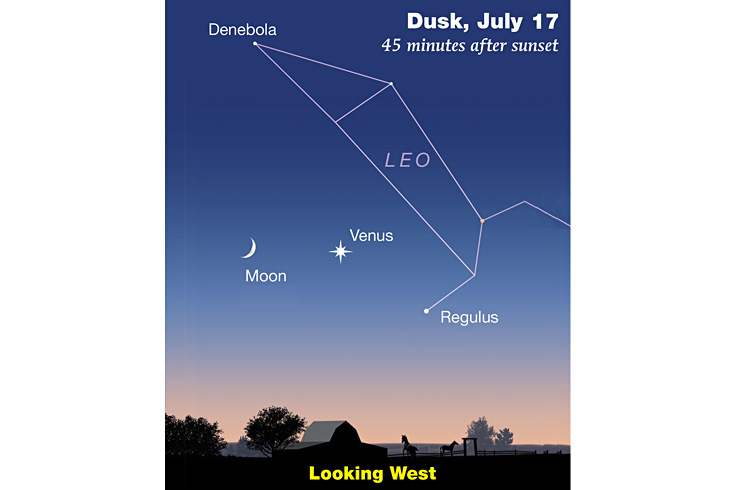
■ During dawn Monday morning, look east for the thin (14% illuminated) waning crescent Moon hanging 7° or 8° above Venus. A little farther than that to their right is orange Aldebaran, much fainter. Way down to their lower left, can you pick up Jupiter?
This Week's Planet Roundup
Mercury is sinking down out of sight into the glow of sunset.
Venus, brilliant at magnitude –4.1, rises above the east-northeast horizon a half hour or more before the first glimmer of dawn. Venus climbs higher until the dawn sky finally grows too bright. In a telescope Venus's shrinking globe (now only about 16 arcseconds pole to pole) has become gibbous, 65% sunlit.
Mars, magnitude 1.5 in Leo, glows low in the west in late twilight and sets soon after dark. Above it by a little more than a fist at arm's length is Denebola, Leo's tailtip, magnitude 2.1.
Jupiter, magnitude –1.9, is beginning to emerge very low in the glow of sunrise. Find it almost three fists lower left of Venus. See the July 12 view at the top of this page.
Venus and Jupiter are closing in toward a striking pre-dawn conjunction just 0.9° apart on August 12th.
Saturn (magnitude +0.9, in Pisces) rises around midnight daylight-saving time. But the best time to try a telescope on Saturn is just before dawn, when it's near its highest in the south. Saturn's rings are almost edge-on this year.
Uranus (magnitude 5.8, in Taurus near the Pleiades) is low in the east just before dawn.
Neptune, a telescopic "star" at magnitude 7.9, lurks just 1° above Saturn before dawn begins. Use the finder chart for Neptune with respect to Saturn in the June Sky & Telescope, page 51. With a pencil, put a dot on the path of each of the two planets for your date. Get everything planned out and ready to go the evening before, so that dawn doesn't outrun you.
All descriptions that relate to your horizon — including the words up, down, right, and left — are written for the world's mid-northern latitudes. Descriptions and graphics that also depend on longitude (mainly Moon positions) are for North America.Eastern Daylight Time (EDT) is Universal Time minus 4 hours. UT is also known as UTC, GMT, or Z time.
Want to become a better astronomer? Learn your way around the constellations. They're the key to locating everything fainter and deeper to hunt with binoculars or a telescope.
This is an outdoor nature hobby. For a more detailed constellation guide covering the whole evening sky, use the big monthly map in the center of each issue of Sky & Telescope, the essential magazine of astronomy.
For the attitude every amateur astronomer needs, read Jennifer Willis's Modest Expectations Give Rise to Delight.
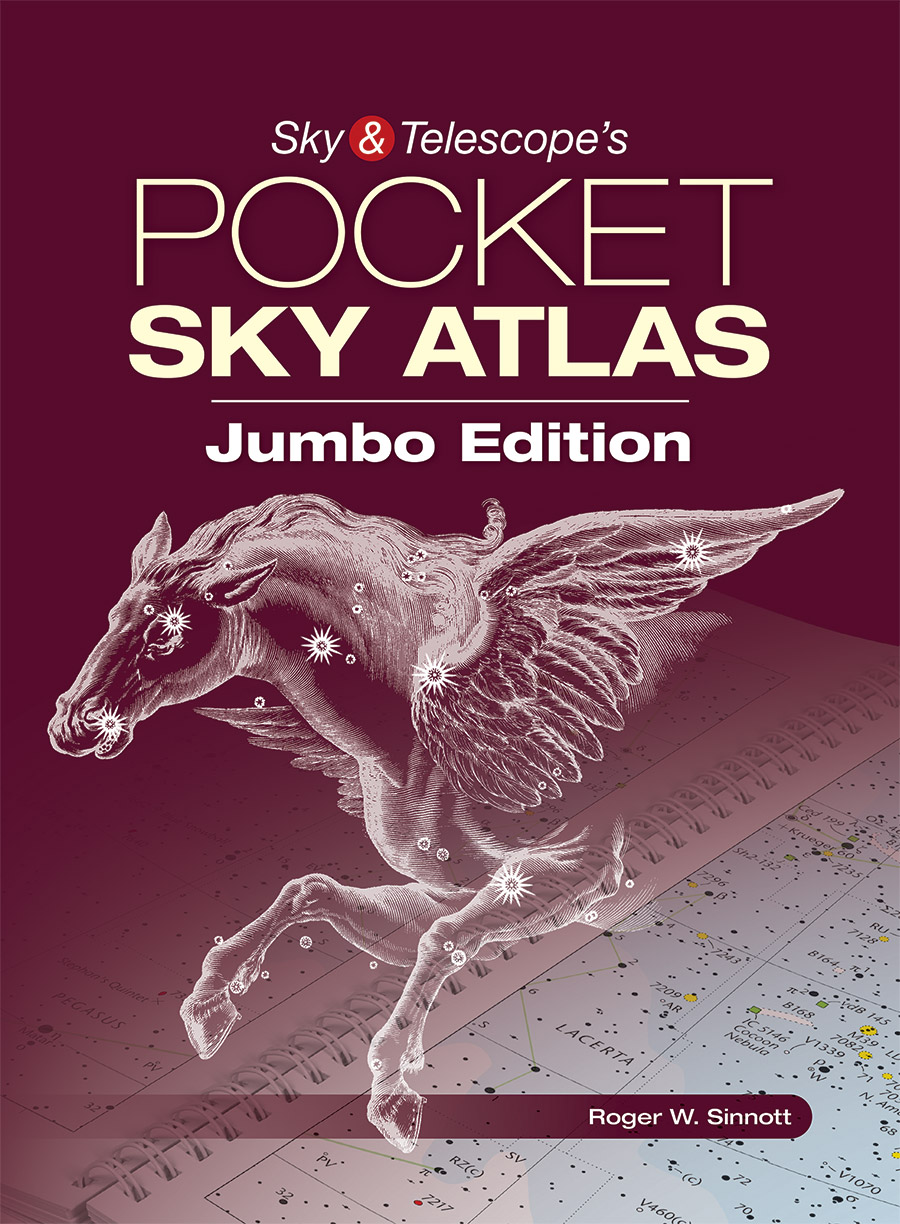
Once you get a telescope, to put it to good use you'll need a much more detailed, large-scale sky atlas (set of charts). The basic standard is the Pocket Sky Atlas, in either the original or Jumbo Edition. Both show all 30,000 stars to magnitude 7.6, and 1,500 deep-sky targets — star clusters, nebulae, and galaxies — to search out among them.
Next up is the larger and deeper Sky Atlas 2000.0, plotting stars to magnitude 8.5; nearly three times as many, as well as many more deep-sky objects. It's currently out of print, but maybe you can find one used.
The next up, once you know your way around well, are the even larger Interstellarum atlas (with 201,000+ stars to magnitude 9.5 and 14,000 deep-sky objects selected to be detectable by eye in large amateur telescopes), and Uranometria 2000.0 (332,000 stars to mag 9.75, and 10,300 deep-sky objects). And read How to Use a Star Chart with a Telescope. It applies just as much to charts on your phone or tablet as to charts on paper.
You'll also want a good deep-sky guidebook. A beloved old classic is the three-volume Burnham's Celestial Handbook. An impressive more modern one is the big Night Sky Observer's Guide set (2+ volumes) by Kepple and Sanner. The pinnacle for total astro-geeks is the new Annals of the Deep Sky series, currently at 11 volumes as it works its way forward through the constellations alphabetically. So far it's up to H.
Can computerized telescopes replace charts? Not for beginners I don't think, and not for scopes on mounts and tripods that are less than top-quality mechanically. Unless, that is, you prefer spending your time getting technology to work rather than learning how to explore the sky. As Terence Dickinson and Alan Dyer say in their Backyard Astronomer's Guide, "A full appreciation of the universe cannot come without developing the skills to find things in the sky and understanding how the sky works. This knowledge comes only by spending time under the stars with star maps in hand and a curious mind." Without these, "the sky never becomes a friendly place."
If you do get a computerized scope, make sure that its drives can be disengaged so you can swing it around and point it readily by hand when you want to, rather than only slowly by the electric motors (which eat batteries).
However, finding faint telescopic objects the old-fashioned way with charts isn't simple either. Do learn the essential tricks at How to Use a Star Chart with a Telescope.
 Audio sky tour. Out under the evening sky with your
earbuds in place, listen to Kelly Beatty's monthly
podcast tour of the naked-eye heavens above. It's free.
"The dangers of not thinking clearly are much greater now than ever before. It's not that there's something new in our way of thinking, it's that credulous and confused thinking can be much more lethal in ways it was never before."
— Carl Sagan, 1996
"Facts are stubborn things; and whatever may be our wishes, our inclinations, or the dictates of our passion, they cannot alter the state of facts and evidence."
— John Adams, 1770
1. Taurus Poniatovii was invented by the rector of Vilnius University, Marcin Poczobut, in 1773 to honor his ruler Stanislaus Poniatowski, King of Poland and Grand Duke of Lithuania. The Poniatowski family's coat of arms had a bull. Poczobut may have needed money for his university; scholars and researchers in those days often had to obsequiously, embarrassingly, flatter their ruling monarchs to enable funding.2 An echo of this requirement from the childhood of modern civilization has re-arisen in the United States of America.
The V asterism in Poniatowski's Bull was meant to echo the real Taurus's face formed by Aldebaran and the brightest Hyades. The rest of the little bull trailed off to the northeast. A few star mappers included it on their sky charts for a while, since Poczobut was respected as an astronomer (J.-J. de Lalande in France used some of Poczobut's positional measurements to help calculate the orbit of Mercury). But the bull on the king's coat of arms has long since been dropped from the sky.
Nevertheless, today "a depiction of the constellation can be found on the wall of the Vilnius University Astronomical Observatory" per Wikipedia. I can't find a photo of that online. Today Vilnius University thrives in a free Lithuania. Can somebody there go look through the observatory building? If you find Taurus Poniatovii on the wall where it originated, please send me pics: [email protected].
------------
2. For instance see the elaborate title pages by Galileo fawning over the Medicis, and by Kepler buttering up his "Roman" Emperor Rudolph II. William Herschel, originally from what is now Germany, named his new planet (now Uranus) "The Georgian Star" to magnify his ruler and financial patron, England's King George III. Herschel's 1781 letter to the Royal Society announcing this name (and using the long s ) drips with flattery:
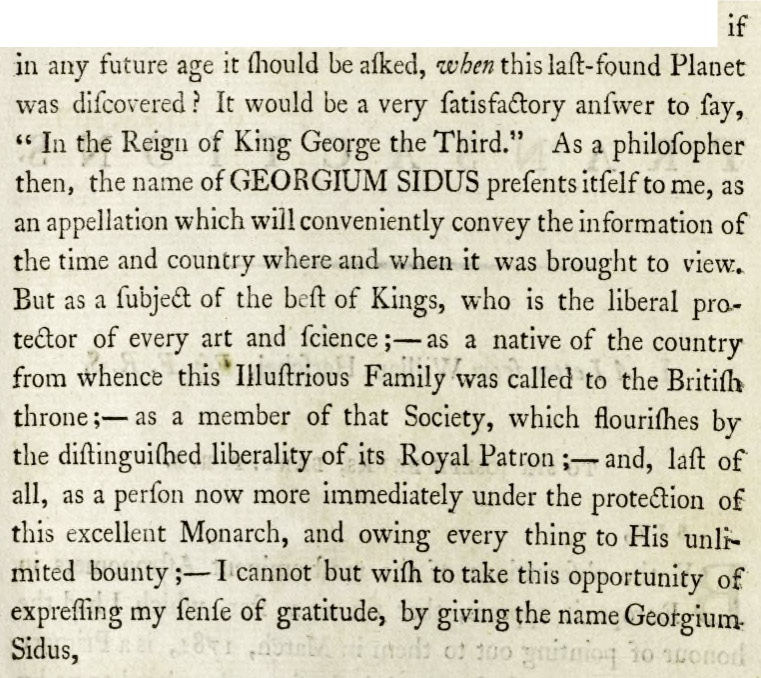
This went over very badly outside England. French astronomers called the planet Herschel instead, following the lead of Charles Messier. Others proposed Astraea, Cybele, Minerva, and more names. After bitter international debates and assertions of wounded pride, astronomers beyond England finally settled on Uranus — a variant on the Greek deity considered the father of Saturn, just as Saturn was the father of Jupiter. But the English shunned the name Uranus for nearly 70 years.
All well and good. But the name "Uranus" was actually proposed just four months after Herschel named the planet for his patron, by the German astronomer Johann Elert Bode. I've wondered if Bode may have had a covert second purpose for this name — its last four letters mean the same in Latin and English — as a low joke for "kiss-ass," a term for "obnoxious sycophant" that was already in use at the time, in both English and German.

I've never seen any evidence for this notion, other than the name being the butt of jokes for at least 144 years now. (Albert Stern has attempted to find the first recorded Uranus joke. The earliest clear one he found, looking only in U.S. publications, is from 1881, though he turned up possibles from the 1870s and 1852.) Elsewhere we read, "Exactly why Bode proposed the Latinized name Uranus over the Greek name for the god of the sky (Ouranus) is unclear. Also, it’s unclear why Bode did not use the Roman name for the god, Caelus, in keeping the with the Roman names of the other planets" including Saturn and Jupiter. Could Bode have been subtly pranking his emigré former countryman for sucking up to the English king?
About Alan MacRobert
Alan M. MacRobert became an avid Sky & Telescope subscriber in 1966 at age 14, joined the editorial staff in 1982, and is now a senior contributing editor, semi-retired. He played a role in practically every part of the magazine and the company's other products for more than a generation, both on the amateur-observing side and the science-reporting side. In 1994 a book collection of his observing how-tos and telescopic sky tours was published as Star Hopping for Backyard Astronomers. He has produced This Week's Sky at a Glance online every week since 1989.


Comments
You must be logged in to post a comment.