 SUNSET:

 5
5The interstellar comet: fading slightly, but now very high. No more horizon problems! This week Comet 3I/ATLAS is about 40° up in the southeast shortly before the first sign of dawn. But it's slowly fading a bit. As of November 29th it was about magnitude 10.4 (an average of visual estimates). You'll need a telescope capable of detecting a very small (2 arcminute), roundish faint fuzzy that dim. Which probably means at least a 6- or 8-inch scope visually, depending on your sky.
Plan to be all set up a full two hours before sunrise. Warning: bright moonlight returns around the morning of December 1st.
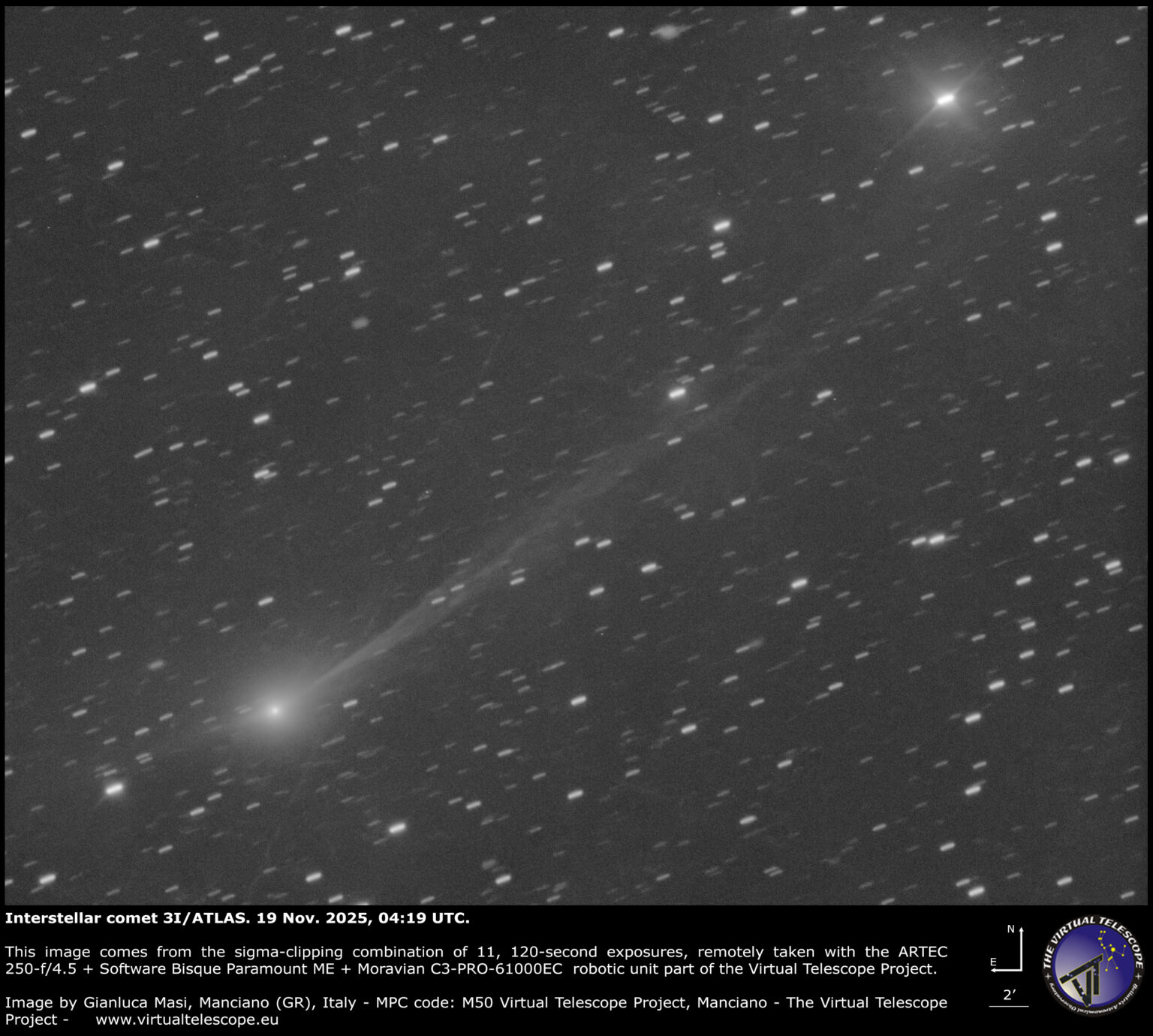
See Bob King's All Eyes on Interstellar Comet 3I/ATLAS. The wide-field chart there for late November and December, with stars to 5th magnitude, gives only its general location passing Beta Virginis this week. You'll need a much larger-scale map with fainter stars for the necessary finding precision. Follow Bob's advice and use a good sky-charting program that downloads fresh orbital elements to plot current new comets, or that allows you to type in the orbital elements yourself. For the orbital elements, and an ephemeris for plotting on your own detailed atlas, see the very bottom of this page.
For more news see King's more recent article Comet K1/ATLAS Crumbles, Interstellar Comet 3I/ATLAS Delights.
Also David Chandler's Updates on Interstellar Comet 3I/ATLAS: NASA Images, Many Tails, and Non-gravitational Forces.
FRIDAY, NOVEMBER 28
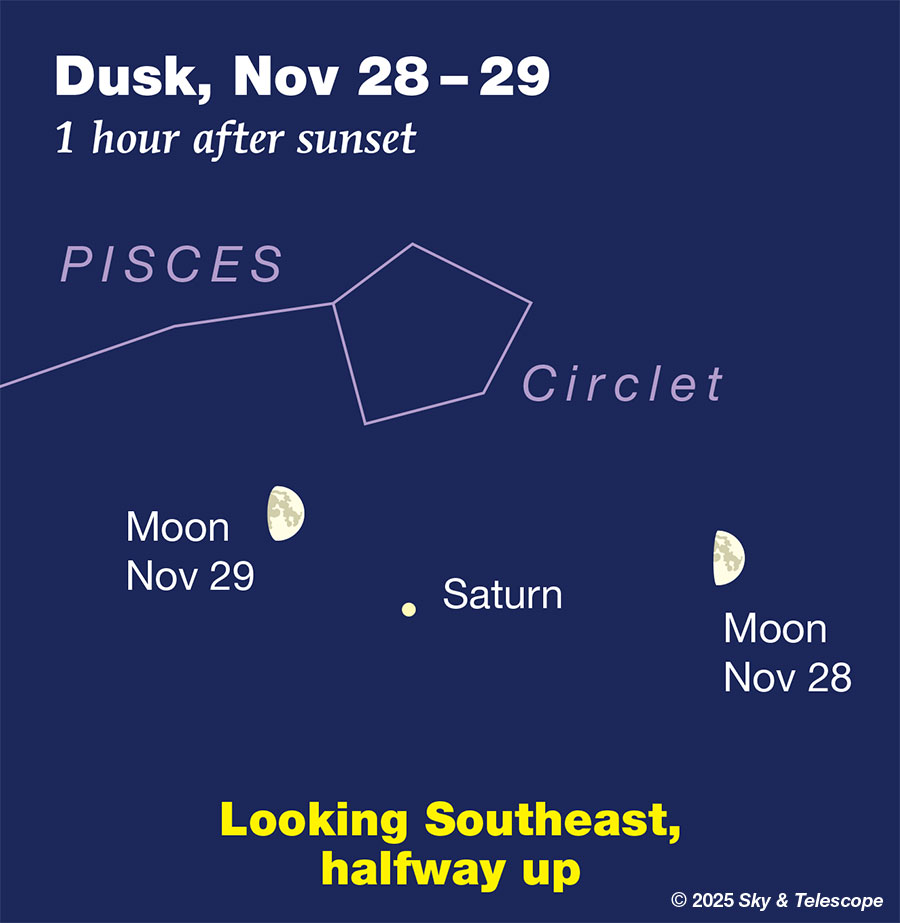
■ The waxing gibbous Moon shines with Saturn this evening and tomorrow evening, as shown below. They may look like a pair, but Saturn is 3,600 times farther away.
■ Does the Sun already seem to be setting about as early as it ever will? You're right! We're still three weeks from the winter solstice — but the Sun actually sets its earliest around December 7th if you're near latitude 40° north. And already the Sun sets within only about two minutes of that time.
A surprising result of this: The Sun actually sets a trace earlier at Thanksgiving time than Christmas — even though Christmas is near the solstice.
But in celestial mechanics, every seeming abnormality is balanced out by an equal abnormality somewhere else. The offset of the earliest sunset from the solstice date is balanced out by the opposite happening at sunrise: The Sun doesn't come up its latest until January 4th. These offsets arise from the tilt of Earth's axis and the eccentricity of Earth's orbit.
SATURDAY, NOVEMBER 29
■ The waxing gibbous Moon, almost two days past first quarter, shines about 4° or 5° upper left of Saturn at dusk, as shown above. Later in the evening it looms straight over Saturn. In a telescope, the sunrise terminator has unveiled flat-floored Plato on the edge of Mare Imbrium in the Moon's north, rayed Copernicus nearer the center, and more spectacularly rayed Tycho in the south.
SUNDAY, NOVEMBER 30
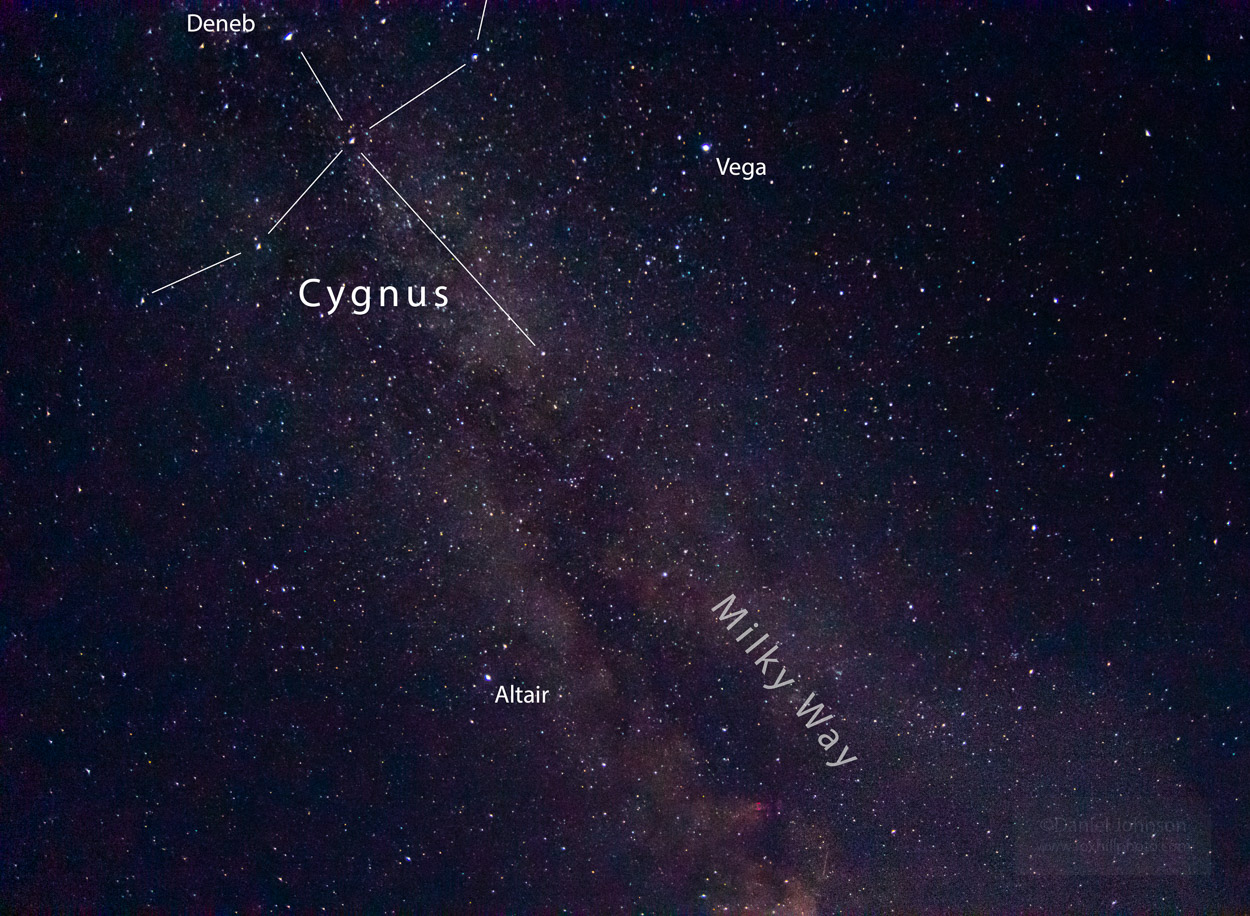
■ Vega still shines brightly well up in the west-northwest after dark. The brightest star above it is Deneb, the head of the big Northern Cross formed by the brightest stars of Cygnus. At nightfall the shaft of the cross extends lower left from Deneb, by about two fists. By about 11 p.m. it stands more or less upright on the northwest horizon.
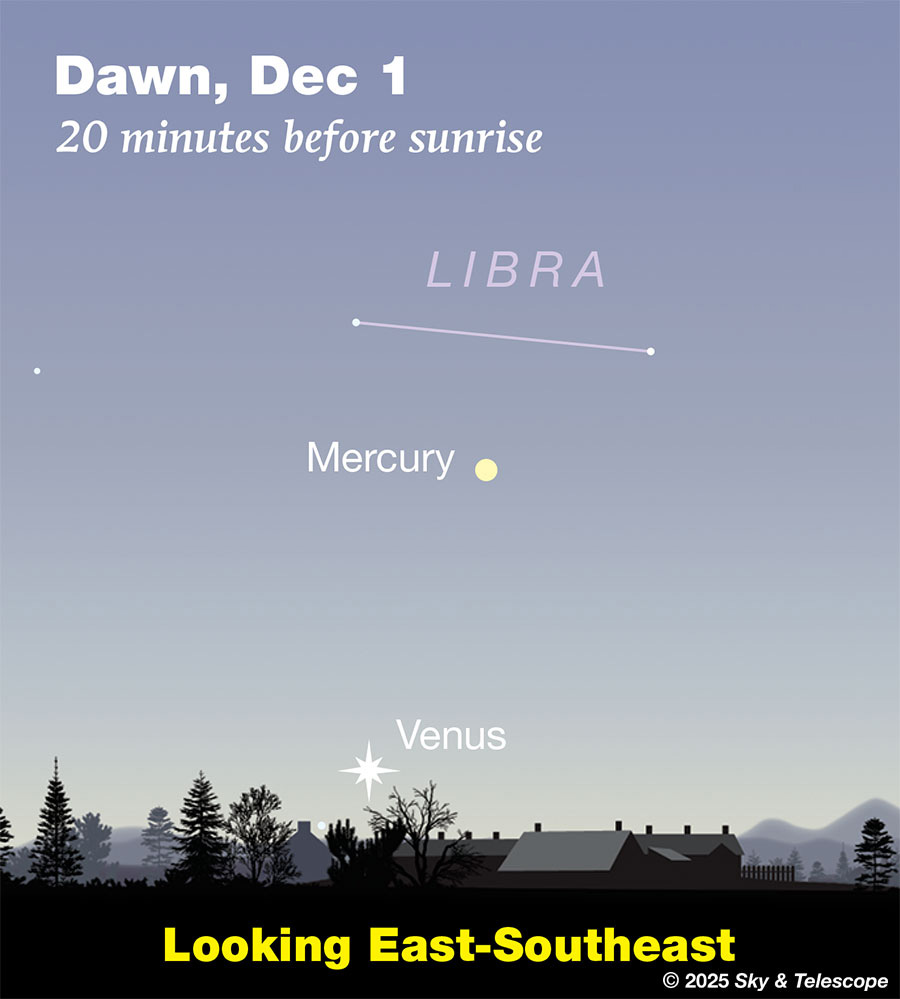
■ Can you still make out Venus 10° under Mercury in the eastern dawn, as shown below? Bring binoculars to a site with a flat east-southeast horizon. Mercury is magnitude 0.o; Venus is mag –3.9 but seen through more atmospheric extinction.
MONDAY, DECEMBER 1
■ As the stars come out, the Cassiopeia W stands on end (its fainter end) high in the northeast. Watch Cas turn around to become a flattened M, even higher in the north, by late evening.
TUESDAY, DECEMBER 2
■ The Big Dipper lies roughly opposite Cassiopeia across Polaris. Therefore, at this time of year the Dipper lies shyly down lowest somewhat after nightfall. It slides entirely below the north horizon if you're as far south as Miami.
But by midnight the Dipper has wheeled to stand straight up on its handle in fine view in the northeast, while Cassiopeia has turned to the northwest to stand nearly upright on the bright end of its W shape.
WEDNESDAY, DECEMBER 3
■ The Moon occults some of the Pleiades this evening and into the night for North America. They'll disappear behind the very thin remaining dark limb of the 99% sunlit Moon — so use a telescope. Plan ahead by running a planetarium program set for your location back and forth through the hours and minutes, or by using the timetables here for the 04 Dec events. That's the UT date.
THURSDAY, DECEMBER 4
■ Full Moon (exactly full at 6:14 p.m. EST). It's a supermoon again: slightly closer, bigger, and brighter than your average full Moon. It's in northern Taurus, about a third of the way from Aldebaran, lower right of it in early evening, to Capella, twice as far from the Moon on its opposite side.
For your location, can you time when the center of the Moon will cross the line between these two stars as the Moon creeps eastward along its orbit? Line up the edge of a yardstick with Capella and Aldebaran. Perhaps fix one end of it to something firm while leaving the other end free to swivel as needed.
For instance, if viewing from Chicago expect the Moon's line-crossing to happen at 6:50 p.m. CST. Note: The Moon moves slowly, taking about an hour to travel its own diameter with respect to the stars.
FRIDAY, DECEMBER 5
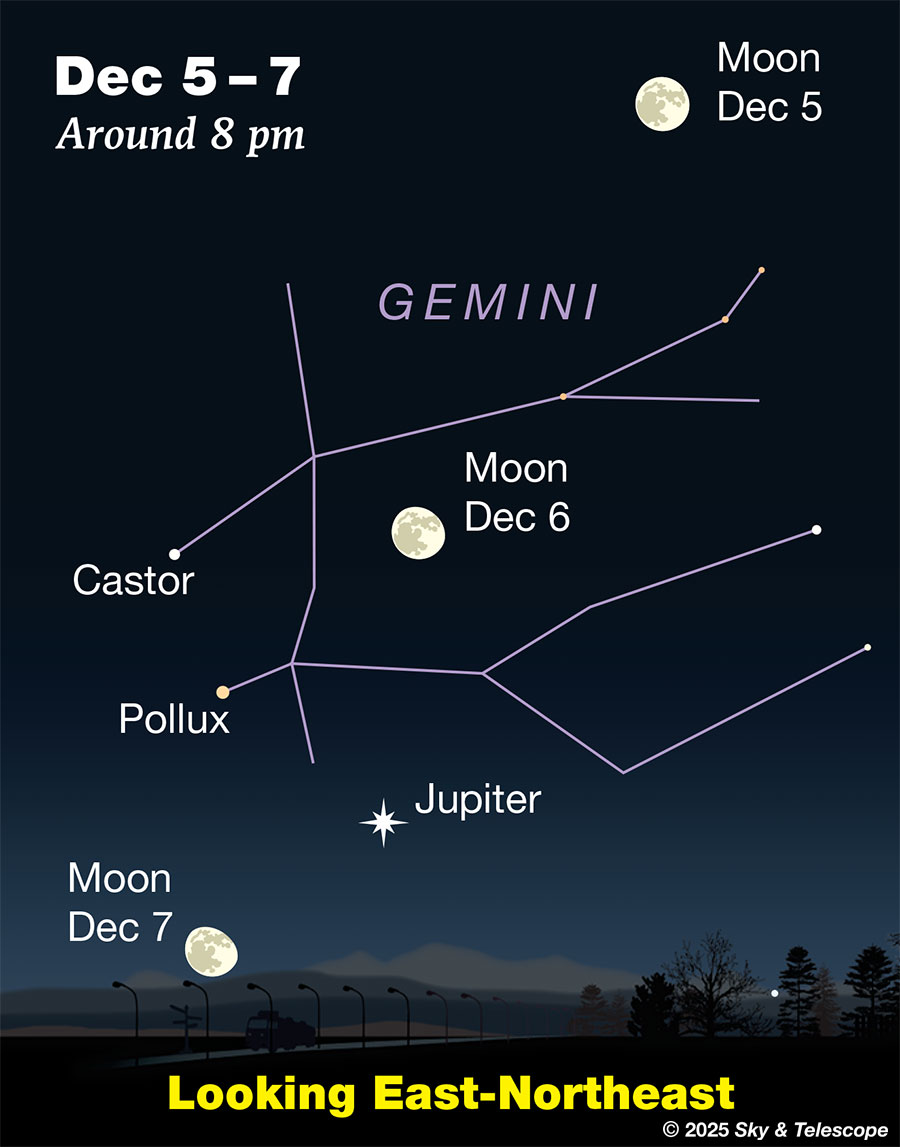
■ The Moon, a day past full, shines over Gemini and lower Jupiter once they're all risen, as shown below.
SATURDAY, DECEMBER 6
■ Now the Moon bunches up with Jupiter, Castor and Pollux, as shown above, for their journey across the sky together through the night.
SUNDAY, DECEMBER 7
■ Tonight the waning Moon bunches up differently with Jupiter, Castor and Pollux: in an upside-down Y through the evening, as shown above. By dawn on the 8th the Y lies on its side, and the Moon-to-Pollux segment has become more prolonged.
■ The December 7th sunset is the earliest of the year if you live near latitude 40° north. Balancing this out, the latest sunrise will come on January 4th. These offsets from the solstice (December 21st) arise from the tilt of Earth's axis and the eccentricity of Earth's orbit.
This Week's Planet Roundup
Mercury is beginning a nice dawn apparition low in the east-southeast. It more than doubles in brightness this week, from magnitude +0.4 on the morning of November 29th to –0.4 on December 6th.
Venus (magnitude –3.9) is out of sight way down below Mercury, rising only in bright twilight about 30 minutes before the Sun.
Mars is lost behind the glare of the Sun.
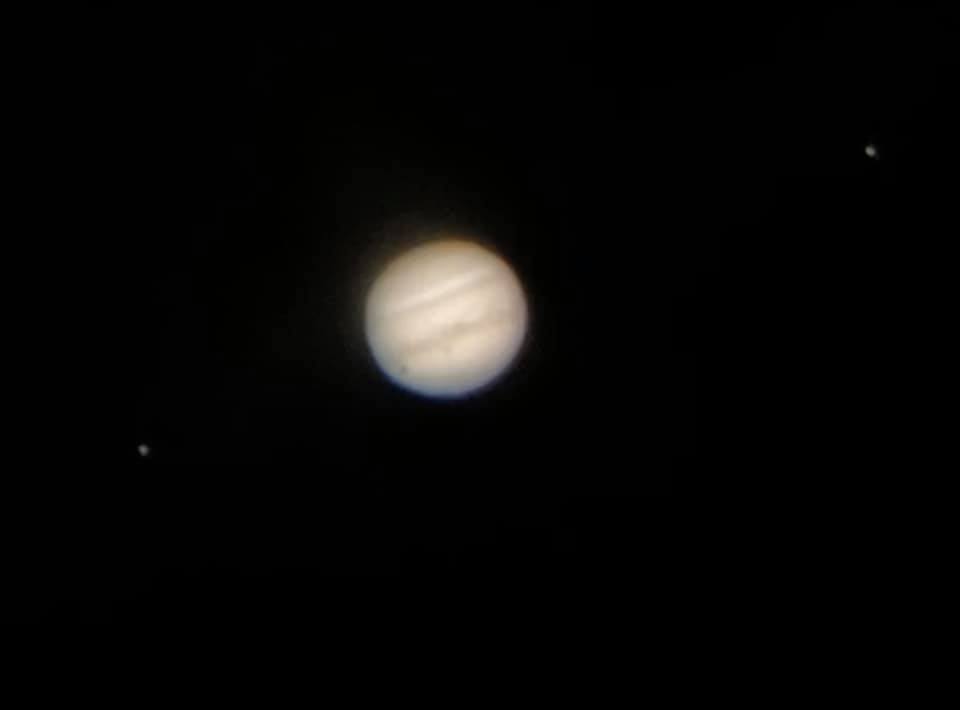
Jupiter (magnitude –2.5, in eastern Gemini) rises in the east-northeast around 8 p.m. It dominates the eastern sky as the evening advances, then the high southeast, and it's highest and sharpest in the south in the early-morning hours. Castor and Pollux shine nearby. Jupiter will reach opposition on January 10th; it appears almost as big and bright now as it will then.
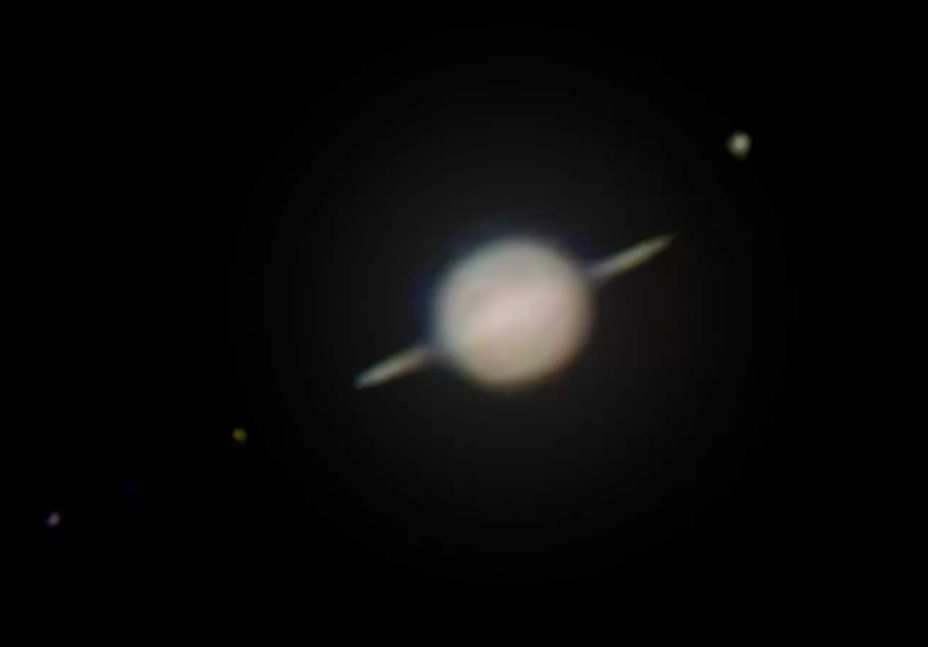
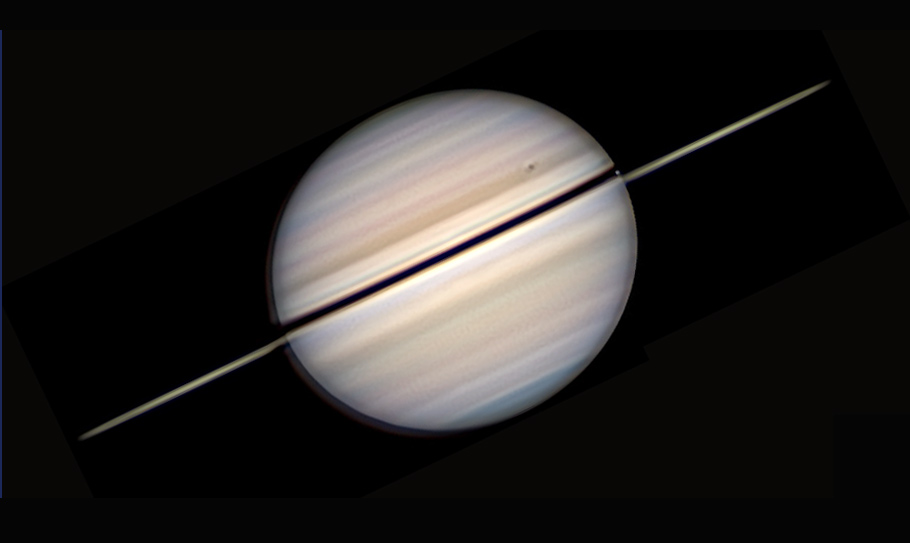
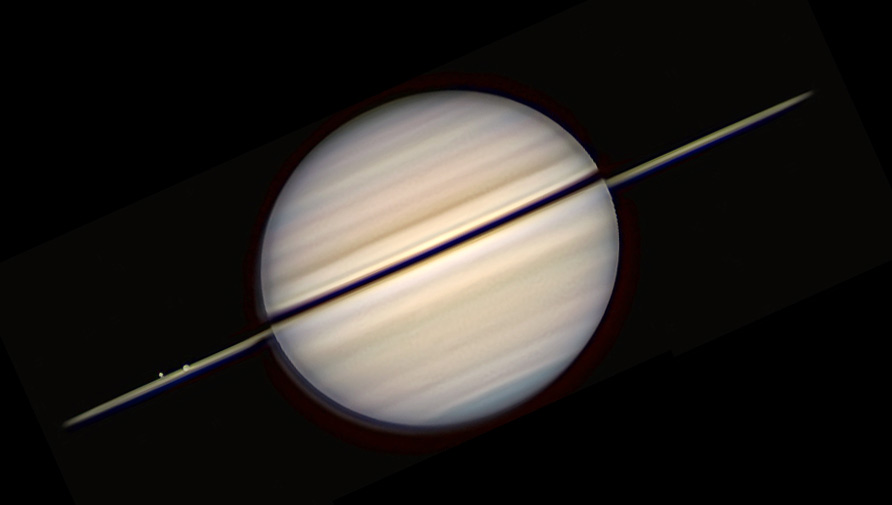
Saturn (magnitude +1.1, at the Aquarius-Pisces border) is still in exciting times. It's the brightest dot high in the south in early evening, below the Great Square of Pegasus.
Saturn's rings remain very close to edge on, tilted only about 0.5° to our line of sight. In my 12.5-inch reflector on the evening of November 20th, at 190x and 240x, the thread-thin ring system (0.4° inclination at the time) looked like a long, exquisitely thin brown needle piercing the oblate globe, in perfect alignment with its thin black shadow on the globe. The shadow was actually more difficult. Titan was perfectly aligned with the needle far off one end. Dione and Rhea, combined in an inseparable conjunction, were closer off the other end. The whole formed a delicate perfection.
For more goings-on at Saturn during this rare time, go to Bob King's See Saturn's Rings at Their Thinnest. He suggests using the rings' near-absence to try to add inner Mimas to your log of Saturnian moons. Or at least Enceladus, which I repeatedly glimpsed in a 6-inch reflector during a previous thin-rings season. King includes a timetable of Mimas's greatest elongations that happen when Saturn is high in the dark for North America. You can find Enceladus's greatest elongations by playing with Sky & Telescope's interactive Saturn's Moons calculator: run the hours and minutes forward and backward to see when Enceladus ("E") is farthest out at a time when Saturn will be high in darkness for you.
Uranus (magnitude 5.6, in Taurus 4° south of the Pleiades) is well up by 8 p.m. At high power in a telescope it's a tiny but definitely non-stellar dot, 3.8 arcseconds wide. You'll need a detailed finder chart to identify it among similar-looking faint stars; turn to the November Sky & Telescope, page 49. Or this week, see J. Kelly Beatty's Spot Uranus at Opposition.
Neptune is a telescopic "star" of magnitude 7.8, a dim speck just 2.3 arcseconds wide 4° northeast of show-stealing Saturn. For Neptune you'll need an even more detailed finder chart.
All descriptions that relate to your horizon — including the words up, down, right, and left — are written for the world's mid-northern latitudes. Descriptions and graphics that also depend on longitude (mainly Moon positions) are for North America. Eastern Standard Time (EST) is Universal Time minus 5 hours. UT is also known as UTC, GMT, or Z time.
Want to become a better astronomer? Learn your way around the constellations. They're the key to locating everything fainter and deeper to hunt with binoculars or a telescope.
This is an outdoor nature hobby. For a more detailed constellation guide covering the whole evening sky, use the big monthly map in the center of each issue of Sky & Telescope, the essential magazine of astronomy.
For the attitude every amateur astronomer needs, read Jennifer Willis's Modest Expectations Give Rise to Delight.
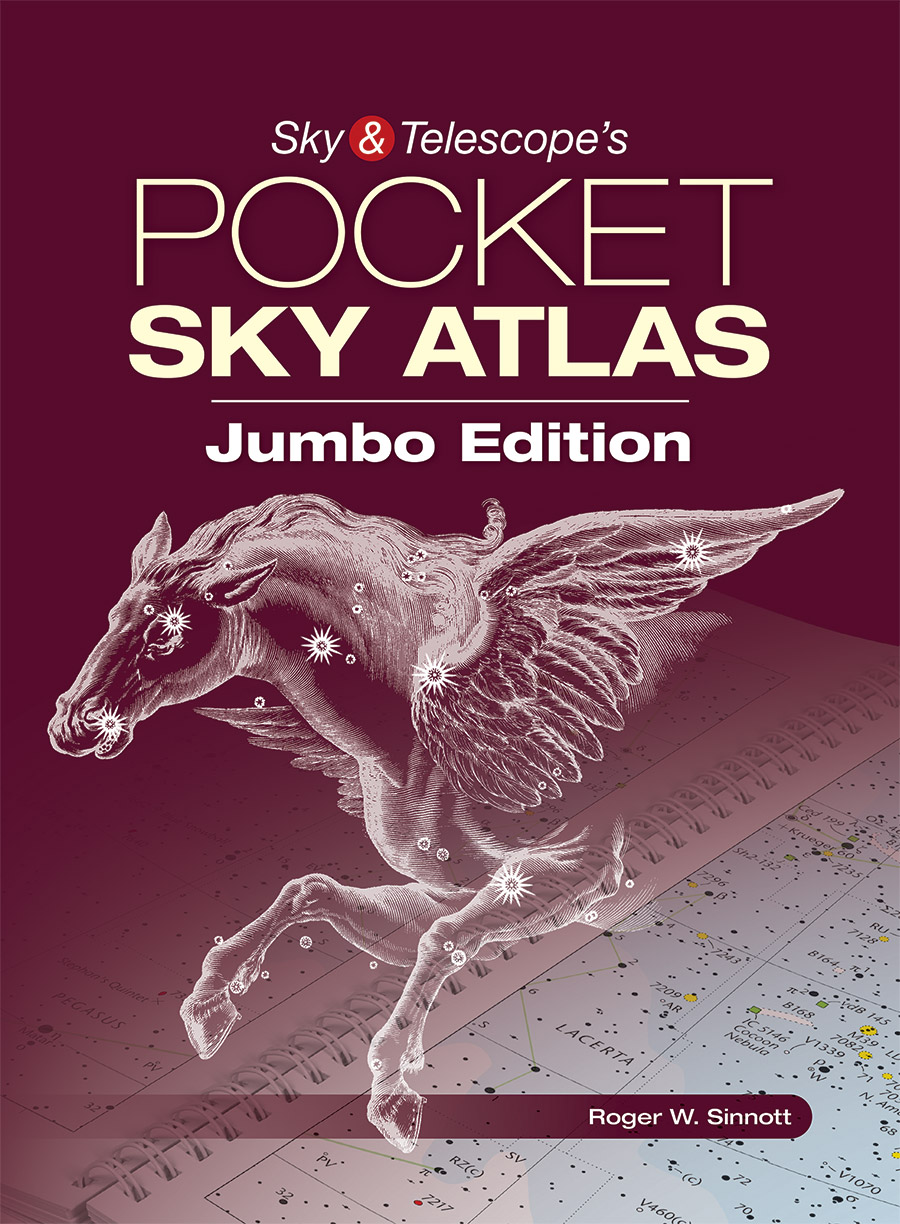
Once you get a telescope, to put it to good use you'll want a much more detailed, large-scale sky atlas (set of charts). The basic standard is the Pocket Sky Atlas, in either the original or Jumbo Edition. Both show all 30,000 stars to magnitude 7.6, and 1,500 deep-sky targets — star clusters, nebulae, and galaxies — to search out among them.
Next up is the larger and deeper Sky Atlas 2000.0, plotting stars to magnitude 8.5; nearly three times as many, as well as many more deep-sky objects. It's currently out of print, but maybe you can find one used.
The next up, once you know your way around well, are the even larger Interstellarum Deep-Sky Atlas (with 201,000+ stars to magnitude 9.5 and 14,000 deep-sky objects selected to be detectable by eye in very large amateur telescopes), and Uranometria 2000.0 (332,000 stars to mag 9.75, and 10,300 deep-sky objects).
And read How to Use a Star Chart with a Telescope. It applies just as much to charts on your phone or tablet, which many observers find handier and more versatile, as to charts on paper.
You'll also want a good deep-sky guidebook. A beloved old classic is the three-volume Burnham's Celestial Handbook. It was my bedside reading for years. An impressive more modern one is the big Night Sky Observer's Guide set (2+ volumes) by Kepple and Sanner. The pinnacle for total astro-geeks is the new Annals of the Deep Sky series, currently at 11 volumes as it works its way forward through the constellations alphabetically. So far it's up to H.
Can computerized telescopes replace charts? Well, I used to say this:
"Not for beginners, I don't think, unless you prefer spending your time getting finicky technology to work rather than learning how to explore through the sky yourself. As Terence Dickinson and Alan Dyer say in their Backyard Astronomer's Guide, 'A full appreciation of the universe cannot come without developing the skills to find things in the sky and understanding how the sky works. This knowledge comes only by spending time under the stars with star maps in hand and a curious mind.' Without these, 'the sky never becomes a friendly place.' "
Well, things change. The technology has continued to improve and become more user-friendly — particularly with software that can now, amazingly, recognize any telescopic star field to determine exactly where the telescope is pointed — finally bypassing all imperfections in the mount, tripod, gears, bearings and other mechanics, or in the user's skill in setting up.
The latest revolution is the rise of small, imaging-only "smartscopes." These take advantage of not only today's pointing technology, but also the vastly better capabilities of imaging chips and processing compared to the human retina and visual cortex. The most sophisticated image stacking and processing can also come built in. The result is reasonably capable deep-sky imagers in shockingly small, low-priced units. The image is viewable on your phone or computer as it builds up in real time. Small smartscopes can enable contributions to serious citizen-science projects.
These are changing the hobby at the entry level. For more on this revolution see Richard Wright's "The Rise of the Smart Telescopes" in the November 2025 Sky & Telescope. And read the magazine's review of this especially tiny one.
If you get a larger, more conventional computerized scope that allows direct visual use, do make sure that its drives can be disengaged so you can swing it around and point it readily by hand when you want to, rather than only slowly by the electric motors (which eat batteries).
 Audio sky tour. Out under the evening sky with your
earbuds in place, listen to Kelly Beatty's monthly
podcast tour of the naked-eye heavens above. It's free.
"The dangers of not thinking clearly are much greater now than ever before. It's not that there's something new in our way of thinking, it's that credulous and confused thinking can be much more lethal in ways it was never before."
— Carl Sagan, 1996
"Facts are stubborn things; and whatever may be our wishes, our inclinations, or the dictates of our passion, they cannot alter the state of facts and evidence."
— John Adams, 1770
The orbital elements of Comet 3I/ATLAS are:
    e (Eccentricity)                : 6.1390070
    q (Perihelion distance)         : 1.3563940
    i (Inclination)                 : 175.11300
    Ω (Longitude of ascending node) : 322.15530
    ω (Argument of perihelion)      : 128.00930
    L (Longitude of perihelion)     : 14.04471
    B (Latitude of perihelion)      : 3.84875
    T (Time of perihelion passage)  : 2460977.98350

    Epoch                           : 2025 Nov 21
    Reference                       : MPEC 2025-W75
Ephemeris:
Date       Time       RA (2000)    DEC (2000)    delta   radius  elong  phase   PA    magn
2025-11-24 00:00 UT   12 25 04.2   -01 35 35     1.994    1.645   55.2   29.5   294   10.9
2025-11-25 00:00 UT   12 21 55.8   -01 19 06     1.982    1.666   57.1   29.8   294   11.0
2025-11-26 00:00 UT   12 18 43.8   -01 02 15     1.970    1.687   58.9   30.1   294   11.0
2025-11-27 00:00 UT   12 15 28.1   +00 45 02     1.958    1.709   60.8   30.3   294   11.1
2025-11-28 00:00 UT   12 12 08.6   +00 27 26     1.946    1.732   62.7   30.4   294   11.2
2025-11-29 00:00 UT   12 08 45.3   +00 09 27     1.934    1.754   64.6   30.5   294   11.3
2025-11-30 00:00 UT   12 05 18.1   +00 08 54     1.923    1.777   66.5   30.6   294   11.3
2025-12-01 00:00 UT   12 01 46.9   +00 27 38     1.912    1.801   68.5   30.6   294   11.4
2025-12-02 00:00 UT   11 58 11.7   +00 46 45     1.901    1.825   70.4   30.6   294   11.5
2025-12-03 00:00 UT   11 54 32.4   +01 06 15     1.891    1.849   72.4   30.5   294   11.6
2025-12-04 00:00 UT   11 50 49.2   +01 26 07     1.881    1.874   74.4   30.4   294   11.7
2025-12-05 00:00 UT   11 47 01.8   +01 46 21     1.871    1.899   76.4   30.3   293   11.7

    Terminology:

    delta:  distance between comet and earth in AU
    radius: distance between comet and sun in AU
    magn:   magnitude (brightness) estimate
    ra:     right ascension in hours (24h = 360deg)
    dec:    declination in degrees
    elong:  elongation in degrees (angle sun-earth-comet)
    phase:  phase angle in degrees (angle sun-comet-earth)
    AU:     Astronomical Unit (mean distance between earth and sun: 149597870.7 km
About Alan MacRobert
Alan M. MacRobert became an avid Sky & Telescope subscriber in 1966 at age 14, joined the editorial staff in 1982, and is now a senior contributing editor, semi-retired. He played a role in practically every part of the magazine and the company's other products for more than a generation, both on the amateur-observing side and the science-reporting side. In 1994 a book collection of his observing how-tos and telescopic sky tours was published as Star Hopping for Backyard Astronomers. He has produced This Week's Sky at a Glance online every week since 1989.




Comments
Tony
November 28, 2025 at 6:08 pm
It's a tad early to be writing off Venus -- on the morning of 28/11 it was easily seen in 16X50 binoculars and was just visible without them. But two factors are weighing against the planet's visibility as November transitions to December: its steadily decreasing elongation, and the changing inclination of the morning ecliptic -- still favourable, as evident with the angle that the Mercury-Venus line makes with the horizon on Dec. 1, but gradually becoming less so.
You must be logged in to post a comment.
Rod
December 1, 2025 at 10:21 am
01-Dec-2025. spaceweather.com reporting large sunspot group visible now, some 4.2 arcminute angular size in telescope views or close to 14x Earth size. I checked out the Sun this morning using my telescope and white light solar filter. Some geeky notes posted here, https://www.youtube.com/post/Ugkx6xDXVjlFBqTd5Cx2Az66iqPFf7fa8664
You must be logged in to post a comment.
misha17
December 2, 2025 at 6:59 pm
Re: December full moon - last January the Moon's ascending node was located at the March solstice point. This meant the highpoint of the Moon's tilted orbit was 5 1/2 degrees higher than the Sun's June solstice point, and its lowpoint was 5 1/2 degrees lower than the Sun's December solstice point.
Although the node has shifted about 20 degrees westward since then, this month's Full Moon will rise and set about as far North as possible until around 2042. It will also pass about as closes to overhead as possible, and will even pass north of the Zenith for cities in southern Texas and Louisiana and cities in central Florida and southward.
The Griffith Observatory in Los Angeles will hold an viewing event for moonrise of the just-past Full Moon on Friday December 5th.
It will also stream the event online - link:
https://griffithobservatory.org/event/major-standstill-northern-moonrise-december-5-2025/
You must be logged in to post a comment.
Rod
December 3, 2025 at 12:21 pm
misha17, very cool here, thanks--Rod
You must be logged in to post a comment.
mary beth
December 5, 2025 at 5:24 pm
Yes! Thank you Misha17! Love this!
You must be logged in to post a comment.
You must be logged in to post a comment.