 SUNSET:


Voyager 2 Enters Interstellar Space
More than 18 billion kilometers from home, Voyager 2 has become the second probe to break through the heliopause, a tenuous boundary between the solar system and the rest of the Galaxy.

60-Second Astro News: Helium Exoplanets and a Supernova Surprise
This week in astronomy news: Inflated helium atmospheres surround two exoplanets, and the Kepler Space Telescope captures the moments around a supernova that hint at a companion star triggering the explosion.

Chang'e 4 Probe Heads to the Lunar Farside
China's latest lunar mission will drop a lander and rover in one of the oldest terrains on the Moon, becoming the first craft to intentionally land on and explore the farside.
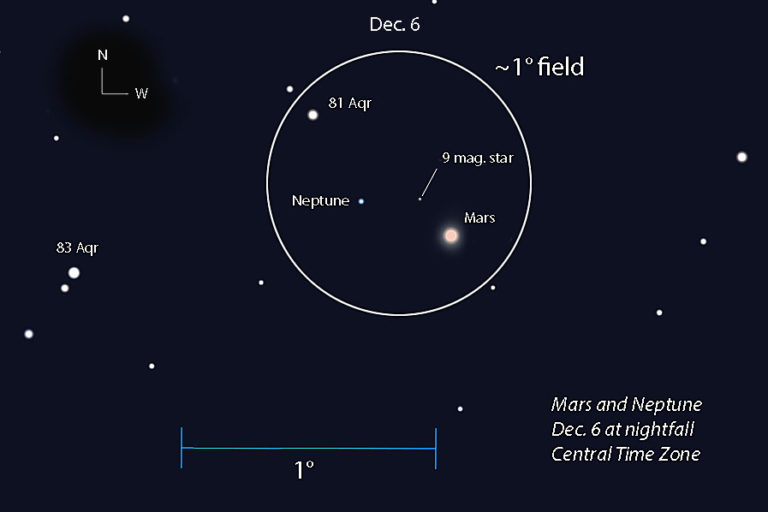
Mars and Neptune Have a Close Shave
Want to find Neptune the easy way? Just point your binoculars or telescope at Mars the next few nights, when the two planets will be in close conjunction.

Starlight Tally Reveals Cosmic History of Star Formation
Nearly 11 billion years ago, the universe churned out stars at a rate 10 times greater than today. And yet all the starlight in the cosmos appears no brighter on the sky than a 60-watt light bulb seen from miles away.

SpaceX Launches Orbiting "Sculpture in the Sky" / Comet Update
An art sculpture achieves orbit, 46P/Wirtanen becomes a naked-eye comet, and C/2018 V1 makes one last good pass.

Gravitational-Wave Observatories Bag Four Black-Hole Collisions
A re-analysis of data from LIGO and Virgo brings the number of gravitational-wave detections to 11, including the most distant and most powerful black-hole merger yet discovered.

Planning the New Horizons Exploration of Ultima Thule
Alan Stern, principal investigator of NASA's New Horizons mission, gives a detailed preview of what the spacecraft will be doing in the days up to, during, and after the impending flyby of the Kuiper Belt Object 2014 MU69.

Osiris-REX Arrives at Asteroid Bennu
NASA's ambitious Osiris-REX mission will now spend the next couple years surveying Bennu before attempting to return a sample to Earth.

Tour December's Sky: Morning Planets
December's astronomy podcast urges you to get outside early to gaze on dazzling Venus — then Mercury, then Jupiter — crowding the eastern sky before dawn.
Happy Birthday, Royal Astronomical Society of Canada!
The RASC turns 150 on December 1st! Join us in wishing them all the best on this historical milestone.

Glowing Serpent Found in the Sky
Astronomers have discovered a star generating a pinwheel of dust 8,000 lightyears away, which may shed some light on the last stages of massive star evolution.

Supernova Discovered in the Bright Galaxy M77
A new supernova in the bright galaxy M77 in Cetus is within range of amateur telescopes. Here's how to find it.

Insight Lander Touches Down on Mars
After a safe landing, NASA's first dedicated geophysical mission to Mars will spend the next two years studying the deep interior of the Red Planet.

Comet 46P/Wirtanen Approaches Earth
On December 16th, the comet will pass within 12 million kilometers of Earth and should brighten to about 3rd magnitude, though the diffuse coma and a nearly full Moon will make observations difficult.

A Black Hole X-Ray Binary Rises
New observations have captured a feeding black hole in our galaxy as it bursts onto the scene.

Jezero Crater Selected as Landing Site for Mars 2020 Rover
NASA's next Mars rover will explore a geologically diverse crater that may once have been flooded with water, a crucial ingredient for the mission's search for evidence of past life.
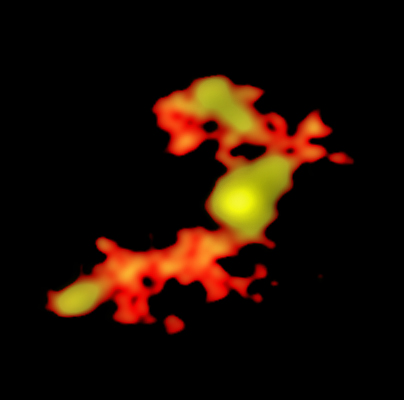
60-Second Astro News: A Carnivorous Quasar and a Galaxy Ghost
In astronomy news this week: The most luminous quasar known in the cosmos is devouring three galaxy companions, while a newly discovered ghostly satellite of the Milky Way hints at hordes more just waiting to be found.

Amateur Planet Hunters Have a New Online Resource
A database run by the American Association of Variable Star Observers will organize and archive data on transiting exoplanets collected by amateur astronomers.

Ducks in Disguise or How Stars Hide Their True Colors
Do star clusters form all at once or over several generations? A team of astronomers finds an answer among the spinning stars of an amateur favorite, the Wild Duck Cluster.
