 SUNSET:


60-Second Astro News: Dust Storms on Titan, Origin of Phobos
In astronomy news this week: Dust storms are seen blowing around Titan for the first time, and new clues from old data suggest that an impact on Mars gave birth to Phobos.

'Oumuamua’s Story Keeps Spinning
Two new studies question the cometary nature of 'Oumuamua, our first interstellar visitor, and where in the Galaxy it might have come from.

Touchdown: Hayabusa 2 Deploys Rovers to Explore Ryugu
The Japanese Hayabusa 2 spacecraft dispatched the first of a set of smaller missions that will explore asteroid 162173 Ryugu.

Dawn Probes Role of Cryovolcanism on Ceres
A recent analysis of data from NASA's Dawn spacecraft reveals the role of cryovolcanism past — and likely present — on the giant asteroid Ceres.

NASA's Cassini Sees Saturn's Towering Polar Hexagon
Cassini's legacy sheds more light on the strange mystery of Saturn's northern polar hexagon.

Jupiter’s Magnetic Field Has Weird Structure
Juno observations reveal that Jupiter’s magnetic field has a wacky plume.

Scientists Successfully Predicted the Shape of the Solar Corona
Scientists predicted the shape of the solar corona as it would be seen during the August 21, 2017, total solar eclipse. Observations confirmed that they got the broad strokes right.

Osiris-REX's First Views of Asteroid Bennu
NASA's Osiris-REX asteroid sample return mission spies target Bennu for the first time. Now the spacecraft is setting up for its close approach in December.
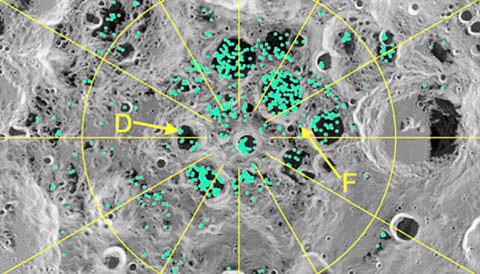
Direct Evidence of Water Ice at Moon's Poles
After more than a decade of tantalizing but inconclusive hints, new research shows convincingly that patches of water ice lie exposed on the floors of many permanently shadowed lunar craters.

Rover Call Home: NASA Listens for Opportunity's Wake-up
The Opportunity rover fell silent in June after nearly 15 years of work on the Red Planet. Now the dust storm that prevented its batteries from charging is clearing.

NASA's Parker Solar Probe Launches to "Touch the Sun"
The unique Parker Solar Probe launched on Sunday, August 12th, set to fly faster and come closer to the Sun than any spacecraft before it.

Found! The Largest Source of Dust on Mars
New results show that the Medusae Fossae Formation, a set of broad and enigmatic plains, provides most of the fine dust found everywhere on the Martian surface.

Tiny Blue Crystals Show Evidence of the Sun’s Active Youth
Scientists studying microscopic minerals found in a meteorite have discovered evidence of the feistiness of the toddler Sun.

Liquid Water on Mars! Really for Real This Time (Probably)
A radar instrument on one of the oldest operational Mars orbiters has discovered possible evidence of liquid water on Mars.

Jupiter's Moons: 10 More Found, 79 Known
Over the past 18 months, astronomers have painstakingly tracked a dozen tiny moons that they found circling the giant planet Jupiter.

Planet-Protection Policies: Due For Revision?
A new National Academies study assesses NASA's efforts to protect neighboring worlds from contamination and recommends ways the space agency could do a better job.

Observers Anxious for Dust to Settle as Mars Opposition Approaches
With opposition only weeks away, will the current global dust storm finally break? We look at the prospects.

Nautilus Expedition Recovers Possible Seafloor Meteorites
The expedition off the coast of Washington state performs a first, recovering meteorite fragments from a documented fall.

Organics Inside Enceladus: Complex Enough for Life?
Scientists aren't comfortable yet saying that organics on Saturn's icy moon arose from life, but they have an idea of what to look for next.

'Oumuamua Was a Comet After All
Researchers have found that 'Oumuamua — the first confirmed object to enter the solar system from interstellar space — was a comet, releasing just enough gas to subtly change its course.
