 SUNSET:

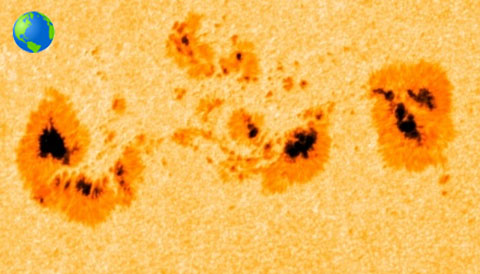
Big Sunspot Group Now in View
For sunwatchers who've been disappointed by this weak solar maximum, Active Region 2339 offers something to cheer about.

Pluto: The Last Picture Show
In his second "insider blog" about the New Horizons mission, principle investigator Alan Stern offers a look at what we might find at Pluto. It sounds like science fiction, but it's not: NASA's New Horizons spacecraft is on final approach to the Pluto system! After 112 months in flight, the…

Messenger Crashes, Its Results Endure
After four years at Mercury, NASA's Messenger orbiter has finished its remarkable mission and crashed into the planet.

Do Explosive Bursts Heat the Sun’s Corona?
New evidence suggests that nanoflares, small but potent bursts of energy, might heat the Sun’s atmosphere. But not everybody’s convinced.

Dawn Maps Ceres in False Color
Thanks to NASA’s Dawn spacecraft, we’re finally seeing more of the asteroid Ceres than a fuzzy ball.

Walter H. Haas (1917–2015)
Amateur astronomy has lost a true pioneer, a keen observer who founded the worldwide Association of Lunar and Planetary Observers.

New Horizons: Navigating to Pluto
In the first of a series of installments written exclusively for Sky & Telescope, New Horizons principal investigator Alan Stern offers his behind-the-scenes perspective on what it took to get the spacecraft to Pluto.

NASA Selects Asteroid Mission Concept
NASA has selected the design for its Asteroid Redirect Mission, opting to retrieve a boulder from a larger asteroid.

MAVEN Spots Dust Cloud, Aurora on Mars
NASA’s MAVEN spacecraft has detected dust high in Mars’s atmosphere and auroras across the planet’s northern hemisphere.
Messenger Reveals Mercury Mysteries
With just weeks left before it crashes into its host planet, NASA's Messenger spacecraft is making the most of its extremely low altitude and finding that Mercury isn't a completely dead world.

Magnetosphere Mission Launches
With the goal of better understanding Earth’s space weather environment, NASA’s Magnetospheric Multiscale (MMS) mission launched just over an hour before midnight on March 12th from Cape Canaveral.
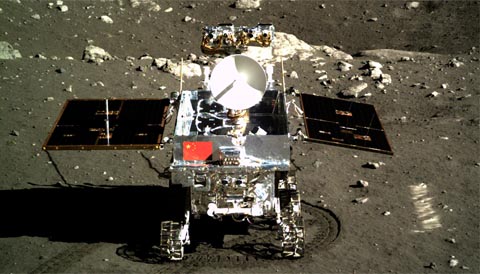
Lots of Lunar Layers Under Chang'e 3
A radar sounder aboard China's first-ever lunar lander found at least nine discrete subsurface layers at its landing site in northern Mare Imbrium.
Dawn Orbiter Reaches Dwarf-Planet Ceres
The long-distance traveler has finally arrived at the first dwarf planet (and largest asteroid) yet studied by spacecraft.

Bright Spots on Ceres Intrigue Scientists
Incoming views of the asteroid belt's largest body reveal spots where ice from the interior might be exposed on the surface.

The Mysterious Martian "Plumes"
An anomalous “cloud” imaged by amateurs in 2012 has puzzled astronomers, spurring some to suggest it was at inexplicably high altitudes above Mars’s surface.

A Star’s Closest Flyby to the Sun
A red dwarf and its brown dwarf companion buzzed through the outer Oort Cloud some 70,000 years ago, around the time when modern humans began migrating from Africa into Eurasia.
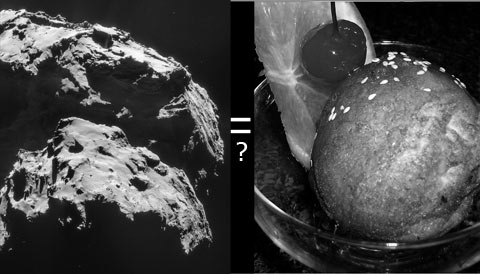
Deep Fried Comet Ice
Scientists studying ice here on Earth think they’ve confirmed why comets have hard crusts covered in hydrocarbon gunk.

Pluto and Charon’s Gravitational Dance
This image series, taken by NASA’s New Horizons spacecraft in late January 2015, reveals the dwarf planet Pluto and its largest moon, Charon, orbiting their common center of mass.

The Long-Lived Magnetic Fields of Meteorites
The magnetic fields in the asteroid parent bodies of two pallasite meteorites lasted hundreds of millions of years after our solar system’s formation.

Rosetta Reveals Much About Comet 67P
Once the Rosetta spacecraft arrived at Comet 67P/Churyumov-Gerasimenko last August, European scientists used an array of instruments to assess every nook and cranny of the remarkable two-lobed nucleus.
