 SUNSET:


Mountain-size Asteroid Glides Past Earth
With a small telescope and our sky charts, you can watch the sizable near-Earth asteroid 2004 BL86 race among the stars on the night of January 26–27.

Give-and-Take Origin for Earth's Water?
Where, exactly, did our oceans come from? New research suggests that asteroids might have both delivered and removed lots of water — and that Earth itself might have locked it away deep inside.
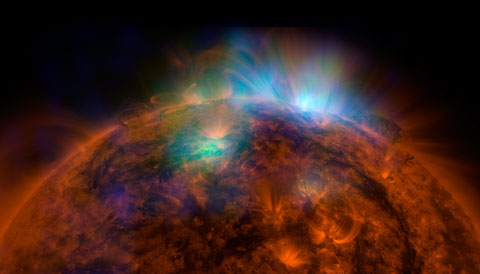
Seeing the Sun with X-ray Vision
NASA’s NuSTAR mission recently returned a striking image that shows the Sun’s active regions crackling with X-rays.

Curiosity Studies Mars Dry-out
Samples taken from two drill holes on Mars support the idea that Mars lost a whole lot of water fairly early in its history.

ESA Bids Farewell to Venus Express
A highly successful spacecraft has ended its mission after returning nearly a decade of data on Earth's nearest planetary neighbor.

Help Name Mercury's Craters
The International Astronomical Union is hosting a public contest to name five of Mercury's craters, with a deadline of January 15.

Rosetta Update: Philae Landed in a Hole
The exact location of Philae’s landing site remains unknown, though the site’s topography might allow the lander to operate longer than planned. Meanwhile, Rosetta is detecting organics and heavy elements even when Comet Churyumov-Gerasimenko is far from the Sun.

Curiosity Finds Methane, Other Organics
NASA’s Curiosity rover has detected both methane in Mars’s atmosphere and carbon-bearing organic compounds in its rocks. But it’s unclear where these molecules come from — or whether there’s any biological connection.

MAVEN Finds New Particles, Ion Plume
NASA’s MAVEN mission has discovered a new population of particles in Mars’s upper atmosphere. It’s also found a plume of particles escaping from the planet’s poles, confirming atmospheric loss is happening today.

Earth's Water Likely Not From Comets
An early outcome from Rosetta's scrutiny of Comet 67P/Churyumov-Gerasimenko is that the isotopes in its water have distinctly different ratios than those on Earth.

Geologic Map Shows What's Where on Vesta
NASA's Dawn spacecraft spent 14 months photographing Vesta from close range. Now geologists have completed a global map of the asteroid's surface geology.

New Horizons Awakens for Pluto Encounter
Right on cue, New Horizons spacecraft has awakened from its final electronic hibernation. Seven months from now, it will make the first-ever visit to Pluto.
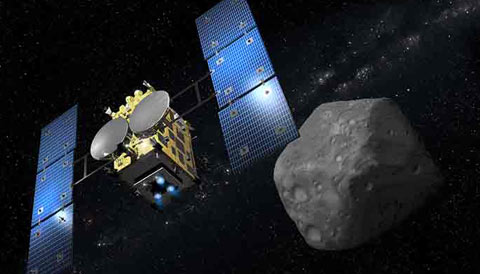
Hayabusa 2 is Asteroid Bound
Japan's second asteroid-sample mission launched successfully on December 3rd after weather delays. If successful it will reach asteroid 1999 JU3 in 2018, explore for 18 months, and then return to Earth with souvenirs.

Breathtaking View of Icy Moon Europa
A newly processed image from NASA’s Galileo spacecraft shows Europa’s breathtaking beauty and tortured surface in greater detail than ever before.

Bright Spot in Uranus’s Atmosphere
Amateur astronomers have confirmed the presence of a large, bright storm cloud on the ice giant Uranus.
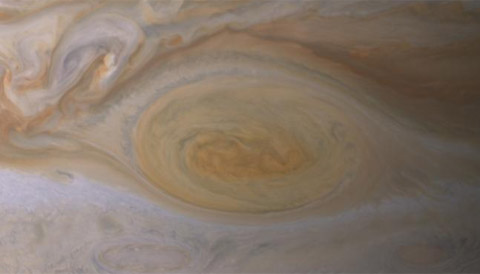
Why is Jupiter's Great Red Spot … Red?
Scientists think they've figured out what causes the mysterious ruddy coloring in the giant planet's enormous oval storm.

Philae Wins Race to Return Comet Findings
With its battery power failing, Philae became the "little lander than could" and managed to return results from all 10 of its science instruments before slipping into hibernation.

Philae Lands on Its Comet — Three Times!
After free-falling toward Comet 67P/Churyumov-Gerasimenko for seven hours, ESA's Philae lander bounced on the surface twice before finally coming to rest.
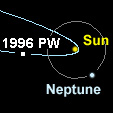
Eight Billion Asteroids in the Oort Cloud?
A fresh look at a nagging problem — asteroids moving in comet-like orbits — concludes that asteroids must make up about 4% of the vast, distant Oort Cloud of comets. When a telescope atop Hawaii's Haleakala swept up a fast-moving object in August 1996, astronomers didn't know what to make…
Rosetta Update: The Scent of a Comet
The Rosetta spacecraft reached its objective, Comet 67P/Churyumov-Gerasimenko, in August. Since then, one instrument has been "smelling" the mix of gases escaping from the comet's nucleus.
