 SUNSET:

What Happened to Mars?
Something happened to the Red Planet early in its history that left roughly half of it heavily cratered and the other half smooth and flat. Was this global facelift the work of a giant impact?
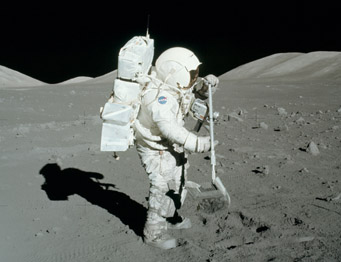
A Whiff of Water From the Moon
After studying the samples returned by Apollo astronauts, geochemists concluded that Moon is probably the driest place in the solar system. But a new study has turned up a tiny trace of water in some green-colored volcanic beads collected near Mare Imbrium.
Genesis Finding: Earth Has a Problem
Even as the Genesis spacecraft lay in a crumpled heap on the ground after its reentry chute malfunctioned in September 2004, its scientists remained confident that they would salvage the mission and answer fundamental questions about how the solar system formed. Now they have — and the results have already sent cosmochemists back to the drawing board.
Getting To Know Mercury
Planetary scientists have gathered in Houston, Texas, to get the latest news on what NASA's Messenger spacecraft learned when it zipped past the innermost planet two months ago.
Ring Around a Saturn Moon?
During a close flyby of Saturn's largest icy moon in late 2005, several instruments aboard Cassini sensed (but didn't actually "see") what appears to be a trio of thin rings and a dust disk surrounding Rhea.
Four Martian Landslides Caught in the Act
A scarp along the edge of the Martian north polar cap is more active than anyone expected.
Of Planets and Palace Elephants
A fourth-grader from Montana bested 800 other contestants to find a new way to remember all 11 major and dwarf planets.

A Triple Asteroid Threat
After taking aim at a passing asteroid with the Arecibo telescope's powerful radar, astronomers discovered that it has two satellites.
Mercury's "Better Half"
When it swept by the innermost planet on January 14th, NASA's Messenger spacecraft showed us a side of Mercury never before seen. After two weeks of intensive study, mission scientists have shared some of the flyby's intriguing results — including views of a "spidery" crater that has them stumped.

A Stardust-Free Comet
When NASA sent a spacecraft to grab samples of a comet and return them to Earth, scientists had high hopes that they'd finally be able to decipher how the solar system formed. Boy, were they wrong!
Mercury, Messenger, and Observers
As the first images are released from Messenger's flyby of the innermost planet, previous ground-based observations are proving to be surprisingly accurate.
A Bird's-Eye View of the Sun
What's it like to coast high over our star? The European-built spacecraft Ulysses is doing that right now — for its third and likely final time.

Reunion with Mercury
For the first time in nearly 33 years, mission controllers have guided a spacecraft past Mercury, a fire-and-ice world that may hold many keys to the solar system's formation.
Mars Dodges a Bullet
Fortified with two months of telescopic tracking, dynamicists say there's now virtually no chance that a small asteroid will strike Mars later this month.
Martian Crater Named for “Chick” Capen
A crater on Mars has been officially named for the American scientist Charles F. Capen.
A New Cycle is Dawning
It's nothing more than an inconspicuous blemish in the Sun's northern hemisphere, but a new sunspot has heralded the start of the next 11-year-long cycle of solar activity.
Cassini's Popularity Contest
After a month-long contest, the Cassini Imaging Central Laboratory for Operations (CICLOPS) has announced which images of Saturn are fan favorites.
Odds of Mars Strike Now 1-in-25
Astronomers have been watching a small asteroid that, they now say, has a 4% chance of colliding with Mars on January 30th.
Mars in the Crosshairs?
Astronomers are waiting to see what becomes of a skyscraper-size asteroid that has a 1-in-75 chance of hitting Mars in late January.
David Levy's Binary Asteroid
An otherwise run-of-the-mill, main-belt asteroid named 3673 Levy just got a lot more interesting: It has a tiny moon!
