 SUNSET:

Tunguska's Blast: Less is More
Aided by high-def supercomputer simulations, two researchers now argue that small asteroids striking Earth — like what happened over Siberia in 1908 — may pose greater danger than previously believed.
Earth's Magnetosphere: On the Ropes
A constellation of five identical orbiting probes has detected skirmishes with the solar wind along Earth's magnetospheric front lines.
Deep Impact's New Assignments
Put to sleep after its smash success in 2005, one of NASA's interplanetary craft is getting a chance to search for extrasolar Earths and to visit a second comet.
Saturn's Sci-Fi Moons
Just when you thought you'd seen everything the ringed planet has to offer, the Cassini orbiter glimpses bizarre little moons shaped like flying saucers.
My Kind of Beauty Contest!
What's the most beautiful image taken by the Cassini spacecraft since it arrived at Saturn? Vote for your favorite today!
Lightning on Venus
The world next door seemed hellish enough with an atmosphere 90 times the sea-level pressure on Earth and surface temperature of 900°. Now, scientists say, there's lots of lightning — and what little water it has seems to be escaping to space.
Call for Images of Venus
Venus Express project scientists are inviting amateur and professional astronomers to contribute Earth-based images of the planet made at infrared, visible, and ultraviolet wavelengths.

Meteor Showers on Mars
Scientists now know what meteor showers occur in the rarefied atmosphere above Mars. So how come NASA's intrepid rovers can't see them?
Automated Lunar Impacts
NASA is watching the Moon to see how often it gets hit by meteoroids.
Pluto's New Family Portrait
Years of painstaking observation with some of the world's most powerful telescopes are finally showing us a glimpse of what awaits New Horizons when it reaches Pluto in 2015.
Titan's Frigid Shores
NASA's Cassini orbiter continues mapping Saturn's largest moon — and finding prime lakefront real estate.
Two Planets, One Discovery
Talk about serendipity! Two teams of scientists on opposite sides of the Atlantic, studying two planets on opposite sides of Earth, come up with the same quirky result.
Spotlight on New Horizons
Jupiter looks great through a backyard telescope, but can you imagine how much better it'd look from just 1.4 million miles away? NASA's Pluto-bound spacecraft got that chance last February.
Iapetus Yields Dark Secrets
Saturn's black-and-white moon has mystified astronomers for centuries. Finally, however, they're learning what a bizarre place it truly is.
Imaging Mercury
A team of astronomers have found new features on the innermost planet using an approach familiar to many amateur astronomers.
Kaguya: To the Moon!
With a brief rocket firing on October 4th, the Japanese spacecraft Kaguya slipped into lunar orbit — the first step in what promises to be an exciting scientific mission.
Sun 1, Comet Tail 0
A solar explosion plows into a comet's tail. Care to place a wager on which one wins?
Uranian Moons Transit Tonight
This evening, if you've got a good planetary imaging setup, see if you can rcord the shadows of Titania and Ariel as they drift across the cloud tops of Uranus.

Skylights into Martian Caves
NASA's Mars Odyssey orbiter may have found deep black pits — possibly sinkholes — that act as skylights for extensive caves on the slopes of the volcano Arsia Mons.
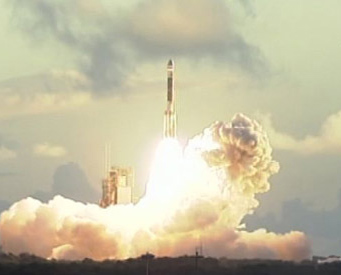
Dawn Heads to Vesta (Finally!)
After many delays (and near termination), NASA's ambitious asteroid mission is finally under way following a picture-perfect launch on Thursday.
