 SUNSET:

 14
14FRIDAY, NOVEMBER 22
■ This evening may be your last chance to spot Mercury in twilight this year. Try for it 21° (about two fists at arm's length) lower right of brilliant Venus about 30 to 45 minutes after sunset, as shown below. Every day now Mercury fades and sinks. Its next evening apparition won't begin until late winter.
Venus, on the other hand, is getting higher and brighter. It will dominate the twilight and early night as the "Evening Star" for the rest of the fall and most of the winter.

■ Last-quarter Moon (exact at 8:28 p.m. EST). The Moon rises around 11 or midnight tonight in Leo, with Regulus shining a few degrees upper right of it. The Sickle of Leo extends upper left from Regulus by a fist-width or a little more.
They all climb together through the rest of the night.
■ Algol should be at its minimum brightness, magnitude 3.4 instead of its usual 2.1, for a couple hours centered on 11:25 p.m. EST; 8:25 p.m. PST. Algol takes several additional hours to fade and to rebrighten. Comparison-star chart.
SATURDAY, NOVEMBER 23
■ The bowl of the Little Dipper swings down in the evening at this time of year, left or lower left of Polaris in the north. Most of the Little Dipper is dim. By 11 p.m. the Little Dipper hangs straight down from Polaris.
■ Around 7 or 8 p.m. this week, the Great Square of Pegasus stands in its level position very high toward the south. (It's straight overhead if you're as far south as Miami.) Its right (western) edge points very far down toward Fomalhaut. Its eastern edge points less directly toward Beta Ceti (also known as Deneb Kaitos or Diphda), less far down.
Now descending farther: If you have a very good view down to a dark south horizon — and if you're not much farther north than roughly New York, Denver, or Madrid — picture an equilateral triangle with Fomalhaut and Beta Ceti as its top two corners. Near where the third corner would be (just a bit right of that point) is Alpha Phoenicis, or Ankaa, in the constellation Phoenix. It's magnitude 2.4, not very bright but the brightest thing in its area. It has a yellow-orange tint (binoculars help check). Have you ever seen anything of the constellation Phoenix to add to your constellation life list?
SUNDAY, NOVEMBER 24
■ Take advantage of the darkness these moonless evenings! A small to medium telescope is all you need to explore Ken Hewett-White's five Bonus Double Stars near the little Hockey Stick asterism in Andromeda, now high overhead. They are unnamed bonuses to the brighter pair Struve 14, orange and pale bluish, at the tip of the Hockey Stick.
The five lie in the large, very loose open cluster NGC 752. See Ken's "Suburban Stargazer" story, chart, and photos in the November Sky & Telescope, starting on page 55.
MONDAY, NOVEMBER 25
■ Two faint fuzzies naked-eye. The Andromeda Galaxy (M31) and the Perseus Double Cluster are two of the most famous deep-sky objects. They're both cataloged as 4th magnitude, and in a fairly good sky you can see each with the unaided eye. Binoculars make them easier. Did you know they're only 22° apart? They're very high toward the east early these evenings — to the right of Cassiopeia and closer below Cassiopeia, respectively.
But they look rather different, the more so the darker your sky. See for yourself. You can find them with the all-sky constellation map in the center of the November or December Sky & Telescope.
■ Algol should be at its minimum brightness, magnitude 3.4 instead of its usual 2.1, for a couple hours centered on 8:14 p.m. EST. It takes several additional hours to rebrighten.
TUESDAY, NOVEMBER 26
■ The thin waning crescent Moon occults Spica before or during dawn Wednesday morning the 27th for most of the eastern and central US and Canada. Spica will disappear behind the Moon's bright limb, then will emerge from behind its dark limb up to an hour or more later. See the end of Bob King's Watch the Moon Occult the Pleiades, Spica too!

Map and timetables. The first two tables, with predictions for many cities and towns, are long. The first table gives the times of the star's disappearance behind the Moon's bright limb; the second gives its reappearance out from behind the Moon's dark limb, an event more easily observable. Scroll to be sure you're using the correct table; watch for the new heading as you scroll down. The first two letters in each entry are the country abbreviation (CA is Canada, not California). The times are in UT (GMT) November 27th. UT is 5 hours ahead of Eastern Standard Time, 6 hours ahead of CST.
For instance, use the tables to find that for New York, Spica disappears at 5:36 a.m. EST in a dark sky when the Moon is 21° up in the southeast (that's azimuth 127°). It reappears from behind the dark limb at 6:51 a.m. EST in a very bright sky when the Sun is only 2° below the horizon and about to rise.
At Chicago, by contrast, Spica disappears in dark night at 4:28 a.m. CST when the Moon is only 10° up in the east-southeast. Spica reappears at 5:37 a.m. CST, again in darkness but with the Moon higher.
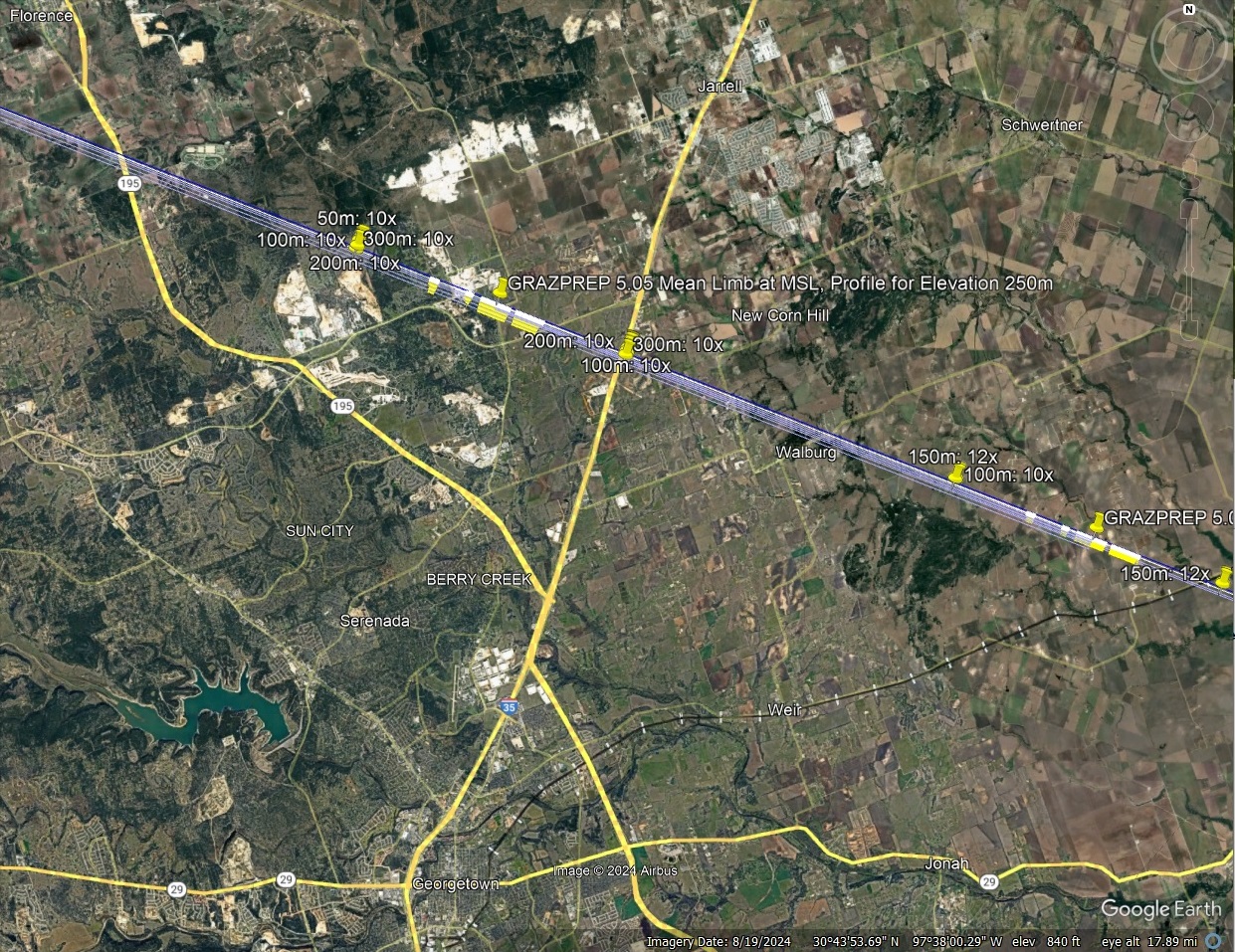
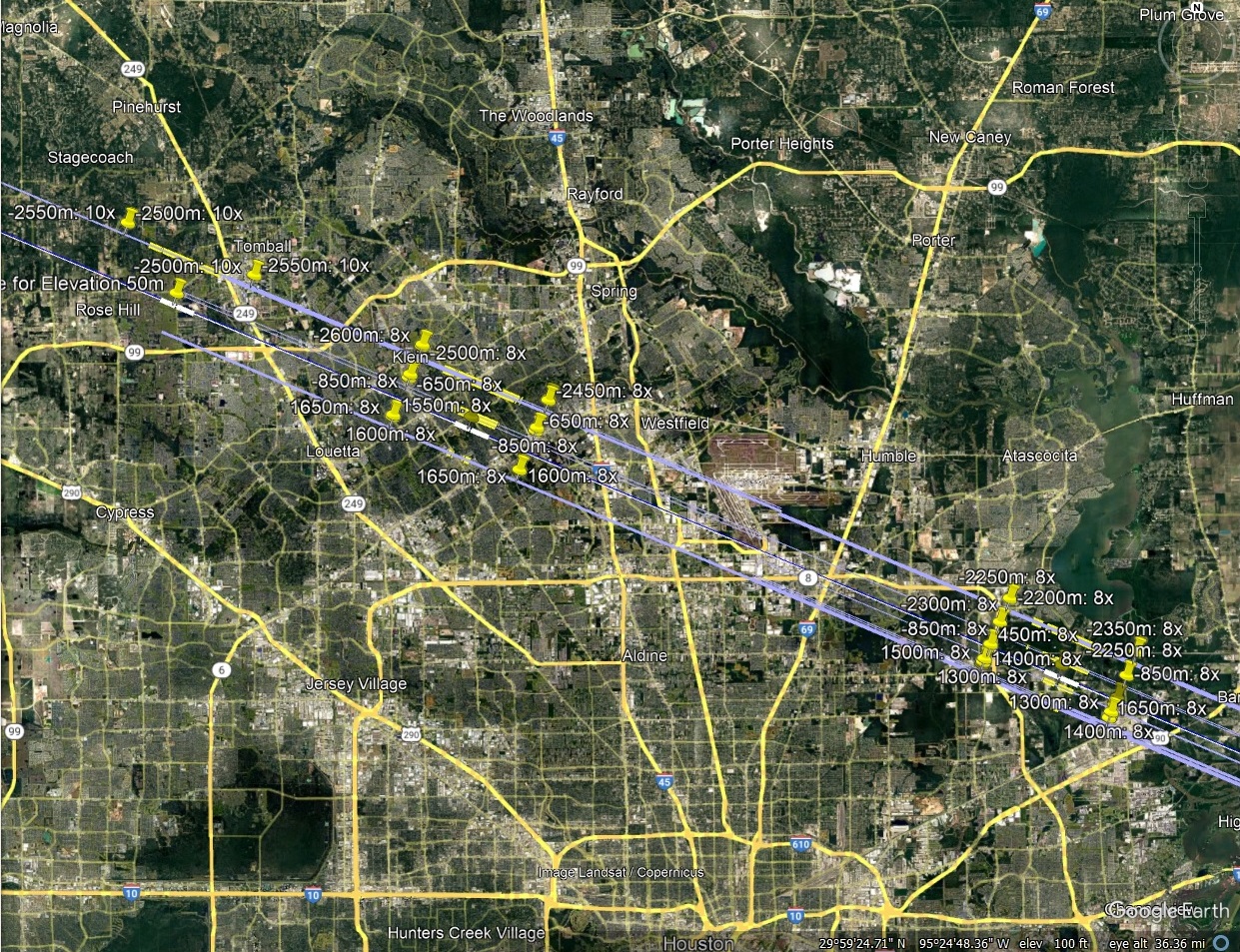
The southern limit of the occultation, or graze line, runs from southeasternmost Texas into New Mexico, passing north of Austin and through northern Houston. The Moon and Spica there will be low. Complex occultation events are possible very close to the graze line, and the International Occultation Timing Association (IOTA) plans an expedition using predictions refined to the city-block level. Spica is a very close double star. Video of a previous Spica graze.
WEDNESDAY, NOVEMBER 27
■ The Double Cluster is Perseus's most famous deep-sky object but by no means its biggest or brightest! That would be the big Alpha Persei Association. Binoculars are the perfect instrument for this swarm of stars born in the same area around the same time. It's called an "association" rather than a "cluster" because it's not gravitationally bound; its stars will simply drift apart.
The Alpha Per Association appears about 3° long, the size of your thumbprint at arm's length, or roughly half the width of an ordinary binocular's field of view. Find it running south-southeast (currently down or lower right) from Perseus's brightest star. Matt Wedel notes that its sheer size makes it so overlooked! Take a tour through it using his Binocular Highlight column and chart in the December Sky & Telescope, page 43.
THURSDAY, NOVEMBER 28
■ Does the Sun already seem to be setting about as early as it ever will? You're right! We're still nearly a month from the winter solstice — but the Sun sets its earliest around December 7th if you're near latitude 40° north. And already the Sun sets within only about 2 minutes of that time.
A surprising result of this: The Sun actually sets a trace earlier on Thanksgiving than on Christmas — even though Christmas is around solstice time!
But in celestial mechanics, every abnormality is balanced out by an equal abnormality somewhere else. The offset of the earliest sunset from the solstice date is balanced out by the opposite happening at sunrise: The Sun doesn't come up its latest until January 4th. Blame the tilt of Earth's axis and the eccentricity of Earth's orbit.
FRIDAY, NOVEMBER 29
■ As the stars come out, the Cassiopeia W now stands on end (its fainter end) high in the northeast. Watch Cas turn around to become a flattened M, even higher in the north, by late evening.
SATURDAY, NOVEMBER 30
■ Vega still shines brightly well up in the west-northwest after dark. The brightest star above it is Deneb, the head of the big Northern Cross, formed by the brightest stars of Cygnus. At nightfall the shaft of the cross extends lower left from Deneb. By about 11 p.m., it plants itself more or less upright on the northwest horizon.
SUNDAY, DECEMBER 1
■ Telescope users can watch the tiny black shadow of Jupiter's moon Io start crossing Jupiter's face at 9:02 p.m. EST (entering on the planet's eastern edge), closely followed by Io itself just 10 minutes later. They depart Jupiter's opposite edge at 11:14 and 11:23 p.m. EST, respectively. Convert to your own time zone. Meanwhile, Jupiter's Great Red Spot will be out of sight on the planet's far side.
■ New Moon (exact at 1:21 a.m. on this date EST).
This Week's Planet Roundup°
Mercury is fading and disappearing into the afterglow of sunset. On Friday the 22nd you might still catch it with optical aid 21° lower right of Venus, as shown at the top of this page. Look 30 to 45 minutes after sunset.
Venus (magnitude –4.1) gleams in the southwest in evening twilight, higher every week. It now remains up for about an hour after dark.
Mars (about magnitude –0.5, in Cancer east of Gemini) rises in the east-northeast around 8 or 9 p.m. This week, it forms the right angle of a right triangle with Castor and Pollux above it and Procyon to its right. Mars is 48° east along the ecliptic from bright Jupiter.
Mars shows best in a telescope when very high toward the southeast or south in the hours after midnight. It has enlarged to 11 arcseconds in apparent diameter. It's on its way to a relatively distant opposition in mid-January, when it will reach a diameter of 14.5 arcseconds.
Jupiter (magnitude –2.8, in Taurus) shines low in the east-northeast as twilight turns to dark. As darkness deepens, watch for Aldebaran and slightly fainter El Nath (Beta Tauri) to come into view right and left of it.
Jupiter is at its telescopic best when very high toward the south by about 11 or so. Jupiter is 48 arcseconds wide in a telescope and it will remain this big all through the weeks around its December 7th opposition.

North is up. Go writes, "The GRS [Great Red Spot] has become very small! The shrink seems to have accelerated. Will the GRS disappear in our lifetime? This might be a possibility!
"The wake of the GRS [left of it here] is very active. Note the strange feature, a complex bright streak [spanning the disk] on the Equatorial Zone above the GRS. A lot of features are resolved towards the poles."
Saturn, magnitude +0.9 in Aquarius, glows highest in the south from late twilight through early evening. Don't confuse it with Fomalhaut twinkling two fists below it.

Uranus (magnitude 5.6, at the Taurus-Aries border) is in the east during evening, about 7° from the Pleiades. You'll need a good finder chart to tell it from its surrounding faint stars; charts are in the November Sky & Telescope, page 49.
Neptune (tougher at magnitude 7.8, under the Circlet of Pisces) is high in the south after dark, 14° east of Saturn. Again you'll need a proper finder chart.
All descriptions that relate to your horizon — including the words up, down, right, and left — are written for the world's mid-northern latitudes. Descriptions and graphics that also depend on longitude (mainly Moon positions) are for North America.
Eastern Standard Time (EST) is Universal Time minus 5 hours. UT is also known as UTC, GMT, or Z time.
Want to become a better astronomer? Learn your way around the constellations. They're the key to locating everything fainter and deeper to hunt with binoculars or a telescope.
This is an outdoor nature hobby. For a more detailed constellation guide covering the whole evening sky, use the big monthly map in the center of each issue of Sky & Telescope, the essential magazine of astronomy.
Once you get a telescope, to put it to good use you'll need a much more detailed, large-scale sky atlas (set of charts). The basic standard is the Pocket Sky Atlas, in either the original or Jumbo Edition. Both show all 30,000 stars to magnitude 7.6, and 1,500 deep-sky targets — star clusters, nebulae, and galaxies — to search out among them.
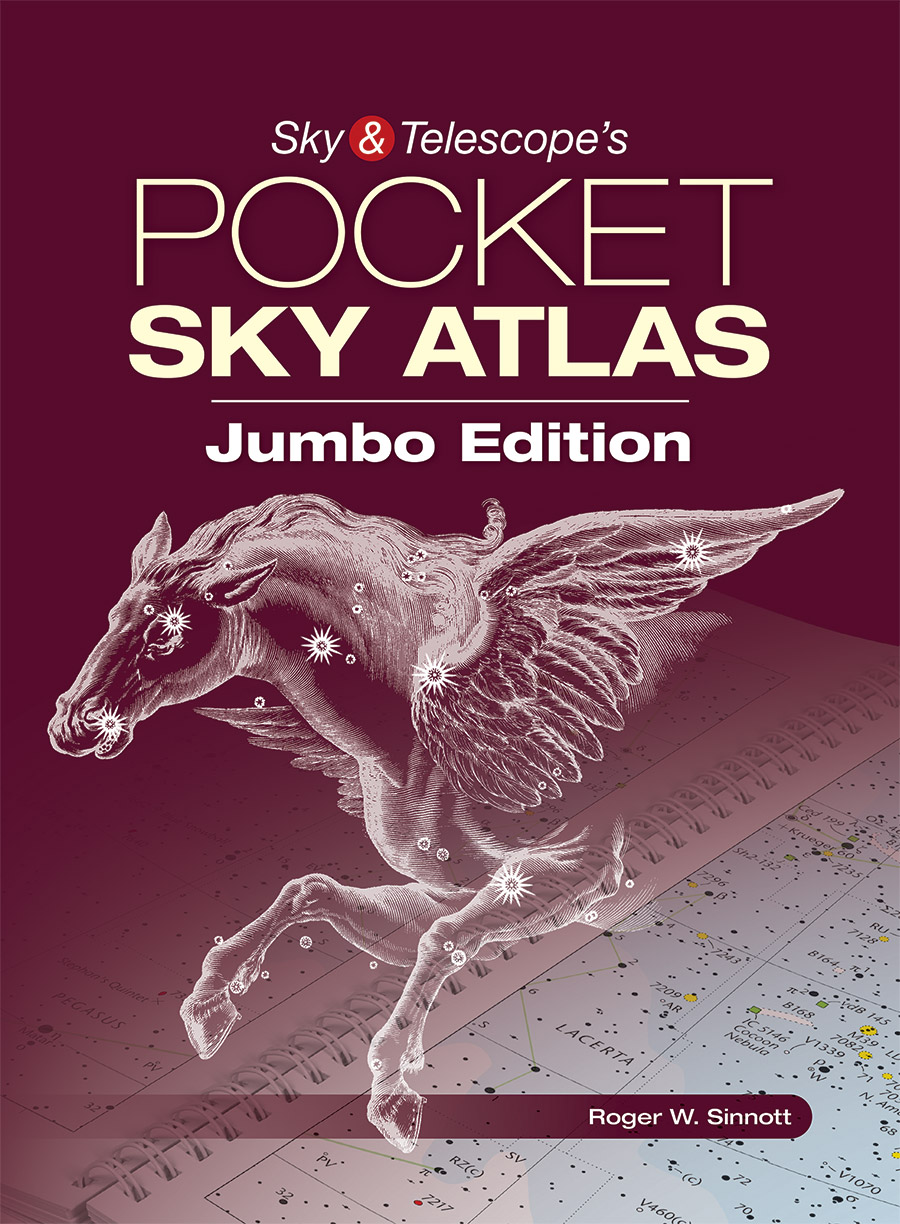
Next up is the larger and deeper Sky Atlas 2000.0, plotting stars to magnitude 8.5; nearly three times as many, as well as many more deep-sky objects. It's currently out of print, but maybe you can find one used.
The next up, once you know your way around well, are the even larger Interstellarum atlas (201,000+ stars to magnitude 9.5, and 14,000 deep-sky objects selected to be detectable by eye in large amateur telescopes), andUranometria 2000.0 (332,000 stars to mag 9.75, and 10,300 deep-sky objects). And read How to Use a Star Chart with a Telescope. It applies just as much to charts on your phone or tablet as to charts on paper.
You'll also want a good deep-sky guidebook. A beloved old classic is the three-volume Burnham's Celestial Handbook. An impressive more modern one is the big Night Sky Observer's Guide set (2+ volumes) by Kepple and Sanner. The pinnacle for total astro-geeks is the new Annals of the Deep Sky series, currently at 11 volumes as it works its way forward through the constellations alphabetically. So far it's up to H.
Can computerized telescopes replace charts? Not for beginners I don't think, and not for scopes on mounts and tripods that are less than top-quality mechanically. Unless, that is, you prefer spending your time getting finicky technology to work rather than learning how to explore the sky. As Terence Dickinson and Alan Dyer say in their Backyard Astronomer's Guide, "A full appreciation of the universe cannot come without developing the skills to find things in the sky and understanding how the sky works. This knowledge comes only by spending time under the stars with star maps in hand and a curious mind." Without these, "the sky never becomes a friendly place."
If you do get a computerized scope, make sure that its drives can be disengaged so you can swing it around and point it readily by hand when you want to, rather than only slowly by the electric motors (which eat batteries).
However, finding faint telescopic objects the old-fashioned way with charts isn't simple either. Do learn the essential tricks at How to Use a Star Chart with a Telescope.
 Audio sky tour. Out under the evening sky with your
earbuds in place, listen to Kelly Beatty's monthly
podcast tour of the naked-eye heavens above. It's free.
"The dangers of not thinking clearly are much greater now than ever before. It's not that there's something new in our way of thinking, it's that credulous and confused thinking can be much more lethal in ways it was never before."
— Carl Sagan, 1996
"Facts are stubborn things."
— John Adams, 1770
About Alan MacRobert
Alan M. MacRobert became an avid Sky & Telescope subscriber in 1966 at age 14, joined the editorial staff in 1982, and is now a senior contributing editor, semi-retired. He played a role in practically every part of the magazine and the company's other products for more than a generation, both on the amateur-observing side and the science-reporting side. In 1994 a book collection of his observing how-tos and telescopic sky tours was published as Star Hopping for Backyard Astronomers. He has produced This Week's Sky at a Glance online every week since 1989.




Comments
ctj
November 22, 2024 at 2:46 pm
I just wanted to express my appreciation for the Christopher Go pictures that regularly adorn the weekly updates. I enjoy seeing them and I hope he continues to submit them. Thanks!
You must be logged in to post a comment.
New Jersey Eclipse Fan
November 23, 2024 at 1:33 pm
Ditto! If my wife & I ever visit my son, who lives in Manila, Philippines, maybe we can make a side trip to visit Mr. Go and stargaze together!
You must be logged in to post a comment.
mary beth
November 23, 2024 at 8:21 pm
Great to see you back! How are you?
You must be logged in to post a comment.
New Jersey Eclipse Fan
November 24, 2024 at 1:48 am
Fantastic--thanks for asking! I'll try to provide details later (no promises!), but let's just say I should change my "handle" to ISRAEL Eclipse Fan.
You must be logged in to post a comment.
mary beth
November 24, 2024 at 12:37 pm
Can’t wait!
Been praying for you every day since last October!
You must be logged in to post a comment.
New Jersey Eclipse Fan
November 24, 2024 at 4:49 pm
Well, they must've been answered, because my wife & I immigrated here this past August! We are blessed to be living in The Holy Land and close to two of our three children and all three grandchildren. We're further south than we were in N.J., so the night sky (and daytime, too, for that matter) looks a bit different. I'm looking forward to our first trip to the desert to be able to once again view the Milky Way and more. There's also an impact crater in this small country, which is on my "bucket list" and which you can read about here:
https://www.touristisrael.com/the-ramon-crater-makhtesh-ramon/2303/
You must be logged in to post a comment.
New Jersey Eclipse Fan
November 25, 2024 at 1:23 am
[I composed & submitted a comment here several hours ago, but I suppose it was revised and possibly even rejected. The only reason I can imagine why that would've happened is if someone didn't approve a link I provided about the Ramon Crater here in Israel, but I haven't received any feedback whatsoever. Stay tuned.]
You must be logged in to post a comment.
mary beth
November 25, 2024 at 2:27 pm
Haha maybe S&T doesn’t like volcanic craters on meteoric! (But I think you’re right they probably just don’t allow links).
You must be logged in to post a comment.
mary beth
November 25, 2024 at 2:27 pm
*only
You must be logged in to post a comment.
Monica Young
December 2, 2024 at 12:25 pm
Correct, our system generally flags comments with links in them for moderation. But sometimes (for reasons I don't understand myself!), it just sends those comments to the spam folder, and then no one checks them. I've found the comment and approved it.
You must be logged in to post a comment.
Rod
November 25, 2024 at 8:59 am
Very good to see New Jersey Eclipse Fan back 🙂 I may view Saturn and Jupiter Tuesday evening (looks to be clearer skies). Getting more clouds and some light rain in my area in MD now.
You must be logged in to post a comment.
mary beth
November 25, 2024 at 2:42 pm
Happy Thanksgiving to you and yours Rod!
You must be logged in to post a comment.
Rod
November 26, 2024 at 8:07 pm
mary beth *Israel Eclipse Fan* 🙂 I did enjoy some stargazing tonight using just my eyes. Clear skies here in MD, temp near 10C. I worked out under the stars tonight enjoying views of Jupiter, Taurus, Auriga, Perseus, Cassiopeia and others. Did some weights, sit-ups and rope jumping under the starry night, great fun. I am not as good as I once was, not as strong as I used to be, but I can still talk some smack, pump some iron, and run some laps 🙂
You must be logged in to post a comment.
mary beth
November 27, 2024 at 12:26 am
That’s wonderful Rod and nice to do all this in the great outdoors!
You must be logged in to post a comment.
You must be logged in to post a comment.