 SUNSET:

 1
1FRIDAY, SEPTEMBER 26
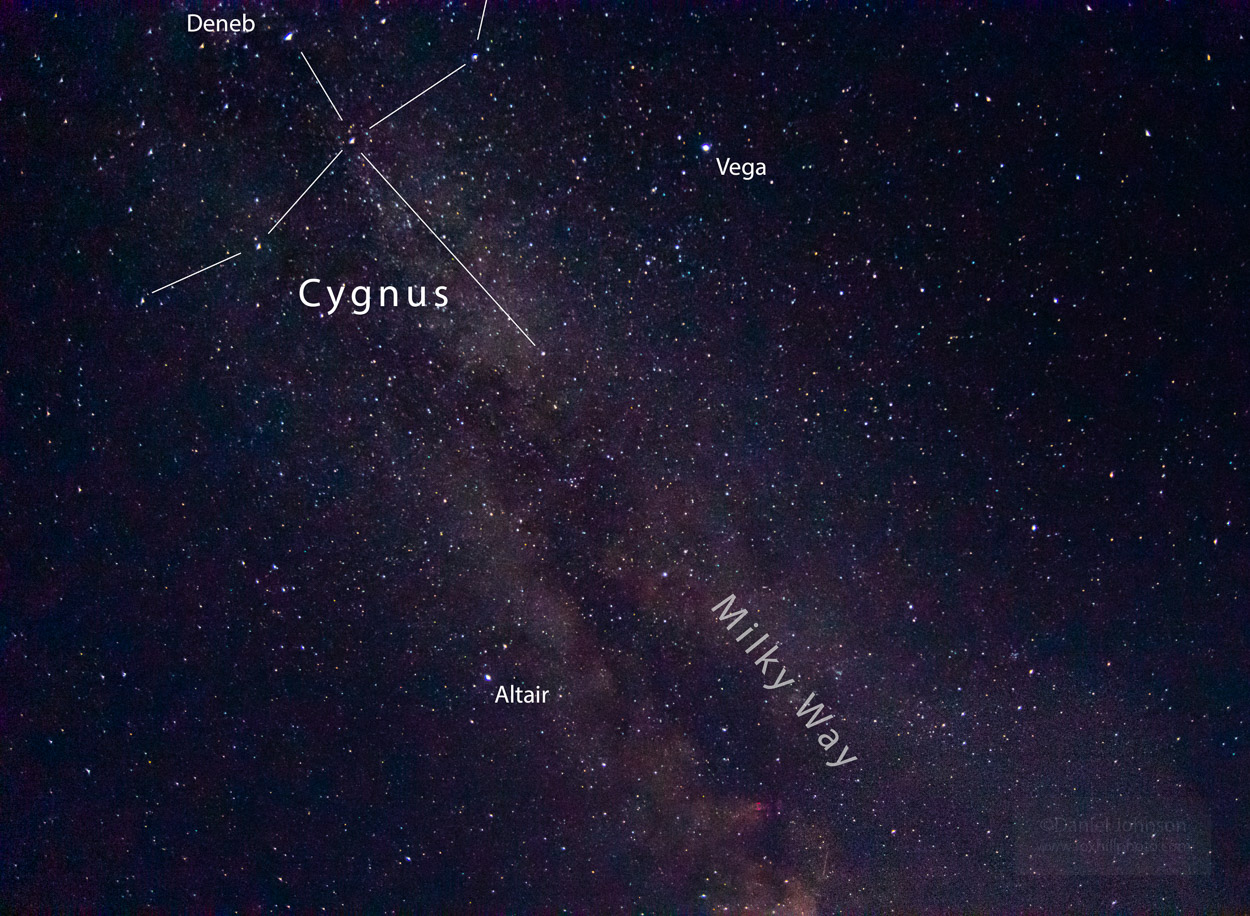
■ In the sky tonight, Cygnus the Swan floats nearly straight overhead. Its brightest stars form the big Northern Cross.
Face southwest and crane your head way, way up, and the cross appears to stand upright. It's about two fists at arm's length tall, with Deneb as its top. Or to put it another way: When you face southwest the Swan appears to be flying downward along the Milky Way.
SATURDAY, SEPTEMBER 27
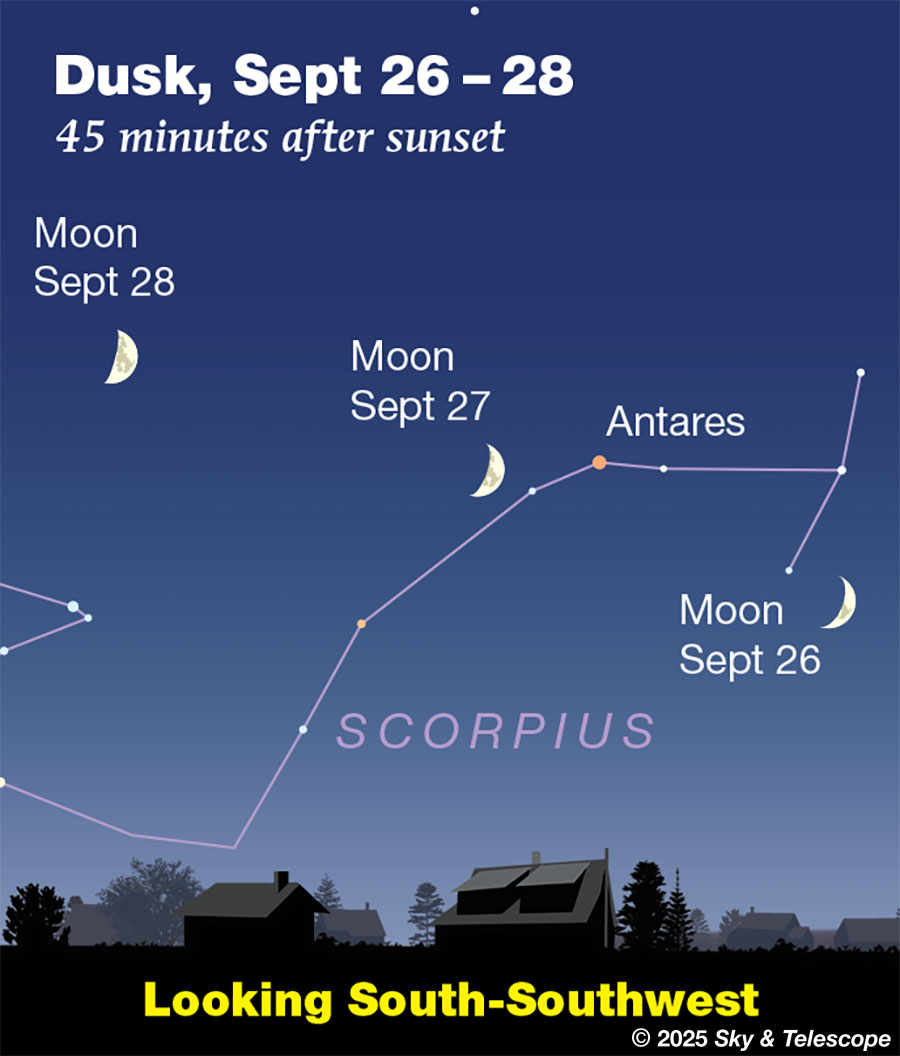
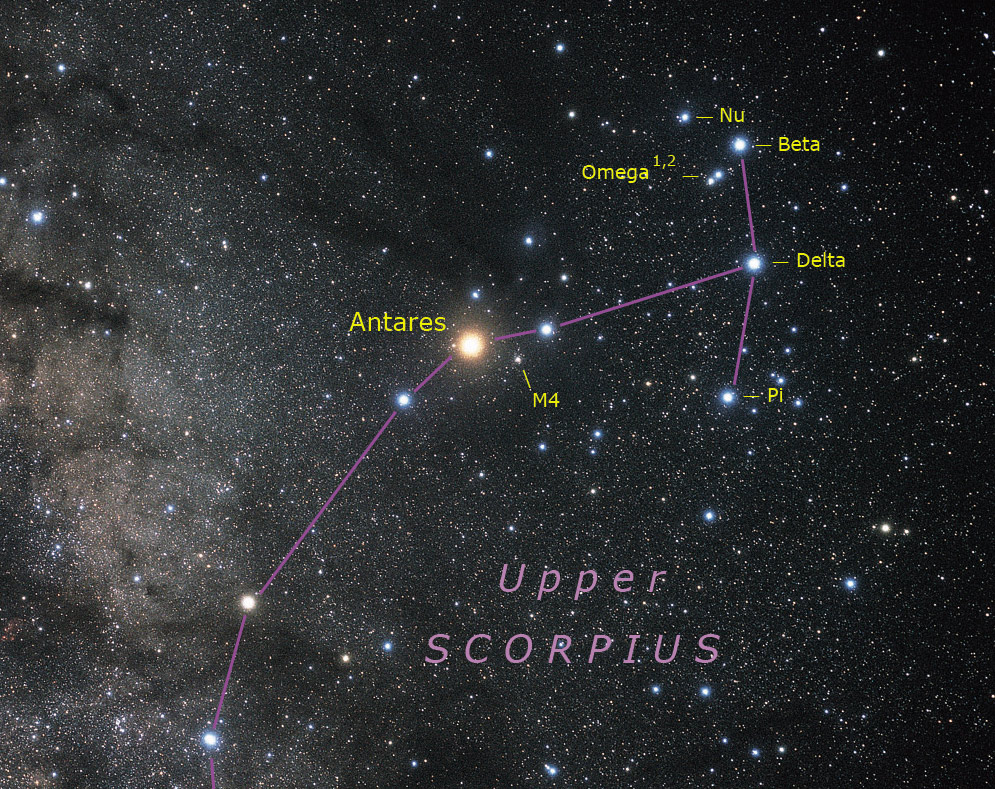
■ At nightfall, the waxing crescent Moon shines about 3° or 4° left of Antares in upper Scorpius, as shown below. The whole stick-figure Scorpion is tilting and lying down on its way out for the season. It sets soon after dark.
SUNDAY, SEPTEMBER 28
■ Now the Moon shines above the Cat's Eyes pair of stars in the tail of Scorpius, as shown above. The pair is a little less than a fist at arm's length below the Moon.
MONDAY, SEPTEMBER 29
■ First-quarter Moon; exactly first-quarter at 7:54 p.m. EDT. The Moon shines near the middle of the Sagittarius Teapot (for the Americas), between the Teapot's four-star handle to the left and its three-star spout to the Moon's lower right. If your sky is light-polluted, cover the Moon with your fingertip to make the stars a little easier to see.
The Moon's terminator is a straight line in early evening for North America. In a telescope the terminator touches the night-side edge of Archimedes in Mare Imbrium, and the night-side edges of big Ptolemaeus, Alphonsus, and Arzachel in the southern highlands, a familiar trio. The same for Purbach a little farther to their south, and big Maginus near the lunar south pole.
TUESDAY, SEPTEMBER 30
■ Now the Moon shines left of the Teapot's handle. The big craters next to the terminator yesterday are now in clear lunar sunlight, though their rims still cast long shadows. The terminator nearly bisects Mare Imbrium now, and toward the south pole, it crosses the big walled plain Clavius with its distinctive internal arc of four (or five) craters.
WEDNESDAY, OCTOBER 1
■ Ceres, the largest asteroid and the first 1 discovered, comes to opposition this week (on October 2nd). It's in binocular range at magnitude 7.6 near Eta Ceti. Use the finder chart in the October Sky & Telescope, page 50. The tick marks on its path there are for 0:00 UT on the dates indicated, which falls on the evening of the previous date for the Americas.
THURSDAY, OCTOBER 2
■ This evening the waxing gibbous Moon forms an enormous triangle with Saturn, about four fists at arm's length to its left, and Altair nearly as far to the Moon's upper right. The Moon itself inhabits dim Capricornus.
■ To the upper left of Saturn, the Great Square of Pegasus balances on its corner high in the east through much of the evening.
Extending away from the Great Square's left corner is the main line of Andromeda: three 2nd-magnitude stars about as bright as those of the Square and spaced similarly far apart. (The three include the Square's corner itself.) This whole dipper-shaped pattern was named the Andromegasus Dipper by the late Sky & Telescope columnist George Lovi — joining the Big and Little Dippers, the Milk Dipper of Sagittarius (nowadays usually subsumed into the Teapot), and the tiny dipper pattern of the Pleiades.
Extend the Andromeda line farther left to Alpha Persei in the northeast, and Andromegasus gains a longer handle to more resemble a giant Little Dipper.
FRIDAY, OCTOBER 3
■ In the sky tonight, Vega is the brightest star very high toward the west. When you face west and look up, to the right of Vega by 14° (a little more than a fist at arm's length) you'll find 2nd-magnitude Eltanin, the nose of Draco the Dragon. The rest of Draco's fainter, lozenge-shaped head is a little farther right. Draco always eyes Vega as they wheel around the sky.
Farther on, behind Draco's head, his long, arched back and tail loop around the Little Dipper.
The main stars of Vega's own constellation, Lyra — faint by comparison — extend from Vega in the direction opposite from Eltanin.
SATURDAY, OCTOBER 4
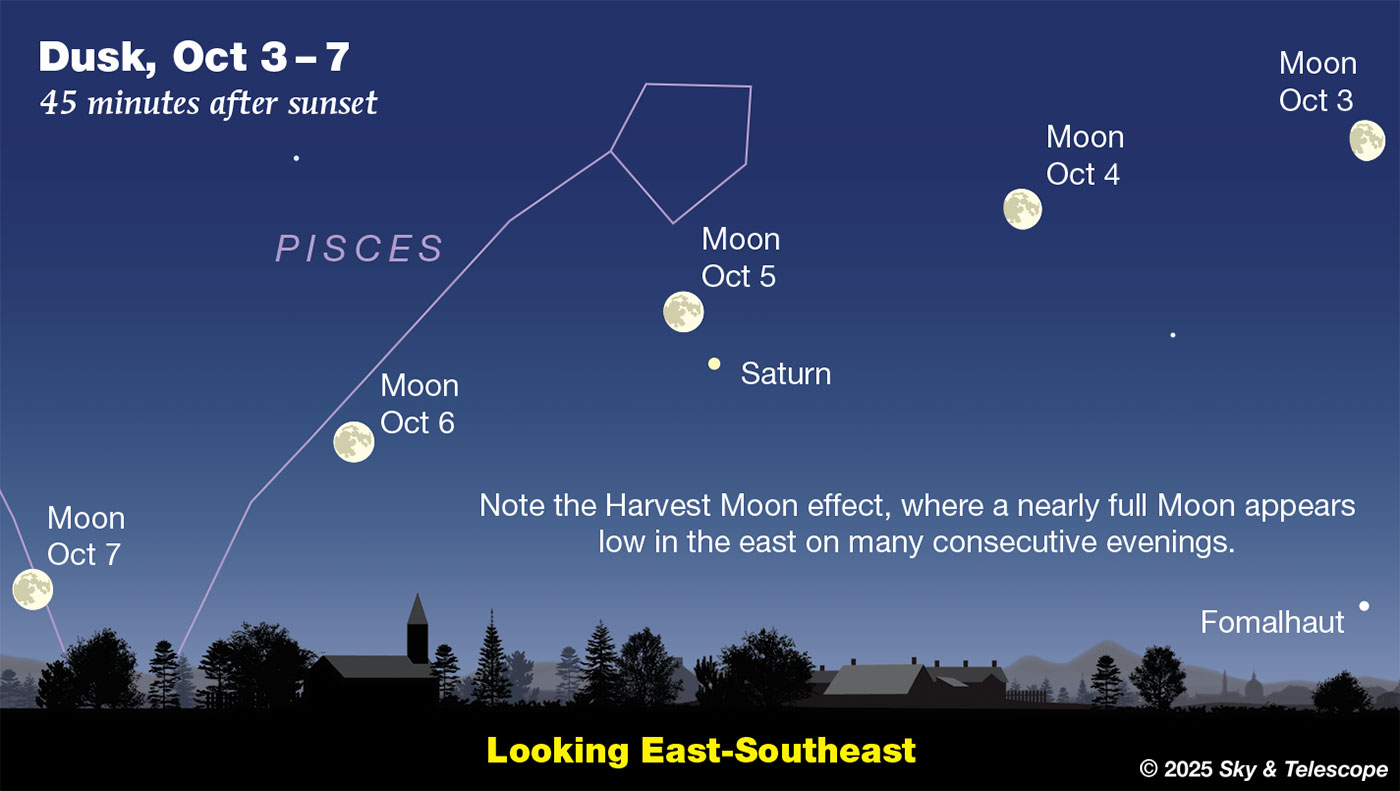
■ This evening find Saturn glowing steadily about a fist to the Moon's left or lower left, and Fomalhaut twinkling nearly twice as far to the Moon's lower right.
SUNDAY, OCTOBER 5
■ The Moon, just a day from full, shines low in the southeast at nightfall with Saturn just a couple degrees below or lower right of it. As the night proceeds into the early morning hours, watch them draw farther apart while Saturn appears to swing straight down under the Moon.
This Week's Planet Roundup
Mercury remains buried deep in the glow of sunset.
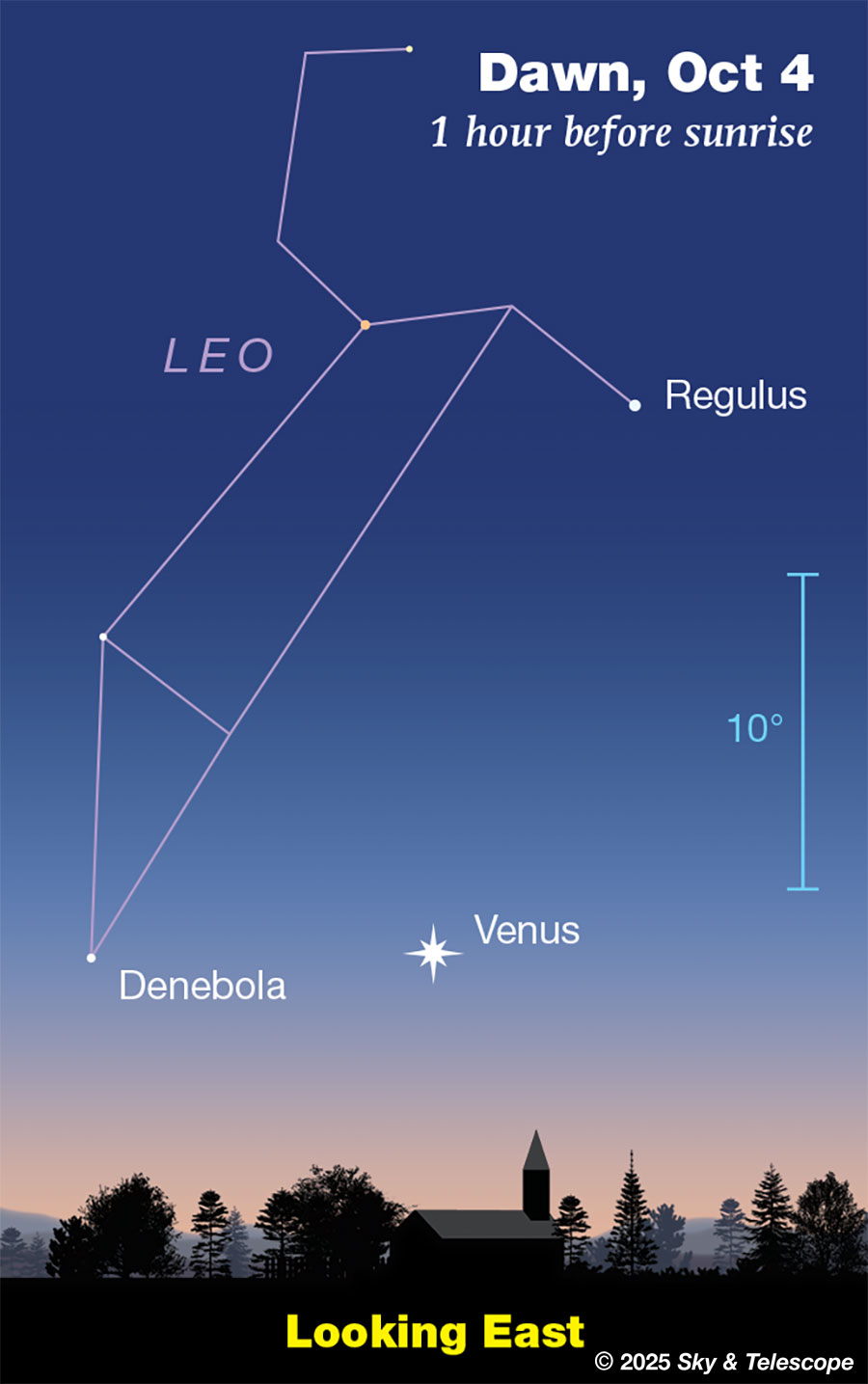
Venus rises about a half hour before the very beginning of dawn. Watch for it to come up a little left of due east.
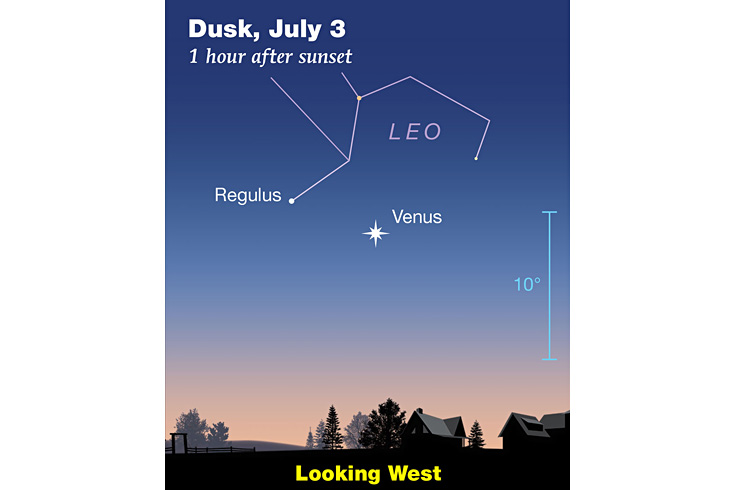
After Venus is up but before the sky gets too bright, look for Regulus, much fainter, increasingly far above it and a bit to the right. Regulus is 10° above Venus on Saturday morning September 27th, and 18° above it a week later on October 4th.
Mars, a weak magnitude 1.6 in Virgo, is slipping away very low in the west-northwest as twilight fades. You might try for it with binoculars about 30 minutes after sunset. Good luck.
Mars is very slowly nearing the end of its long 2024-2025 apparition. It won't actually reach conjunction with the Sun until the start of 2026!
Jupiter, magnitude –2.1 in Gemini, rises around midnight or 1 a.m. daylight-saving time and dominates the east as the morning hours advance. Castor and Pollux shine to Jupiter's upper left. By the beginning of dawn the three stand very high in the east — with Orion off to their right, Capella near the zenith, and Venus coming into view low in the east.
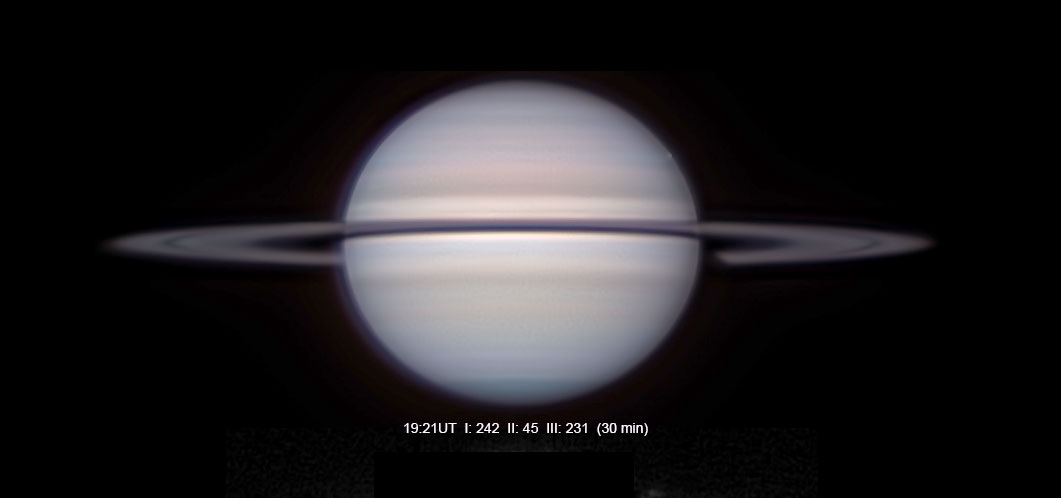
Saturn was at opposition on September 2oth. In now rises before sunset and glows in the east-southeast as the stars come out. At magnitude +0.7 it's brighter than the stars of the Great Square of Pegasus, which stands on one corner to Saturn's upper left.
Saturn climbs higher through the evening and transits the meridian (due south) around 11 or midnight. Its rings remain nearly edge-on.
Uranus (magnitude 5.6, in Taurus near the Pleiades) rises around 9 p.m. and is high before midnight. At high power in a telescope it's a tiny but definitely non-stellar dot, 3.6 arcseconds wide.
Neptune is a telescopic "star" of magnitude 7.8 and just 2.4 arcseconds wide. Use the finder chart for Neptune with respect to Saturn in the September Sky & Telescope, page 49. With a pencil, put a dot on the path of each of the two planets for your date.
All descriptions that relate to your horizon — including the words up, down, right, and left — are written for the world's mid-northern latitudes. Descriptions and graphics that also depend on longitude (mainly Moon positions) are for North America. Eastern Daylight Time (EDT) is Universal Time minus 4 hours. UT is also known as UTC, GMT, or Z time.
Want to become a better astronomer? Learn your way around the constellations. They're the key to locating everything fainter and deeper to hunt with binoculars or a telescope.
This is an outdoor nature hobby. For a more detailed constellation guide covering the whole evening sky, use the big monthly map in the center of each issue of Sky & Telescope, the essential magazine of astronomy.
For the attitude every amateur astronomer needs, read Jennifer Willis's Modest Expectations Give Rise to Delight.
Once you get a telescope, to put it to good use you'll need a much more detailed, large-scale sky atlas (set of charts). The basic standard is the Pocket Sky Atlas, in either the original or Jumbo Edition. Both show all 30,000 stars to magnitude 7.6, and 1,500 deep-sky targets — star clusters, nebulae, and galaxies — to search out among them.
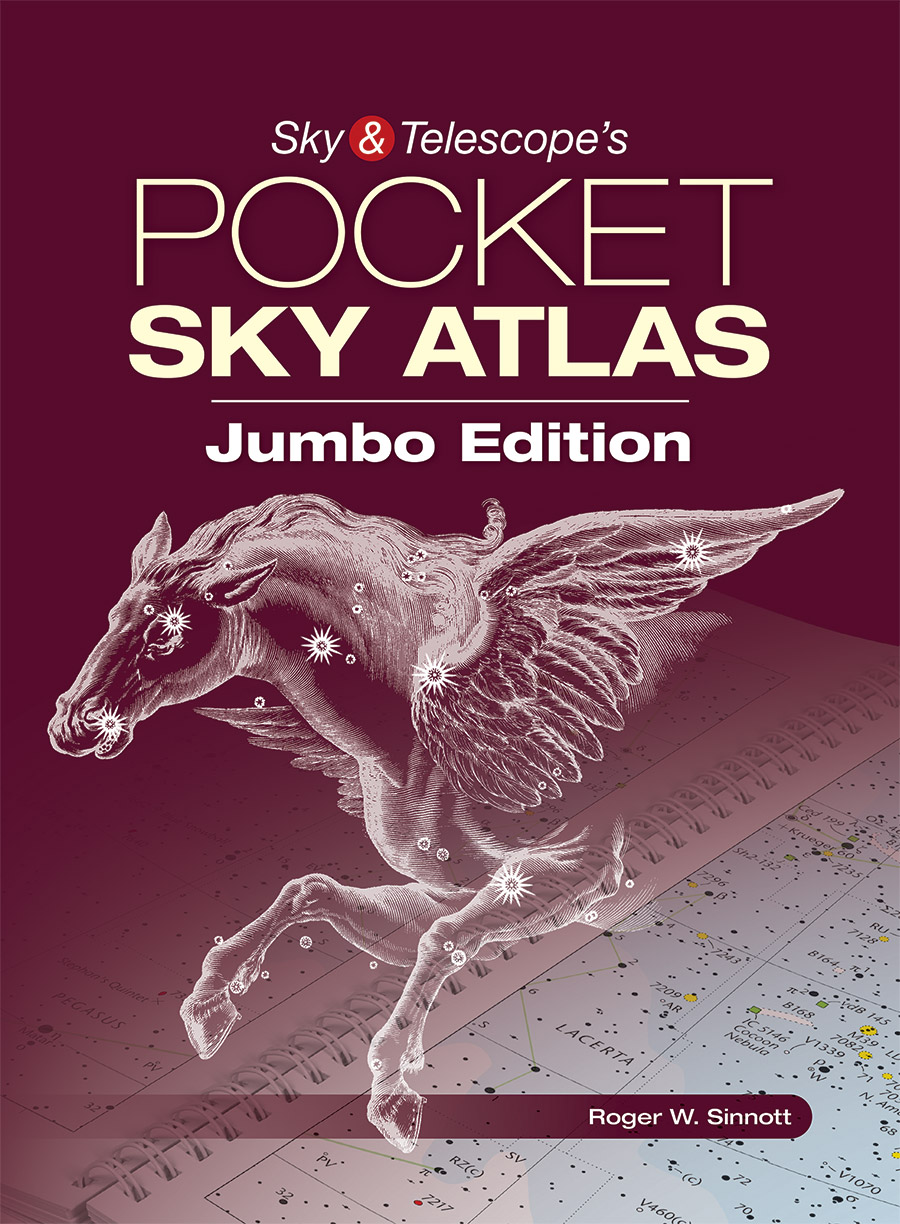
Next up is the larger and deeper Sky Atlas 2000.0, plotting stars to magnitude 8.5; nearly three times as many, as well as many more deep-sky objects. It's currently out of print, but maybe you can find one used.
The next up, once you know your way around well, are the even larger Interstellarum atlas (with 201,000+ stars to magnitude 9.5 and 14,000 deep-sky objects selected to be detectable by eye in large amateur telescopes), and Uranometria 2000.0 (332,000 stars to mag 9.75, and 10,300 deep-sky objects). And read How to Use a Star Chart with a Telescope. It applies just as much to charts on your phone or tablet (which many observers find more versatile) as to charts on paper.
You'll also want a good deep-sky guidebook. A beloved old classic is the three-volume Burnham's Celestial Handbook. An impressive more modern one is the big Night Sky Observer's Guide set (2+ volumes) by Kepple and Sanner. The pinnacle for total astro-geeks is the new Annals of the Deep Sky series, currently at 11 volumes as it works its way forward through the constellations alphabetically. So far it's up to H.
Can computerized telescopes replace charts? Not for beginners I don't think, and not for scopes on mounts and tripods that are less than top-quality mechanically. Unless, that is, you prefer spending your time getting finicky technology to work rather than learning how to explore the sky. As Terence Dickinson and Alan Dyer say in their Backyard Astronomer's Guide, "A full appreciation of the universe cannot come without developing the skills to find things in the sky and understanding how the sky works. This knowledge comes only by spending time under the stars with star maps in hand and a curious mind." Without these, "the sky never becomes a friendly place."
If you do get a computerized scope, make sure that its drives can be disengaged so you can swing it around and point it readily by hand when you want to, rather than only slowly by the electric motors (which eat batteries).
However, finding faint telescopic objects the old-fashioned way with charts isn't simple either. Do learn the essential tricks at How to Use a Star Chart with a Telescope.
 Audio sky tour. Out under the evening sky with your
earbuds in place, listen to Kelly Beatty's monthly
podcast tour of the naked-eye heavens above. It's free.
"The dangers of not thinking clearly are much greater now than ever before. It's not that there's something new in our way of thinking, it's that credulous and confused thinking can be much more lethal in ways it was never before."
— Carl Sagan, 1996
"Facts are stubborn things; and whatever may be our wishes, our inclinations, or the dictates of our passion, they cannot alter the state of facts and evidence."
— John Adams, 1770
Audio sky tour. Out under the evening sky with your
earbuds in place, listen to Kelly Beatty's monthly
podcast tour of the naked-eye heavens above. It's free.
"The dangers of not thinking clearly are much greater now than ever before. It's not that there's something new in our way of thinking, it's that credulous and confused thinking can be much more lethal in ways it was never before."
— Carl Sagan, 1996
"Facts are stubborn things; and whatever may be our wishes, our inclinations, or the dictates of our passion, they cannot alter the state of facts and evidence."
— John Adams, 1770
About Alan MacRobert
Alan M. MacRobert became an avid Sky & Telescope subscriber in 1966 at age 14, joined the editorial staff in 1982, and is now a senior contributing editor, semi-retired. He played a role in practically every part of the magazine and the company's other products for more than a generation, both on the amateur-observing side and the science-reporting side. In 1994 a book collection of his observing how-tos and telescopic sky tours was published as Star Hopping for Backyard Astronomers. He has produced This Week's Sky at a Glance online every week since 1989.



Comments
mary beth
October 2, 2025 at 8:11 pm
Happy October! Hoping everyone has had clear skies! It’s been great here in the evenings, we are enjoying Saturn and Fomalhaut. It’s kind of sad to see Antares and Scorpius leaving the evening sky soon. We might be able to see them for about two or even three more weeks.
You must be logged in to post a comment.
You must be logged in to post a comment.