 SUNSET:

 0
0Why are the stars so far away?
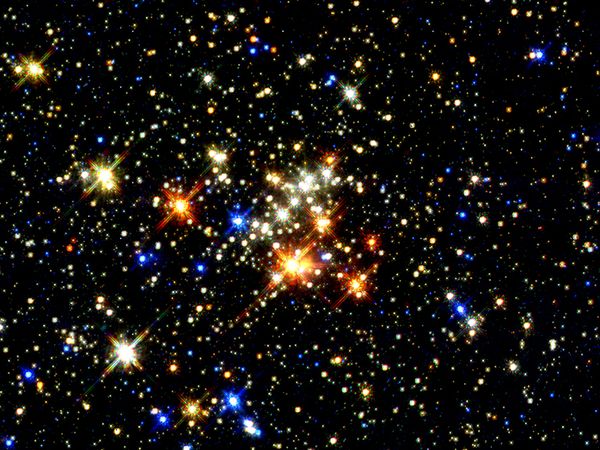
That question has a real answer: Because if the stars were much closer, Earth wouldn’t exist, and we wouldn’t be here to ask. In places where stars are much closer together, such as globular clusters and the center of the Milky Way, planetary systems are probably unstable in the long run. Sooner or later a close-passing star would tug our Jupiter into an elongated orbit, which would then spread chaos among the lighter planets. Earth would eventually be either flung out of the solar system, thrown into the Sun, or slammed into another planet. The fact that we exist to ask the question requires that we be in a region where stars are far apart. This is an example of “anthropic reasoning,” which some people can’t wrap their heads around but others say can be very powerful and predictive when used with caution (S&T: March 2004, page 43).
An equivalent question is: Why do we find ourselves on a planet with air and water rather than on a world like the Moon, even though Moon-like worlds are much more common in the universe?
— Alan MacRobert
About Alan MacRobert
Alan M. MacRobert became an avid Sky & Telescope subscriber in 1966 at age 14, joined the editorial staff in 1982, and is now a senior contributing editor, semi-retired. He played a role in practically every part of the magazine and the company's other products for more than a generation, both on the amateur-observing side and the science-reporting side. In 1994 a book collection of his observing how-tos and telescopic sky tours was published as Star Hopping for Backyard Astronomers. He has produced This Week's Sky at a Glance online every week since 1989.



Comments
You must be logged in to post a comment.