 SUNSET:

Japanese Craft Sail Off to Venus
Are volcanoes erupting on Venus? Does lightning zap the planet's atmosphere? A new interplanetary probe aims to answer these questions and many others.

A New Type of Supernova?
A pair of exploding stars, witnessed in 2005, apparently represent the first examples of a new class of supernova. But astronomers don't yet agree on what triggered these tremendous events..
The Hidden Face of M83
The Southern Pinwheel Galaxy is already famous as a gorgeous deep-sky showpiece. Now astronomers have probed its structure with a high-resolution infrared view.

Disappearing Act on Jupiter
One of the giant planet's signature bands, the South Equatorial Belt, began fading late last year. Now, for the first time since 1992, it's completely missing. Amateur and professional observers worldwide are eagerly hoping to witness its return.
NASA's Administrator Visits Boston
Charles Bolden, who took the reins of NASA last July, made an appearance in Boston last week and offered some views about the space agency's future.
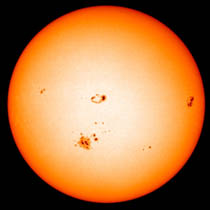
Sun's Size is "Rock Steady"
After measuring the Sun's diameter every 12 minutes for 12 years, astronomers have confidence that our star's diameter is constant to within one part in a million.
S&T's Audio Sky Tour for May 2010
Right now the evening sky is adorned with three bright planets. Spotting them is a snap using this month's audio sky tour. Host: S&T's Kelly Beatty. (56.5MB MP3 download: running time: 5m 53s)
Name an Asteroid!
Astronomers have a list of about 225,000 minor planets eligible to be named — and a few lucky students will get a chance to pick one.

Tour May's Sky! | April 30th, 2010
Right now the evening sky is adorned with three bright planets. Spotting them is a snap using this month's audio sky tour.
Amateurs Alert NASA to Saturn Storm
Thanks to the vigilance of planet-watchers around the world, Cassini scientists have captured key observations of a storm that erupted into view during mid-March.
Peak Picked for World's Largest Scope
If you were building a mega-telescope with an aperture half the length of a football field, where in the world would you put it?
Happy Birthday, Hubble!
It's been 20 years since the most productive telescope ever built rocketed into orbit. So let's celebrate!
Readying for Hayabusa's Return
When the Hayabusa spacecraft returns to Earth on June 13th, an international welcoming party will be waiting in Australia to spot and recover its sample-return capsule.

A Solar Sentinel's Stunning Debut
NASA researchers are betting that the Solar Dynamics Observatory will help them understand the Sun as never before — and enthrall the public with kaleidoscopic images and videos.
The Return of Neptune
It's taken 164 years, but Neptune is once again located exactly where it was when discovered by Johann Galle and Heinrich d'Arrest.
Sparks on Saturn
NASA's Cassini orbiter has finally captured images of lightning storms on the ringed planet.
Wrong-way Planets Confound Theorists
Planet-formation theory has been turned on its head by the discovery of planets that travel around their stars in retrograde orbits.
Saturated With Springtime Star Parties?
April 2010 is Global Astronomy Month. This is also International Dark-Sky Week, to be followed later this month by Astronomy Day. Lots of events come and go — but who's participating in them?
Project Ozma: The First SETI
It's been 50 years since a young radio astronomer named Frank Drake audaciously attempted, for the first time, to eavesdrop on radio transmissions from alien civilizations.

Mystery Eclipse Caught in the Act
After struggling for decades to understand why Epsilon Aurigae's partial eclipses last so long, astronomers are finally watching the event as it happens.
