 SUNSET:


Tour October's Sky: Saturn in the Southwest
October's astronomy podcast helps you track down Saturn after sunset and offers a peek at what's in view before dawn.

Asteroid Florence Has Two Moons
A large Earth-approaching asteroid, now sailing near Earth, has a lumpy shape and is accompanied by a pair of tiny moonlets.
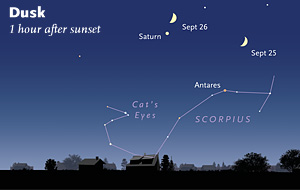
Tour September's Sky: Saturn Time!
In September's astronomy podcast, you'll learn what's special about the ringed planet Saturn, now visible in the evening sky.

New Horizons' 2019 Target: A Binary Body?
A challenging and intensive campaign by telescope-toting teams yields big-time results on the body that the New Horizons spacecraft will fly past in 17 months.

Amateur Observers Find an Asteroid's Moon
A team of amateurs observers, some armed with just 3-inch telescopes, have found that the main-belt asteroid 113 Amalthea probably has a small companion.

New Wrinkles in the Search for “Planet X”
Are astronomers being misled about a possible ninth planet by the quirky alignment of orbits that they’re finding in the distant Kuiper Belt?

Observers Track New Horizons' Next Target
On June 3rd, two dozen teams of observers in South America and South Africa tried to learn something about distant 2014 MU69, which New Horizons will visit in early 2019.

Two New Satellites for Jupiter
Just a mile across, a pair of moonlets found orbiting Jupiter bring the planet's total satellite count to 69.

NASA's Lunar Orbiter Takes a Hit
A Moon-orbiting camera briefly shuddered — then got back to work — when it was hit by a tiny bit of space rock no bigger than a pinhead.

Tour June's Sky: Saturn at Opposition
June's astronomy podcast takes you on a star- and planet-studded tour of the sky you'll see after sunset.

Sky & Telescope Promotions S&T's Adventures in Chile"}'>
S&T's Adventures in Chile
Sky & Telescope's third tour to this astronomical paradise in South America wowed its participants day and night. Here's what they saw!

Tour May's Sky: Big Dipper Leads the Way
Listen to May's astronomy podcast to learn why stargazers think of the Big Dipper as the "Swiss Army Knife" of the late-spring northern sky.
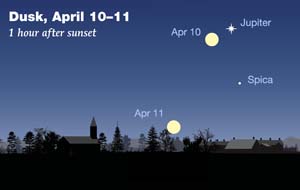
Tour April's Sky: Critters on the March
As you'll hear in this month's podcast, April is a time when it's easy to spot a lion, a sea serpent, and two bears in the evening sky.
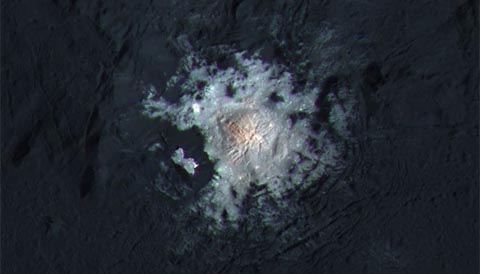
Bright Mound on Ceres Due to Briny Eruptions?
The strange bright deposits inside Occator crater on Ceres are probably from cryovolcanic eruptions that are much younger than the crater itself.
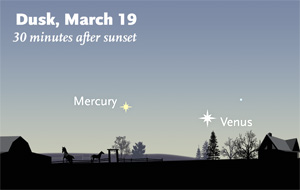
Tour March's Sky: Venus Sinks, Mercury Rises
In this month's easy-to-download podcast, find out how you can spot Venus in both the evening and predawn skies.Late in March, Mercury makes an appearance.
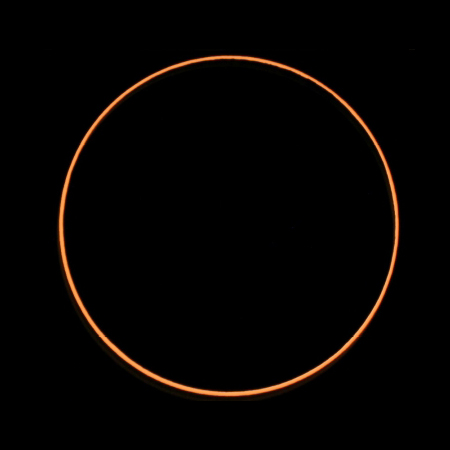
Sunday's Annular Solar Eclipse: First Reports
Clear skies prevailed across Patagonia in South America, providing intrepid eclipse-chasers with beautiful views of February 26th's annular solar eclipse.

February 26th's Annular Solar Eclipse in 2017
Die-hard eclipse chasers have journeyed to the Southern Hemisphere to catch a short but dramatically thin "ring" eclipse of the Sun this weekend.

Tour February's Sky: How To Find Monoceros
Download our monthly astronomy podcast to spot Venus and Mars in the west — and a celestial unicorn hiding in plain sight among the stars.

When and How Did the Moon Form?
New studies offer contrasting scenarios for making the Moon. One argues for a one big splat early in solar-system history; a second envisions a score of lesser blows that built up the Moon over time; and a third suggests water was involved.

Solar and Lunar Eclipses in 2017
It won't be a great year for lunar eclipses, with a deep penumbral event on February 11th and a partial on August 7th. But an annular solar eclipse is observable from the Southern Hemisphere on February 26th, and a total solar eclipse crosses the continental U.S. on August 21st.
