 SUNSET:

Comet LINEAR Graces the Northern Sky
An unexpectedly bright comet is crossing a well-known part of the sky.

Venus's Daytime Vanishing Act on Monday
Brilliant Venus will disappear behind the dark limb of the crescent Moon on Monday, June 18th, for observers in the Middle East and India — and in daytime for Europe and the northeastern tip of North America.

Crescent Moon to Occult Regulus Tuesday
When a star or planet ducks behind the Moon, it's a dramatic celestial sight. This month many lucky viewers will have the chance to see either a planet (Venus) or a bright star (Regulus) play peekaboo.
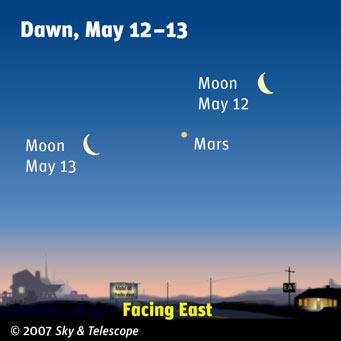
Red Planet Rising
Now that mornings are getting warmer, it's far less daunting to get out of your warm bed and do some early-morning stargazing. But if you need some added motivation to set that alarm, look no further than Mars.

See Vesta at Its Brightest!
This odd asteroid hasn't been so close to Earth in 18 years, and you may be surprised at how easy it is to spot with your eyes alone.

The Moon Meets the Pleiades
The Moon will be closing in on Messier 45 tonight; observers along the West Coast may see the Moon pass in front of some of the star cluster.
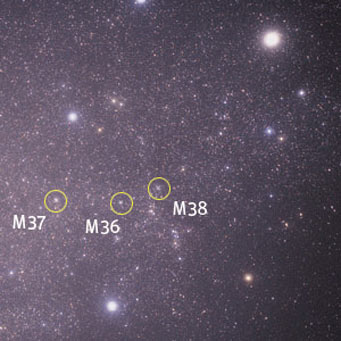
Starry Starry Night
Open star clusters are among the most straightforward deep-sky objects to observe with binoculars, and three wonderful targets for Northern Hemisphere observers ride high overhead as darkness falls at this time of year.
This Weekend's Total Lunar Eclipse
For many of us, the Moon is about to go dark for the first time in 2½ years.
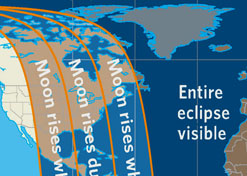
March 3rd's Total Lunar Eclipse
For many of us, the Moon is about to go dark for the first time in 2½ years.

The Best Asteroid Occultation in Decades: A First Report
On the morning of January 26th, at least 20 observers spread from Virginia to northern California timed the occultation of the star 32 Lyncis by the asteroid (372) Palma — in spite of the track shifting nearly half a path-width south of what was predicted.
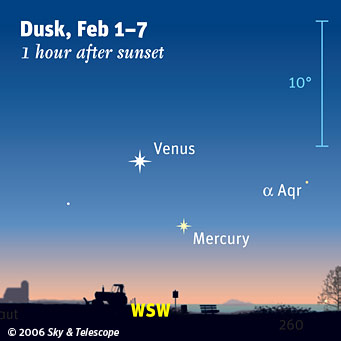
Inner Planets in the Evening
Venus and Mercury shine in the west after sunset. The pair will be closest on Sunday evening.
Get Hooked on the Ringed Planet
It's nearly full Moon, so you might need an excuse to go outside and brave the frigid weather. Here's a great one: treat yourself to the majesty of Saturn. Right now the planetary gem is shining in Leo at magnitude 0.0, and it is currently the brightest it will be for many years to come.
Friday's Stellar Vanishing Act
This coming Friday morning you'll need only binoculars, a clear sky, and the right location to witness the best asteroid occultation visible in the continental US during the last quarter century.
Eclipses in 2007
Two total lunar eclipses are visible from parts of North America in 2007. But if you're looking for a total solar eclipse, you'll need to wait till August 2008 — and travel to Central Asia.
Meteor Showers in 2007
The coming year promises to be a good one for observing showers of shooting stars.
Tour January's Sky by Ear
January nights may be cold, but they boast a spectacular array of constellations. Our podcast will guide you through this month's sky with no need to fuss with paper or red flashlights.
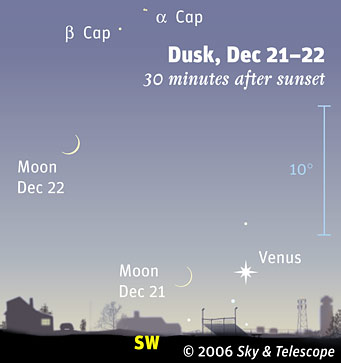
Celestial Omens
Go out at dusk to see Venus and the crescent Moon pair up. It is always a sight to behold when the brightest objects in the evening sky get together.
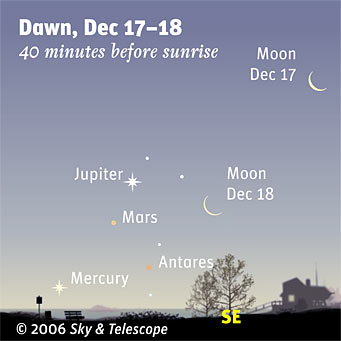
A Reason to Rise
Most of us consider weekends a time for sleeping in, but skywatchers who get up before the Sun are presently in for a treat. A trio of planets will dance with the bright star Antares, and on the mornings of the 17th and 18th there will be a guest appearance by the waning crescent Moon. The performance is free, but clear skies and an unobstructed southeastern horizon are required.
Aurora Watch!
Talk about a red-letter night for astronomy. Not only are Geminid meteors still raining down from the skies, there is a major aurora alert in effect for Thursday and Friday. No telescope needed. Just get outside and look up.
Best Meteor Shower of 2006
With only minor interference from the Moon, the Geminids should put on a great display late Wednesday night and Thursday morning. What's more, a major solar flare just erupted, providing a strong chance for a tremendous northern lights show on Thursday or Friday.
