 SUNSET:

Tour August's Evening Sky in 2006
Download this MP3 file to your iPod or other handheld device, and you'll be guided to Jupiter, the constellation Scorpius, the Milky Way, and more! You'll also get tips on when and how to watch the Perseid meteor shower. (5.5MB file; hosted by Kelly Beatty, editor of Night Sky magazine.)
Tour July's Evening Sky In 2006
Track down dazzling Jupiter and the trio of bright stars that comprise the Summer Triangle. (4MB MP3 file; hosted by Kelly Beatty, editor of Night Sky magazine.)
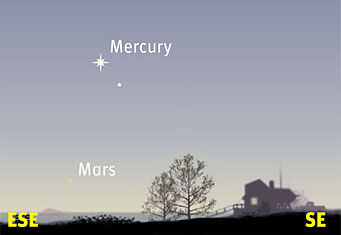
Mercury and Mars at Dawn
Rise and shine! Fleeting Mercury will be highest above the southeastern horizon Sunday morning — your best chance to see it until February. It joins Mars in a predawn appearance.
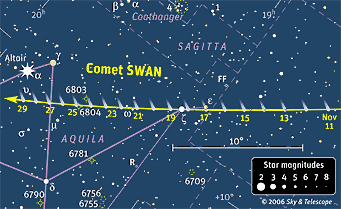
Comet SWAN Still Glows After Dusk
Comet SWAN remains a nice but fading target for telescopes in early evening. Follow it using our chart.

A Crescent Moon and Friends
The crescent Moon all by itself is a gorgeous sight when it hangs low above the horizon amid twilight. The scene improves when it's paired with a second bright object. During the next several evenings the Moon will move southward and upward as it waxes toward first-quarter phase on September 30th.

Mercury-Moon Meeting
Shortly after sunset on Sunday the 24th, you may be able to catch the ever-elusive Mercury in an unusual lineup with Spica and a thin crescent Moon. This one will be a challenge.
An Atlantic Solar Eclipse
On Friday, September 22nd, the Sun will rise as a shining ring of light for lucky skywatchers in South America and Africa.

An Early-Morning Close Encounter
Here's a fun challenge for those who wish to get up with the Sun. About 40 minutes or so before sunrise, head outside and look to the east. As dawn's light grows bright, the hairline crescent Moon has a close conjunction with Venus just above the eastern horizon.
Earth Bites Moon
On the night of September 7-8, a partial lunar eclipse will be visible in Europe, Africa, Asia, and Australia. On the same night, observers on the west coast of the Americas will see a double shadow transit on Jupiter. Head outdoors and see it for yourself.

Catch a Naked-eye Sunspot
There's a nice big naked-eye spot on the Sun today, even though we're near the minimum of the 11-year sunspot activity cycle. Of course, when we're talking about the Sun, "naked-eye" means looking through a safe solar filter.

The Moon Near the Pleiades
The Moon will be closing in on Messier 45 tomorrow morning; observers in Hawaii will see the Moon pass in front of the star cluster.
Perseids Perform
The reports are in! Despite a waning gibbous Moon on the evening of August 12th, the Perseid meteor shower did not disappoint. Between twilight and moonrise, observers from dark country skies reported up to 20 “shooting stars” an hour — a meteor every three minutes — some fast and blip-like, some slow and spectacular.
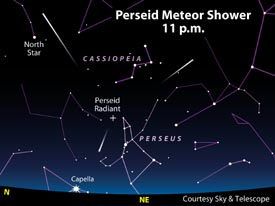
Moonlight Perseids
Although the peak has past, the Perseid meteor shower, an annual celestial event beloved by millions of skywatchers around the world, still has a few stragglers left to see. Try looking for some tonight.
Some Special Events in 2006
It's going to be an active year for stargazers. Here's where you can find some of the highlights of 2006, including a list of upcoming lunar occultations.
Meteor Showers in 2006
Here are the dates and estimated hourly rates of some of the better showers in 2005 and 2006.
April's Lyrid Meteor Shower
Traditionally the Lyrids are a poor shower — rarely do they surprise observers.

An Eclipsing Binary in the Trapezium
Every now and then one of the four Trapezium stars in the Orion Nebula is in eclipse; observers in the Far East will have the best view of the next event on December 12th.

What was that flashing light in the sky?
I'm new to astronomy (1½ months) and I live in New Jersey. Last night, July 31st, I saw a bright planet (I assume Jupiter) in the southwestern sky, and just below it what looked like an airplane with a flashing red tail marker — but it never moved. When I…

What was the cloud spotted near the western horizon August 31, 2004?
Around 9 p.m. on August 31, 2004, I saw a bright patch of light about half the size of the Moon near the western horizon. It moved slowly upward and fluctuated somewhat in brightness. Through an 8-inch Schmidt-Cassegrain telescope here in New Bloomfield, Pennsylvania, there were two points of light…

Watch This (Sun) Spot
Sunspots change their shape and size as they travel across the face of the Sun. Catch an evolving sunspot group caught in the act.
