 SUNSET:

 1
1FRIDAY, DECEMBER 19
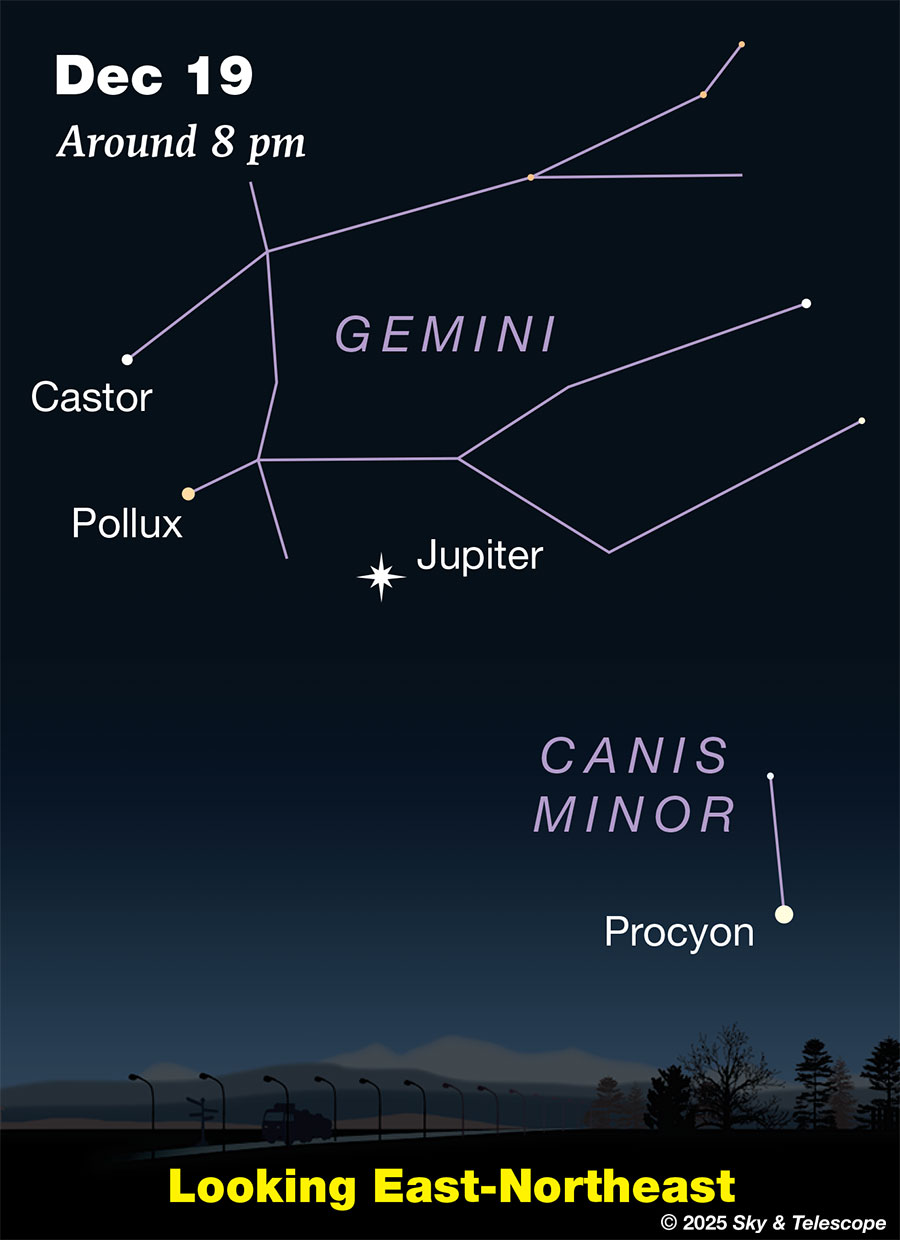
■ Bright Jupiter rises in the east-northeast soon after dark now, and it shines higher in the east as evening grows later. Once it's up in view you can't miss it.
Jupiter doesn't move against the starry background as fast as the inner planets do, but move it does. Currently it's moving westward ("retrograde") against the stars on its way to opposition January 10th. Compared to a week ago, notice that Jupiter has shifted well off the line between Pollux and Procyon, as shown below.
■ New Moon (exact at 8:43 p.m. EST).
SATURDAY, DECEMBER 20
■ Sirius and Procyon in the balance: Sirius, the brilliant Dog Star, sparkles low in the east-southeast by 8 or 9 p.m. Procyon, the Little Dog Star, shines to its left in the east about two fist-widths at arm's length from Sirius.
But directly left? That depends! If you live around latitude 30° (Tijuana, Austin, New Orleans, Jacksonville), the two canine stars will be at the same height above your horizon soon after they rise. If you're north of that latitude, Procyon will be higher. If you're south of there, Sirius will be the higher one. Your eastern horizon tilts differently with respect to the stars depending on your latitude. Because Earth is round.
■ Algol, the prototype eclipsing variable star, should be at its minimum brightness (magnitude 3.4 instead of its usual 2.1) for a couple hours centered on 7:17 p.m. EST. Algol takes several additional hours to fully rebrighten. Comparison-star chart giving magnitudes, with north up. (In the sky, celestial north is always the direction toward Polaris. When you're outside at night using charts with north up, turn them around to match this direction.)
At any random time you glance up at Algol, you have a 1-in-30 chance of catching it at least 1 magnitude fainter than normal.
■ You are remembered, Carl Sagan (November 9, 1934 – December 20, 1996).
SUNDAY, DECEMBER 21
■ These are the longest nights of the year (in the Northern Hemisphere); winter begins today at the solstice, at 10:03 a.m. EST. This is the moment when the Sun halts its southward journey in Earth's sky and begins its six-month return back northward, with the promise of a new spring and summer to come.
MONDAY, DECEMBER 22
■ This is the time of year when M31, the Andromeda Galaxy, passes your zenith soon after dark (if you live in the world's mid-northern latitudes). The exact time depends on your longitude within your time zone. Binoculars will show M31 as a small, dim gray haze, elongated with a brighter middle, just off the knee of the Andromeda constellation's stick figure; see the big evening constellation chart in the center of Sky & Telescope.
Lie on your back with the binocs and look straight up. M31 crosses smack through your zenith if you're at 41° north latitude (roughly Denver, New York, Madrid.)
TUESDAY, DECEMBER 23
■ The crescent Moon, rather low in the southwest at nightfall, hangs between Fomalhaut, a couple of fists to its left, and Altair, farther to the Moon's right. These bright stars are two of our nearest neighbors, 25 and 17 light-years away, respectively.
The Moon is 1.3 light-seconds away.
WEDNESDAY, DECEMBER 24
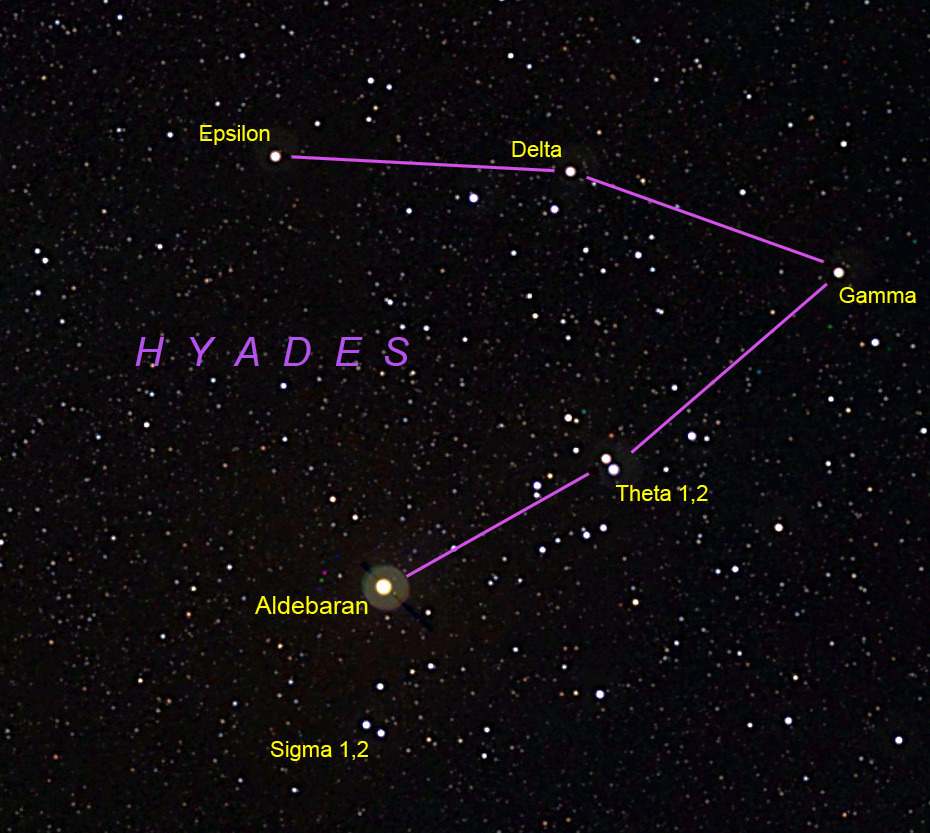
■ The House in the Hyades. Above Orion shines orange Aldebaran with the large, loose Hyades cluster in its background. Binoculars are the ideal instrument for this cluster given its size: its brightest stars (4th and 5th magnitude) span an area about 4° wide. Higher above, the Pleiades by comparison are hardly more than 1° across, counting just the brightest stars.
The main Hyades stars famously form a V. It's currently lying on its side, open to the left. Aldebaran forms the lower of the V's two tips.
With binoculars, follow the lower branch of the V to the right from Aldebaran. The first thing you come to is the House asterism: a pattern of stars like a child's drawing of a house with a peaked roof. The house is currently upright and bent to the right like it got pushed.
Star field image: Starry Night Pro 8
The House includes three easy binocular double stars that form an equilateral triangle, with each pair facing the others. The brightest pair is Theta1 and Theta2 Tauri. You may even find that you can resolve the Theta pair with your unaided eyes.
THURSDAY, DECEMBER 25
■ Did you, or a friend or relative, get a telescope as a holiday present? Do them a big favor and point them to How To Start with Your New Telescope. It's our essential guide to getting it set up and ready, avoiding the most common beginners' pitfalls and frustrations, and finding several kinds of celestial targets this very night.
FRIDAY, DECEMBER 26
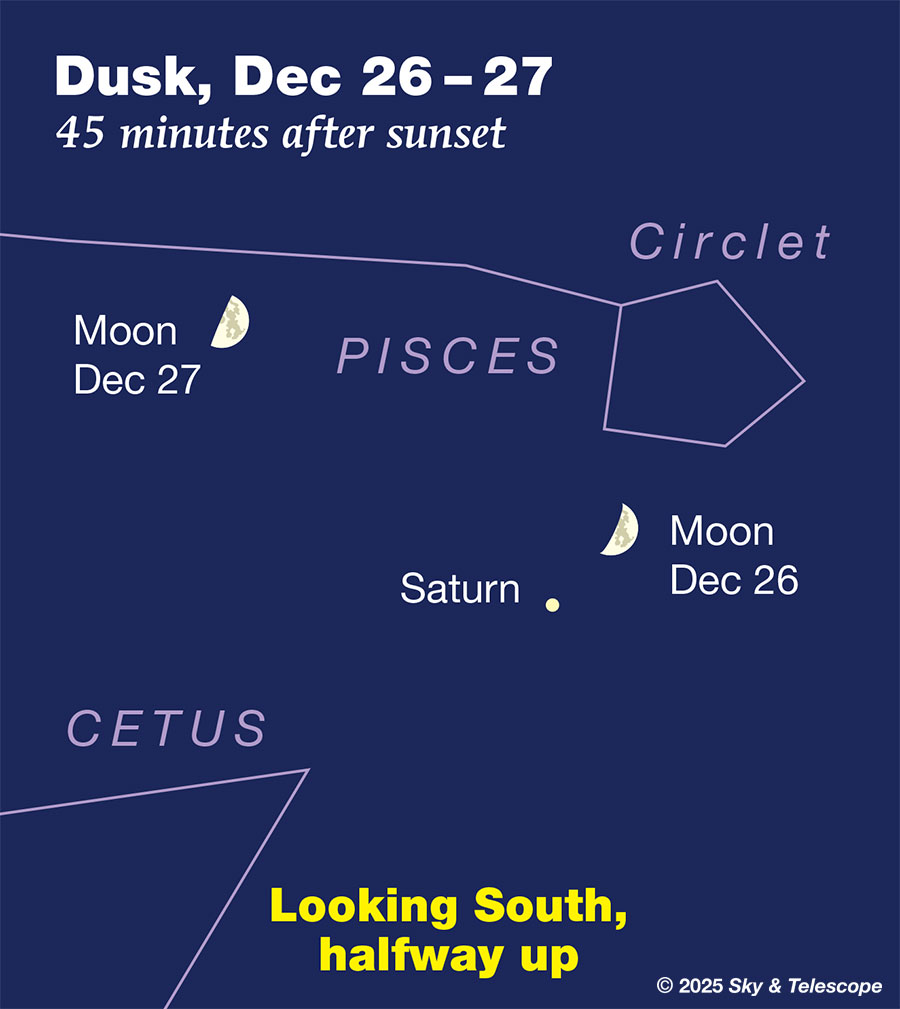
■ This evening the Moon is having its monthly conjunction with Saturn, and an unusually close one it is. They're 3° apart for evening viewers in the Americas, as shown below.
SATURDAY, DECEMBER 27
■ First-quarter Moon (exactly so at 2:10 p.m. EST). At dusk the Moon shines a fist or a little more to the upper left of Saturn, as shown above. Spot Fomalhaut nearly three fists below Saturn; they're almost exactly equal in brightness.
By 8 p.m. the Moon hangs straight above Saturn, now lower in the southwest, and Fomalhaut is nearly setting.
■ This is the time of year when Orion shines in the east-southeast after dinnertime. He's well up now, but his three-star Belt is still nearly vertical. The Belt points up toward Aldebaran (more or less) and, even higher, the Pleiades. In the other direction, it points down to where bright Sirius will rise around 7 or 8 p.m. to twinkle furiously.
SUNDAY, DECEMBER 28
■ The waxing Moon, now a day past first quarter, offers a dramatic view to telescope users. In the north the sunrise terminator crosses the middle of big, round Mare Imbrium, ringed by mountains and sporting flat-floored Plato just off its northern rim. Just south of Imbrium's mountain-edge, the terminator starkly dramatizes Copernicus. Near the Moon's south limb, the terminator has unveiled much bigger Clavius with its unique curving arc of four internal craters. Somewhat in from Clavius is sharp, young Tycho, centered in its far-flung white rays.
This Week's Planet Roundup
Mercury is still visible low in the dawn early in the week, holding its brightness at magnitude –0.5. But it's getting lower every morning. Look for it very ow in the east-southeast as dawn brightens. Your best chance might be about 50 or 40 minutes before sunrise. Nothing else down there is that bright
Venus and Mars are out of sight behind the glare of the Sun.
Jupiter (magnitude –2.6, in eastern Gemini) rises in the east-northeast soon after full dark. It dominates the eastern sky as the evening proceeds, then the high southeast. Castor and Pollux shine nearby. Jupiter is highest and telescopically sharpest in the south after midnight; it will reach opposition January 10th. It's now a big 45 arcseconds wide, essentially as large as it will be at opposition (47 arcseconds).
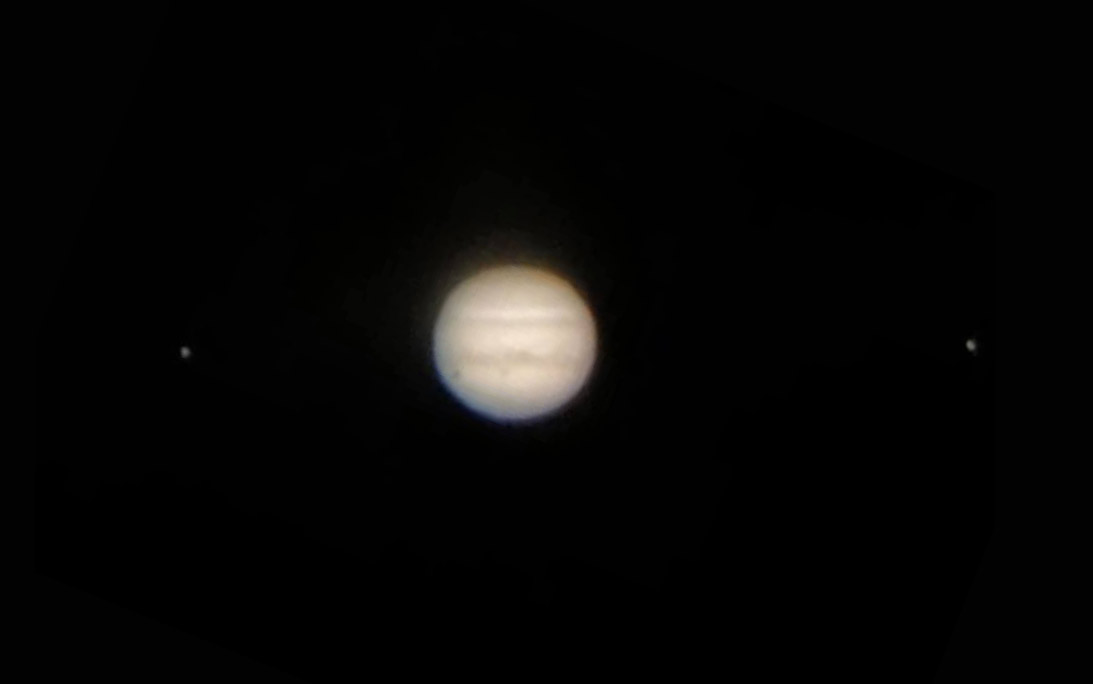
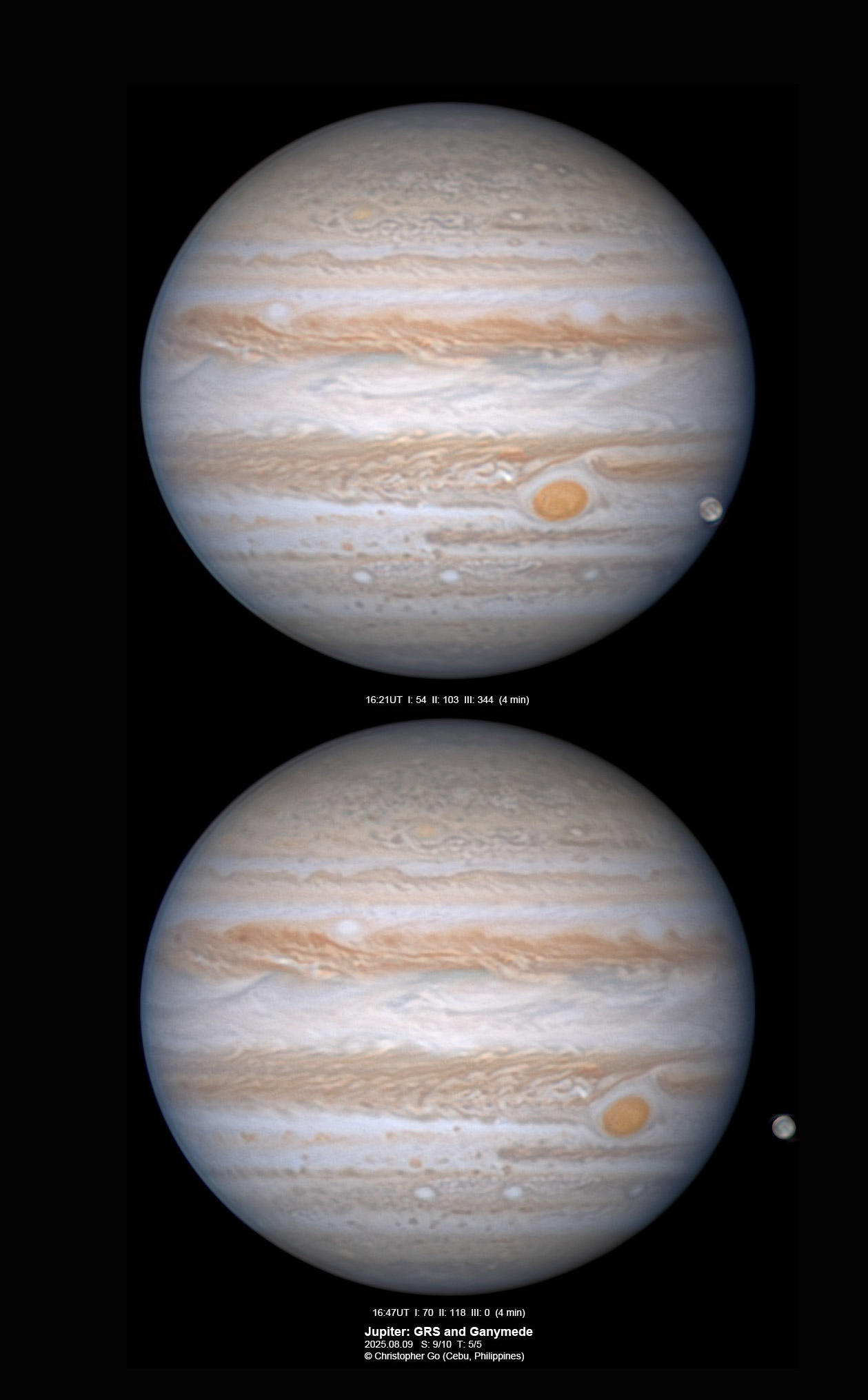
Go writes, "Conditions were perfect! Details inside the Great Red Spot are well resolved. There is a bright outbreak on the wake of the GRS [small, white, just left of the Great Red Spot]. The chimney above the GRS is open." The chimney is the whitish plume from the Red Spot Hollow that frequently breaks through, or maybe covers, the tan belt-material north of it. "The North Equatorial Belt is narrow in this region. Ganymede is also well resolved with surface details."
Go uses a 14-inch telescope from the low-latitude Philippines, a top-end planetary video camera, and state-of-the-art frame stacking, de-rotation of Jupiter, and image processing to bring out detail.
Saturn (magnitude +1.1, at the Aquarius-Pisces border) is the brightest dot high in the south at nightfall, lower left of the Great Square of Pegasus. It gets lower in the southwest through the evening and sets around midnight.
Below Saturn, by almost three fists at arm's length, you'll find Fomalhaut, similar to Saturn in brightness. The two of them form a big isosceles triangle (two equal sides) with lesser Beta Ceti about half as far to Saturn's lower left.
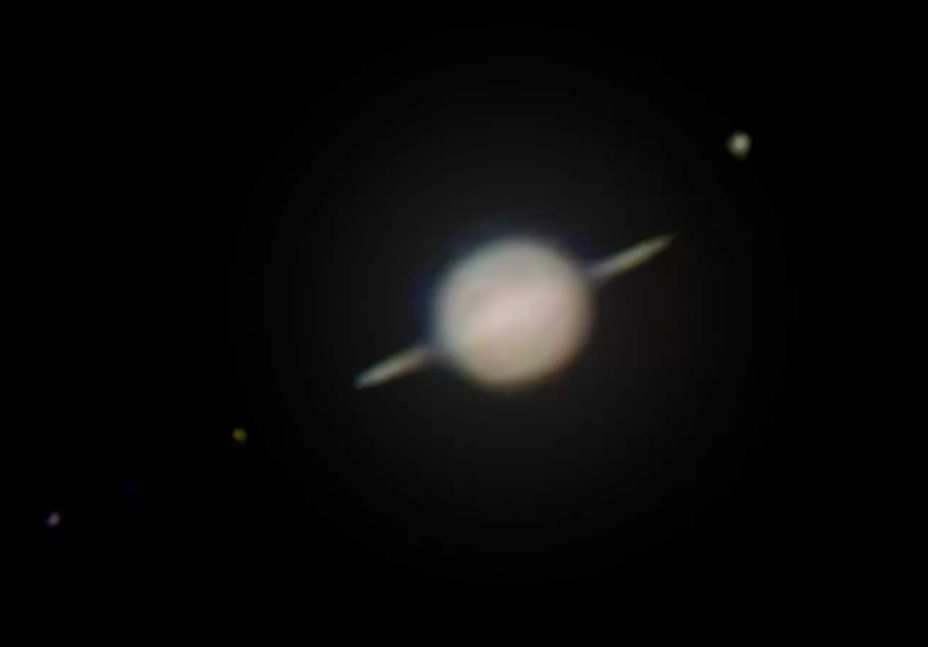
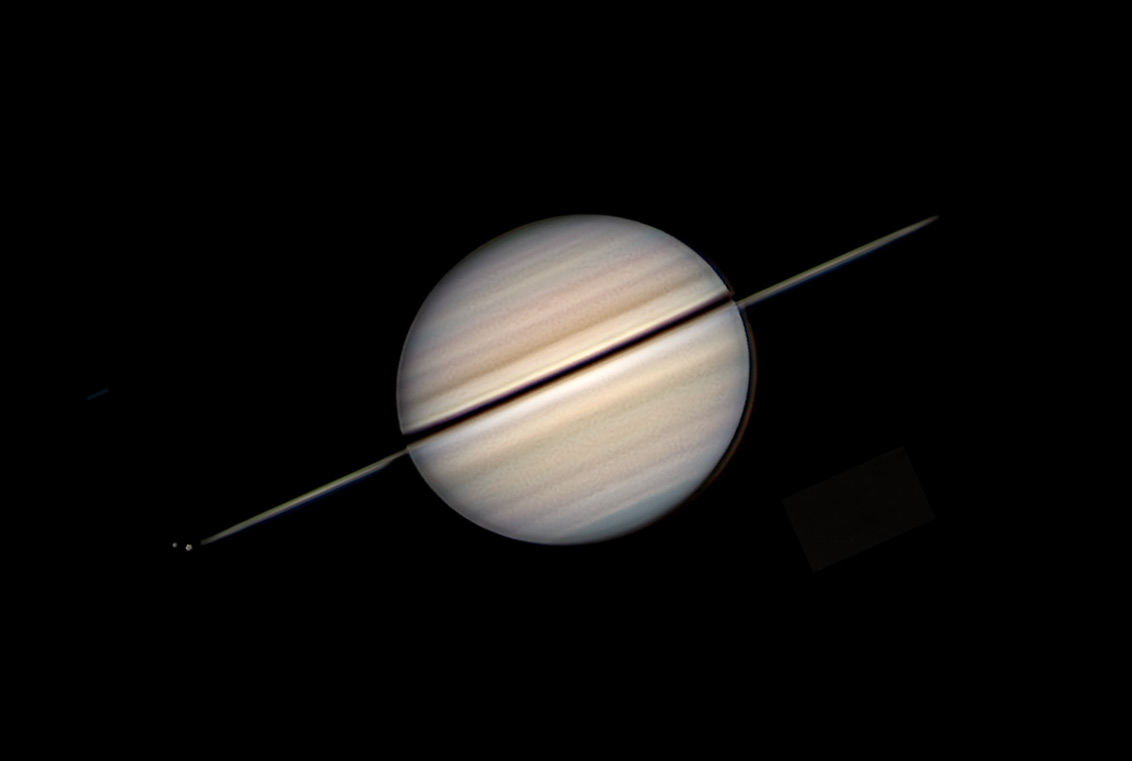
In a telescope Saturn's rings remain very close to edge on, tilted less than 1° to our line of sight. This continues for the rest of December. For more goings-on at Saturn during this rare time, see Bob King's See Saturn's Rings at Their Thinnest. He suggests using the rings' near-absence to try to add inner Mimas to your log of Saturnian moons. Or at least Enceladus, which I repeatedly glimpsed in a 6-inch reflector during a previous thin-rings season. King includes a timetable of Mimas's greatest elongations that happen when Saturn is high in the dark for North America. As for Enceladus's greatest elongations, you can find them by playing with Sky & Telescope's interactive Saturn's Moons calculator. Run the hours and minutes forward and backward to see when Enceladus ("E") is farthest out at a time when Saturn will be high in darkness for you.
Uranus (magnitude 5.6, in Taurus 5° south of the Pleiades) is well up by 7 p.m. At high power in a telescope it's a tiny but definitely non-stellar dot, 3.8 arcseconds wide. You'll need a detailed finder chart to identify it among similar-looking faint stars; turn to the November Sky & Telescope, page 49.
Neptune is a telescopic "star" of magnitude 7.8, a dim speck just 2.3 arcseconds wide 4° northeast of show-stealing Saturn. For Neptune you'll need an even more detailed finder chart.
All descriptions that relate to your horizon — including the words up, down, right, and left — are written for the world's mid-northern latitudes. Descriptions and graphics that also depend on longitude (mainly Moon positions) are for North America. Eastern Standard Time (EST) is Universal Time minus 5 hours. UT is also known as UTC, GMT, or Z time.
Want to become a better astronomer? Learn your way around the constellations. They're the key to locating everything fainter and deeper to hunt with binoculars or a telescope.
This is an outdoor nature hobby. For a more detailed constellation guide covering the whole evening sky, use the big monthly map in the center of each issue of Sky & Telescope, the essential magazine of astronomy.
For the attitude every amateur astronomer needs, read Jennifer Willis's Modest Expectations Give Rise to Delight.
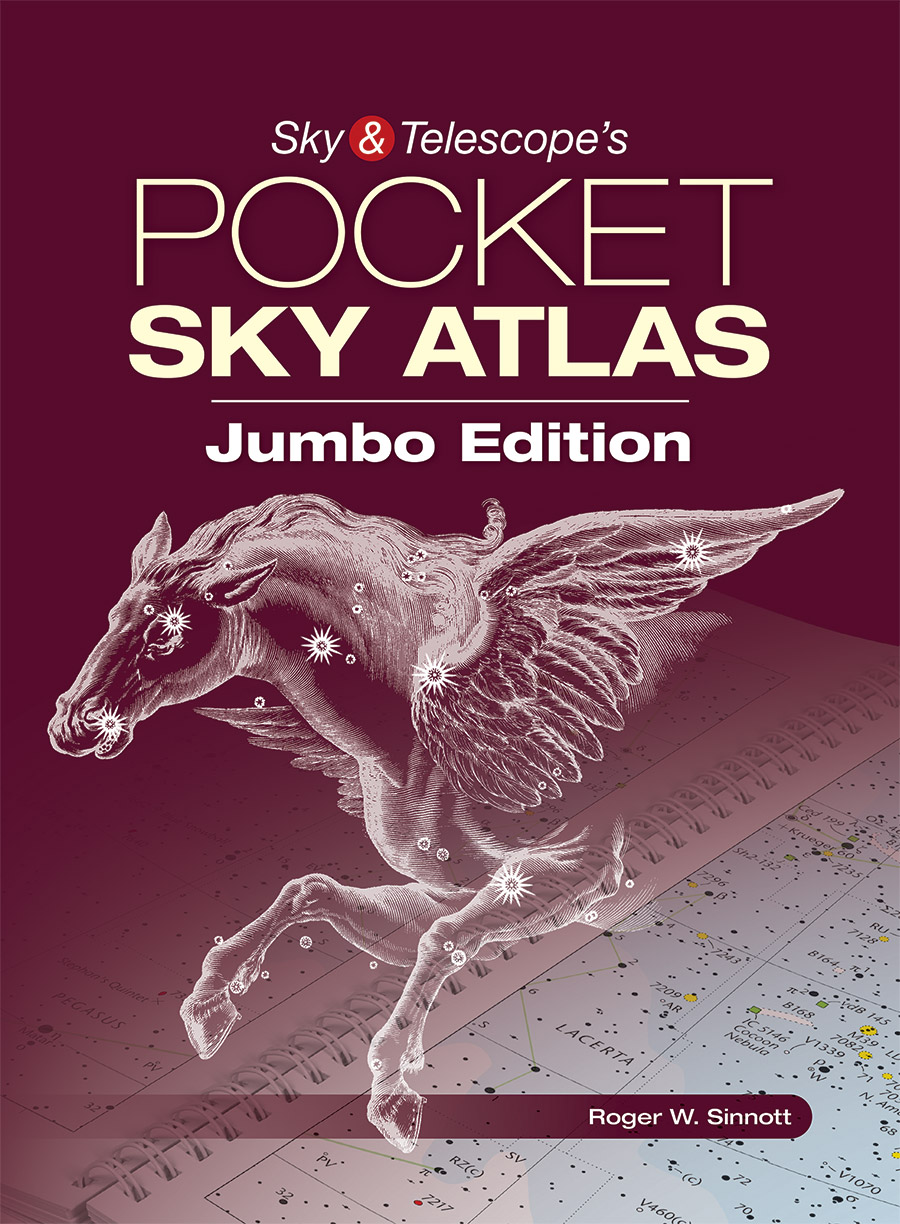
Once you get a telescope, to put it to good use you'll want a much more detailed, large-scale sky atlas (set of charts). The basic standard is the Pocket Sky Atlas, in either the original or Jumbo Edition. Both show all 30,000 stars to magnitude 7.6, and 1,500 deep-sky targets — star clusters, nebulae, and galaxies — to search out among them.
Next up is the larger and deeper Sky Atlas 2000.0, plotting stars to magnitude 8.5; nearly three times as many, as well as many more deep-sky objects. It's currently out of print, but maybe you can find one used.
The next up, once you know your way around well, are the even larger Interstellarum Deep-Sky Atlas (with 201,000+ stars to magnitude 9.5 and 14,000 deep-sky objects selected to be detectable by eye in very large amateur telescopes), and Uranometria 2000.0 (332,000 stars to mag 9.75, and 10,300 deep-sky objects).
And read How to Use a Star Chart with a Telescope. It applies just as much to electronic charts on your phone or tablet, which many observers find handier and more versatile, if perhaps less carefully designed, than charts on paper.
You'll also want a good deep-sky guidebook. A beloved old classic is the three-volume Burnham's Celestial Handbook. It was my bedside reading for years. An impressive more modern one is the big Night Sky Observer's Guide set (2+ volumes) by Kepple and Sanner. The pinnacle for total astro-geeks is the new Annals of the Deep Sky series, currently at 11 volumes as it works its way forward through the constellations alphabetically. So far it's up to H.
Can computerized telescopes replace charts? Well, this is what I used to say:
"Not for beginners, I don't think, unless you prefer spending your time getting finicky technology to work rather than learning how to explore through the sky yourself. As Terence Dickinson and Alan Dyer say in their Backyard Astronomer's Guide, 'A full appreciation of the universe cannot come without developing the skills to find things in the sky and understanding how the sky works. This knowledge comes only by spending time under the stars with star maps in hand and a curious mind.' Without these, 'the sky never becomes a friendly place.' "
Well, things change. The technology has continued to improve and become more user-friendly — particularly with software that can now, amazingly, recognize any telescopic star field to determine exactly where the telescope is pointed — finally bypassing all imperfections in the mount, tripod, gears, bearings and other mechanics, or in the user's skill in setting up.
The latest revolution is the rise of small, imaging-only "smartscopes." These take advantage of not only today's pointing technology, but also the vastly better capabilities of imaging chips and processing compared to the human retina and visual cortex. The most sophisticated image stacking and processing can come built in. The result is reasonably capable deep-sky imaging from shockingly small, low-priced units. The image may be viewable on your phone or computer as it builds up in real time. Small smartscopes can enable contributions to serious citizen-science projects.
These are changing the hobby at the entry level. For more on this revolution see Richard Wright's "The Rise of the Smart Telescopes" in the November 2025 Sky & Telescope. And read the magazine's review of this especially tiny one.
If you get a larger, more conventional computerized scope that allows direct visual use, do make sure that its drives can be disengaged so you can swing it around and point it readily by hand when you want to, rather than only slowly by the electric motors (which eat batteries).
 Audio sky tour. Out under the evening sky with your
earbuds in place, listen to Kelly Beatty's monthly
podcast tour of the naked-eye heavens above. It's free.
"The dangers of not thinking clearly are much greater now than ever before. It's not that there's something new in our way of thinking, it's that credulous and confused thinking can be much more lethal in ways it was never before."
— Carl Sagan, 1996
"Facts are stubborn things; and whatever may be our wishes, our inclinations, or the dictates of our passion, they cannot alter the state of facts and evidence."
— John Adams, 1770
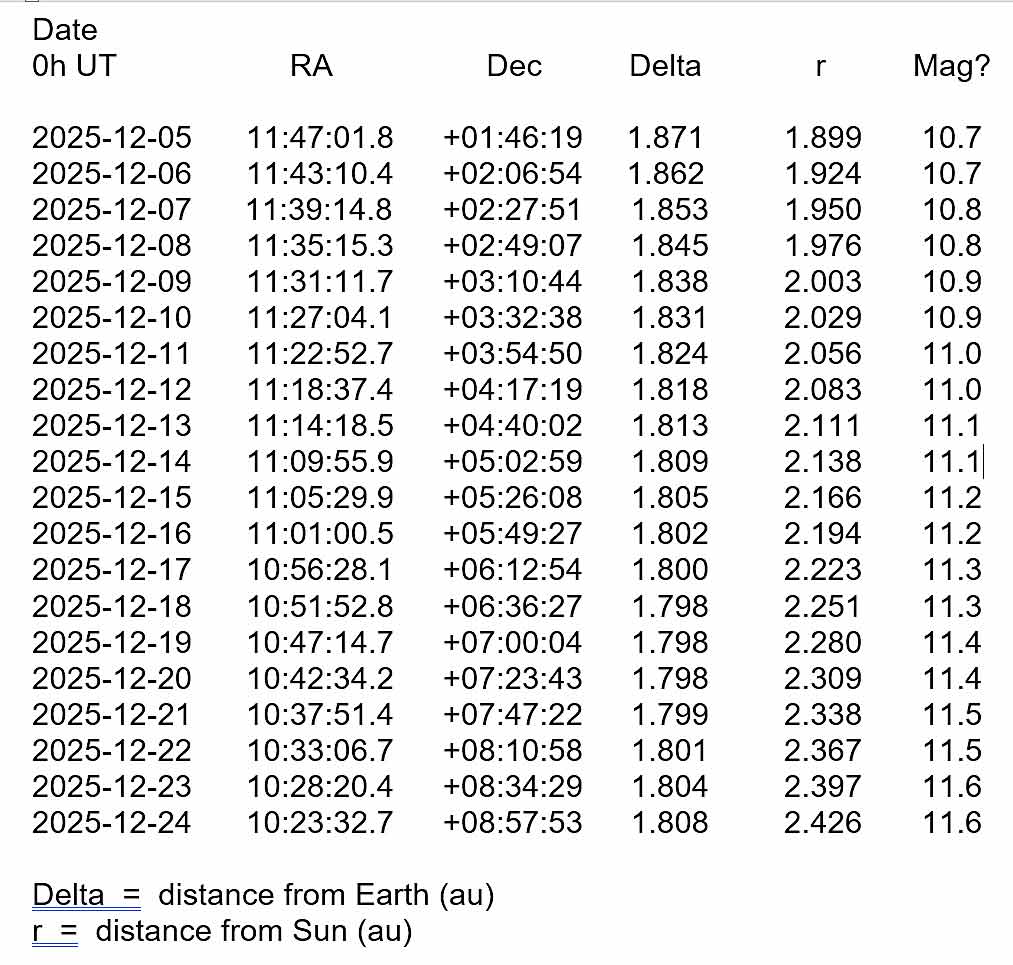
Ephemeris for Comet 3I ATLAS:
About Alan MacRobert
Alan M. MacRobert became an avid Sky & Telescope subscriber in 1966 at age 14, joined the editorial staff in 1982, and is now a senior contributing editor, semi-retired. He played a role in practically every part of the magazine and the company's other products for more than a generation, both on the amateur-observing side and the science-reporting side. In 1994 a book collection of his observing how-tos and telescopic sky tours was published as Star Hopping for Backyard Astronomers. He has produced This Week's Sky at a Glance online every week since 1989.




Comments
misha17
December 23, 2025 at 2:57 am
Re: WEDNESDAY, DECEMBER 24
■ The House in the Hyades.
"...The House includes three easy binocular double stars that form an equilateral triangle, with each pair facing the others. The brightest pair is Theta1 and Theta2 Tauri. You may even find that you can resolve the Theta pair with your unaided eyes."
Maybe it's the darker skies in most of rural Central America, but Theta1 and Theta2 Tauri are known in Mexico as "Los Ojos de Santa Lucia" ("the eyes of St. Lucy"), so they are bright enough to be noticeable to casual observers there. They serve as the winter equivalent of "the Cat's Eyes" double star pair in the "Stinger" in the constellation of Scorpius.
Lucy was a member of a 3rd-Century pagan noble family in Sicily. Engaged to be married another pagan noble, she converted to Christianity and called off her engagement. Her jilted suitor turned her over to the local Roman authorities, who tortured her before killing her. Among the cruel treatment she was blinded, but according to tradition her vision was miraculously restored before her death. She is the patroness of afflictions of the eyes. Her feast day is on December 13th.
Around midnight on her feast day, The Eyes of St. Lucy Tauri pass almost directly overhead as seen from Mexico.
You must be logged in to post a comment.
You must be logged in to post a comment.