 SUNSET:

 11
11FRIDAY, JULY 25
■ As summer progresses, Arcturus moves down the western side of the evening sky. Its pale ginger-ale tint always helps identify it.
Arcturus forms the bottom point of the Kite of Boötes. The Kite, rather narrow, extends upper right from Arcturus by 23°, about two fists at arm's length. The lower right side of the kite is dented inward, as if some invisible celestial intruder banged into it.
SATURDAY, JULY 26
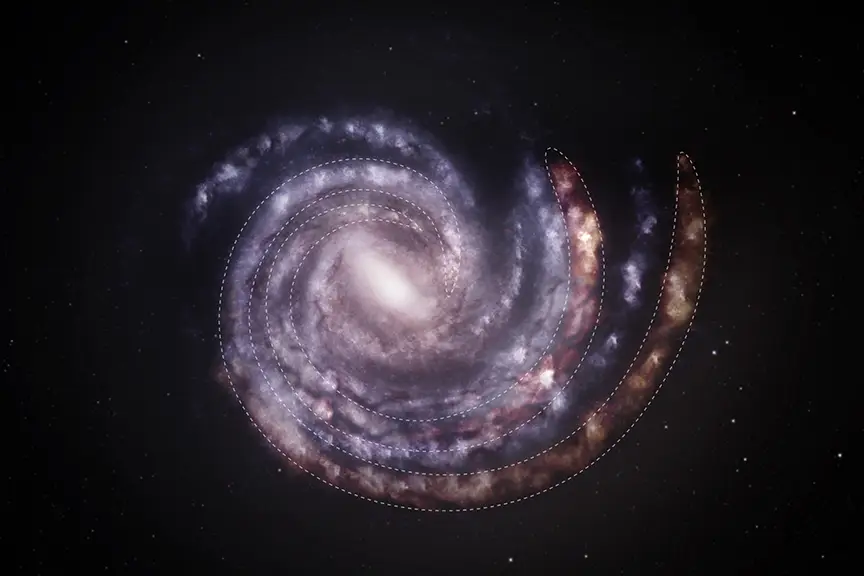
■ Look again to Arcturus high in the west. In astronomy lore today, Arcturus may be best known for its cosmic history: It's an orange giant some 7 billion years old, older than the Sun and solar system, racing by our part of space on a trajectory that indicates it was born in another galaxy: a dwarf galaxy that fell into the Milky Way and merged with it.
But in the astronomy books of our grandparents, Arcturus had a different claim to fame: It turned on the lights of the 1933 World's Fair in Chicago, optimistically celebrating "a century of progress." Astronomers rigged the newly invented photocell to the eye ends of big telescopes around the US and aimed them where Arcturus would pass at the correct moment on opening night. Where the sky was clear the star's light crept onto the cells, the weak signals were amplified and sent over telegraph wires to Chicago, and on blazed the massive lights to the cheers of tens of thousands.
Why Arcturus? Astronomers of the time thought it was 40 light-years away (the modern value is 36.7 ±0.2). So the light would have been in flight since the previous such great event in Chicago, the World's Columbian Exhibition in 1893.
And earlier? Arcturus was famous as one of the first stars discovered to show proper motion, its own independent motion on the celestial sphere. In 1718 Edmond Halley realized that Arcturus, Sirius, and Aldebaran had moved more than half a degree from where the Greek astronomer Hipparchus measured them to be some 1,850 years earlier.
And before that? Arcturus was the first nighttime star to be seen in the daytime with a telescope: by Jean-Baptiste Morin in 1635.
■ The long, drawn-out Delta Aquariid meteor shower sputters along late at night all this week. Its nominal peak is July 30th, but the shower is already under way and continues dribbling along to mid-August, overlapping the more robust Perseids at that time. Although this year the Perseids (due to peak the night of August 12-13) will be pretty seriously mooned out. See Bob King's Thumbs Up for the Delta Aquariid Meteor Shower.
SUNDAY, JULY 27
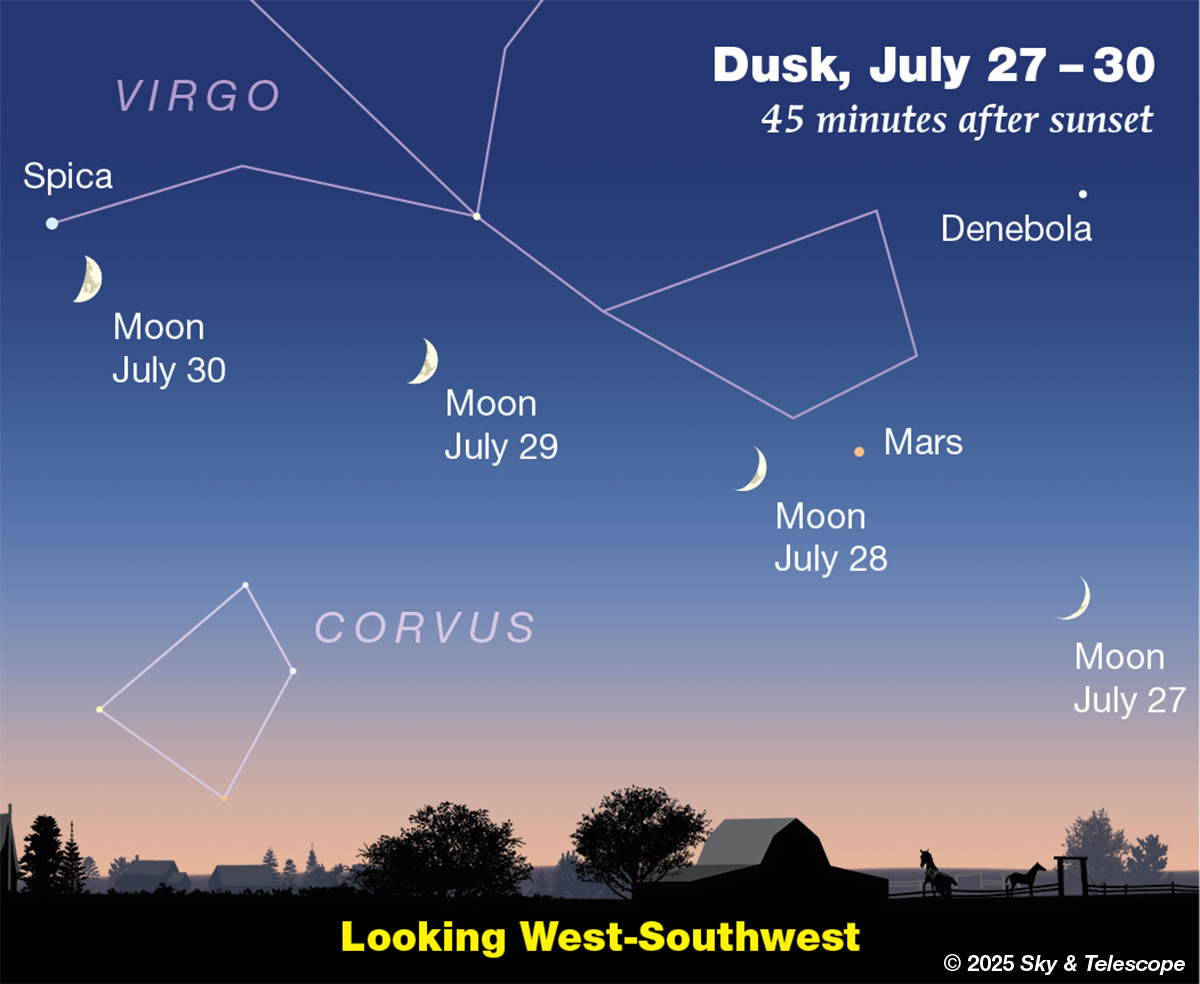
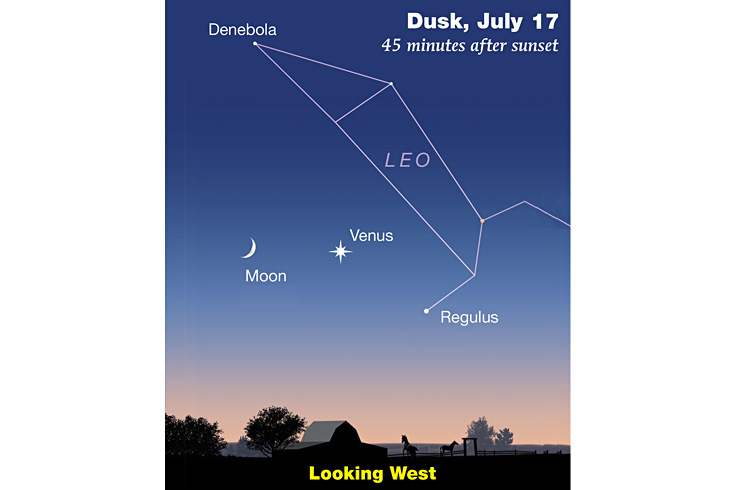
■ Use the low crescent Moon to guide you to Mars and Denebola in the fading twilight this evening, as shown below.
MONDAY JULY 28
■ At this time of year the Big Dipper hangs diagonally in the northwest after dark. From the Big Dipper's midpoint, look three fists to the right to find Polaris, not very bright at 2nd magnitude, glimmering due north as always.
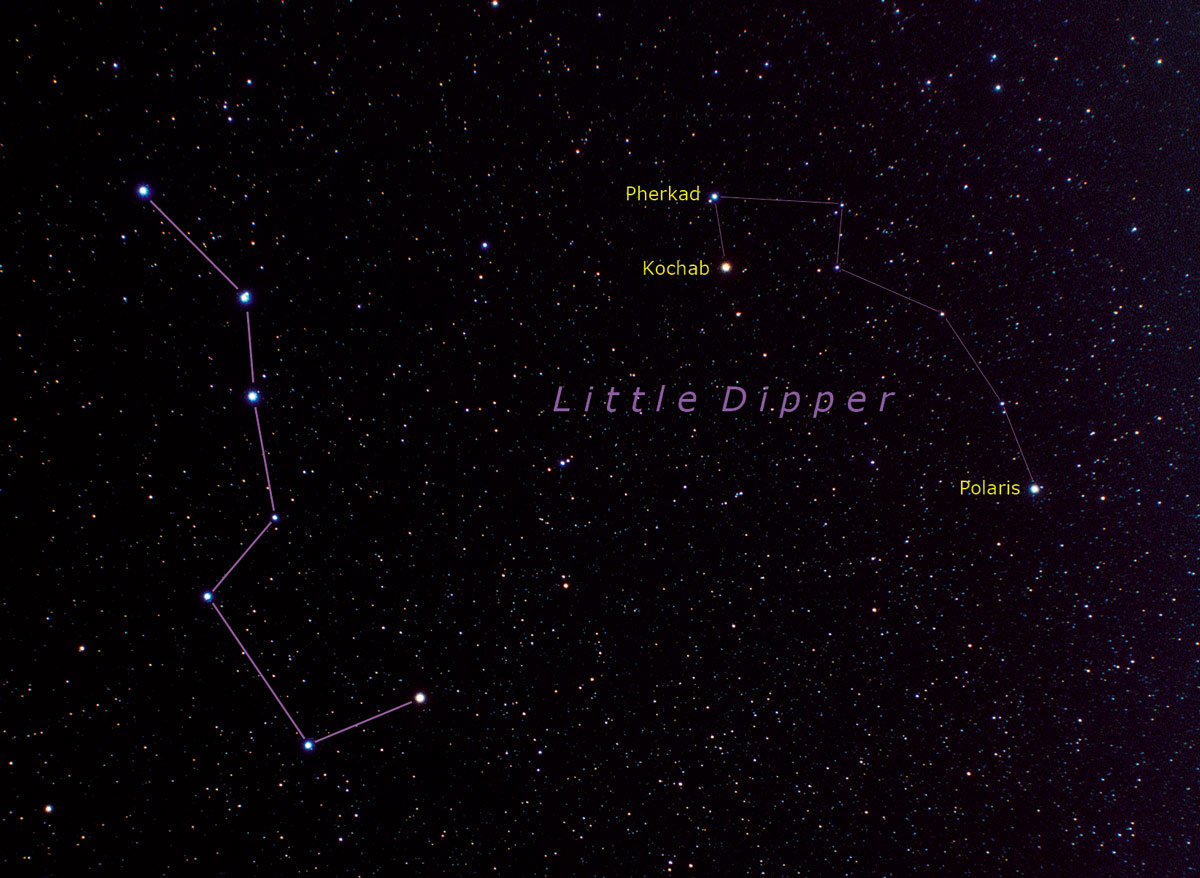
Polaris is the end of the Little Dipper's handle. The only other Little Dipper stars that are even moderately bright are the two forming the outer end of its bowl: Kochab and Pherkad. These evenings you'll find them to Polaris's upper left by about a fist and a half at arm's length, as shown above. They're called the Guardians of the Pole, since they ceaselessly circle around Polaris through the night and through the year. I sometimes imagine them marching around and around like the Wicked Witch's guards in the Wizard of Oz movie, chanting "O-ee-o, Eeee-o."
They do not in fact do this. They are giant orange-hot and white-hot balls of gas, respectively, spectral types K4 III and A2 III, located 131 and 490 light-years away. They neither march nor speak. Nevertheless, imaginative conceptions and artistic impressions are real things: abstract things that exist in the few cubic inches of your skull, physically encoded in the neural network that gives rise to your mind and its internal model of the exterior world.
External realities and your internal experiences of them are both real things, but they are fundamentally two separate orders of being. Conflating the two is, the more you examine it, the origin of a very large slice of humanity's errors and failings.
TUESDAY, JULY 29
■ One of the brightest Cepheid variable stars in the sky — a naked-eye, glance-up-to-check-it star waiting there for you — is . . . Eta Aquilae.
Never heard of it? It's located 8° due south of Altair and pulses from magnitude 4.3 to 3.4 and back every 7.18 days. That's slightly more than a doubling in brightness. Its rise to maximum is faster than its fade to minimum, as with other classical Cepheids. Its period is so close to a week that you'll find it repeating itself on the same weekdays for a month or two at a time.
Judge its brightness by comparing it between Theta Aquilae, magnitude 3.2; Delta Aql, mag. 3.4; Beta Aql; mag. 3.7; and Iota Aql, mag. 4.4. They're all part of Aquila's flying-eagle stick figure. See the comparison-star chart with Bob King's "Summer Nights with Eta Aquilae" in the August Sky & Telescope, page 50.
WEDNESDAY, JULY 30
■ The Moon, a fat crescent just 1½ days short of first quarter, hangs 2° below Spica this evening, about a finger's width at arm's length.
THURSDAY, JULY 31
■ Summer advances. Bright Vega passes its closest to overhead around 11 p.m. now, depending on how far east or west you are in your time zone.
How closely Vega misses your zenith depends on how far north or south you are. It passes right through your zenith if you're at latitude 39° north (Washington DC, Cincinnati, Kansas City, Lake Tahoe). How closely can you judge its verticality? It helps to lie on your back.
Deneb crosses closest to the zenith almost exactly two hours after Vega. But to see Deneb straight up you need to be farther north, close to latitude 45°: Portland, Minneapolis, Montreal, central Maine, southern France, northern Italy, Odesa, Kherson. Mariupol.
FRIDAY, AUGUST 1
■ First-quarter Moon; exactly so at 8:41 a.m. EDT. At dusk, a half a day later, look for the Moon's terminator to already be very slightly convex.
The Moon, in Libra, will be hanging halfway between Antares two fists to its upper left and Spica sinking away two fists to its lower right.
SATURDAY, AUGUST 2
■ Titan casts its shadow on Saturn tonight. Every 15 years Titan, Saturn's largest moon, repeatedly crosses Saturn's face from Earth's viewpoint — and, more visibly, cast its very tiny black shadow onto Saturn' face. A new series of these events is under way. They will continue every 16 days until October.
Tonight Titan's shadow crosses Saturn from 6:25 to 11:04 UT August 3rd (UT date). That's from 2:25 a.m. to 7:04 a.m. August 3rd Eastern Daylight Time; 11:25 p.m. to 4:04 a.m. PDT. Wherever you are, Saturn rises by 11 p.m. local daylight-saving time and is high in good seeing before dawn begins. So all of North America now gets a chance. See Bob King's Titan Shadow Transit Season Underway.
SUNDAY, AUGUST 3
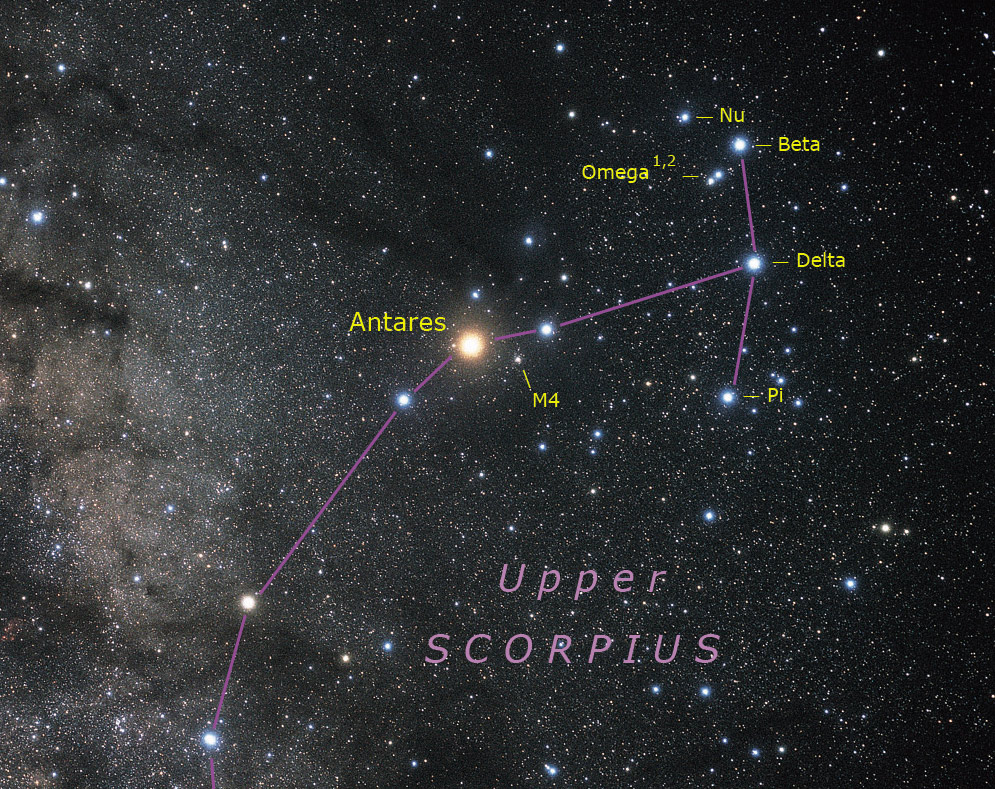
■ This evening the waxing gibbous Moon hangs hardly more than 1° below orange Antares, the 1st-magnitude heart of Scorpius. "The neutral gray of the lunar surface always seems to enhance the color of whatever star or planet the Moon is near," writes Gary Seronik in the August Sky & Telescope. Do you think so too?
This Week's Planet Roundup
Mercury is out of sight in conjunction with the Sun.
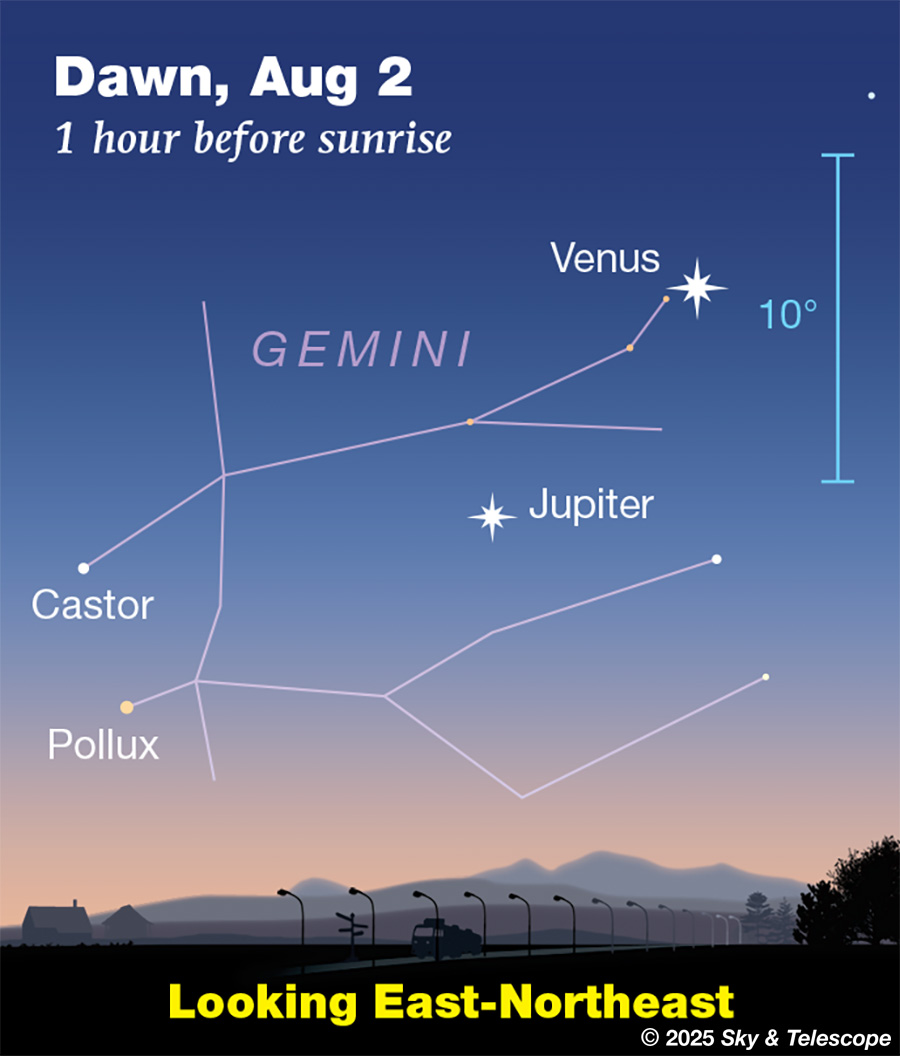
Venus, brilliant at magnitude –4.0, rises above the east-northeast horizon about an hour before the first glimmer of dawn. It will continue to do this for the rest of the summer. Venus climbs higher until the dawn sky finally grows too bright. In a telescope Venus's shrinking globe is small and gibbous, now 14 arcseconds pole to pole and 74% sunlit.
Mars, magnitude 1.6 at the border of Leo and Virgo, can still be spotted very low due west as twilight fades toward dark. Binoculars will help. Mars sets right after full dark.
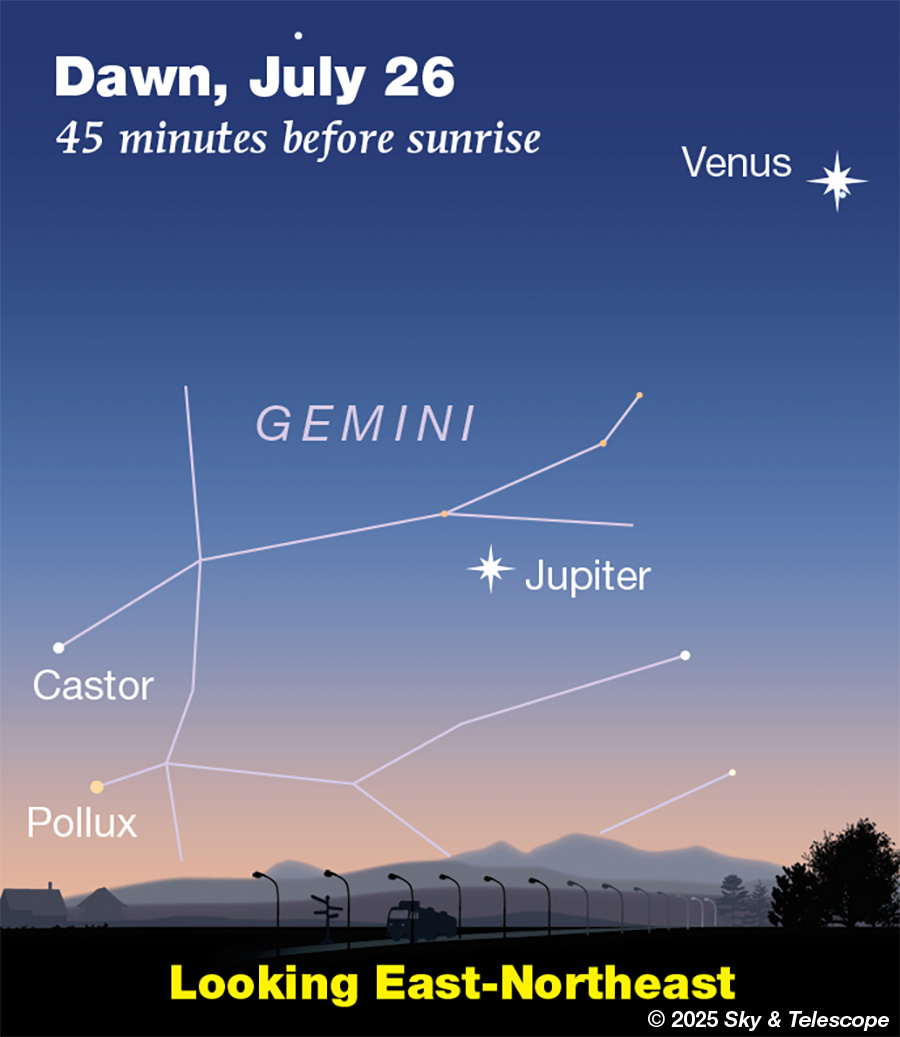
Jupiter, magnitude –1.9, rises soon before the beginning of dawn. Find it lower left of Venus; see the July 26 view at the top of this page. Venus and Jupiter are 16° apart on July 26th and about 9° apart a week later (on August 2nd). They're heading for a close conjunction just 0.9° apart on August 12th.
Saturn (magnitude +0.8, in Pisces) rises around 10 or 11 p.m. daylight-saving time. But the best time to try a telescope on Saturn is in the hour or so before the beginning of dawn, when it's at its highest in the south.
We see Saturn's rings almost edge-on this year, and the Sun shines on them from nearly our direction too. So the rings and their shadow form a super-thin black line along Saturn's equator.
Uranus (magnitude 5.8, in Taurus near the Pleiades) rises around 1 a.m. and is well up in the east before the beginning of dawn.
Neptune, a telescopic "star" at magnitude 7.9, lurks 1° above Saturn before dawn begins. Use the finder chart for Neptune with respect to Saturn in the June Sky & Telescope, page 51. With a pencil, put a dot on the path of each of the two planets for your date. Get everything planned and ready the evening before, so that dawn doesn't catch you out.
All descriptions that relate to your horizon — including the words up, down, right, and left — are written for the world's mid-northern latitudes. Descriptions and graphics that also depend on longitude (mainly Moon positions) are for North America. Eastern Daylight Time (EDT) is Universal Time minus 4 hours. UT is also known as UTC, GMT, or Z time.
Want to become a better astronomer? Learn your way around the constellations. They're the key to locating everything fainter and deeper to hunt with binoculars or a telescope.
This is an outdoor nature hobby. For a more detailed constellation guide covering the whole evening sky, use the big monthly map in the center of each issue of Sky & Telescope, the essential magazine of astronomy.
For the attitude every amateur astronomer needs, read Jennifer Willis's Modest Expectations Give Rise to Delight.
Once you get a telescope, to put it to good use you'll need a much more detailed, large-scale sky atlas (set of charts). The basic standard is the Pocket Sky Atlas, in either the original or Jumbo Edition. Both show all 30,000 stars to magnitude 7.6, and 1,500 deep-sky targets — star clusters, nebulae, and galaxies — to search out among them.
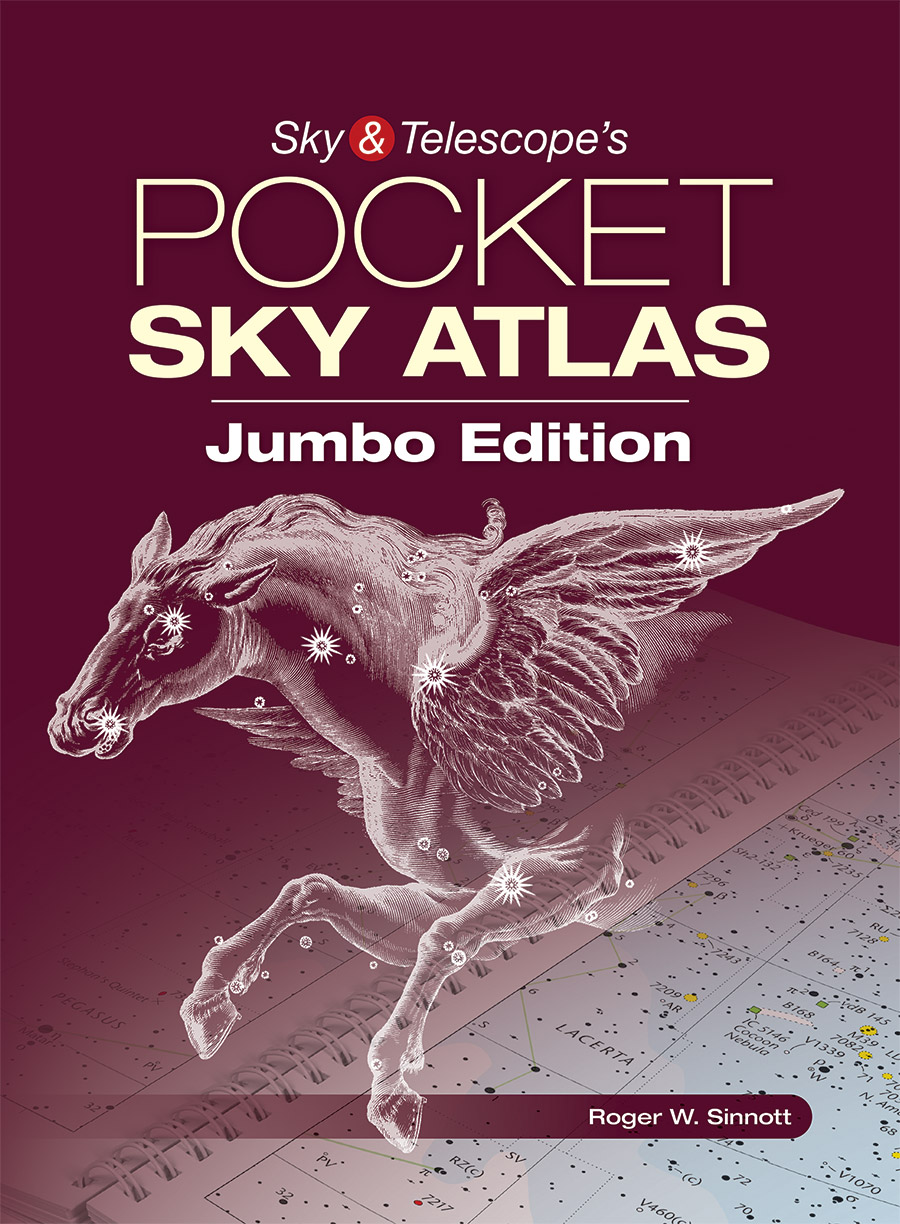
Next up is the larger and deeper Sky Atlas 2000.0, plotting stars to magnitude 8.5; nearly three times as many, as well as many more deep-sky objects. It's currently out of print, but maybe you can find one used.
The next up, once you know your way around well, are the even larger Interstellarum atlas (with 201,000+ stars to magnitude 9.5 and 14,000 deep-sky objects selected to be detectable by eye in large amateur telescopes), and Uranometria 2000.0 (332,000 stars to mag 9.75, and 10,300 deep-sky objects). And read How to Use a Star Chart with a Telescope. It applies just as much to charts on your phone or tablet as to charts on paper.
You'll also want a good deep-sky guidebook. A beloved old classic is the three-volume Burnham's Celestial Handbook. An impressive more modern one is the big Night Sky Observer's Guide set (2+ volumes) by Kepple and Sanner. The pinnacle for total astro-geeks is the new Annals of the Deep Sky series, currently at 11 volumes as it works its way forward through the constellations alphabetically. So far it's up to H.
Can computerized telescopes replace charts? Not for beginners I don't think, and not for scopes on mounts and tripods that are less than top-quality mechanically. Unless, that is, you prefer spending your time getting technology to work rather than learning how to explore the sky. As Terence Dickinson and Alan Dyer say in their Backyard Astronomer's Guide, "A full appreciation of the universe cannot come without developing the skills to find things in the sky and understanding how the sky works. This knowledge comes only by spending time under the stars with star maps in hand and a curious mind." Without these, "the sky never becomes a friendly place."
If you do get a computerized scope, make sure that its drives can be disengaged so you can swing it around and point it readily by hand when you want to, rather than only slowly by the electric motors (which eat batteries).
However, finding faint telescopic objects the old-fashioned way with charts isn't simple either. Do learn the essential tricks at How to Use a Star Chart with a Telescope.
 Audio sky tour. Out under the evening sky with your
earbuds in place, listen to Kelly Beatty's monthly
podcast tour of the naked-eye heavens above. It's free.
"The dangers of not thinking clearly are much greater now than ever before. It's not that there's something new in our way of thinking, it's that credulous and confused thinking can be much more lethal in ways it was never before."
— Carl Sagan, 1996
"Facts are stubborn things; and whatever may be our wishes, our inclinations, or the dictates of our passion, they cannot alter the state of facts and evidence."
— John Adams, 1770
About Alan MacRobert
Alan M. MacRobert became an avid Sky & Telescope subscriber in 1966 at age 14, joined the editorial staff in 1982, and is now a senior contributing editor, semi-retired. He played a role in practically every part of the magazine and the company's other products for more than a generation, both on the amateur-observing side and the science-reporting side. In 1994 a book collection of his observing how-tos and telescopic sky tours was published as Star Hopping for Backyard Astronomers. He has produced This Week's Sky at a Glance online every week since 1989.




Comments
Braveson
July 27, 2025 at 2:29 am
Dear Alan MacRobert ,
Two things:
1) Although Kochab and Pherkad appear to be near each other, they are located 131 and 490 light-years away, with Pherkad being nearly 4 times further away. Love it.
2) You wrote "Nevertheless, imaginative conceptions and artistic impressions are real things: abstract things that exist in the few cubic inches of your skull, physically encoded in the neural network that gives rise to your mind and its internal model of the outer world.
External realities and your internal experiences of them are both real things, but they are fundamentally separate orders of being. Conflating the two is, the more you examine it, the origin of a very large slice of humanity's errors."
Exquisite.
You must be logged in to post a comment.
misha17
July 28, 2025 at 9:06 pm
As has been posted in previous years, August 1st is Lammas Day or Lughnasadh, one of the four traditional "cross-quarter" days midway between the solstices and equinoxes. The most familiar cross-quarter day is Samhain on October 31st, whose present-day celebration has evolved into Halloween.
As with Samhain/Halloween, the Christianity has overlaid the pagan Lughnasadh feast with Lammas, which is derived from "Loaf Mass".
Early August is the start of the August Harvest season; in the Middle Ages the first grains from the harvest were used to bake leaves of bread, which were taken to Mass on August 1st for a special blessing.
And depending on how you measure it, the actual midpoint between the June Solstice and the September Equinox occurs either next week -
at (1) the chronological midpoint between the seasons, or (2) the instant a day or so later when the Sun lies halfway between the Solstice and Equinox points (the Sun's uneven apparent motion along the Ecliptic causes the time difference) - or a couple of weeks later when the Sun's declination is halfway between its max 23 1/2-degree Summer declination and its 0-degree declination at the Equinox.
Here is Los Angeles, the sunset time is still occurring around 8pm PDT, but will quickly start occurring earlier each night.
However, sunrise at 6am PDT is already occurring almost 50 minutes later than it did in mid-June.
You must be logged in to post a comment.
misha17
July 28, 2025 at 9:07 pm
The bginning of the last paragraph should read,
"Here in Los Angeles, ..."
You must be logged in to post a comment.
mary beth
July 30, 2025 at 7:00 pm
Thanks! I am planning on celebrating. The midpoint between the seasons is more exciting to me than the actual first day of the season.
Tomorrow night, I will read Romeo and Juliet, Juliet was born Lammas Eve. I think it is metaphorical that she never comes to fruition as a mature woman.
You must be logged in to post a comment.
misha17
July 30, 2025 at 11:57 pm
I did not know that about Juliet; thank you for sharing that!
You must be logged in to post a comment.
misha17
July 30, 2025 at 11:56 pm
Re: "WEDNESDAY, JULY 30
■ The Moon, a fat crescent just 1½ days short of first quarter, hangs 2° below Spica this evening, about a finger's width at arm's length." -
Tonight as the Moon passes near Spica, it will occult the star as seen from Antarctica. The path also crosses the extreme southwest tip of Australia, but it will be a daytime event there.
This is the next-to-last occultation in the series that began last Summer; the final one in late August features the Moon covering the star visible in the night sky only as seen from very close to the terrestial South Pole. It will be a daytime event as seen from southern Chile and Argentina.
You must be logged in to post a comment.
mary beth
July 31, 2025 at 2:51 pm
I was so hoping to see Spica and the moon together last night, but it was too cloudy. Would love to someday see a visible occultation!
Here's a nice link to a good Shakespeare blog about Juliet's birthday being Lammas Eve. You might enjoy reading!
https://theshakespeareblog.com/2013/07/juliets-birthday-shakespeare-and-lammas-tide/
You must be logged in to post a comment.
misha17
July 31, 2025 at 4:24 pm
I think I stumbled across that last blog night when I was researching after your earlier post.
Other articles tried to pin down her birthday down to the year, based on reports of earthquakes in Verona and England (?) from which Shakepeare might have drawn inspiration.
*****
In a similar way, when Gloucester says,
"These late eclipses in the sun and moon portend no good to us."
in Act 1, Scene 2 of "King Lear", Wikipedia's entry of the play cites the the lunar eclipse of 27 September 1605 and the solar eclipse of 12 October 1605 as the inspiration for that line.
The lunar eclipse was a partial umbral eclipse (when 2/3rds of the moon entered the Earth's shadow), and the solar eclipse was a deep partial eclipse; both were observable from London.
There are still "echoes" of those eclipses today, if you use the 18-year Saros eclipse series.
The lunar eclipse was part of Saros 111. The most recent eclipse in that series was a very weak penumbral eclipse in June 2020. There are only 4 more eclipses remaining in that series.
The solar eclipse was part of Saros 136.
The most recent eclipse in that series was an annular eclipse in June 2020. That series is only halfway through, but the remaining central eclipses will all be annular, with the moon covering less of the sun at mid-eclipse.
You must be logged in to post a comment.
misha17
July 31, 2025 at 4:32 pm
My bad, the solar eclipse of 1605 was a total solar eclipse, but the path of totality passed south of England and Ireland. It was total in parts of Greenland and along the French-Spanish frontier.
https://eclipsewise.com/solar/SEprime/1601-1700/SE1605Oct12Tprime.html
All all dates are in the Gregorian Calendar, even though England was still using the Julian Calendar until the 18th Century.
You must be logged in to post a comment.
mary beth
July 31, 2025 at 11:39 pm
Thank you for doing that research. I was thinking about doing some of that myself. You found some really interesting stuff. And excellent that you remembered to factor in the calendar difference!
I am not at all familiar with that term Saros. I need to look that up.
I’m enjoying the all the fascinating directions this conversation has taken us!
You must be logged in to post a comment.
mary beth
August 1, 2025 at 12:03 am
Posting this for anyone else who is interested (you probably already know this Misha17)
The Greek word Saros apparently either comes from the Babylonian word sāru meaning the number 3600 or the Greek verb saro (σαρῶ) that means "sweep (the sky with the series of eclipses)"
I like the second poetic definition myself!
You must be logged in to post a comment.
You must be logged in to post a comment.