 SUNSET:

 0
0FRIDAY, JULY 26
■ Week by week, Venus is edging a little higher in the west through the afterglow of sunset. Fading Mercury is sinking down. And can you make out fainter, twinkly Regulus near Mercury? See below for their positions this evening.

SATURDAY, JULY 27
■ Last-quarter Moon (exact at 10:52 p.m. EDT). The Moon, in Pisces, rises around 11 or midnight tonight below the head of Andromeda and the Great Square of Pegasus.
■ With the advance of summer the Sagittarius Teapot, sitting in the south left of Scorpius, is tilting to pour from its spout to the right. As it moves westward, the Teapot will tilt farther and farther for the rest of the summer and into early fall — or far into the night if you stay out late.
SUNDAY, JULY 28
■ Starry Scorpius is sometimes called "the Orion of Summer" — for its brightness, its blue-white giant stars, and its prominent red supergiant (Antares in the case of Scorpius, Betelgeuse for Orion). But Scorpius passes a lot lower across the southern sky than Orion does, for those of us at mid-northern latitudes. That means it has only one really good evening month: July.
■ The rich tail-of-Scorpius area is at its best low in the south right after complete nightfall, as shown below. Find it lower right of the Teapot's spout by a fist at arm's length or less. Or, about a fist and a half lower left of Antares. How high or low this whole scene will appear depends on how far north or south you live: the farther south, the higher.

Spot the two stars especially close together in the tail. These are Shaula and Lesath, Lambda and Upsilon Scorpii, also known as the Cat's Eyes. They're unequal and canted at an angle; the cat has a bleary eye and is tilting his head to the right. They're magnitudes 1.6 and 2.6. Both are blue-white supergiants, 700 and 500 light years away, respectively. Yes, the fainter one, Lesath, is the nearer one.
Between the Cat's Eyes and the Teapot's spout are the open star clusters M7 and M6, showy speckle-splashes in binoculars. M7 is the bigger and brighter one; M6 is more subdued.
Also: A line through the Cat's Eyes points west (right) by nearly a fist toward Mu Scorpii, a much tighter pair known as the Little Cat's Eyes. They're oriented almost exactly the same way as Lambda and Upsilon, but they're only 0.1° apart, so they appear as a single dot on the chart above; bring binoculars. They too are not a true binary. They're 800 and 500 light-years away, and again the fainter one is nearer.
MONDAY, JULY 29
Standing atop Scorpius, and butting heads with Hercules much higher, is enormous Ophiuchus the Serpent-Holder. Just east of his east shoulder (Beta Ophiuchi) is a dim V-shaped asterism like a smaller, fainter Hyades. This is the defunct constellation Taurus Poniatovii, "Poniatowski's Bull." The V is 2½° tall and stands almost vertically now.
Its top two stars are the faintest (magnitudes 4.8 and 5.5). The middle star of its left (east) side is the famous orange-dwarf binary star 70 Ophiuchi, visual magnitudes 4.2 and 6.2, distance just 17 light-years. The two stars of the pair are currently 6.7 arcseconds apart in their 88-year orbit: close but nicely separable in any telescope.
Just 1¼° NNE of Beta Oph is the large, loose open cluster IC 4665, a nice binocular object. See the whole scene and read more about it in Matt Wedel's Binocular Highlight column in the August Sky & Telescope, page 43.
TUESDAY, JULY 30
■ We're not quite halfway through summer, but already W-shaped Cassiopeia, a constellation best known for fall and winter evenings, is climbing up in the north-northeast as evening grows late. And the Great Square of Pegasus, eternal emblem of fall, comes up to balance on one corner just over the eastern horizon.
WEDNESDAY, JULY 31
■ Look low in the northwest or north at the end of these long summer twilights. Would you recognize noctilucent clouds if you saw them there? They're the most astronomical of all cloud types, what with their extreme altitude and, sometimes, their formation on meteoric dust particles. They used to be rare, but they've become more common in recent years as the atmosphere changes. See Bob King's Nights of Noctilucent Clouds.
THURSDAY, AUGUST 1
■ Today is Lammas Day or Lughnasadh, one of the four traditional "cross-quarter" days midway between the solstices and the equinoxes. Sort of. During the many centuries after this tradition took hold in Europe and the British Isles, the calendar drifted with respect to Earth's position in its orbit (until our Gregorian calendar was instituted a few centuries ago to halt such problems). So in 2024, the midpoint between the June solstice and the September equinox actually falls on August 6th, at 12:47 p.m. Eastern Daylight Time (16:47 UT).
That minute is the exact center-balance of astronomical summer: the very top of the circle of the year as defined by the astronomical seasons (for the Northern Hemisphere; the very bottom of the year for the Southern Hemisphere.)
FRIDAY, AUGUST 2
■ Week by week, Venus is getting just a little less low in the sunset. Using optical aid, can you pick it up and then detect Regulus and Mercury to its left, as indicated below?

SATURDAY, AUGUST 3
■ Bright Vega passes closest to overhead around 10 or 11 p.m., depending on how far east or west you live in your time zone.
How closely Vega misses your zenith depends on how far north or south you are. It passes right through your zenith if you're at latitude 39° north (Washington DC, Cincinnati, Kansas City, Lake Tahoe). How closely can you judge this just by looking?
Deneb crosses closest to the zenith almost exactly two hours after Vega. But to see Deneb exactly straight up you need to be farther north, at latitude 45°: Portland, Minneapolis, Montreal, southern Maine, southern France, northern Italy, Odesa, Kherson.
SUNDAY, AUGUST 4
■ The T Cor Bor Watch continues. Have you been checking Corona Borealis overhead these clear evenings? The recurrent nova T Corona Borealis could erupt to 2nd magnitude anytime this summer. Or fall. Or later? Astronomers are pretty sure it's getting set to blow sometime fairly soon, for the first time since 1946.
What's the exact spot to watch?
Look a third of the way from Arcturus to Vega. There's Alpha Coronae Borealis, also known as Alphecca. At magnitude 2.2 it's the only moderately bright star in the delicate Northern Crown. Alphecca is easy to see through my suburban light pollution. The rest of Corona Borealis is not.

Sky & Telescope
Is Alphecca alone? One of these days, it won't be!

Bob King
In 1866 and 1946 T Cor Bor peaked at 2nd or 3rd magnitude, roughly matching Alphecca. See Bob King's Is the Blaze Star About to Blow? You May Be the First to Know, with more information and detailed charts. Even as it simmers along at its normal 10th magnitude, T CrB is a pretty easy pickup with a small telescope. Give it a look while it's still gathering its forces.
T Cor Bor's rise last time took just a few hours, and its peak brightness lasted only a day or so. To sign up for the fastest alert, see the end of Bob's article linked above. But for your best chance of catching it, just look. Every night you can.
This Week's Planet Roundup
Mercury and Venus are drawing together very deep in the afterglow of sunset, and Regulus lurks near them too. But this is a challenge sighting. If you can bring binoculars or a wide-field telescope to a place with a very low west horizon, start scanning for them about 20 minutes after sunset.
Venus is by far the brightest, magnitude –3.9, so you'll pick it up it first. It's actually a little to the right of due west. Upper left of it are Mercury, fading from mag +0.7 to +1.3 this week, and Regulus, feebly twinkling at +1.4.
On July 26th Regulus and Mercury are about 11° from Venus, as shown at the top of this page. By August 2nd they're 3° and 8° to the left of Venus, respectively. Good luck.
Mars and Jupiter (magnitudes +0.9 and –2.1, respectively, in Taurus) rise by about 1 or 2 a.m., with Mars-like Aldebaran tagging along with them. Watch for them to come up in the east-northeast. Mars shines upper right of brighter Jupiter. Twinkly Aldebaran is more directly right of Jupiter. Watch the Mars-Jupiter gap shrink from 9° to 5½° this week. Above all three are the Pleiades.
The whole array is much higher in the east, with Orion rising down below, before dawn overtakes the scene. The waning crescent Moon hangs with them on Tuesday and Wednesday mornings, as shown below.

Saturn (magnitude +0.9, near the Aquarius-Pisces border) rises in the east right after the end of twilight. Watch for it to come up lower right of the Great Square of Pegasus, which is balancing on one corner. The Square's top-right edge points diagonally down almost to Saturn, two fists at arm's length away.
Saturn reaches its highest position in the south, in the steadiest atmospheric seeing for a telescope, in the couple hours before the start of dawn.

Uranus (magnitude 5.8, at the Aries-Taurus border) is several degrees upper right of Mars in the morning sky. You'll need a good finder chart to identify it among surrounding stars.
Neptune (a tougher magnitude 7.9, in Pisces) is 11° east of Saturn before dawn begins. Again you'll need a proper finder chart.
All descriptions that relate to your horizon — including the words up, down, right, and left — are written for the world's mid-northern latitudes. Descriptions and graphics that also depend on longitude (mainly Moon positions) are for North America.
Eastern Daylight Time (EDT) is Universal Time minus 4 hours. UT is also known as UTC, GMT, or Z time.
Want to become a better astronomer? Learn your way around the constellations. They're the key to locating everything fainter and deeper to hunt with binoculars or a telescope.
This is an outdoor nature hobby. For a more detailed constellation guide covering the whole evening sky, use the big monthly map in the center of each issue of Sky & Telescope, the essential magazine of astronomy.
Once you get a telescope, to put it to good use you'll need a much more detailed, large-scale sky atlas (set of charts). The basic standard is the Pocket Sky Atlas (in either the original or Jumbo Edition), which shows all stars to magnitude 7.6.
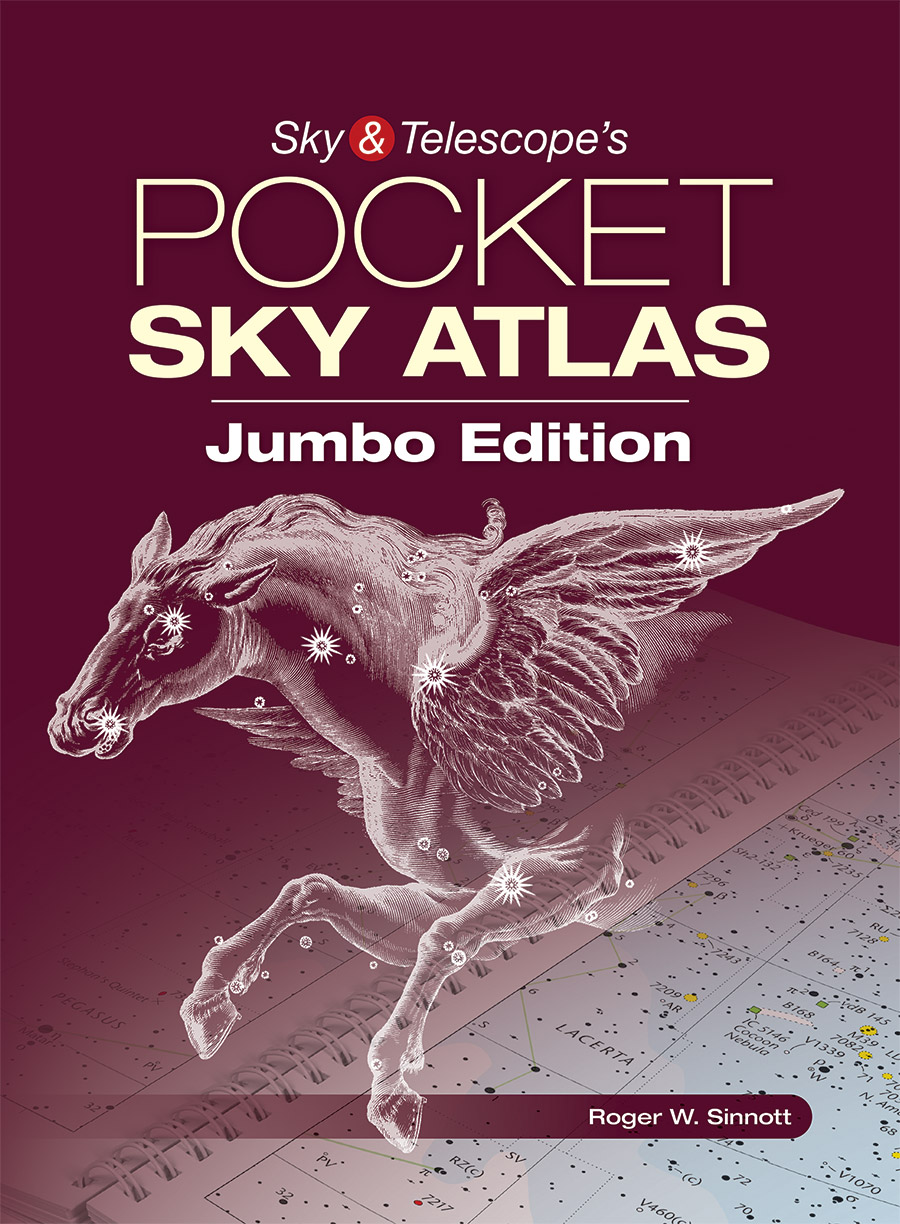
Next up is the larger and deeper Sky Atlas 2000.0, plotting stars to magnitude 8.5; nearly three times as many. (It's currently out of print.) The next up are the even larger Interstellarum atlas (stars to magnitude 9.5) or Uranometria 2000.0 (stars to mag 9.75). And read How to Use a Star Chart with a Telescope. It applies just as much to charts on your phone or tablet as to charts on paper.
You'll also want a good deep-sky guidebook. A beloved old classic is the three-volume Burnham's Celestial Handbook. An impressive more modern one is the big Night Sky Observer's Guide set (2+ volumes) by Kepple and Sanner. The top of the hill for total astro-geeks is the Annals of the Deep Sky series, currently at 10 volumes as it slowly works forward through the constellations alphabetically. So far it's only up to F.
Can computerized telescopes replace charts? Not for beginners I don't think, and not for scopes on mounts and tripods that are less than top-quality mechanically. Unless, that is, you prefer spending your time getting finicky technology to work rather than learning the sky. And as Terence Dickinson and Alan Dyer say in their Backyard Astronomer's Guide, "A full appreciation of the universe cannot come without developing the skills to find things in the sky and understanding how the sky works. This knowledge comes only by spending time under the stars with star maps in hand and a curious mind." Without these, "the sky never becomes a friendly place."
If you do get a computerized scope, make sure its drives can be disengaged so you can swing it around and point it readily by hand when you want to, rather than only slowly by the electric motors (which eat batteries).
However, finding faint telescopic objects the old-fashioned way with charts isn't simple either. Learn the essential tricks at How to Use a Star Chart with a Telescope.
 Audio sky tour. Out under the evening sky with your
earbuds in place, listen to Kelly Beatty's monthly
podcast tour of the naked-eye heavens above. It's free.
"The dangers of not thinking clearly are much greater now than ever before. It's not that there's something new in our way of thinking, it's that credulous and confused thinking can be much more lethal in ways it was never before."
— Carl Sagan, 1996
"Facts are stubborn things."
— John Adams, 1770
About Alan MacRobert
Alan M. MacRobert became an avid Sky & Telescope subscriber in 1966 at age 14, joined the editorial staff in 1982, and is now a senior contributing editor, semi-retired. He played a role in practically every part of the magazine and the company's other products for more than a generation, both on the amateur-observing side and the science-reporting side. In 1994 a book collection of his observing how-tos and telescopic sky tours was published as Star Hopping for Backyard Astronomers. He has produced This Week's Sky at a Glance online every week since 1989.



Comments
You must be logged in to post a comment.