 SUNSET:

 5
5FRIDAY, MAY 23
■ In the sky tonight, bright Capella sets low in the northwest soon after dark (depending on your latitude). That leaves Vega and Arcturus as the two brightest stars in the evening sky. Vega shines fairly high in the east-northeast. Arcturus is very high as you face south.
A third of the way from Arcturus down to Vega look for semicircular Corona Borealis, with 2nd-magnitude Alphecca as its one moderately bright star.
Two thirds of the way from Arcturus to Vega is the dim Keystone of Hercules. It's now lying almost level:

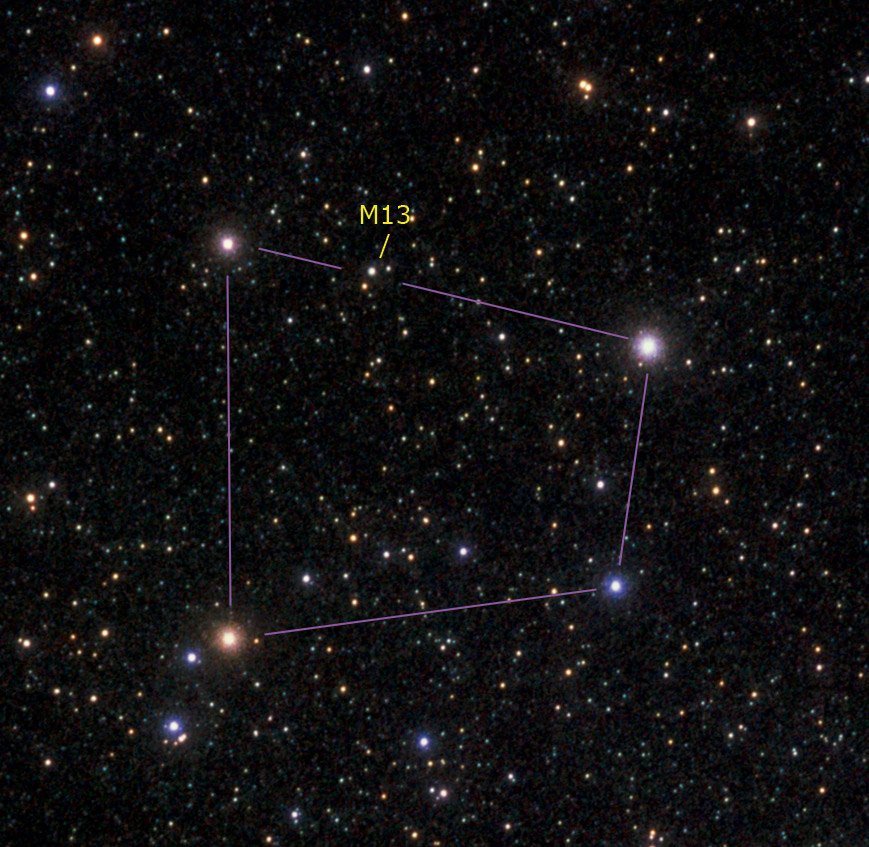
■ Use binoculars or a telescope to examine the Keystone's top edge. A third of the way from its left end to the right is M13, one of Hercules's two great globular star clusters, labeled below. In binoculars it's a tiny glowing cottonball, 6th magnitude, flanked by two 7th-magnitude stars ¼° to its sides. A 4- or 6-inch scope begins to resolve some of its speckliness. Located 22,000 light-years away far above the plane of the Milky Way, it consists of several hundred thousand stars in a swarm about 140 light-years wide.
SATURDAY, MAY 24
■ Zero-magnitude Vega dominates the east-northeast these evenings. Look for its little constellation Lyra hanging down from it. The most familiar part of Lyra is a small, almost-equilateral triangle with Vega as its top corner, and a larger parallelogram hanging to the lower right from the triangle's bottom corner. The bottom two stars of the parallelogram, Beta and Gamma Lyrae, are the two brightest stars of the pattern after Vega.

Akira Fujii
Most of the time Beta and Gamma are almost indistinguishable in brightness: Gamma is visual magnitude 3.25 and Beta is 3.4. But Beta is a famous eclipsing variable, one of the first discovered. Look up at those two enough times, and sooner or later you will catch Beta very obviously dimmer than Gamma, at its minimum brightness of mag 4.3. More often you're likely to catch it somewhere in between, when the difference is clearly apparent but not as striking.
SUNDAY, MAY 25
■ Can you see the big Coma Berenices star cluster? Does your light pollution really hide it, or do you just not know exactly where to look? It's 2/5 of the way from Denebola (Leo's tail tip) to the end of the Big Dipper's handle (Ursa Major's tail tip). Its brightest members form an inverted Y. The entire cluster is about 4° or 5° wide — a big, dim glow in a fairly dark sky. It nearly fills a binocular view.
MONDAY, MAY 26
■ Catch the brightest asteroid, 4 Vesta, before it fades further. It's nicely placed high in the south-southeast after the sky is fully dark (at least two hours after sunset now) in a moonless dark sky. It's almost a month past opposition but still about magnitude 6.2. It's located 24° below Arcturus, near the Virgo-Libra border and about 12° above both Beta and Alpha Librae. You'll need the finder chart with Bob King's article Asteroid Vesta Now an Easy Catch in Binoculars. The dates on the chart there are in Universal Time; subtract one day from them to get evening dates for the Americas.
■ New Moon (exact at 11:02 p.m. EDT; 8:02 p.m. PDT).
TUESDAY, MAY 27
■ Using binoculars 30 minutes or less after sunset, can you pick up Jupiter and the super-thin crescent Moon very low in the west-northwest? See below. Which of the two is the least detectable? Moon is only about 24 hours old at dusk in North America. Compare the time you spot it with the time of new Moon (see just above) to get the crescent's exact age. Does this set a young-Moon record for you?
WEDNESDAY, MAY 28
■ The Moon in twilight hangs less than a fist above Jupiter, the "False Evening Star." Jupiter is bright but hardly a match for Venus. See below.

THURSDAY, MAY 29
■ Now the Moon hangs under Pollux and Castor, as shown above.
■ Constellations seem to twist around fast when they pass your zenith — if you're comparing them to your direction "down." Just a week and a half ago, the Big Dipper floated horizontally in late twilight an hour after sunset (as seen from 40° N latitude). Now the Dipper angles diagonally in late twilight. In just another week and a half it will hang straight down by its handle at that time.
FRIDAY, MAY 30
■ The Big Dipper floats high in the northwest these evenings. The middle star of its bent handle is Mizar, with tiny little Alcor right next to it. On which side of Mizar should you look for Alcor? As always, on the side toward Vega. Which is now the brightest star in the east.
■ Titan casts its shadow on Saturn tonight! Only every 15 years does Titan, Saturn's largest moon, cross Saturn's face from Earth's viewpoint and, more visibly, cast its tiny black shadow onto Saturn. The latest series of these events has begun. They will happen every 16 days from now to October.
Tonight Titan's shadow crosses Saturn's face from 9:05 UT to 14:53 UT May 31st; that's from 5:05 a.m. to 10:53 a.m. Eastern Daylight Time May 31st; 2:05 to 7:53 a.m. PDT May 31st. Since Saturn is only up in view for a short while before and during early dawn, these times mean that only western North America is favored. And, it's fairly likely that blurry seeing when Saturn is so low will make the shadow undetectable even in a largish telescope. So hope for steady air! As the months proceed, the situation will improve. See Bob King's Titan Shadow Transit Season Underway.
SATURDAY, MAY 31
■ The crescent Moon is approaching Mars this evening, as shown below. At nightfall in North America they're about 4° apart.
But that's just their apparent separation: the way they appear on the surface of the celestial sphere. In actual 3-D space the Moon is 1.3 light-seconds distant from us, but Mars is currently 650 times farther in the background at a distance of 14 light-minutes.

SUNDAY, JUNE 1
■ Now the Moon leaves Mars behind to get chummier with Regulus, shining only about 1° from it (depending on your location). But at a distance of 79 light-years, Regulus is 1.9 billion times farther from us than the Moon is. A scale model: If the Moon was just a foot from your eye like on a screen, Regulus would be 360,000 miles in the background — a nuclear fireball at about the Moon's actual distance from us!
This Week's Planet Roundup
Mercury is hidden in conjunction with the Sun.
Venus, brilliant at magnitude –4.5, continues to rise almost due east at the very beginning of dawn (about two hours before sunrise). Once Venus is up in the clear you can't miss it. . . until the sky grows too bright. How long can you follow Venus up until it's lost in the growing light of day?
In a telescope, Venus's globe is now about half lit.
Saturn, much dimmer, is higher in the dawn, moving ever farther to Venus's upper right. See the Saturn entry below.
Mars (magnitude +1.3, crossing from Cancer into Leo) remains high in the west in the evening. It's the orange dot two or three fists upper left of Pollux and Castor, and roughly one fist lower right of Regulus, the brightest star of Leo and the bottom of the Sickle of Leo's handle.
Watch Mars and Regulus close in on each other for the next couple of weeks. They'll have a close conjunction on June 16th and 17th, passing 0.8° apart.
In a telescope Mars is now just a fuzzy blob 5½ arcseconds in diameter.
Jupiter (magnitude –1.9) is on the way out. As twilight fades look for it very low in the northwest, lower every day.
Saturn is the other dawn planet along with Venus. But at magnitude +1.1 it's only about 1/200 as bright. Look early. Binoculars will help locate Saturn 18° upper right of Venus on the morning of May 24th, almost two fists at arm's length. That widens to 24° by May 31st.
If you get your telescope on Saturn down there in the low-altitude poor seeing, expect a fuzzy, low-surface-brightness cheeseball, very slightly oval, with hints of a toothpick stuck though it diagonally. The toothpick is Saturn's rings; we see them nearly edge-on this year.
Uranus is hidden in conjunction with the Sun.
Neptune, a telescopic "star" at magnitude 7.9, lurks deep in the background of Saturn 2° to its celestial northeast this week.
All descriptions that relate to your horizon — including the words up, down, right, and left — are written for the world's mid-northern latitudes. Descriptions and graphics that also depend on longitude (mainly Moon positions) are for North America.
Eastern Daylight Time (EDT) is Universal Time minus 4 hours. UT is also known as UTC, GMT, or Z time.
Want to become a better astronomer? Learn your way around the constellations. They're the key to locating everything fainter and deeper to hunt with binoculars or a telescope.
This is an outdoor nature hobby. For a more detailed constellation guide covering the whole evening sky, use the big monthly map in the center of each issue of Sky & Telescope, the essential magazine of astronomy.
For the attitude every amateur astronomer needs, read Jennifer Willis's Modest Expectations Give Rise to Delight.
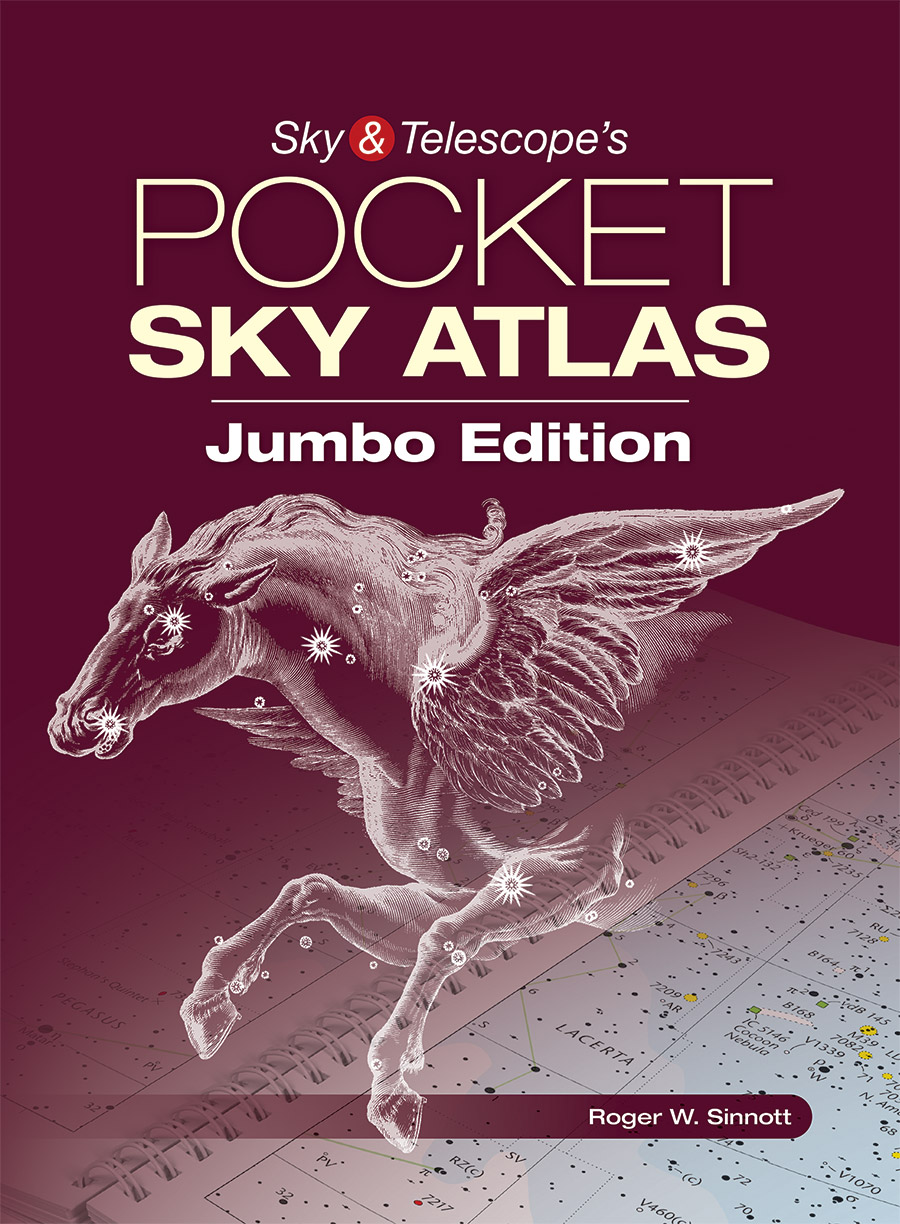
Once you get a telescope, to put it to good use you'll need a much more detailed, large-scale sky atlas (set of charts). The basic standard is the Pocket Sky Atlas, in either the original or Jumbo Edition. Both show all 30,000 stars to magnitude 7.6, and 1,500 deep-sky targets — star clusters, nebulae, and galaxies — to search out among them.
Next up is the larger and deeper Sky Atlas 2000.0, plotting stars to magnitude 8.5; nearly three times as many, as well as many more deep-sky objects. It's currently out of print, but maybe you can find one used.
The next up, once you know your way around well, are the even larger Interstellarum atlas (with 201,000+ stars to magnitude 9.5 and 14,000 deep-sky objects selected to be detectable by eye in large amateur telescopes), and Uranometria 2000.0 (332,000 stars to mag 9.75, and 10,300 deep-sky objects). And read How to Use a Star Chart with a Telescope. It applies just as much to charts on your phone or tablet as to charts on paper.
You'll also want a good deep-sky guidebook. A beloved old classic is the three-volume Burnham's Celestial Handbook. An impressive more modern one is the big Night Sky Observer's Guide set (2+ volumes) by Kepple and Sanner. The pinnacle for total astro-geeks is the new Annals of the Deep Sky series, currently at 11 volumes as it works its way forward through the constellations alphabetically. So far it's up to H.
Can computerized telescopes replace charts? Not for beginners I don't think, and not for scopes on mounts and tripods that are less than top-quality mechanically. Unless, that is, you prefer spending your time getting technology to work rather than learning how to explore the sky. As Terence Dickinson and Alan Dyer say in their Backyard Astronomer's Guide, "A full appreciation of the universe cannot come without developing the skills to find things in the sky and understanding how the sky works. This knowledge comes only by spending time under the stars with star maps in hand and a curious mind." Without these, "the sky never becomes a friendly place."
If you do get a computerized scope, make sure that its drives can be disengaged so you can swing it around and point it readily by hand when you want to, rather than only slowly by the electric motors (which eat batteries).
However, finding faint telescopic objects the old-fashioned way with charts isn't simple either. Do learn the essential tricks at How to Use a Star Chart with a Telescope.
 Audio sky tour. Out under the evening sky with your
earbuds in place, listen to Kelly Beatty's monthly
podcast tour of the naked-eye heavens above. It's free.
"The dangers of not thinking clearly are much greater now than ever before. It's not that there's something new in our way of thinking, it's that credulous and confused thinking can be much more lethal in ways it was never before."
— Carl Sagan, 1996
"Facts are stubborn things; and whatever may be our wishes, our inclinations, or the dictates of our passion, they cannot alter the state of facts and evidence."
— John Adams, 1770
About Alan MacRobert
Alan M. MacRobert became an avid Sky & Telescope subscriber in 1966 at age 14, joined the editorial staff in 1982, and is now a senior contributing editor, semi-retired. He played a role in practically every part of the magazine and the company's other products for more than a generation, both on the amateur-observing side and the science-reporting side. In 1994 a book collection of his observing how-tos and telescopic sky tours was published as Star Hopping for Backyard Astronomers. He has produced This Week's Sky at a Glance online every week since 1989.



Comments
Rod
May 24, 2025 at 11:16 pm
I did get out this evening and spend some time under the heavens. Observed 2030-2230 EDT. Sunset near 2020 EDT. New Moon 27-May-2025 0302 UT. Lovely evening under the sky tonight after sunset. I enjoyed views of M13, M92, and M4 globular clusters using 10x50 binoculars and 90-mm refractor telescope. TeleVue 32-mm plossl and 14-mm Delos used. At 71x, M13 showed some halo stars all around. My 10-inch Newtonian reflector provides the best view. M92 and M4 viewed using 10x50 binoculars as I walked around the pastures and fields. Fireflies were out all around. Numerous satellites passing over and one very bright (much brighter than Vega), likely ISS or China station. I did not check the times but observed moving ESE near 2148 EDT. I could see 7 stars in Corona Borealis so stars visible at least 5th magnitude. The fireflies are delightful to see with their bioluminescent and flashes all around. Sometimes they fly by my telescope and flash near, in the eyepiece, I see a greenish flash 🙂 Temperature 15C and winds NW 4 knots tonight.
You must be logged in to post a comment.
mary beth
May 25, 2025 at 1:41 pm
Rod, that sounds like a perfect kick off to summer! We don’t see many fireflies in the big city, so I’m glad you get to enjoy them. I love the Corona Borealis, I even bought a piece of jewelry depicting it. I remembered reading about Alphecca dimming. Even before I read that, I had noticed that myself, back in the early 2000s I could see it very well, but in the middle of that time between now and maybe two or three years ago, I had trouble seeing it. Then all the sudden I could see it real well again and decided to research the issue. I was glad it wasn’t my eyes failing lol. I’m not sure what caused the drop in apparent magnitude, but I remember Betelgeuse I believe went through a similar phase.
I hope you and your family have a wonderful and safe holiday weekend! May the souls of all of those who gave their precious lives for our freedom, be resting in peace, and staying in our hearts.
You must be logged in to post a comment.
Rod
May 25, 2025 at 2:03 pm
Thanks mary beth. 26-May-2025 is Memorial Day. Freedom is not free. The Origins of Memorial Day, https://www.va.gov/OPA/PUBLICATIONS/CELEBRATE/MEMDAY.PDF
You must be logged in to post a comment.
mary beth
May 25, 2025 at 6:22 pm
Thank you Rod that’s all very beautiful! We have celebrated May 30 as decoration day as a military family for decades, we always felt like Memorial Day was too commercialized, so we decided to have a more serious tribute on 30 May every year. My dad served in the Navy during World War II. He was on a minesweeper and one of the first to arrive at the beaches of Normandy in June 1944. Both my older brothers served during the Vietnam war. Thankfully, everyone came home safely, but we so appreciate those who paid the ultimate price for our freedom.
I follow a great account on Twitter/X called “Remember the Fallen”. The page owner is a former Marine and New York City policeman. He does a fantastic job paying tribute to those who died in the line of duty. I highly recommend it to any patriot!
https://x.com/44magnumblue1?s=21
You must be logged in to post a comment.
mary beth
May 27, 2025 at 10:12 pm
I saw the .95 day old moon at 8:48 pm! Altitude was 5.9°, azimuth was 298.6° and illumination was only 1.53%. Thank you S&T for the challenge, I doubt I would have seen it without your prompting! So fun and it was a beautiful sight especially with Jupiter in field of vision.
You must be logged in to post a comment.
You must be logged in to post a comment.