 SUNSET:

 7
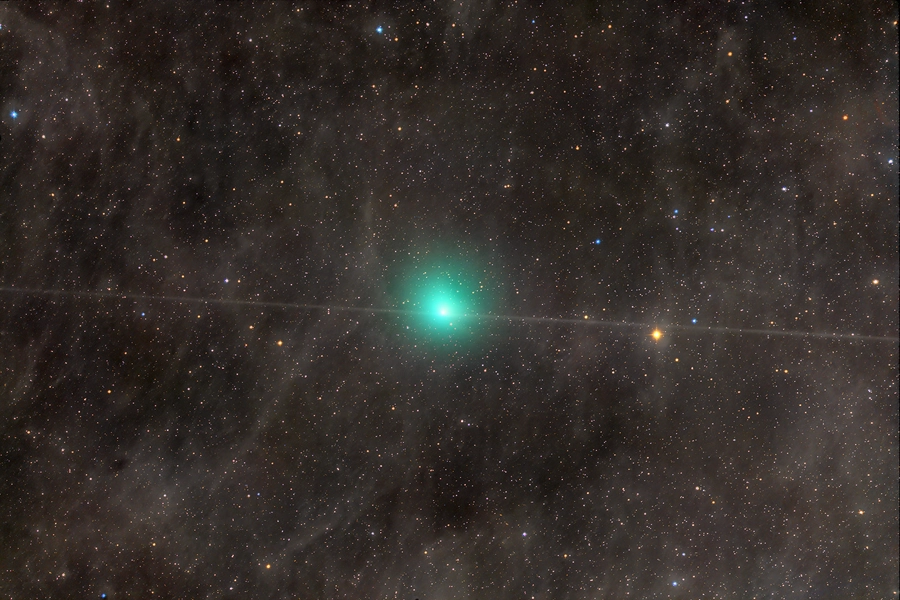
7Updated: Comet Tsuchinshan-ATLAS (pronounced "Choo-chin-SHAHN") is in its week of evening glory for Northern Hemisphere skywatchers. It began emerging very low in the west in evening twilight around the 11th. As of the 16th it's rapidly getting higher every evening just after twilight, even as begins to fade and shrink into the distance and the Moon turns full for the 16th and 17th. (By unlucky coincidence, this is the largest and brightest supermoon of the year).

Sky & Telescope graphics
But on the evening of the 15th the comet was large and easy to spot in my moonlit, suburban sky even amid streaks of thin cloud. 10x50 binoculars showed at least 5° or 6° of tail — looking just like the pictures, though of course, as seen by eye, both dimmer and with greater dynamic range (both dim and bright parts well presented at once). The almost stellar innermost nucleus that the 10x50s showed on October 12th had become more diffuse.
See Bob King's articles Get Ready for Comet Tsuchinshan-ATLAS — The Best Is Yet to Come! and his update Comet Tsuchinshan-ATLAS Climbs, Brightens and Delights! Also, our press release for the media.
FRIDAY, OCTOBER 11
■ Comet Tsuchinshan-ATLAS (C/2003 A3) swung through perihelion on September 27th, passing 0.39 a.u. from the Sun. Now, as its solar roasting continues, it emerges low into the Northern Hemisphere's evening-twilight sky with its head likely to be shining at around magnitude –1.5, as bright as Sirius.
Start trying for the comet this evening, but it might not yet be easy. Find a place with a clear view practically down to the horizon due west. By 30 minutes after sunset, start examining the sky there just 6° or so above horizontal. That's hardly more than three finger-widths at arm's length.
Alternatively: The comet's head will be about 28° — meaning almost three fist-widths — to the right of bright Venus, and probably somewhat lower (depending on your latitude; the farther south you are, the lower with respect to Venus).
It will likely appear tiny, with its bright inner tail curving sharply to the right tonight. The comet sets while twilight is still fairly bright.
Tomorrow it'll be about 4° higher and a little easier. The view will continue to improve as it gets higher every evening after that, and the tail will swing around to point upward. However, even as Comet T-A becomes easier to locate, it will fade as it recedes from the Sun.
See Bob King's excellent Get Ready for Comet Tsuchinshan-ATLAS — The Best Is Yet to Come! It has a finder chart through the end of October.

SATURDAY, OCTOBER 12
■ Now Comet Tsuchinshan-ATLAS stands higher, about 10° above the west horizon 30 minutes after sunset (as seen from mid-northern latitudes). Its brightness may be down to magnitude –0.8. Again, bring binoculars or a telescope if you have them.
Sixty minutes after sunset, as a few stars are beginning to come out, the comet's head is still 5° above the horizon's west point. The head sets around twilight's end, but as darkness becomes complete the long dust tail may be detectable extending very far upward — depending on your light pollution. Once night is fully dark, how much of the tail can you see emerging from the west horizon?
SUNDAY, OCTOBER 13
■ And now, even 60 minutes after sunset, the comet 's head is still a fine 9° high or so in the darkening sky. It's about midway between Venus to its left or lower left, and Arcturus to its right or upper right. The head may match Arcturus, magnitude zero, for brightness.
By now T-A is predicted to grow a thin, faint antitail pointing opposite the main tail. An antitail can appear when Earth passes through the plane of a comet's orbit and we view the thin, broad sheet of its dust debris edge-on.
At twilight's end now, the comet is still a couple degrees over the horizon. However, when any celestial body is that low, atmospheric extinction dims it considerably.
The comet will climb higher and stay up longer through the rest of the coming week, while dimming and receding into the distance. Expect it to be about magnitude 2.5 on the evening of the 16th and mag 4 by the 21st.
The post-twilight sky grows poorer as the light of the waxing gibbous Moon grows brighter. The Moon is full on the evenings of the 16th and 17th. But on about the 20th, a window of darkness will begin to open between twilight's end and moonrise.

MONDAY, OCTOBER 14
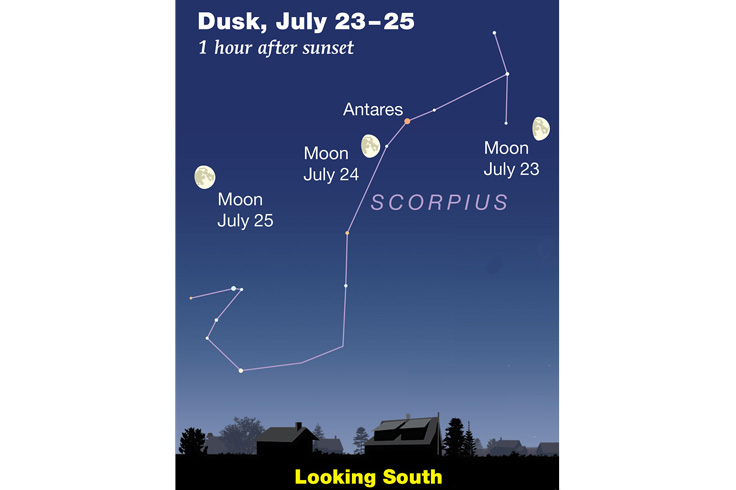
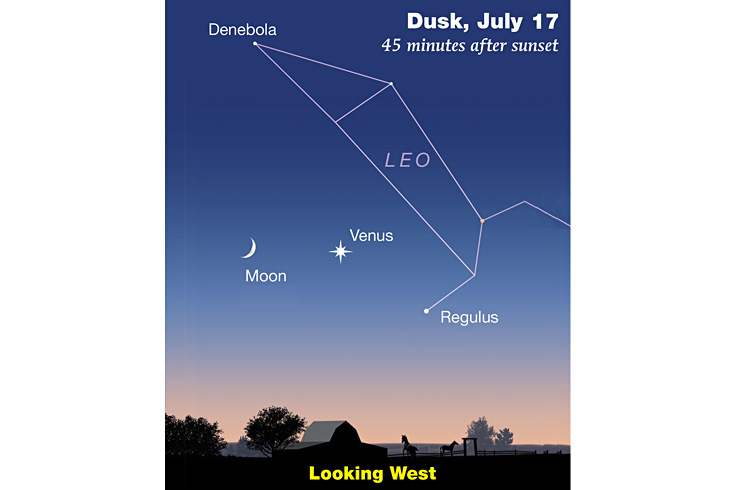
■ How early in twilight can you spot Saturn, magnitude +0.7, in the far background of the Moon? They'll appear about 5° apart during evening in North America. See the scene above.
TUESDAY, OCTOBER 15
■ This evening for the Americas, the head of Comet T-A will be passing only about 1.2° south of the 6th-magnitude globular cluster M5 — "a not-to-miss opportunity for photographers," writes Bob King. The comet's head by now should be about 2nd magnitude.
WEDNESDAY, OCTOBER 16
■ Full Moon this evening and tomorrow evening. The Moon is exactly full at 7:26 a.m. EDT on the 17th: about halfway between these two evenings for the Americas.
■ And while comet-spotting, take note of Arcturus low in the west-northwest about 2½ fists at arm's length to the comet's right or lower right. Sometime around when twilight ends, you'll find that Arcturus is the same height above the horizon as equally bright Capella in the northeast. When that happens, turn to the south-southeast, and there will be 1st-magnitude Fomalhaut at about the same height too — exactly so if you're at latitude 43° north (Boston, Buffalo, Milwaukee, Boise, Eugene). Seen from south of that latitude Fomalhaut will appear higher; from north of there it will be lower.
THURSDAY, OCTOBER 17
■ The Great Square of Pegasus, emblem of autumn, is now high in the east-southeast after dark — still, for now, balanced on one corner (for the world's mid-northern latitudes).
FRIDAY, OCTOBER 18
■ This is the time of year when the Big Dipper lies down horizontal low in the north-northwest when evening grows late, around 10 p.m. How low? The farther south you are, the lower. Seen from 40° north (New York, Denver) even its bottom stars twinkle nearly ten degrees high at their lowest. But at Miami (26° N) the entire Dipper will skim along out of sight just below the north horizon.

Antares, 9° left of Venus, is magnitude 1.0, twice as bright as Delta Sco.
SATURDAY, OCTOBER 19
■ The Moon, now waning gibbous, follows a few degrees behind the delicate Pleiades as they cross the sky tonight. Use your fingertip to block the Moon's glare.
Aldebaran and Jupiter follow along farther behind the Moon.
SUNDAY, OCTOBER 20
■ Now that it's mid-October, Deneb has replaced Vega as the zenith star after nightfall (for skywatchers at mid-northern latitudes). Accordingly, Capricornus has replaced Sagittarius as the zodiacal constellation posing low in the south.
■ The Orionid meteor shower should be active in the hours before dawn Sunday morning, but don't expect to see many at all through the waning gibbous moonlight. The radiant, in Orion's upraised club, will be high in the southeast to south by then.
■ Even if the meteors disappoint when you're out before dawn Sunday, you can certainly catch Pollux, Mars, and Procyon forming a straight line, in that order from upper left to lower right. The three shine with fairly similar brightnesses: magnitudes +1.1, +0.3, and +0.4, respectively. Pollux is three times closer to Mars than Procyon is.
Mars is moving eastward against the stars fast. Tomorrow morning the line won't be so straight.
This Week's Planet Roundup
Mercury remains out of sight deep in the sunset.
Venus, magnitude –3.9, gleams low in the southwest as evening twilight fades. It sets around twilight's end.
Mars (magnitude +0.3, in Gemini) rises around 11 or midnight. It shows best, very high in the southeast, in the hour before dawn. It's now 30° down east of bright Jupiter. Mars in a telescope is still a small 8 arcseconds wide, on its way to a mediocre opposition (14.5 arcseconds) next January.
Jupiter (magnitude –2.6, still near the horntip stars of Taurus) rises in the east-northeast around 9 p.m. Like Mars, it's highest in the hours before dawn. Jupiter is now a nice 44 arcseconds wide in a telescope, hardly smaller than the 48-arcsecond width it will attain for the weeks around its opposition in December.

Mars here shows its North Polar Cap, dark Mare Sirenum near the South Polar Cloud Hood, and some finer detail. On Jupiter, the North Equatorial Belt (with a bright white cloud outbreak) is slightly darker than the South Equatorial Belt, at least on this side of the planet.
Saturn, magnitude +0.7 in Aquarius, is well up in the southeast as the stars come out. Don't confuse it with Fomalhaut two fists to its lower right. Saturn is highest in the south by about 10 p.m.

Uranus (magnitude 5.6, near the Taurus-Aries border) is well up by late evening about 5° from the Pleiades. You'll need a good finder chart to identify it among its surrounding faint stars.
Neptune (tougher at magnitude 7.8, near the Circlet of Pisces) is 14° east of Saturn. Again you'll need a proper finder chart.
All descriptions that relate to your horizon — including the words up, down, right, and left — are written for the world's mid-northern latitudes. Descriptions and graphics that also depend on longitude (mainly Moon positions) are for North America.
Eastern Daylight Time (EDT) is Universal Time minus 4 hours. UT is also known as UTC, GMT, or Z time.
Want to become a better astronomer? Learn your way around the constellations. They're the key to locating everything fainter and deeper to hunt with binoculars or a telescope.
This is an outdoor nature hobby. For a more detailed constellation guide covering the whole evening sky, use the big monthly map in the center of each issue of Sky & Telescope, the essential magazine of astronomy.
Once you get a telescope, to put it to good use you'll need a much more detailed, large-scale sky atlas (set of charts). The basic standard is the Pocket Sky Atlas (in either the original or Jumbo Edition), which shows all stars to magnitude 7.6.
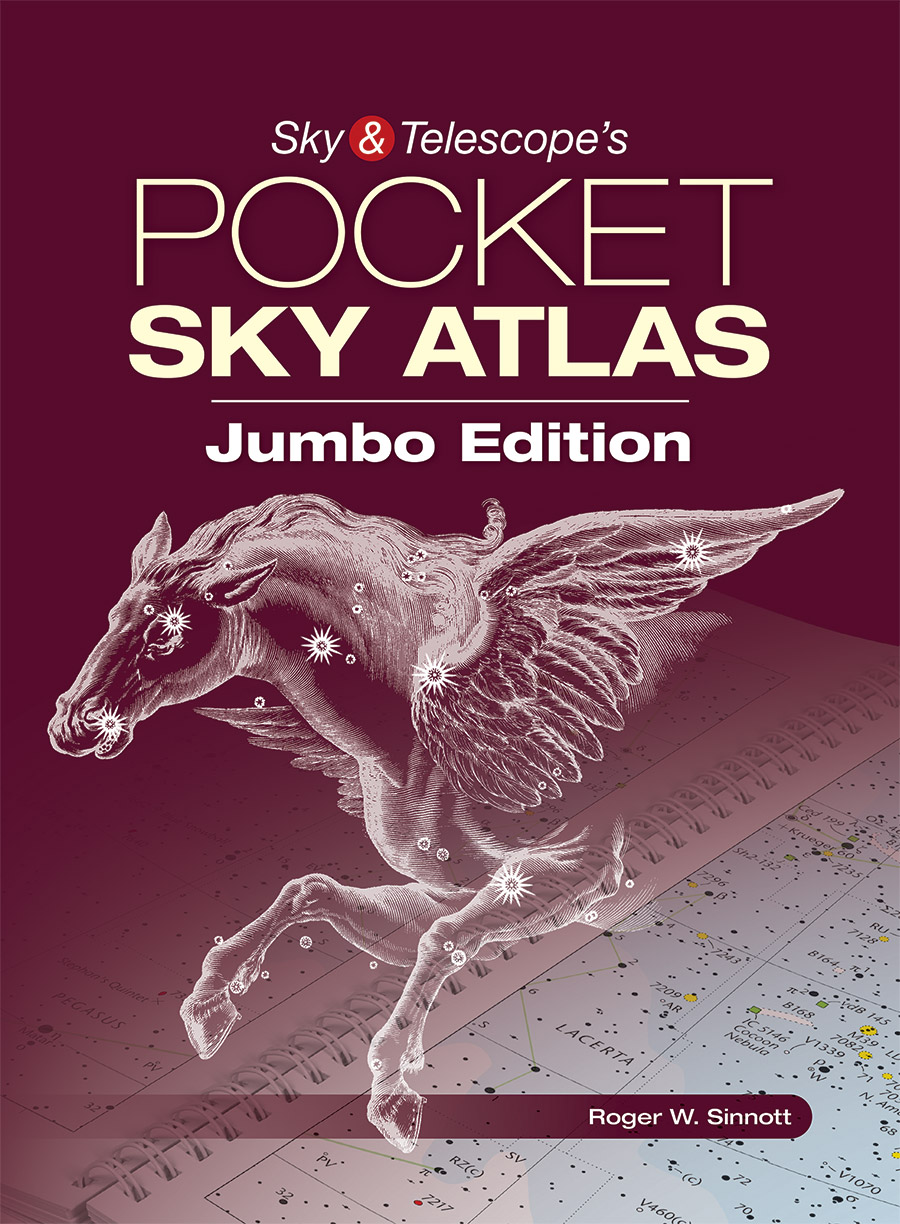
Next up is the larger and deeper Sky Atlas 2000.0, plotting stars to magnitude 8.5; nearly three times as many. It's currently out of print. The next up, once you know your way around well, are the even larger Interstellarum atlas (stars to magnitude 9.5) or Uranometria 2000.0 (stars to mag 9.75). And read How to Use a Star Chart with a Telescope. It applies just as much to charts on your phone or tablet as to charts on paper.
You'll also want a good deep-sky guidebook. A beloved old classic is the three-volume Burnham's Celestial Handbook. An impressive more modern one is the big Night Sky Observer's Guide set (2+ volumes) by Kepple and Sanner. The pinnacle for total astro-geeks is the Annals of the Deep Sky series, currently at 10 volumes as it slowly works forward through the constellations alphabetically. So far it's only up to F.
Can computerized telescopes replace charts? Not for beginners I don't think, and not for scopes on mounts and tripods that are less than top-quality mechanically. Unless, that is, you prefer spending your time getting finicky technology to work rather than learning how to explore the sky. As Terence Dickinson and Alan Dyer say in their Backyard Astronomer's Guide, "A full appreciation of the universe cannot come without developing the skills to find things in the sky and understanding how the sky works. This knowledge comes only by spending time under the stars with star maps in hand and a curious mind." Without these, "the sky never becomes a friendly place."
If you do get a computerized scope, make sure that its drives can be disengaged so you can swing it around and point it readily by hand when you want to, rather than only slowly by the electric motors (which eat batteries).
However, finding faint telescopic objects the old-fashioned way with charts isn't simple either. Learn the essential tricks at How to Use a Star Chart with a Telescope.
 Audio sky tour. Out under the evening sky with your
earbuds in place, listen to Kelly Beatty's monthly
podcast tour of the naked-eye heavens above. It's free.
"The dangers of not thinking clearly are much greater now than ever before. It's not that there's something new in our way of thinking, it's that credulous and confused thinking can be much more lethal in ways it was never before."
— Carl Sagan, 1996
"Facts are stubborn things."
— John Adams, 1770
About Alan MacRobert
Alan M. MacRobert became an avid Sky & Telescope subscriber in 1966 at age 14, joined the editorial staff in 1982, and is now a senior contributing editor, semi-retired. He played a role in practically every part of the magazine and the company's other products for more than a generation, both on the amateur-observing side and the science-reporting side. In 1994 a book collection of his observing how-tos and telescopic sky tours was published as Star Hopping for Backyard Astronomers. He has produced This Week's Sky at a Glance online every week since 1989.




Comments
misha17
October 11, 2024 at 4:52 pm
Re: "MONDAY, OCTOBER 14
■ How early in twilight can you spot Saturn, magnitude +0.7, in the far background of the Moon? They'll appear about 5° apart during evening in North America."
Earlier in the day on the opposite side of the world from North America, the Moon occulted Saturn as seen from Africa and Central Asia - map:
http://www.lunar-occultations.com/iota/planets/1014saturn.htm
You must be logged in to post a comment.
misha17
October 11, 2024 at 4:53 pm
The same general area will see the Moon pass through the Pleiades on October 19th.
You must be logged in to post a comment.
misha17
October 11, 2024 at 5:10 pm
... Just beyond the timeframe of this week's article, the Moon will occult Beta Tauri ( aka "El Nath") in the predawn skies on Monday October 21st, as seen from Mexico, Central America - and extreme southern Texas (Brownsville, Corpus Christi, McAllen, Laredo, etc.). The star will disappear along the Moon's sunlit Eastern limb. Reappearance will occur along the dark western limb, but in a brightening twilight sky.
Beta Tauri lies along the extreme northern limit for possible lunar occultation objects, and for the next 3-4 months the viewing paths lie about as far north on the Earth as possible. Next favorable sightings after this series won't recur for another 18+ years.
You must be logged in to post a comment.
misha17
October 11, 2024 at 5:12 pm
For the rest of the U.S. the Moon will pass just south of the star. Over the next few months viewers will watch as the Moon passes a little further South each month.
You must be logged in to post a comment.
Rod
October 11, 2024 at 7:34 pm
Some folks may find this pic interesting. Northern lights from Salisbury MD last night, the Sun kicked off some activity 🙂
https://www.youtube.com/channel/UCN037NurHvHu7wpWp9XPtaA/community?lb=UgkxyhuIlxaLfVK3ofmgGLC1hT5kb98yuVry
You must be logged in to post a comment.
mary beth
October 12, 2024 at 12:23 pm
Great photo, thanks for sharing!
You must be logged in to post a comment.
misha17
October 16, 2024 at 11:19 am
Re: "WEDNESDAY, OCTOBER 16
■ Full Moon this evening and tomorrow evening. The Moon is exactly full at 7:26 a.m. EDT on the 17th: about halfway between these two evenings for the Americas."
1. This Full Moon is the Hunter's Moon. Like last month's Harvest Moon, the difference in the time of moonrise from one night to the next is less than usual. This is due to several factors:
a. On average moonrise occurs about 50 minutes later each night as the Moon moves eastward about 13 degrees daily, on average. However, in
this part of the sky, the Moon's eastward movement night-to-night is less than usual as it moves along the steepest part of the Ecliptic, so the delay in moonrises is also less.
b. for Northern Hemisphere viewers, the Moon's path is the same as the Sun's path in April and May. Sunrise occurs earlier each morning during those months as the Sun heads towards the Summer solstice; for the Moon, this effect partly offsets the delay in moonrise caused by the Moon's eastward motion
(which is already less than usual due to "a." above).
c. Right now, the tilt in the Moon's orbit is lined up along the Ecliptic so the Moon's high point occurs near the June Solstice point, and its path is even deeper than usual - it's moving towards a high point 28 degrees above the Celestial Equator compared to the usual 23 degrees - so its nightly northward movement is even more pronounced.
*****
What usually goes unmentioned is what is happening at moonset in the morning: just as sunset is quickly occurring later each day during May and June, the differences between daily moonset will occur later than usual each morning for the next few days. The Moon's steeper-than-average path mentioned in "c." means that the daily difference in moonset times is greater than usual.
*****
In addition, this Full Moon is also a "Super Moon", when it is closer to the Earth than the average Full Moon. It is also moving faster along this part of its orbit.
For the night sky, the Moon moving eastward a little faster than expected by the Ecliptic tilt ("a."), but it also moving northward faster ("b." and "c.").
For the morning sky, this adds to the day difference in moonrise.
Bottom line, for the next few mornings, the Moon will quickly "pop" in to view, hanging around in the Western sky as is sets much later each morning.
You must be logged in to post a comment.
You must be logged in to post a comment.