 SUNSET:

 3
3Two binocular comets! This week Comets C/2025 A6 Lemmon and C/2025 R2 SWAN are both passing their closest to Earth and are at their brightest. Lemmon should reach 5th or possibly 4th magnitude, SWAN about 6th. And, both are nicely placed in the evening sky right after the end of twilight (for skywatchers at mid-northern latitudes).
SWAN this week moves fast across Scutum and southern Aquila: nicely high in the southwest to south after nightfall.
Lemmon this week moves fast across Canes Venatici and Boötes into Serpens Caput: lower, and in the northwest to west right after nightfall.
See Bob King's Two Bright Comets Converge on Northern Hemisphere Skies with finder charts for SWAN, and his Sweet Prospects for Comet Lemmon with a current chart for Lemmon.
FRIDAY, OCTOBER 17
■ This is the time of year when the Big Dipper lies down horizontal low in the north-northwest soon after dark. How low? The farther south you are, the lower. Seen from 40° north (New York, Denver) even its bottom stars twinkle nearly ten degrees high. But at Miami (26° N) the entire Dipper will skim along out of sight just below the northern horizon.
■ Jupiter's busy face: For West Coast and Hawaii telescope users, Jupiter offers two double-shadow transits early Saturday morning. Jupiter's moons Io and Europa will both be casting their tiny black shadows onto Jupiter's face from 3:42 to 5:49 a.m. PDT Saturday morning. Then 18 minutes after Io's shadow leaves, Callisto's shadow enters Jupiter's limb at 6:07 a.m. PDT — before Europa's leaves Jupiter at 6:30 a.m. EDT.
By then it's getting light in the Pacific time zone. But Hawaiians have a good view of both of these double-shadow events. Subtract 3 hours from PDT to get Hawaii times.
SATURDAY, OCTOBER 18
■ A challenge in bright twilight. Mercury and Mars are in conjunction, 2° apart, very low in the west-southwest in the fading afterglow of sunset, as shown below. Bring good binoculars, or a telescope with its lowest-power, widest-field eyepiece, to a site with a flat horizon to the west-southwest. Starting about 15 minutes after sunset, scan slowly just above the horizon.
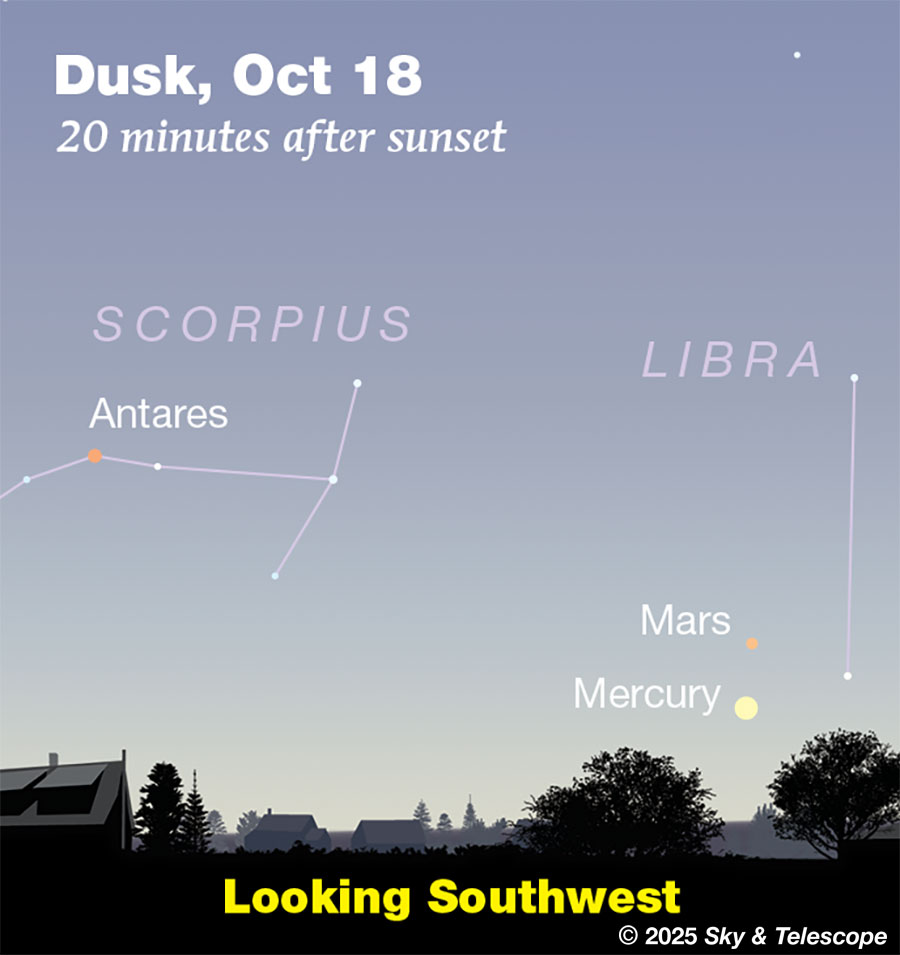
Mercury is by far the brighter of the two at magnitude –0.2 (not counting atmospheric extinction). If you catch Mercury, move upward by 2°. That's about a third the width of the view in many binoculars. Mars is only magnitude +1.5, a fifth as bright as Mercury.
Good luck. If you manage to glimpse Mars, you'll be one of the last few people on Earth to see it as its 2024-2025 apparition draws to a close.
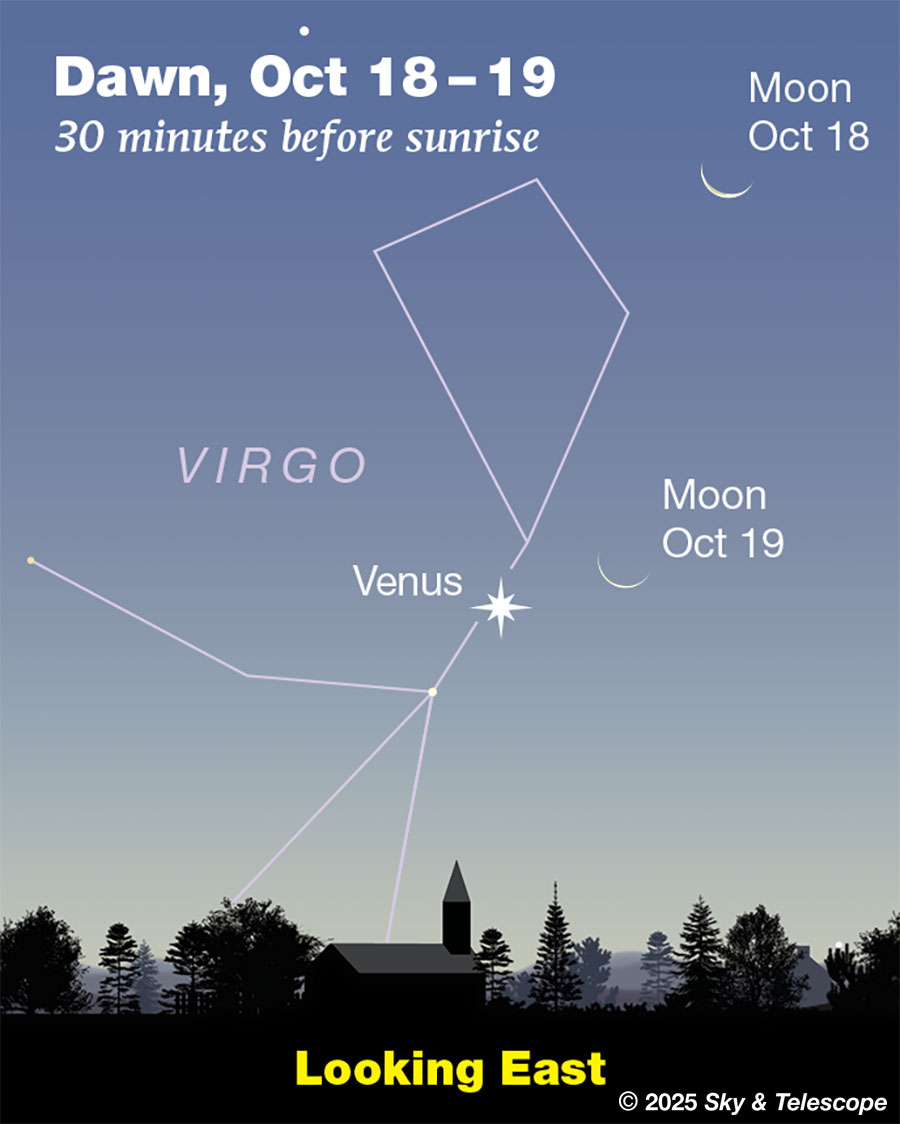
■ Much easier: In Sunday's dawn the thin Moon, just two days from new, shines about 4° to the right or upper right of bright Venus low in the east, as shown below.
SUNDAY, OCTOBER 19
■ Another double-shadow transit on Jupiter! Io and Ganymede are both casting their little shadows onto Jupiter's face tonight from 2:42 to 3:18 a.m. EDT (12:42 p.m. to 1:18 a.m. Mountain Daylight Time). In the Pacific time zone, Jupiter will still be low in the east in poor seeing.
MONDAY, OCTOBER 20
■ Spot bright Altair high in the southwest soon after dark. Brighter Vega is far to its right or upper right.
Above Altair lurk two distinctive little constellations: Delphinus the Dolphin, hardly more than a fist at arm's length to Altair's upper left, and smaller, fainter Sagitta the Arrow, slightly less far to Altair's upper right, as shown below. Is your sky too bright for them? Use binoculars!
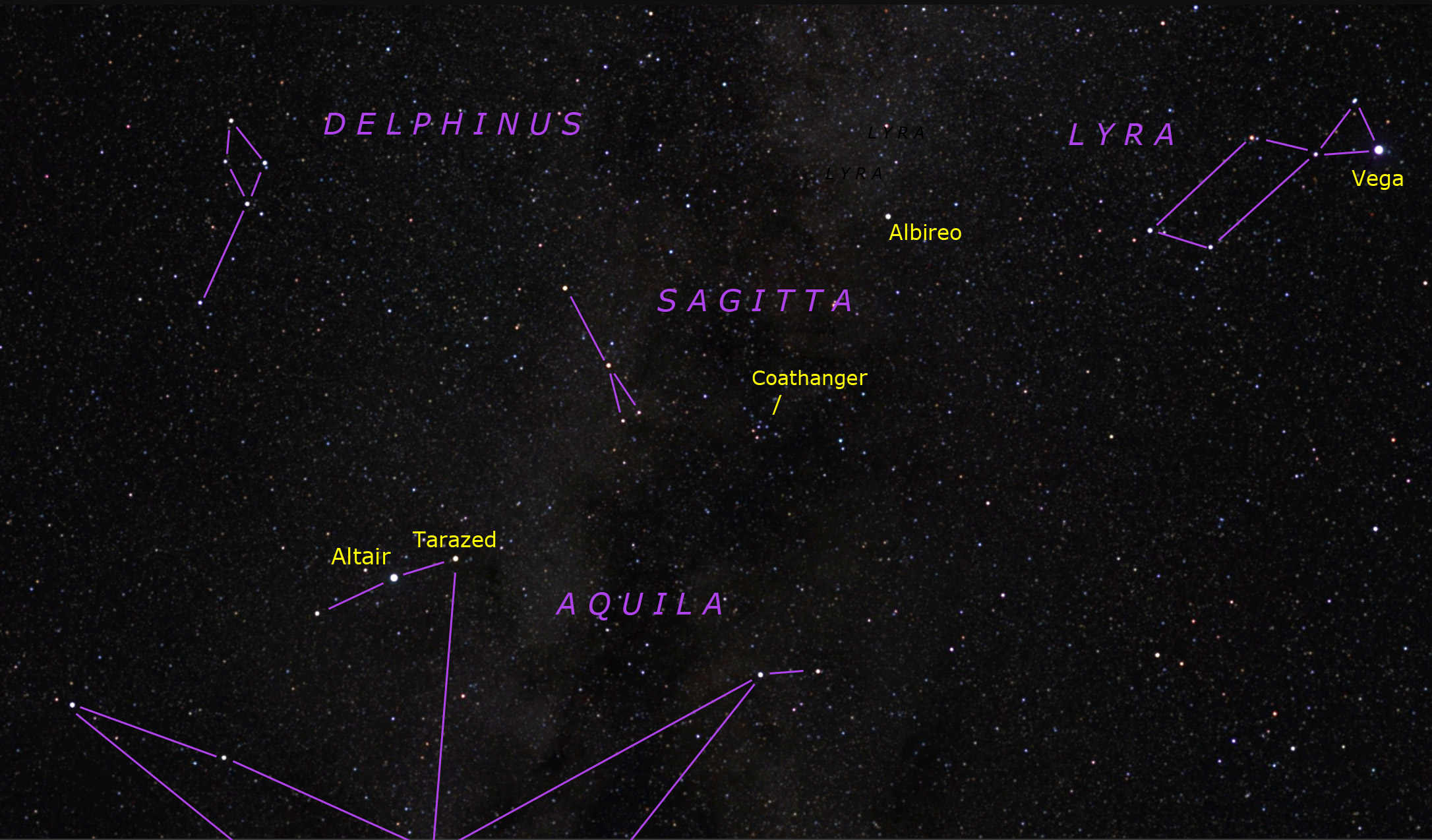
Binoculars can show the little Coathanger asterism off Sagitta's tail. The coathanger is upside down.
TUESDAY, OCTOBER 21
■ The Orionid meteor shower is predicted to peak late tonight in the hours leading up to dawn. This relatively long-lasting shower is also active for several days before and after. There will be no Moon. The shower's radiant is at the top of Orion's club at the feet of Gemini.
Says the International Meteor organization: "In a normal year the Orionids produce 10-20 shower members at maximum. In exceptional years, such as 2006-2009, the peak rates were on par with the Perseids (50-75 per hour). Recent displays have produced low to average displays of this shower."
S&T's Bob King writes, "Assuming good weather I'll set my alarm for 3 a.m. and observe till 5 from a lounge chair in my front yard. One hour is about the minimum for watching a meteor shower. But if you make it 2, you'll see the full gamut of what the shower has to offer, from pipsqueak flashes at the limit of vision to potential fireballs.
"While meteor-gazing is essentially effortless, it does require patience and low expectations. Every time I slip down into the chair and pull the wool blanket up to my chin, I'm amazed that the shower happens at all. The fact that it does feels strangely miraculous, the way the first snowfall of the season begins with a single flake." Read his Dip a Toe in the Orionid Meteor Stream.
■ New Moon (at 8:25 a.m. on the 21st EDT).
WEDNESDAY, OCTOBER 22
■ Globular clusters are most abundant on summer evenings, and here it is late October. But with moonlight gone from the evening sky, set up your telescope to look in on four remaining ones that Josh Urban calls The Last Wildflowers: Globular Clusters Greet Autumn. There's "Sagittifolia," the Arrowhead Flower, M71 next to Sagitta; "Queen Anne's Lace," M15 sneezed from the nose of Pegasus; "Watercress by the Stream," M2 in Aquarius a little farther south; and "Seaflower of the Deep," M30 deep in southern Capricornus.
■ Ceres, the largest asteroid and the first discovered, remains in binocular range at magnitude 7.7. It's now near Phi1 Ceti. Use the finder chart in the October Sky & Telescope, page 50. There, the tick marks on its path are for 0:00 UT on the dates indicated. This falls on the evening of the previous date in the Americas.
THURSDAY, OCTOBER 23
■ Look for bright Capella sparkling low in the northeast these evenings. Look for the Pleiades cluster about three fists at arm's length to Capella's right. These harbingers of the cold months rise higher as evening grows late. And watch for Aldebaran to rise below the Pleiades.
Upper right of Capella, and upper left of the Pleiades, the stars of Perseus lie astride the winter Milky Way.
FRIDAY, OCTOBER 24
■ A twilight challenge: About 30 or 40 minutes after sunset, find the thin crescent Moon very low due southwest. Use binoculars or, better, a telescope to look for orange Antares twinkling a degree or two above or upper right of it (for North America).
SATURDAY, OCTOBER 25
■ The Ghost of Summer Suns. Halloween is approaching, and this means that Arcturus, the star sparkling low in the west-northwest in twilight, is taking on its role as "the Ghost of Summer Suns." For several evenings centered on October 25th every year, Arcturus occupies a special place above your local landscape. It closely marks the spot where the Sun stood at the same time, by the clock, during hot June and July — in broad daylight, of course!
So, as Halloween approaches every year, you can see Arcturus as the chilly ghost of the departed summer Sun.
SUNDAY, OCTOBER 26
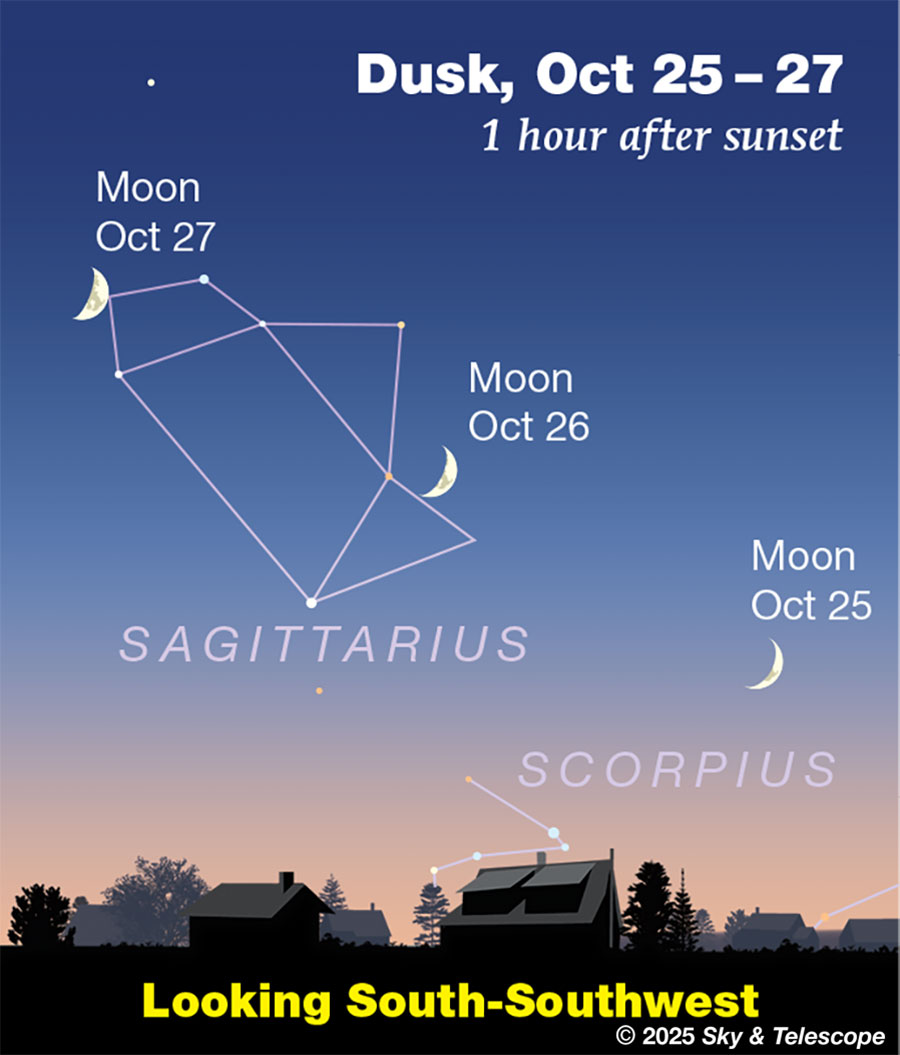
■ The waxing crescent Moon hangs low in the southwest just after nightfall. This evening the Moon floats just atop the spout of the Teapot for North American skywatchers, as indicated above. Don't wait or they'll get too low in the horizon murk and then set.
This Week's Planet Roundup
Mercury (magnitude –0.2) and Mars (magnitude +1.5) remain very low in the bright afterglow of sunset. They're in conjunction on October 18th and 19th, as shown near the top of this page. You'll definitely need optical aid. Good luck.
Venus (magnitude –3.9) rises due east around the beginning of dawn. It seems to fade in the brightening dawn as it climbs upward, but of course that's an illusion. Venus remains the same. Its appearance, when increasingly swamped by the brightening sky, is what changes. It's another reminder that the external reality outside of us, and our experience of it, are two fundamentally different things — even different orders of being. So often we instinctively confuse them, to our bafflement and misfortune.
The thin waning crescent Moon accompanies Venus on the morning of October 19th.
Jupiter, magnitude –2.2 in Gemini, rises by 11 or midnight local daylight-saving time. It dominates the east, then the southeast, as the early-morning hours proceed. Castor and Pollux shine upper left of it.
By the beginning of dawn the three are very high in the south — with Procyon below them and Orion standing upright farther to their lower right.
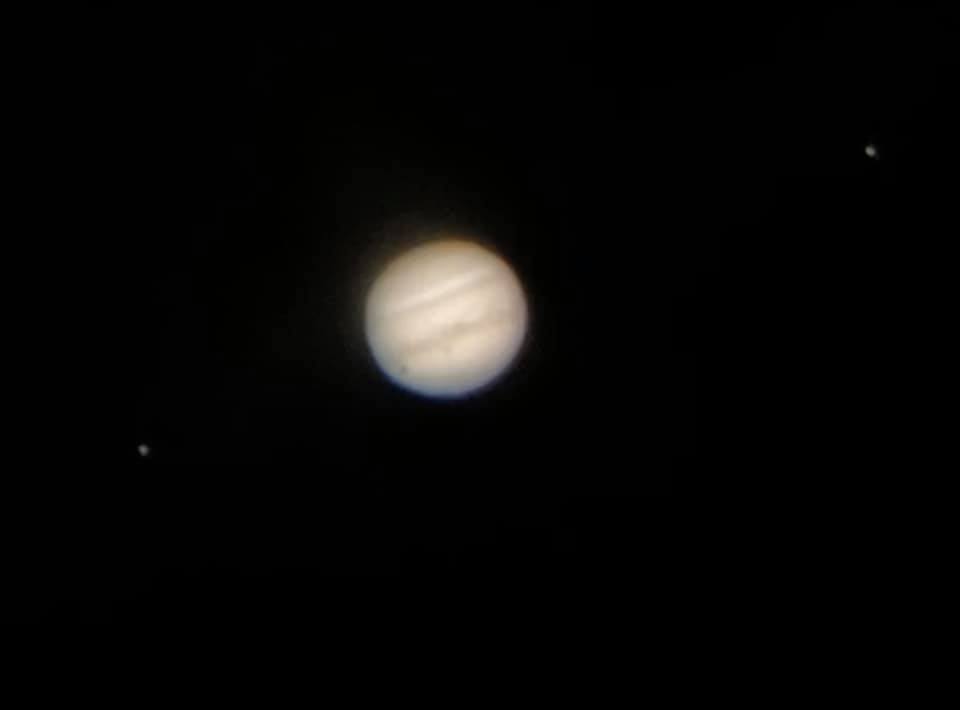
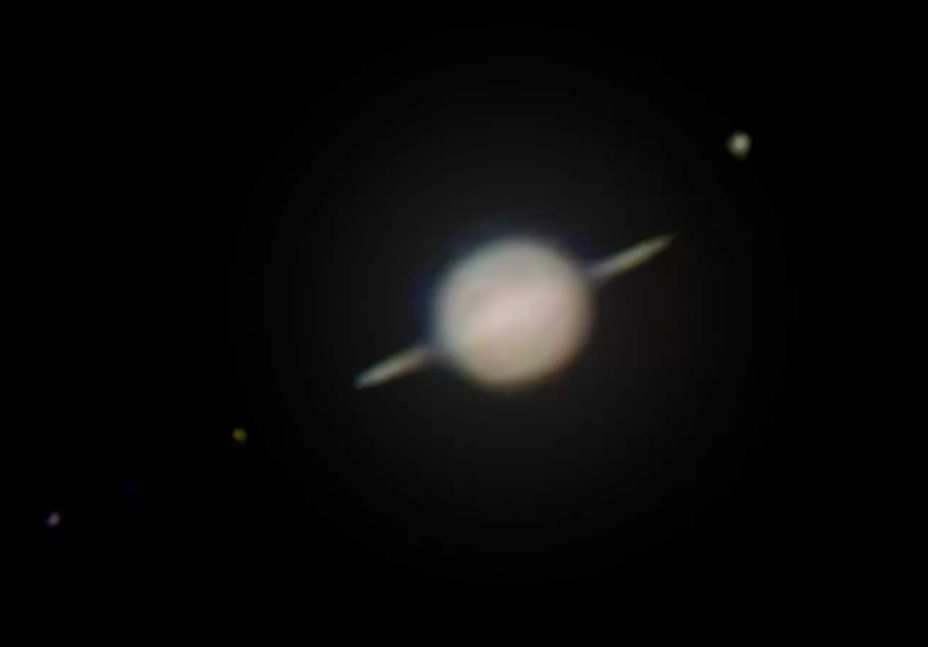
Saturn (magnitude +0.8) is the brightest dot in the east-southeast at nightfall. It's getting higher every week. The Great Square of Pegasus poses upper left of Saturn early in the evening and straight above it by the time Saturn transits the meridian (due south) around 11 p.m. In a telescope Saturn's rings remain very nearly edge-on.
Uranus (magnitude 5.6, in Taurus 4° from the Pleiades) is well up by 9 p.m. At high power in a telescope it's a tiny but definitely non-stellar dot, 3.6 arcseconds wide.
Neptune is a telescopic "star" of magnitude 7.8, a dim pinhead just 2.4 arcseconds wide a few degrees from Saturn. Use the finder chart for Neptune with respect to Saturn in the September Sky & Telescope, page 49. With a pencil, put a dot on the path of each of the two planets for your date.
All descriptions that relate to your horizon — including the words up, down, right, and left — are written for the world's mid-northern latitudes. Descriptions and graphics that also depend on longitude (mainly Moon positions) are for North America. Eastern Daylight Time (EDT) is Universal Time minus 4 hours. UT is also known as UTC, GMT, or Z time.
Want to become a better astronomer? Learn your way around the constellations. They're the key to locating everything fainter and deeper to hunt with binoculars or a telescope.
This is an outdoor nature hobby. For a more detailed constellation guide covering the whole evening sky, use the big monthly map in the center of each issue of Sky & Telescope, the essential magazine of astronomy.
For the attitude every amateur astronomer needs, read Jennifer Willis's Modest Expectations Give Rise to Delight.
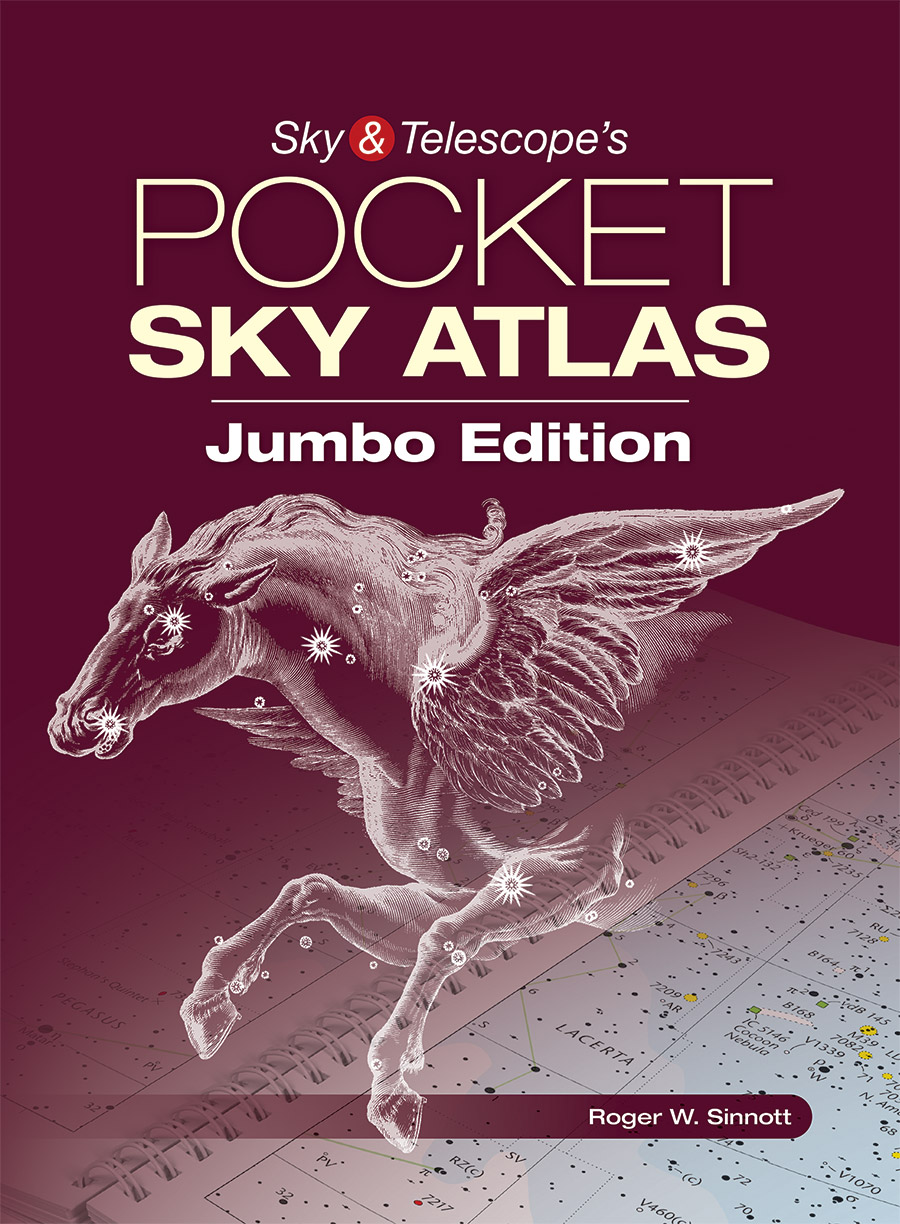
Once you get a telescope, to put it to good use you'll need a much more detailed, large-scale sky atlas (set of charts). The basic standard is the Pocket Sky Atlas, in either the original or Jumbo Edition. Both show all 30,000 stars to magnitude 7.6, and 1,500 deep-sky targets — star clusters, nebulae, and galaxies — to search out among them.
Next up is the larger and deeper Sky Atlas 2000.0, plotting stars to magnitude 8.5; nearly three times as many, as well as many more deep-sky objects. It's currently out of print, but maybe you can find one used.
The next up, once you know your way around well, are the even larger Interstellarum Deep-Sky Atlas (with 201,000+ stars to magnitude 9.5 and 14,000 deep-sky objects selected to be detectable by eye in very large amateur telescopes), and Uranometria 2000.0 (332,000 stars to mag 9.75, and 10,300 deep-sky objects).
And read How to Use a Star Chart with a Telescope. It applies just as much to charts on your phone or tablet (which many observers find more versatile) as to charts on paper.
You'll also want a good deep-sky guidebook. A beloved old classic is the three-volume Burnham's Celestial Handbook. It was my bedside reading for years. An impressive more modern one is the big Night Sky Observer's Guide set (2+ volumes) by Kepple and Sanner. The pinnacle for total astro-geeks is the new Annals of the Deep Sky series, currently at 11 volumes as it works its way forward through the constellations alphabetically. So far it's up to H.
Can computerized telescopes replace charts? Not for beginners I don't think, and not for scopes on mounts and tripods that are less than top-quality mechanically. Unless, that is, you prefer spending your time getting finicky technology to work rather than learning how to explore the sky. As Terence Dickinson and Alan Dyer say in their Backyard Astronomer's Guide, "A full appreciation of the universe cannot come without developing the skills to find things in the sky and understanding how the sky works. This knowledge comes only by spending time under the stars with star maps in hand and a curious mind." Without these, "the sky never becomes a friendly place."
If you do get a computerized scope, make sure that its drives can be disengaged so you can swing it around and point it readily by hand when you want to, rather than only slowly by the electric motors (which eat batteries).
However, finding faint telescopic objects the old-fashioned way with charts isn't simple either. Do learn the essential tricks at How to Use a Star Chart with a Telescope.
 Audio sky tour. Out under the evening sky with your
earbuds in place, listen to Kelly Beatty's monthly
podcast tour of the naked-eye heavens above. It's free.
"The dangers of not thinking clearly are much greater now than ever before. It's not that there's something new in our way of thinking, it's that credulous and confused thinking can be much more lethal in ways it was never before."
— Carl Sagan, 1996
"Facts are stubborn things; and whatever may be our wishes, our inclinations, or the dictates of our passion, they cannot alter the state of facts and evidence."
— John Adams, 1770
About Alan MacRobert
Alan M. MacRobert became an avid Sky & Telescope subscriber in 1966 at age 14, joined the editorial staff in 1982, and is now a senior contributing editor, semi-retired. He played a role in practically every part of the magazine and the company's other products for more than a generation, both on the amateur-observing side and the science-reporting side. In 1994 a book collection of his observing how-tos and telescopic sky tours was published as Star Hopping for Backyard Astronomers. He has produced This Week's Sky at a Glance online every week since 1989.


Comments
Rod
October 17, 2025 at 8:51 am
"Two binocular comets!" I have seen a number of reports on the comets, I may have to get out and observe them 🙂 I did view the stars last night vs. watch Thursday night football 🙂 M31, Double Cluster in Perseus, and Saturn with 2 moons visible. Titan and Rhea. It was a beautiful fall evening. Some geeky details here. https://www.youtube.com/post/UgkxaNHBhbuxG3RDCLZhoTCGKIaDigW2E-dL
You must be logged in to post a comment.
Zubenelgenubi 61
October 17, 2025 at 11:31 am
I like the images of Jupiter and Saturn shown here. They are representative of what actually can be SEEN with a modest telescope. Of course there is a place for the stacked and processed planetary images and the long exposure comet/deep sky pictures. But they docreate an unrealistic expectation for the general public. Lemmon, for example. Visually it is a dim fuzzball, with some tail if you have a good enough sky. I have shown it to about 15 people, and every single one except for the experienced stargazers has been disappointed. There is no cure for this except by realistic descriptions and occasionally posting "real" images like you did here
You must be logged in to post a comment.
Rod
October 18, 2025 at 7:37 am
I was able to view comet C/2025 A6 (Lemmon) this morning using my 10x50 binoculars, and 90-mm refractor telescope. Some geeky observation details here, https://www.youtube.com/post/Ugkx6Kp3JX4uvma7QkVUQzXPm_HU1f-I5XHr
You must be logged in to post a comment.
You must be logged in to post a comment.