 SUNSET:


R Coronae Borealis Awakes and Pluto Blocks a Star
Sometimes, it's just as exciting to watch a celestial object fade or disappear as it is to see it explode. We celebrate the "return" of a mysterious variable star and prepare for Pluto to occult a star.

Catch the Perseid Meteor Shower at Its Peak
Plan for optimal conditions for the year’s Perseid meteor shower, early in the mornings of August 12th and 13th.

Mind the Gap: Gaia Mission Reveals the Insides of Stars
Astronomers have discovered a hiccup in stellar luminosities that may point to a new understanding of stellar structure.

Found! The Largest Source of Dust on Mars
New results show that the Medusae Fossae Formation, a set of broad and enigmatic plains, provides most of the fine dust found everywhere on the Martian surface.
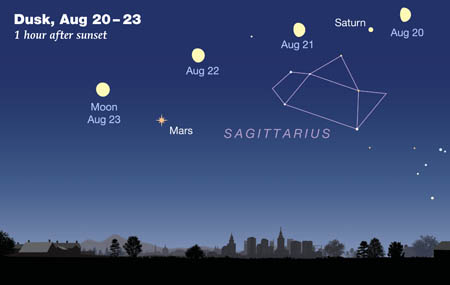
Tour August's Sky: Perseid Time!
As told in this month's astronomy podcast, August offers excellent viewing conditions for the always-flashy Perseid meteor shower — and a chance to see four bright planets at once.

A Rapidly Spinning Black Hole with a Warped Disk
An X-ray telescope recently installed on the International Space Station has provided a detailed look at a black hole feeding off its companion star.

Tiny Blue Crystals Show Evidence of the Sun’s Active Youth
Scientists studying microscopic minerals found in a meteorite have discovered evidence of the feistiness of the toddler Sun.

Star Swings Around Black Hole, Tests Gravity
Astronomers have seen a star’s light redden as it passed our galaxy’s central black hole, just as general relativity predicts.

Meet Regulus, Little King of the Ecliptic
Meet Regulus A, dubbed "Little King" and "Heart of the Lion," among the 25 brightest stars in the sky. The star belongs to a complex system, including a close white dwarf companion that makes its ultimate fate uncertain.

Liquid Water on Mars! Really for Real This Time (Probably)
A radar instrument on one of the oldest operational Mars orbiters has discovered possible evidence of liquid water on Mars.

Red Moon Meets Red Planet in Longest Total Lunar Eclipse of the Century
Not only will the Moon will be totally eclipsed this Friday, but Mars will be at opposition and shine in tandem with the red Moon all night!

HaloSat: A Small Satellite for a Big Question
HaloSat, a mini-satellite recently deployed from the International Space Station, is on the hunt for the universe's missing matter.

Andromeda Collided with Galactic Sibling Billions of Years Ago
A new study says our neighbor galaxy’s big stellar halo and stellar evolution are due to a major collision that ended 2 billion years ago.

See Mars at Its Best Since 2003
Wonder what to see now that Mars is at its biggest and brightest? Here are expert tips for when, where, and how to look.

IceCube Neutrino Offers New Eyes on the Cosmos
A combination of neutrino detection and observations across the full spectrum of light has pinpointed a cosmic accelerator for the first time, revitalizing multi-messenger astronomy.

When Giant Planets Orbit Evolved Stars
A new study explores the impacts of stars that age past the main sequence and evolve into red giants on the planets orbiting around them by looking at the orbits of gas giants closely circling evolved stars.
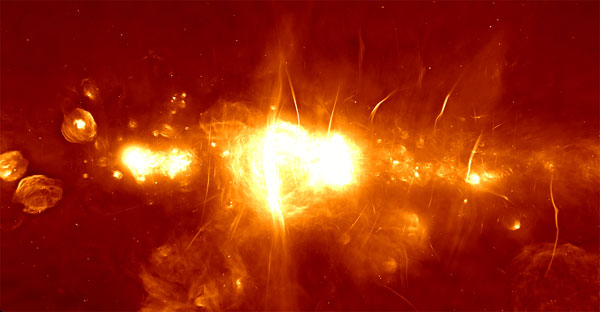
60-Second Astro News: Must-See Images of the Week
Catch up on this week in astronomy news with a trio of images: a pair of near-Earth asteroid twins, ground-based views that beat Hubble's, and the tumultuous galactic center.

Jupiter's Moons: 10 More Found, 79 Known
Over the past 18 months, astronomers have painstakingly tracked a dozen tiny moons that they found circling the giant planet Jupiter.

PanSTARRS Comet, Rocked by Outburst, Goes Green
Comet PanSTARRS (C/2017 S3) has erupted again! Now bright enough to see in binoculars, it might become a naked-eye object if it survives until perihelion.

What Can Lunar Eclipses Do For Science?
On the night of July 27, 2018, the longest total lunar eclipse for the next 105 years will be visible across parts of Europe, Africa, Asia and Australia. Six months later, on January 20, 2019, there will be the 'Great American' lunar eclipse, where totality is visible across all 50 states.
