 SUNSET:

 2
2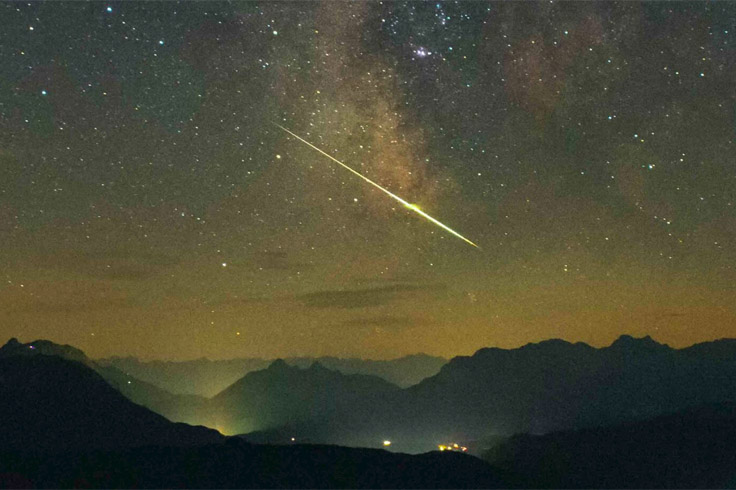
Of all the different celestial sights visible around the year, meteor showers especially seem to captivate public interest. It’s clear why. On a quiet, dark night under the stars, you’re caught by surprise when a bit of space rock zips into the top of Earth’s atmosphere as a shooting star ― ending its life in a moment before your eyes, after ages of roaming loose in the solar system.
But while the sight of an individual meteor streaking through the sky is a matter of chance, meteor showers are fairly predictable, coming at about the same times each year. Below we list all of the big meteor showers of 2026, highlighting those that will offer the best show. And keep reading if you want to learn more about what meteors and meteor showers are, and how to get the most out of a meteor-watching session.
Looking Back at 2025’s Top Meteor Showers
Some of last year’s highlights, like the Perseids in August and Geminids in December, dazzled observers across North America. For a full recap of 2025, see our complete 2025 guide.
Meteor Showers in 2026
The dates in the table below are for the predawn hours in North America closest to the predicted peak of Earth’s passage through the meteoroid stream. Most showers are also active to some degree for a number of nights, sometimes many nights, before and after the predicted peak date.
Important: The listed peak rate is what’s called the “zenithal hourly rate,” which is what an experienced viewer would see at the peak time under ideal conditions: a very dark, unobstructed sky free of moonlight or light pollution (so that stars of magnitude 6.5 are detectable without optical aid), with full dark adaptation and the shower's radiant being high overhead. Rarely are we so blessed, so most likely you’ll see lower rates than those listed.
Peak Dates and Visibility
| Shower | Radiant (and its direction) | Morning of maximum | Typical peak rate (per hour) | Parent comet or asteroid |
| Quadrantids* | Boötes (NE) | Jan. 3 or 4 | 15-110 | 2003 EH1 |
| Lyrids | Lyra (E) | April 22 | 10-20+ | Thatcher |
| Eta Aquariids* | Aquarius (E) | May 4 | 50 | 1P/Halley |
| Delta Aquariids | Aquarius (SE) | July 25 to Aug. 5 | 20 | 96P/Machholz? |
| Perseids | Perseus (NE) | Aug. 12 | 100 | 109P/Swift-Tuttle |
| Orionids | Orion (SE) | Oct. 21, 22 | 20 | 1P/Halley |
| Taurids | Taurus (overhead) | Oct. and Nov. | 5 | 2P/Encke |
| Leonids | Leo (E) | Nov. 17, 18 | 15 | 55P/Tempel-Tuttle |
| Geminids | Gemini (E) | Dec. 14 | 140 | 3200 Phaethon |
| Ursids* | Ursa Minor (N) | Dec. 22 | 10 | 8P/Tuttle |
January 3: The Quadrantids
It's a no-good, very bad year for the “Quads.” First, the bright light of the just-past-full Moon will flood the sky all night. Second, the shower's relatively brief peak, predicted for about 1 p.m. to 7 p.m. EST (18:00 to 24:00 UT) January 3rd, is almost exactly a half day out of sync with the best early-morning meteor-watching hours for North America on the morning before and the morning after.
Background: In years when everything aligns just right, the Quads deliver 1 or 2 meteors visible per minute (on average) if you have excellent sky conditions. In fact, the nominal peak zenithal hourly rate (which, again, is for an observer with perfect viewing conditions) is a very high 110. In some years, it has reached 200.
The shower's radiant is in northernmost Boötes, between the end of the Big Dipper’s handle and the head of Draco, in the defunct constellation Quadrans Muralis. The radiant is highest before dawn, as is true for most showers.
The Quads' parent body is a small object designated 2003 EH1 for its discovery year. (It’s also known as asteroid 196256 but hasn’t yet been named.) It loops around the Sun every 5½ years between the orbits of Earth and Jupiter. Only in 2004 did meteor specialist Peter Jenniskens discover that this body is responsible for the Quadrantids. It’s not an active comet — more likely it's an “extinct comet” that no longer has any ice to evaporate.
April 22: The Lyrids
Stellarium
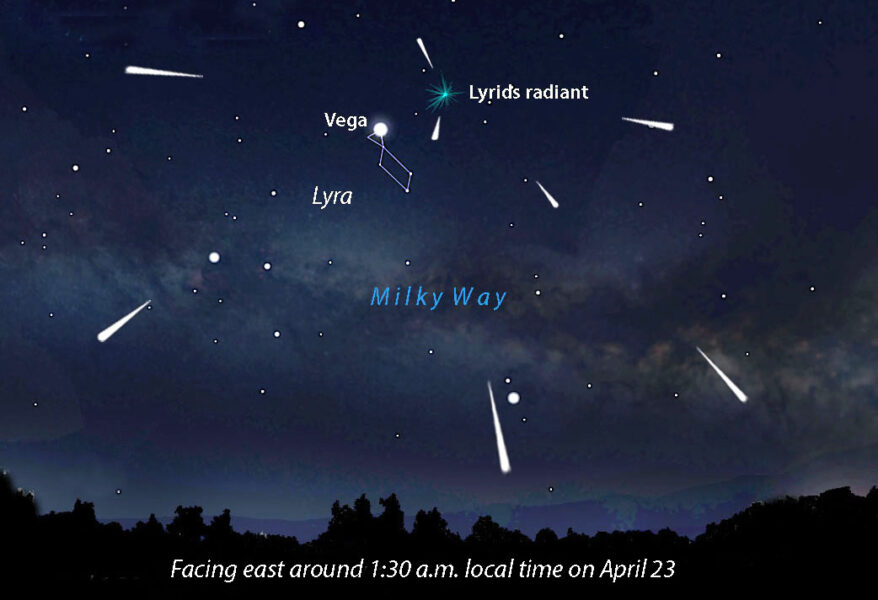
More than 3½ months pass until the next major annual shower. April’s Lyrids are usually weak; you might glimpse one every 5 minutes on average. But surprises occur; counts exceeded one a minute during a Lyrid outburst in 1982. The main part of the shower generally lasts three days, but the center of the stream is generally narrow; the predicted peak this year (near 20h UT April 22nd) would be best for East Asia. But the time of this narrow peak often varies.
That morning the Moon, just past last quarter, will pose some interference, but only after it rises around 3 a.m. local time.
May 4: The Eta Aquariids
The waning gibbous Moon could hardly be timed worse for this spring shower, even though its maximum activity is drawn out over several days. Moonlight blasts the early-morning sky all the way through. Oh well, wait'll next year.
Background: The Eta Aquariids, like the Orionids of November, originate from none other than Halley’s Comet, and its meteors come in fast: 66 km (41 miles) per second. This blazing speed often creates shock-wave trains — looking like glowing smoke trails — that linger for several seconds after the meteors themselves have come and gone.
For those in the Southern Hemisphere, the Eta Aquariids are often the best shower of the year. They’re not nearly so good for us northerners; the shower’s radiant (in the Water Jar asterism of Aquarius) stays low before dawn as seen from mid-northern latitudes, so rates for us are low no matter what.
Mid-July to Mid-August: The Delta Aquariids
This long-lasting shower, more formally called the Southern Delta Aquariids, has a radiant below the celestial equator and thus, like the Eta Aquariids, is best seen from the Southern Hemisphere. The shower is at least slightly active all the way from mid-July to mid-August, even overlapping the Perseids, but it’s most active for a week around its nominal maximum date of July 30th.
For us mid-northerners, the radiant is well above the southern horizon from a couple of hours before midnight to a few hours after midnight.
Also active through much of the Delta Aquariid weeks are the sparser Alpha Capricornids. Their radiants are fairly close to each other, but the Alpha Caps are distinguishable by their slowness compared to the swift-flying Delta Aquariids.
August 13: The Perseids
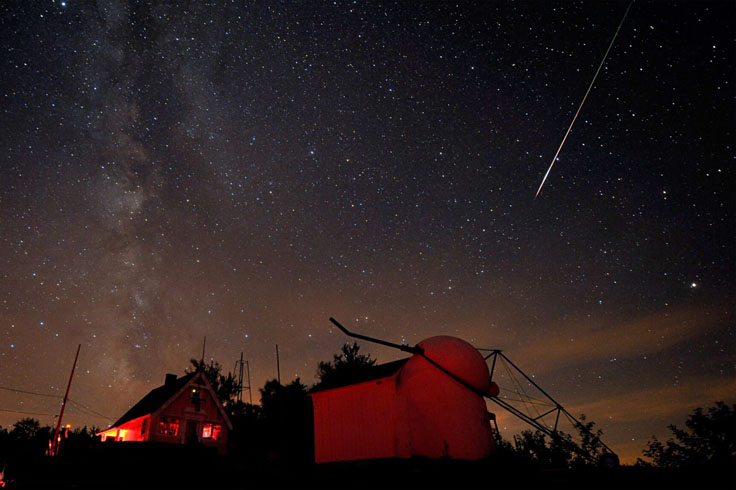
The sky is moonless for the Perseids this year, the most widely known and loved of the annual meteor showers. The Perseids are reliable. In richness, they're second only to the Geminids of December. The Perseids often deliver about a meteor per minute on average, under pleasant summer skies during vacation season, when more people are in unspoiled rural darkness.

Sky & Telescope
Their numbers are lower in the evening, slowly increasing through the night as the radiant rises high. (It’s near the Perseus Double Cluster just under Cassiopeia.) But the Perseid radiant does clear the northeastern horizon as early as 8 p.m. When the radiant is low, the few Perseids you might see will be dramatically long “Earth grazers” skimming almost horizontally far across the top of the atmosphere.
The shower builds up slowly, starting as early as late July, then drops off more rapidly in the nights after the peak.
The Perseids are bits of debris shed by Comet 109P/Swift-Tuttle, which orbits the Sun every 130 years. Careful observers first realized that the Perseids are an annual event in the 1830s.
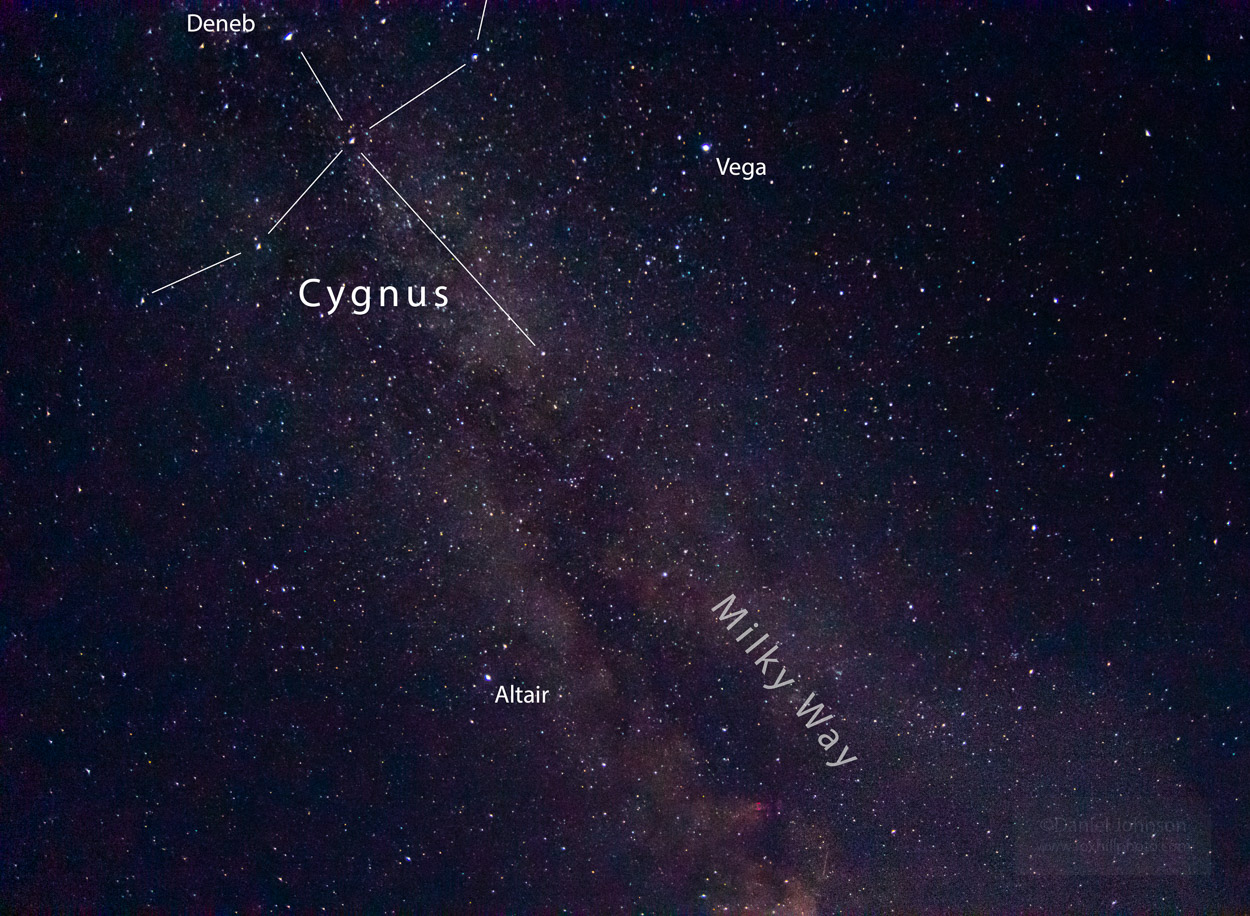
During a Perseid watch, you may also catch the occasional Delta Aquariid or a rarer, slower-moving Kappa Cygnid.
Sky & Telescope / Dennis di Cicco
October 22 and 23: The Orionids
The Orionids will be Moon-free for a few hours before dawn, depending on the date. Like the Eta Aquariids of May, the Orionids are bits of Halley’s Comet; Earth makes two passes through Halley’s (rather dispersed) meteoroid stream in our annual circle around the Sun. Like the Eta Aquariids, this shower runs for at least several nights.
Sky & Telescope
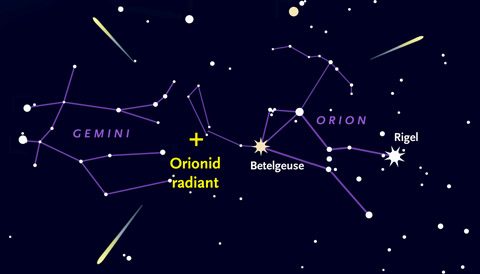
The Orionid radiant (in Orion's dim club, north of Betelgeuse) is highest in the hour before the start of dawn. The Orionids performed richly from 2006 through 2009, boasting peak rates of more than 50 meteors per hour. Since then, the activity has dwindled to a fraction of that.
Mid-October to mid-November: The Southern Taurids
Late October to late November: The Northern Taurids
Fireballs coming? Maybe. The weak, protracted, combined Taurid display sputters along from mid-October through mid- to late November. It typically produces five or 10 meteors per hour around a poorly defined maximum in early November. Moreover, while both Taurid components include bits of debris shed by Comet 2P/Encke, a recent analysis shows that a host of other objects — near-Earth asteroids, collisional fragments, and dormant cometary nuclei — may be creating several overlapping streams of particles. Consequently, both components have broad maxima that aren’t easy to pin down.
What makes the Taurids potentially exciting is that they are known for a high proportion of bright fireballs — occasionally, an extremely bright one that rattles the public and makes the news.
The Taurids strike the atmosphere at a relatively slow 19 miles (30 km) per second. That’s because they are catching up with Earth from behind, which means that they streak less quickly than do most meteors, and that they do well in the evening hours.

Medisilvanus / Wikimedia Commons
November 17: The Leonids
The Leonids are another largely Moon-free shower during the early-morning hours this year, but not a strong one. The Leonids' parent comet, 55P/Tempel-Tuttle, tends to leave narrow, concentrated streams of debris. These produced prodigious displays in 1833, 1866, 1966, 1999, 2001, and 2002, around times when their parent comet, with its 33-year period, swung through the inner solar system. Since then, the Leonids have gone back to being quite modest, with a peak zenithal hourly rate of about 15. Comet Tempel-Tuttle's next arrival is in 2031.
Be patient, and you'll likely catch an occasional zip radiating from the direction of Leo’s Sickle asterism in the hours before dawn. The Moon, a waning crescent, will be no problem.
Sky & Telescope
December 13-14: The Geminids
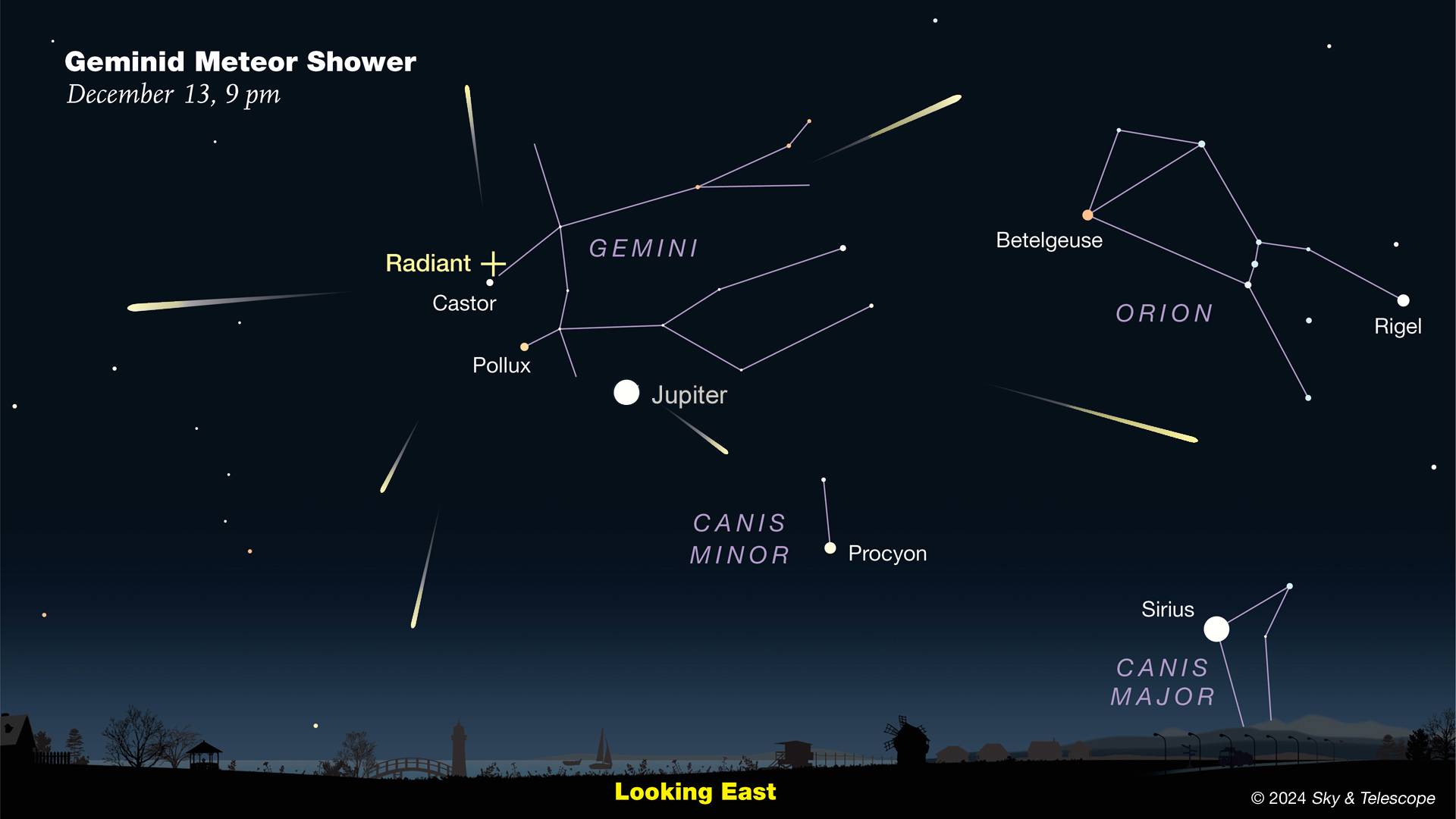
A great year for the great Geminids! This is "the best and most reliable of the major annual showers presently observable," says the International Meteor Organization. Observers properly dressed and blanketed up for frigid nights may see upward of 100 meteors per hour radiating from a spot near Castor in Gemini, as indicated above. This year, there's only a crescent Moon, and even that's gone by mid-evening.
Moreover, unlike with most showers, the Geminid radiant is kind to evening observers. It's well up in the east sky by 9 or 10 p.m. as seen from mid-northern latitudes. It passes almost overhead around 2 a.m., enabling observers with dark skies to actually observe the zenithal hourly rate.
Bob King
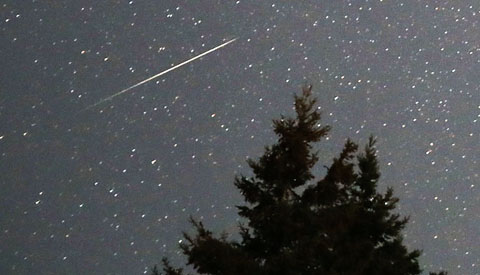
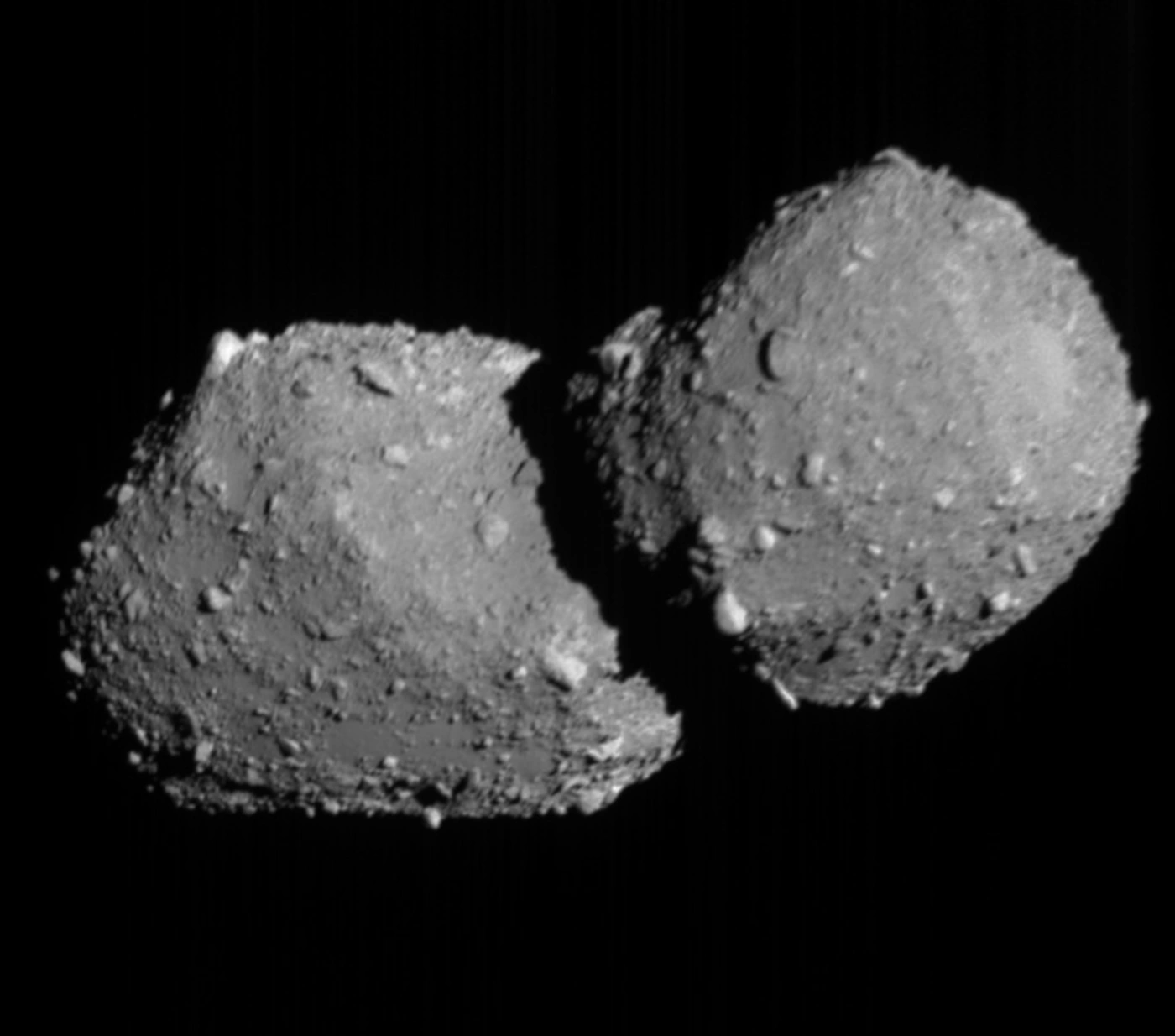
Geminid meteors come from 3200 Phaethon, an asteroid discovered as recently as 1983 that circles the Sun every 3.3 years. The particles are denser and stronger than typical shower meteors. Phaethon might be considered a “rock comet” that sheds bits when its rocky surface heats up to roughly 1,300°F (700°C) when blazingly close to the Sun at perihelion.
December 22: The Ursids
Well, not this year. This weak annual follow-on to the Geminids will be quite mooned out.
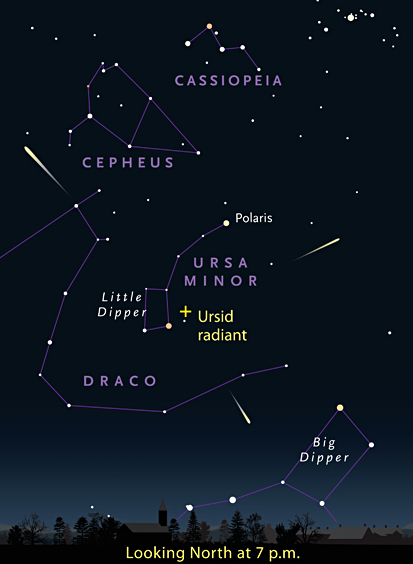
Background: The Ursid shower usually delivers only a modest 10 meteors per hour even under the best conditions, but it has the advantage of a radiant very far north, near the bowl of the Little Dipper — so it’s up all night for skywatchers at northern latitudes. Nevertheless, it’s highest in the hours before dawn.
Sky & Telescope
What Are Meteors?
A meteor is the streak of light you see when a bit of interplanetary debris vaporizes as it rips into Earth’s upper atmosphere. Most arrive at a speed of 30 to 70 km per second (20 to 45 miles per second). Although some meteors look so bright you could almost touch them, they occur at altitudes of 80 to 120 km (50 to 75 miles).
Meteors are pretty common. If you gaze steadily into a clear, moonless night sky far from city lights, you’ll likely see a sporadic (random) meteor a few times per hour. But showers bring the main action.
Meteors range in brightness from tiny flicks at the limit of visibility to dramatically bright fireballs that outshine Venus and may even light up the landscape around you. The rarest of these, called a bolide, shatters explosively into pieces during its descent and, if it penetrates deep enough into the atmosphere, can create a boom or rumble that reaches you a minute or two later. Those are once in a lifetime events.
Sky & Telescope
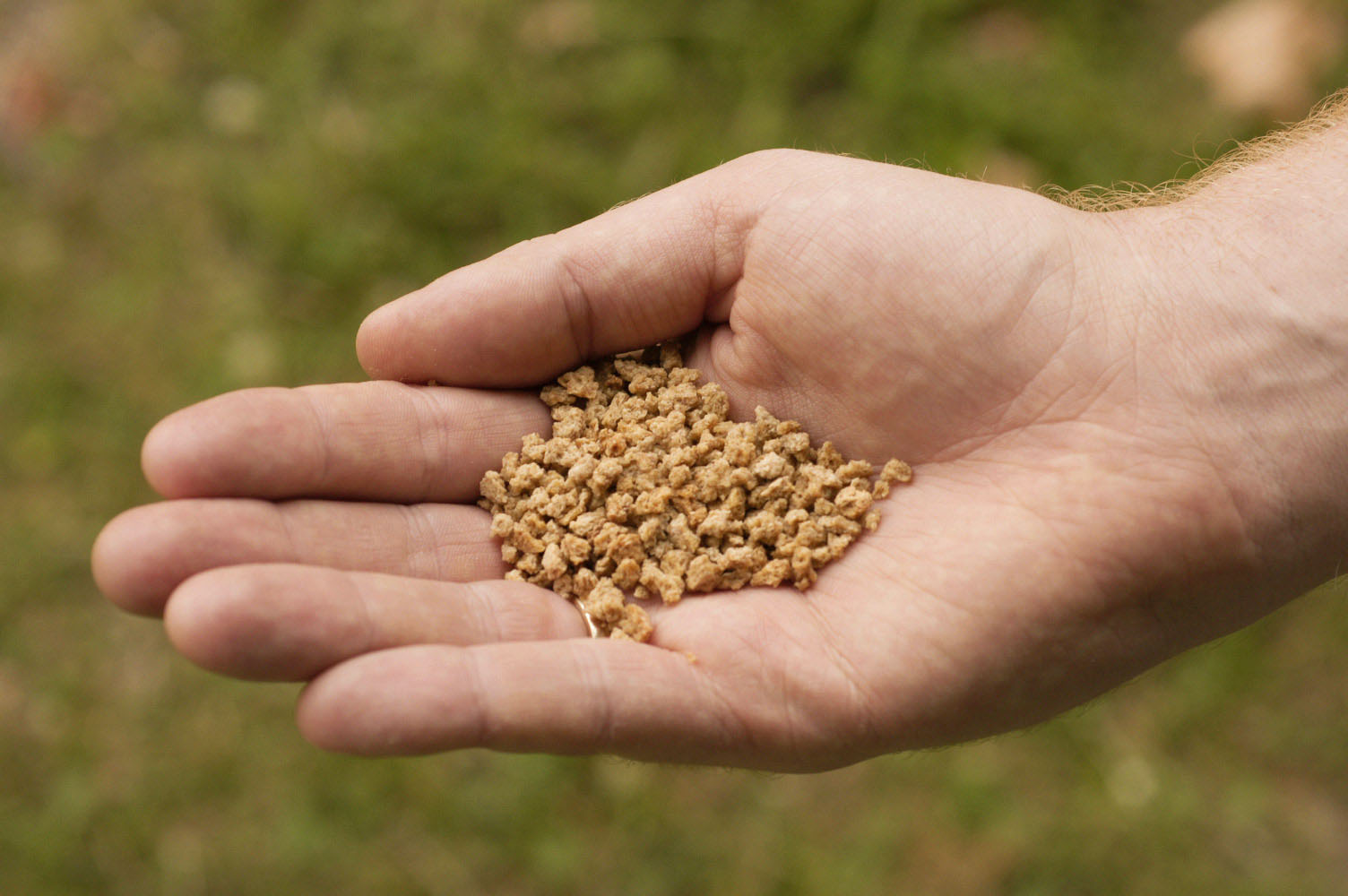
Because they arrive so fast, even small meteor particles produce a lot of light. Typically, they’re no bigger than large sand grains or tiny pebbles. One the size of a pea can create a meteor that's dramatically bright. Those high velocities give each little particle a whole lot of kinetic energy, which converts to heat and light due to air friction and shock heating in the upper atmosphere. Many people assume a meteor occurs because the particle “burns up.” But actually, as the particle vaporizes, the shock wave spreading away from it heats the surrounding air to thousands of degrees. The air molecules usually cool in a split second, giving off light as they do. (Here’s the in-depth explanation.)
What's a Meteor Shower?
Most meteor particles (they’re called meteoroids when still in space) are bits of debris that were shed by comet nuclei, crumbling when warmed by the Sun. The debris continues along the comet’s orbit, eventually spreading all around the orbit and, more slowly, out to the sides as well. Whenever Earth, in its own orbit, passes through one of these sparse streams of grit, the result is a meteor shower. Some sporadic meteors are from old meteor streams that have spread out and lost their identity. Others are rockier debris from old asteroid collisions.
During the half dozen strongest annual showers, under a wide-open dark sky, you may see something like 20 to 60 meteors or more per hour late at night. Some showers last just a few hours. Others, older and more diffuse, sputter along for weeks.
Keep watch for at least half an hour during one of the strongest showers, and you’ll notice something: Not only are meteors more frequent than usual, but they appear to fly in directions away from some particular spot in the sky. That spot is called the shower’s radiant. It’s the perspective point where all the shower members (which are flying in parallel) would appear to come from if you could see them approaching from a far distance, instead of in just the last second or so as they enter the atmosphere. They can flash into view anywhere in your sky. But their paths, if you trace them backward far enough, all intersect the radiant spot.
To get a better sense of the picture, check out the interactive meteor-stream animations created by Ian Webster. The one below shows particles spread out around the orbit of Comet 109P/Swift-Tuttle, the comet responsible for the Perseid shower. Have some fun with it: Click and drag the animation to get different perspectives, or go to meteorshowers.org to try a different shower.
Note: Most of the actual meteor streams are somewhat narrower than displayed; the animations are based on meteor directions and speeds measured from the ground, and measurement uncertainties broaden the spread of the 3D paths shown here in space.
Meteor Shower Radiants
A shower usually gets its name not from its parent object but from the constellation where the radiant lies. For example, August’s well-known Perseid shower has its radiant in Perseus, and December’s Geminids appear to radiate from Gemini. One exception is January’s Quadrantid shower, named for the now-defunct constellation Quadrans Muralis. Its radiant is in northern Boötes.

Sky & Telescope
The higher the shower’s radiant is in your sky, the more nearly straight down the meteoroids arrive, and thus the more you'll see in a given area of sky. When the radiant is low, more miss us, and we see fewer of them. When the radiant is below your horizon, no shower members appear at all.
Meteor showers are usually at their best after midnight, because most radiants are highest in the hours before dawn. Why? The graphic below shows. Morning is when you’re on the side of Earth facing forward as Earth speeds along its orbit. We circle the Sun at about 30 km (18 miles) per second, so interplanetary debris slams into the morning sky especially hard and fast, making each meteor brighter than it would be if it had hit in the evening, when it would be catching up to Earth from behind.
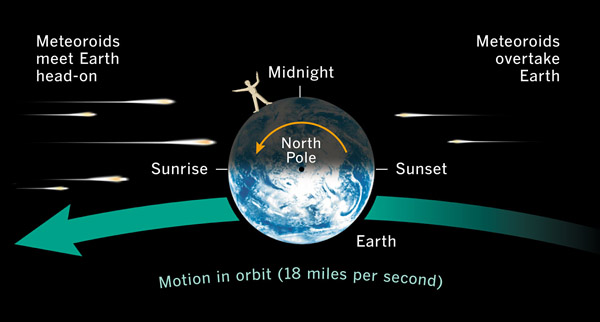
Sky & Telescope
Think of raindrops hitting your car’s windshield. If the car is moving forward, the drops hit harder and more plentifully. In addition, the radiant of the raindrops shifts from overhead to somewhat in front of you, as you can see in your headlights on a rainy or snowy night.
Solar-system dynamicists have gotten rather good at predicting when a particular shower might display an extra burst of activity. Usually, these bursts, typically lasting just a few hours, are from thin, denser ribbons of particles embedded in the larger stream — particles that were ejected by the parent comet only decades or centuries ago and have not had time to disperse much. And some meteoroid streams have a higher proportion of large particles than others, which creates a higher proportion of fireballs.
The table and descriptions below list the year’s best and most dependable annual displays. (There are many more: The International Astronomical Union now recognizes more than 100 well-defined meteor showers and hundreds of other “shower candidates” that remain unconfirmed. But most are so weak that it takes trained and very patient observers, or automated cameras, to detect a pattern.)
How to Watch Meteor Showers
Find a dark location with an open view overhead as far from urban light pollution as you can get, and where no local lights glare into your eyes. Find a way to block any lights you can’t escape, and the Moon, too, if it’s up. You want your best night vision working. Your night vision improves for at least your first 30 to 45 minutes in the dark.
Make yourself comfortable in a reclining lawn chair, and wear more warm layers than you imagine you'll need. When you’re exposed to a wide expanse of clear sky, radiational cooling will chill you to a surprising degree even in summer. Especially when you’re out in the coldest hours of the late night. And if you are not moving, which we usually do when outdoors!
A sleeping bag, or a thick blanket under and over you, provides warmth and mosquito armor. Put DEET insect repellent on your exposed parts if it might be buggy. The reclining lawn chair matters if ticks could be on the ground. Lie back, gaze into the darkest part of your sky (usually straight up), contemplate the stars, and be patient.
Photographing Meteor Showers
If you want to capture meteors on camera, the essentials are a fast, wide-angle lens, a tripod, and dark skies. Point your camera away from city lights and roughly 90º from the shower’s radiant to catch the longest streaks, and keep your shutter open for multiple seconds at a time.
Other Sky & Telescope Meteor Resources
Learn how to watch, count, and study meteors in our meteor observing Guides, including both beginner and advanced tips. To dive deeper, check out the abundant material on the website of the International Meteor Organization, recently revamped and modernized.
Stay Up to Date with Weekly Sky Events
Meteor showers are just one of the many celestial events worth tracking each year. To catch comets, lunar phases, planetary alignments, and more, consider checking out Sky & Telescope’s observing guide for each Week’s Sky at a Glance. It’s updated every week with tips, timings, and highlights, so you won’t miss anything in the night sky.
About Alan MacRobert
Alan M. MacRobert became an avid Sky & Telescope subscriber in 1966 at age 14, joined the editorial staff in 1982, and is now a senior contributing editor, semi-retired. He played a role in practically every part of the magazine and the company's other products for more than a generation, both on the amateur-observing side and the science-reporting side. In 1994 a book collection of his observing how-tos and telescopic sky tours was published as Star Hopping for Backyard Astronomers. He has produced This Week's Sky at a Glance online every week since 1989.


Comments
SunJao
January 3, 2026 at 8:50 am
Thanks for publishing this helpful guide.
Does the asterisk on Perseids entry in the 2026 table indicate "Strong moonlight will interfere"?
Is this year's Perseids peak around new moon?
You must be logged in to post a comment.
Monica Young
January 3, 2026 at 11:47 am
Thanks for catching that! The Perseids do indeed occur at new Moon and thus do *not* have strong moonlight interfering. I've updated the table to reflect this.
You must be logged in to post a comment.
You must be logged in to post a comment.