 SUNSET:

 2
2FRIDAY, SEPTEMBER 12
■ In eight days Saturn will be at opposition. So now's the time to carefully examine the brightness of Saturn's nearly edge-on rings — to compare with how they bright they will appear right around opposition date. The brightening of Saturn's rings at opposition is called the Seeliger effect. Will the rings' nearly edge-on aspect at this opposition suppress it or enhance it? See the Saturn entry in This Week's Planet Roundup near the bottom of this page.
The rings have been slowly brightening in recent months, because their tilt with respect to the Sun (as opposed to Earth) is slowly but steadily increasing now.
■ The waning gibbous Moon, in Taurus, rises around 10 p.m. tonight daylight-saving time. As it gets higher look for the Pleiades a few degrees to its upper right. Cover the Moon with your finger to make delicate stars near it easier to see.
And about a fist at arm's length below the Moon, watch for orange Aldebaran coming up.
SATURDAY, SEPTEMBER 13
■ Tonight the last-quarter Moon rises around 11 p.m. It forms an isosceles triangle with bright Capella nearly two fists to its upper right and the Pleiades the same distance to its upper left. A little less far to the Moon's right is Aldebaran. Much closer lower left of the Moon sparkles Beta Tauri.
The Moon becomes precisely last quarter at 6:33 a.m. EDT Sunday morning.
SUNDAY, SEPTEMBER 14
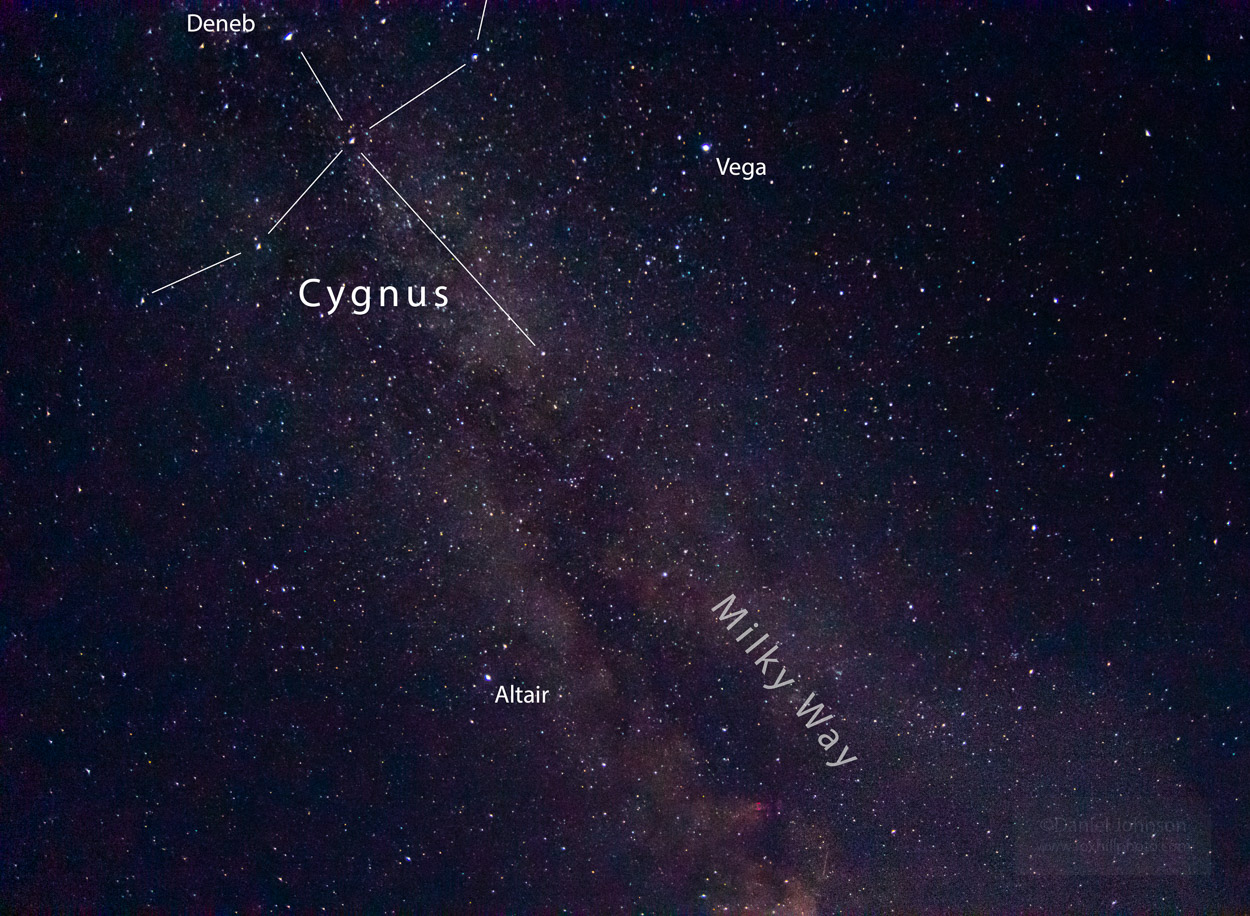
■ Altair is the bright star high towards the south in early evening. Find little Sagitta, the Arrow, barely a fist at arm's length above it. If your light pollution is too bad, use binoculars.
Now imagine rotating the Arrow on its point a third of a turn counterclockwise. Its middle star would now rest almost at M27, the Dumbbell Nebula. With a total magnitude of 7½, the Dumbbell is a big but subtle gray glow nearly 0.1° wide, easily seen in binoculars or a finderscope under a dark sky. In a 4- to 8-inch telescope it's a rectangle or hourglass. It's the brightest planetary nebula in the sky if you sum up all of its spread-out light.
The name "Dumbbell Nebula" was bestowed by John Herschel in 1828. He was referring to the exercise weights we still call dumbbells, but in his day they were sometimes made by connecting two heavy bells top-to-top by a short rod. The bells were missing their clappers, so they were literally dumb bells. I saw an example once in vintage photos of a gym. It really did look sort of like the nebula's hourglass shape.
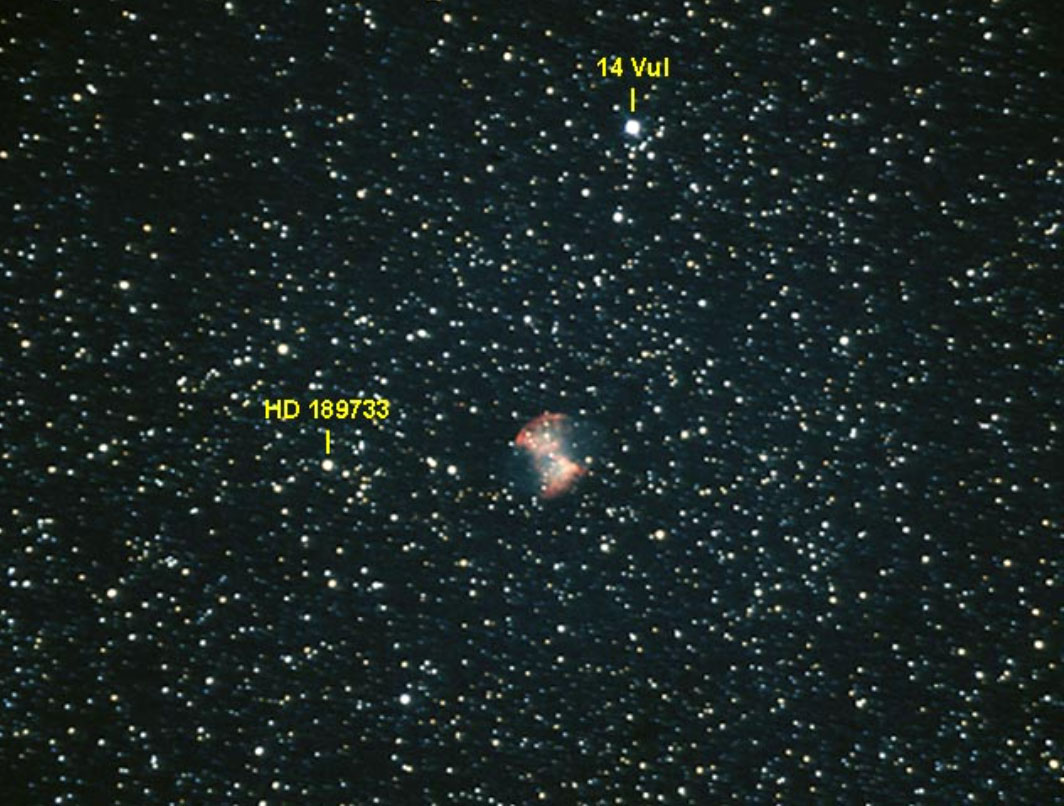
■ Back to Altair. Now that you've found Sagitta, here's another, easier little neighbor of Altair. Look about a fist to the star's left soon after dark, or to its upper left as the evening grows late. There's Delphinus, the Dolphin, a little bigger and brighter than Sagitta. The Dolphin's stick-figure pattern leaps in the direction away from Altair. Again, binoculars help.
Another name for Delphinus is Job's Coffin. The origin and meaning of that is something of a mystery, but Steve O'Meara explores a likely idea in his Stories of the Stars column in the September Sky & Telescope, page 45. It involves death ships.
MONDAY, SEPTEMBER 15
■ The two brightest stars of September evenings are Vega high overhead and Arcturus in the west, both magnitude 0.
Draw a line from Vega down to Arcturus. A third of the way down you cross the dim Keystone of Hercules. Two thirds of the way you cross the dim semicircle of Corona Borealis with its one modestly bright star: Alphecca, the gem of the crown.
Just off the Corona semicircle, the recurrent nova T Coronae Borealis still has not erupted (see where to check). This is looking like one more example of astronomy popularizers' notorious eagerness to overpredict exciting but chancy things to the public. T Cor Bor will blow up. . . one of these years. . . eventually. My personal hunch? Considering Bayesian priors as best I can guess: 50-50 chance by 2028.
■ The waning Moon bunches up with Jupiter, Pollux, and Castor in the early-morning hours of Tuesday. They rise around midnight and shine high in the east by the beginning of dawn.
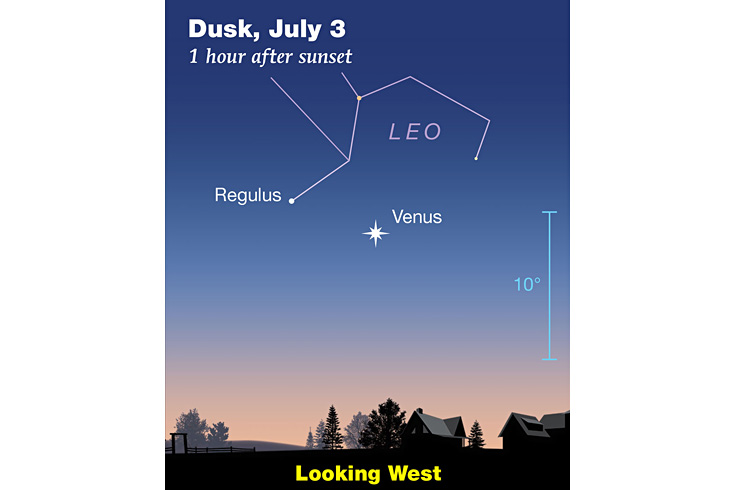
By that time Venus, and Regulus 4° under it, are in view way down below.
TUESDAY, SEPTEMBER 16
■ Vega now passes the zenith about 50 minutes after sunset, for those of us at mid-northern latitudes. How early can you pick it up through the twilight? It soon becomes more obvious.
Vega is bigger, hotter, and 50 times brighter than our Sun. But at a distance of 25 light-years, it's 1.6 million times farther away.
WEDNESDAY, SEPTEMBER 17
■ "Late summer and early fall are among the most enjoyable seasons for stargazing," writes Matthew Wedel in the September Sky & Telescope. "Nights are getting longer, temperatures are usually not too bad, and there's a lot up there to choose from. ... One of my favorites [is the] globular cluster M2 in Aquarius." At magnitude 6.6 it's visible in a good finderscope under a decent sky. It's easy to locate west of Alpha Aquarii and north of Beta Aquarii if you memorize the shape of the triangle it makes with those two 3rd-magnitude stars. See Matt's chart on page 43.
Just don't be jealous of the Hubble view.
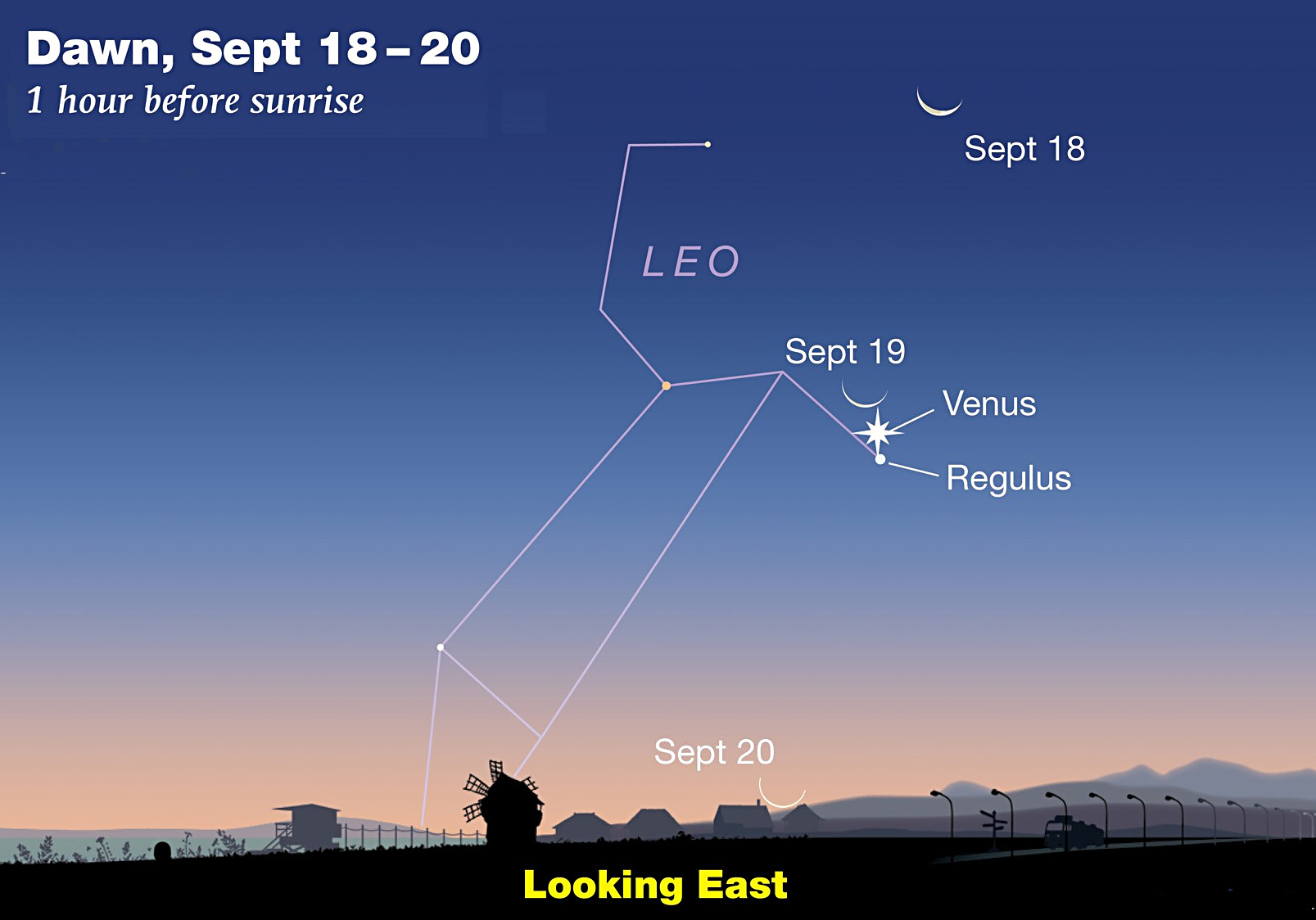
■ At dawn Thursday morning, the crescent Moon hangs above Venus as shown below. Take a look to get ready for Friday morning!
THURSDAY, SEPTEMBER 18
■ Set your alarm: A strikingly close Moon-Venus conjunction awaits you in the east during early dawn Friday morning, with fainter Regulus thrown in as an extra. As shown below.
This presents a nice photo opportunity. Find a good view low to the east, frame the Moon and its companions with nice foreground, and brace your phone or camera on something motionless. Start early! Try zooming in by different amounts.
The Moon actually occults Venus for northernmost Canada, Greenland, Iceland, all Europe, northwestern Africa, and northwestern Asia. Map and timetables.
FRIDAY, SEPTEMBER 19
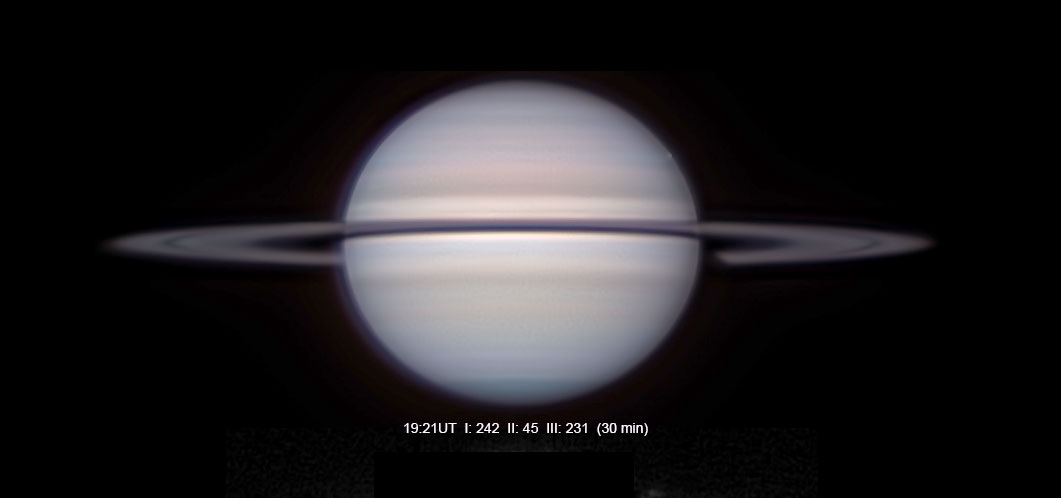
■ Titan, Saturn's largest moon, casts its shadow onto Saturn's face tonight in the second-to-last of these events for another 15 years. Around when we see Saturn's rings nearly edge on, Titan repeatedly crosses in front of Saturn from Earth's viewpoint — and, more visibly, casts its tiny black shadow onto the planet.
Tonight, Titan's shadow skims just inside Saturn's northern limb from 5:09 to 7:34 UT September 20th (UT date). In EDT that's tonight from 1:09 a.m. to 3:34 a.m. In PDT it's tonight from 10:09 p.m. to 12:34 a.m.
Saturn is up all night now, though it is highest in the steadiest seeing around the middle of the night local time. So all of North and Central America again get a good chance at this event. See Bob King's Titan Shadow Transit Season Underway.
SATURDAY, SEPTEMBER 20
■ Saturn is at opposition tonight. See the Saturn entry in This Week's Planet Roundup below.
■ Arcturus shines in the west these evenings as twilight fades out. Capella, equally bright, is barely rising in the north-northeast (depending on your latitude; the farther north you are the higher it will be.) They're both magnitude 0.
Later in the evening, Arcturus and Capella shine at the same height in their respective compass directions. When will this happen? That depends on both your latitude and longitude.
When it does, turn around and look low in the south-southeast. There will be 1st-magnitude Fomalhaut at about the same height too — exactly so if you're at latitude 43° north (from Boston to Buffalo, Milwaukee, Boise, Eugene). Seen from south of that latitude, Fomalhaut will appear higher than Capella and Arcturus are. Seen from north of there, it will be lower.
SUNDAY, SEPTEMBER 21
■ By 9 or 10 p.m. two of the best-known deep-sky objects, the Double Cluster in Perseus and the Great Andromeda Galaxy M31, are in high view in the east. They're only 22° (two fists) apart. They're both cataloged as 4th magnitude but to the naked eye they look rather different from each other, the more so the darker your sky. See for yourself using this finder chart.
Sky too bright? Use binoculars!
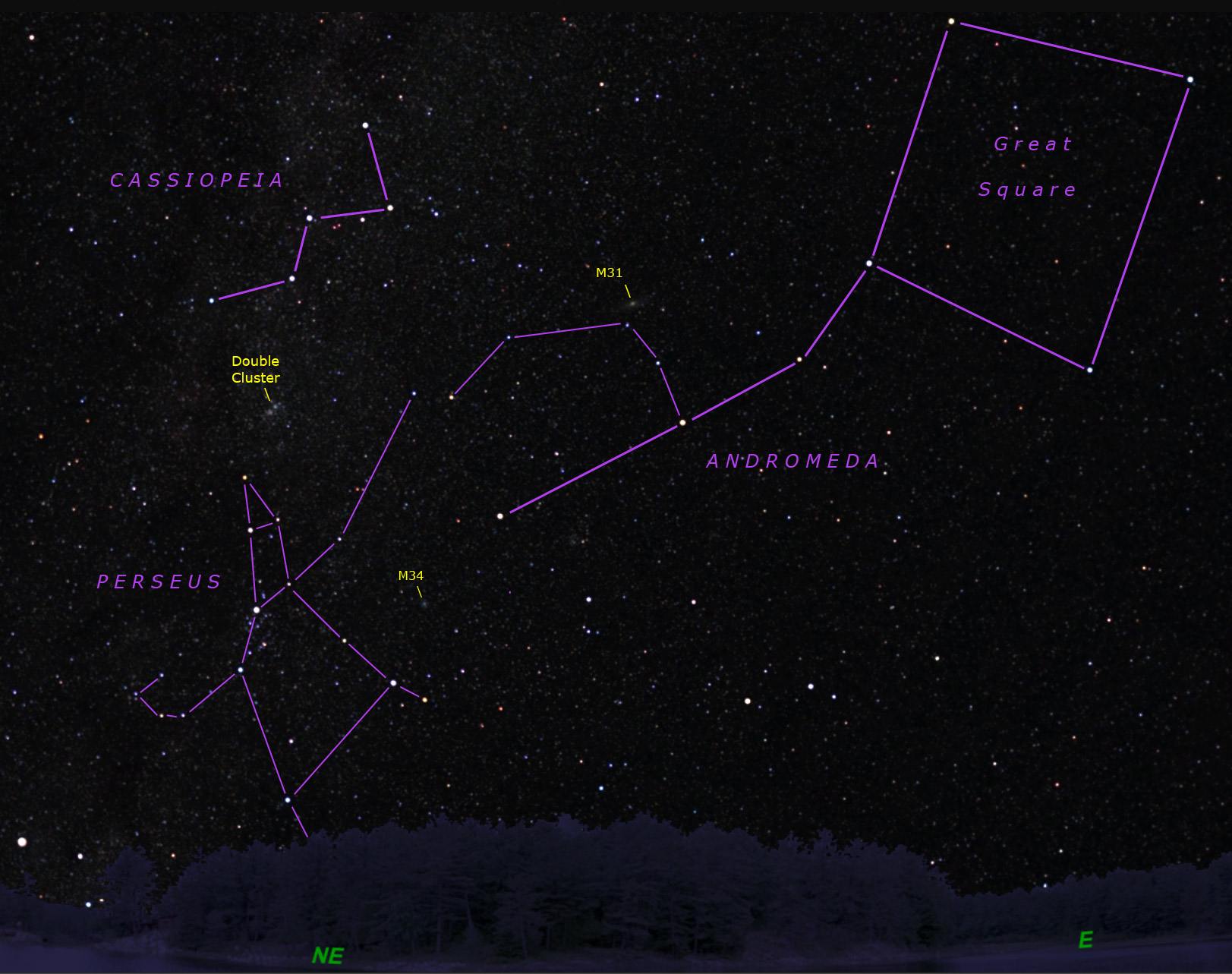
The two clusters of the Double Cluster (NGC 869 and NGC 884) are at very similar distances about 7,600 light-years away. M31, at 2.5 million light-years, is 330 times farther. Fainter M34, another open cluster (magnitude 5.5), is only 1,500 light-years 0ut.
■ New Moon (at 3:54 p.m. EDT).
This Week's Planet Roundup
Mercury is hidden deep in the glow of sunset.
Venus and Jupiter shine in the east before and during dawn. Venus blazes low at magnitude –3.9, Jupiter high at magnitude –2.0. They continue to move farther apart: from 32° apart on Saturday September 13th to 40° a week later on the 20th.
Left of Jupiter are the Gemini heads, Castor and Pollux, much fainter.
Venus, meanwhile, is approaching little Regulus. The star is 8° above Venus on Saturday morning the 13th. They reach conjunction just ½° apart on the morning of Friday the 19th.
Mars, a weak magnitude 1.6 in Virgo, still glimmers very low in the west as twilight fades. Use binoculars to try to catch it about 40 minutes after sunset a little above the west-southwest horizon. On Friday the 12th, look for Spica twinkling 2¼° to Mars's lower left. From there, Spica moves to the lower right day by day.
Saturn comes to opposition on September 2oth. This week it rises around sunset and looms low in the east-southeast as the stars come out. It's lower right of the Great Square of Pegasus, which is standing on one corner.
Saturn climbs higher hour by hour. The best time to observe it with a telescope is around the middle of the night when it's highest toward the south.
We currently see Saturn's rings almost edge-on, and this might alter an interesting effect that the rings display. For a few days around opposition, do you notice that Saturn's rings are distinctly brighter than usual, compared to Saturn's globe? This is the Seeliger effect, caused by the solid ring particles backscattering sunlight to us when the Sun is almost directly behind us. The dusty surfaces of the Moon and Mars do this too, but Saturn's clouds do not. In the case of Saturn the effect is named for Hugo von Seeliger, who studied it in detail and published his findings in 1887.
This fall the rings are fairly dark, because they are also presented almost edge-on to the Sun (though that angle is gradually increasing now). Will the rings' current dimness mask the Seeliger effect, or enhance it?
Uranus (magnitude 5.7, in Taurus near the Pleiades) rises around 10 p.m. and gets high in the east in the early morning hours. In a telescope it's a tiny but definitely non-stellar dot 3.6 arcseconds wide.
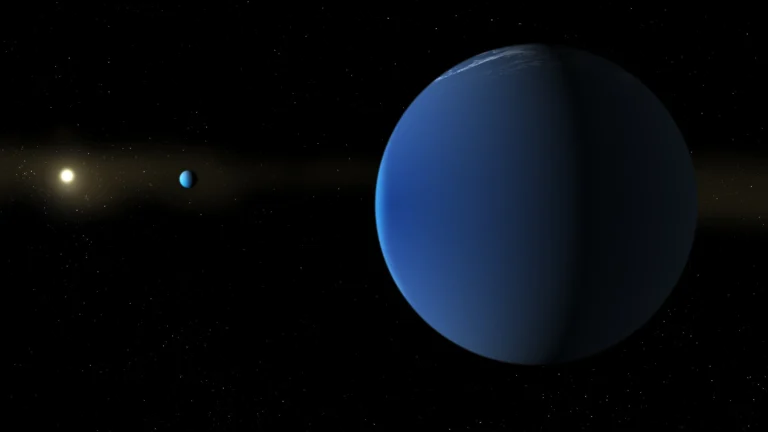
Neptune, a telescopic "star" at magnitude 7.8, lurks 2° northeast of Saturn and hence comes to opposition on the 23rd, one day after Saturn. Neptune is just 2.4 arcseconds wide. Use the finder chart for Neptune with respect to Saturn in the September Sky & Telescope, page 49. With a pencil, put a dot on the path of each of the two planets for your date.
All descriptions that relate to your horizon — including the words up, down, right, and left — are written for the world's mid-northern latitudes. Descriptions and graphics that also depend on longitude (mainly Moon positions) are for North America. Eastern Daylight Time (EDT) is Universal Time minus 4 hours. UT is also known as UTC, GMT, or Z time.
Want to become a better astronomer? Learn your way around the constellations. They're the key to locating everything fainter and deeper to hunt with binoculars or a telescope.
This is an outdoor nature hobby. For a more detailed constellation guide covering the whole evening sky, use the big monthly map in the center of each issue of Sky & Telescope, the essential magazine of astronomy.
For the attitude every amateur astronomer needs, read Jennifer Willis's Modest Expectations Give Rise to Delight.
Once you get a telescope, to put it to good use you'll need a much more detailed, large-scale sky atlas (set of charts). The basic standard is the Pocket Sky Atlas, in either the original or Jumbo Edition. Both show all 30,000 stars to magnitude 7.6, and 1,500 deep-sky targets — star clusters, nebulae, and galaxies — to search out among them.
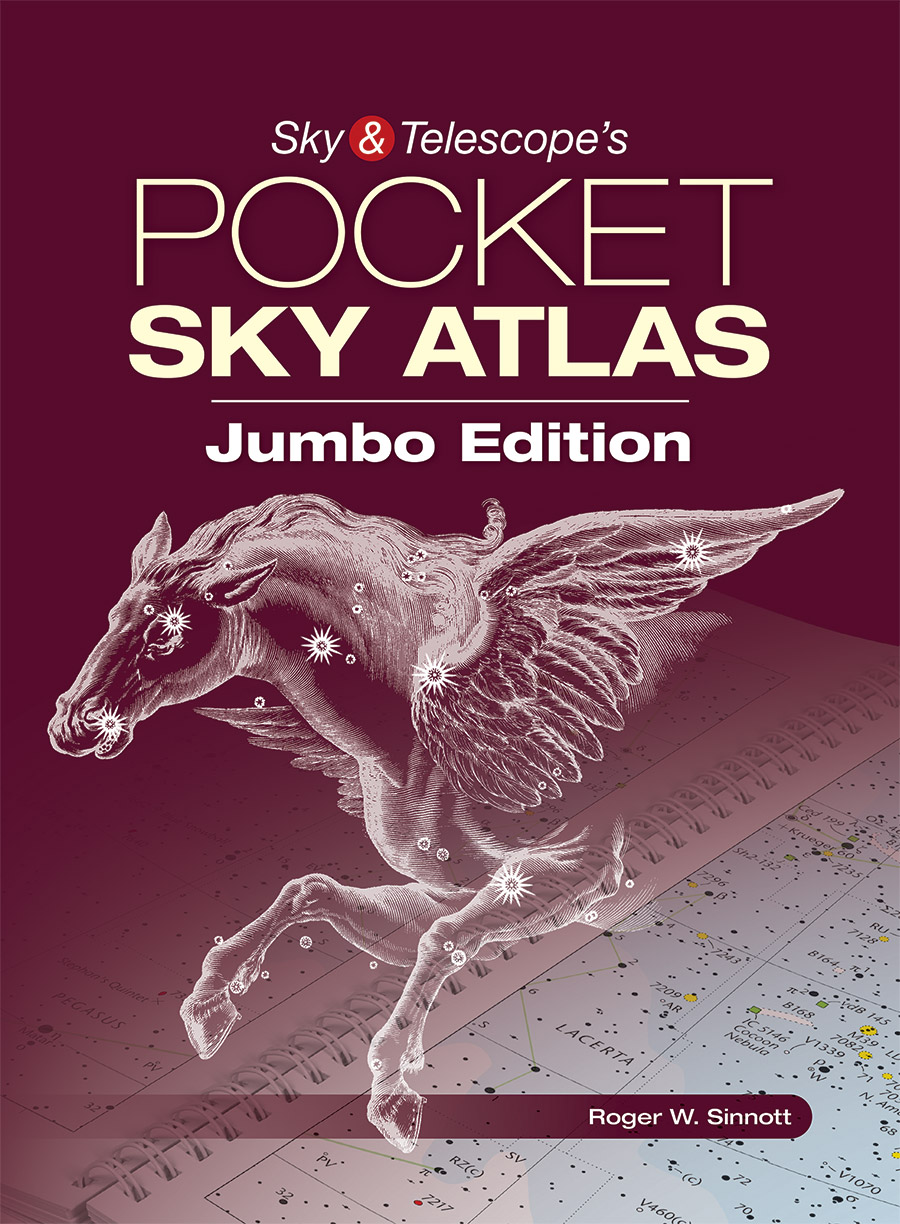
Next up is the larger and deeper Sky Atlas 2000.0, plotting stars to magnitude 8.5; nearly three times as many, as well as many more deep-sky objects. It's currently out of print, but maybe you can find one used.
The next up, once you know your way around well, are the even larger Interstellarum atlas (with 201,000+ stars to magnitude 9.5 and 14,000 deep-sky objects selected to be detectable by eye in large amateur telescopes), and Uranometria 2000.0 (332,000 stars to mag 9.75, and 10,300 deep-sky objects). And read How to Use a Star Chart with a Telescope. It applies just as much to charts on your phone or tablet (which many observers find more versatile) as to charts on paper.
You'll also want a good deep-sky guidebook. A beloved old classic is the three-volume Burnham's Celestial Handbook. An impressive more modern one is the big Night Sky Observer's Guide set (2+ volumes) by Kepple and Sanner. The pinnacle for total astro-geeks is the new Annals of the Deep Sky series, currently at 11 volumes as it works its way forward through the constellations alphabetically. So far it's up to H.
Can computerized telescopes replace charts? Not for beginners I don't think, and not for scopes on mounts and tripods that are less than top-quality mechanically. Unless, that is, you prefer spending your time getting finicky technology to work rather than learning how to explore the sky. As Terence Dickinson and Alan Dyer say in their Backyard Astronomer's Guide, "A full appreciation of the universe cannot come without developing the skills to find things in the sky and understanding how the sky works. This knowledge comes only by spending time under the stars with star maps in hand and a curious mind." Without these, "the sky never becomes a friendly place."
If you do get a computerized scope, make sure that its drives can be disengaged so you can swing it around and point it readily by hand when you want to, rather than only slowly by the electric motors (which eat batteries).
However, finding faint telescopic objects the old-fashioned way with charts isn't simple either. Do learn the essential tricks at How to Use a Star Chart with a Telescope.
 Audio sky tour. Out under the evening sky with your
earbuds in place, listen to Kelly Beatty's monthly
podcast tour of the naked-eye heavens above. It's free.
"The dangers of not thinking clearly are much greater now than ever before. It's not that there's something new in our way of thinking, it's that credulous and confused thinking can be much more lethal in ways it was never before."
— Carl Sagan, 1996
"Facts are stubborn things; and whatever may be our wishes, our inclinations, or the dictates of our passion, they cannot alter the state of facts and evidence."
— John Adams, 1770
About Alan MacRobert
Alan M. MacRobert became an avid Sky & Telescope subscriber in 1966 at age 14, joined the editorial staff in 1982, and is now a senior contributing editor, semi-retired. He played a role in practically every part of the magazine and the company's other products for more than a generation, both on the amateur-observing side and the science-reporting side. In 1994 a book collection of his observing how-tos and telescopic sky tours was published as Star Hopping for Backyard Astronomers. He has produced This Week's Sky at a Glance online every week since 1989.



Comments
misha17
September 13, 2025 at 10:03 pm
Re: "SATURDAY, SEPTEMBER 13
■ Tonight the last-quarter Moon rises around 11 p.m. It forms an isosceles triangle with bright Capella nearly two fists to its upper right and the Pleiades the same distance to its upper left. A little less far to the Moon's right is Aldebaran. Much closer lower left of the Moon sparkles Beta Tauri."
The Moon will occult Beta Tauri in the pre-dawn skies on Sunday Sept 14th as seen from San Diego and the Imperial Valley in California and southern Arizona.
Times for locations are here:
http://www.lunar-occultations.com/iota/bstar/0914zc810.htm
Further east, the event occurs close to sunrise in Texas and Mexico, and in daylight skies over Central America and northern South America.
This is the last occultation in this series visible from the U.S.; Beta Tauri lies at the northern limit of the Moon's maximum declination, and later occultations will only be visible farther south on Earth as the Moon's ascending node moves further west, making the Moon pass further south of the star each month.
The next occultation of Beta Tauri visible from the U.S. will occur in October 2043.
You must be logged in to post a comment.
misha17
September 13, 2025 at 10:07 pm
There will only be 2 occultations of Beta Tauri visible from the U.S. in 2043 and 2044, and Florida will be favored for viewing both events.
You must be logged in to post a comment.
You must be logged in to post a comment.